Why can AIs code for 1h but not 10h?
A simple explanation: if there's a 10% chance of error per 10min step (say), the success rate is:
1h: 53%
4h: 8%
10h: 0.002%
@tobyordoxford has tested this 'constant error rate' theory and shown it's a good fit for the data
chance of success declines exponentially
I shared this note with the Washington Post team this morning:
I’m writing to let you know about a change coming to our opinion pages.
We are going to be writing every day in support and defense of two pillars: personal liberties and free markets. We’ll cover other topics too of course, but viewpoints opposing those pillars will be left to be published by others.
There was a time when a newspaper, especially one that was a local monopoly, might have seen it as a service to bring to the reader’s doorstep every morning a broad-based opinion section that sought to cover all views. Today, the internet does that job.
I am of America and for America, and proud to be so. Our country did not get here by being typical. And a big part of America’s success has been freedom in the economic realm and everywhere else. Freedom is ethical — it minimizes coercion — and practical — it drives creativity, invention, and prosperity.
I offered David Shipley, whom I greatly admire, the opportunity to lead this new chapter. I suggested to him that if the answer wasn’t “hell yes,” then it had to be “no.” After careful consideration, David decided to step away. This is a significant shift, it won’t be easy, and it will require 100% commitment — I respect his decision. We’ll be searching for a new Opinion Editor to own this new direction.
I’m confident that free markets and personal liberties are right for America. I also believe these viewpoints are underserved in the current market of ideas and news opinion. I’m excited for us together to fill that void.
Jeff
Vice President JD Vance has a powerful message for young men 🔥🔥
“My message to young men is don’t allow this broken culture to send you a message that you’re a bad person because you’re a man, because you like to tell a joke, because you like to have a beer with your friends, or because you’re competitive.
Our culture “wants to turn everybody, whether male or female, into androgynous idiots who think the same, talk the same, and act the same.”
“We actually think God made male and female for a purpose, and we want you guys to thrive as young men, and as young women. And we’re going to help with our public policy to make it possible to do that.”
Amen.
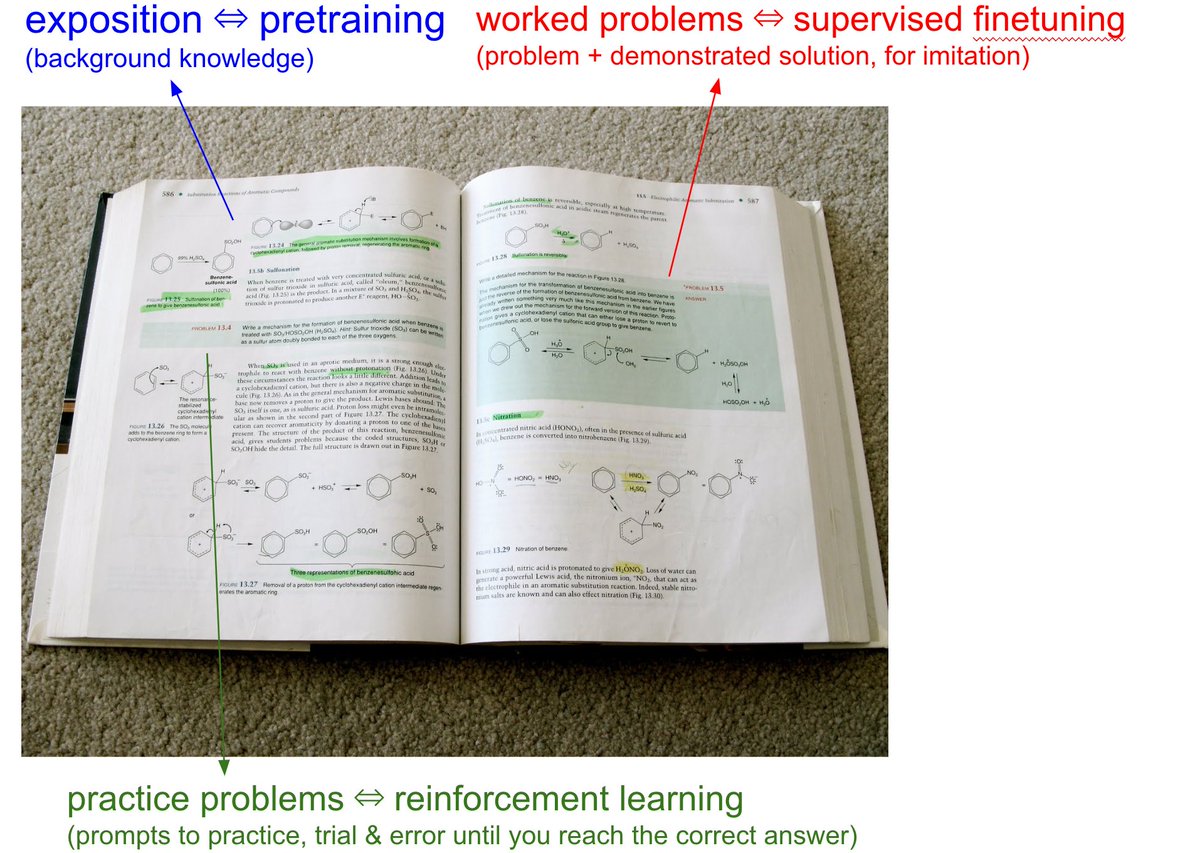
We have to take the LLMs to school.
When you open any textbook, you'll see three major types of information:
1. Background information / exposition. The meat of the textbook that explains concepts. As you attend over it, your brain is training on that data. This is equivalent to pretraining, where the model is reading the internet and accumulating background knowledge.
2. Worked problems with solutions. These are concrete examples of how an expert solves problems. They are demonstrations to be imitated. This is equivalent to supervised finetuning, where the model is finetuning on "ideal responses" for an Assistant, written by humans.
3. Practice problems. These are prompts to the student, usually without the solution, but always with the final answer. There are usually many, many of these at the end of each chapter. They are prompting the student to learn by trial & error - they have to try a bunch of stuff to get to the right answer. This is equivalent to reinforcement learning.
We've subjected LLMs to a ton of 1 and 2, but 3 is a nascent, emerging frontier. When we're creating datasets for LLMs, it's no different from writing textbooks for them, with these 3 types of data. They have to read, and they have to practice.
This weekend falling deeper into the rabbit hole of contaminants exposure in daily life...
I am a bit surprised how weak the U.S. regulations are compared to other countries around industrial chemical use. E.g. the lab @plasticlistorg recommended for testing had this infographic on their website. There are thousands of pesticides, herbicides and various synthetic chemicals banned in other countries that are ok for use in the U.S.
It doesn't help to know that you should be eating organic kale when the one you bought shows "disturbing" levels of known toxic chemicals. It doesn't help to eat a Sweetgreen Chicken Pesto Parm Salad when it randomly tests in the 99th percentile of DEHP. Or dark chocolate apparently steeped in heavy metals.
The other thing is that there are known good mitigations for many of the risks if you do some research. E.g. in water treatment you want a Reverse Osmosis system at home. For air there are some pretty good HEPA air filters on the market. For clothing you want natural materials (cotton, wool, linen, hemp etc.) instead of synthetic fibers that you inevitable breathe in. You have to know to avoid plastics everywhere (esp warm) and including in secret locations you wouldn't expect them in (e.g. lined *inside* aluminum containers). You have to know about PFAS in your cosmetics. You have to know that you want a stainless steel or cast iron pan. You have to know how to read food packaging ingredients because some brands give you the thing you want, while some brands add 50 other things - emulsifiers, preservatives, "natural and artificial flavors" stuff like Yellow 5 (gross!), "fragnances", high fructose corn syrup, cellulose, artificial sweeteners. You have to stumble by the BobbyApproved app for help. Food is the big wild card that will probably take a while to sort through.
A lot of the burden of wanting to live a simple, natural, uncontaminated life turns out to fall on the consumer, and it also seems hard to spend a marginal dollar to decrease your risk exposure without having to run a full research program.
But it's okay, I'll run mine and I'll try to write something up when it reaches some maturity.
This is a game-changer announcement by Apple around cryptography. It is the “HTTPS moment for AI” in some ways..
Here is what this means: your private confidential data can be pooled with other data sources and used to securely improve your UX and that of the wider community without even revealing your private data at all: it stays encrypted end-to-end. This is a win-win, a rare non-zero-sum game in technology.
For example, consider a picture on your device. It gets converted to vector embeddings (the numbers you see below), then encrypted and sent to the “Homomorphic Encryption” (HE) process running on a server which returns a fully encrypted result back, without decrypting (revealing) the encrypted user private data sent initially - even for it’s own processing. This is search over fully encrypted data!
The user gets a notification that the picture region here looks like the Eiffel Tower in this example.
Thus this system enables using the network hivemind to securely to improve the UX across so many applications in the time ahead. It will especially benefit AI products which have a direct relationship with end-users as now the standalone tool with access to confidential data can also benefit from network effects for optimal UX.
Information wants to be free and mashed together endlessly, and this pushes in that direction.
cc @AravSrinivas@sama -> FHE is a key enabling technology over a 5 year horizon. This is how you leapfrog Google.
Archbishop Carlo Maria Viganò
former Apostolic Nuncio to the United States of America
𝗢𝗣𝗘𝗡 𝗟𝗘𝗧𝗧𝗘𝗥 𝗧𝗢 𝗔𝗠𝗘𝗥𝗜𝗖𝗔𝗡 𝗖𝗔𝗧𝗛𝗢𝗟𝗜𝗖𝗦
𝗼𝗻 𝘁𝗵𝗲 𝗲𝘃𝗲𝗻 𝗼𝗳 𝘁𝗵𝗲 𝟮𝟬𝟮𝟰 𝗣𝗿𝗲𝘀𝗶𝗱𝗲𝗻𝘁𝗶𝗮𝗹 𝗘𝗹𝗲𝗰𝘁𝗶𝗼𝗻
« […] Voting for Donald Trump means firmly distancing ourselves from an anti-Catholic, anti-Christian and anti-human vision of society.
It means stopping those who want to create a hellish dystopia that is even worse than the one announced by George Orwell.
And it also means – do not forget – giving him our vote of confidence, so that President Trump knows that the massive vote of Catholics and Christians that brought him back to the White House must become the premise for a more incisive commitment to the defense of life from conception to natural death, the traditional family, the right of parents to educate their children, and to the defense of the Christian Faith and the cultural identity of the Nation.[…] »
https://t.co/WGTkDj4TxV
@realDonaldTrump@elonmusk@TuckerCarlson@RobertKennedyJr@GenFlynn@RealAlexJones@PatrickByrne@corsijerome1@JoeUnauthorized@EVerastegui@RealCandaceO@TaylorRMarshall@gatewaypundit
Fast Food is a part of American culture. But that doesn’t mean it has to be unhealthy, and that we can’t make better choices. Did you know that McDonald’s used to use beef tallow to make their fries from 1940 until phasing it out in favor of seed oils in 1990? This switch was made because saturated animal fats were thought to be unhealthy, but we have since discovered that seed oils are one of the driving causes of the obesity epidemic. Interestingly enough, this began to drastically rise around the same time fast food restaurants switched from beef tallow to seed oils in their fryers.
People who enjoy a burger with fries on a night out aren’t to blame, and Americans should have every right to eat out at a restaurant without being unknowingly poisoned by heavily subsidized seed oils. It’s time to Make Frying Oil Tallow Again 🇺🇸🍔
New Anthropic research: Sabotage evaluations for frontier models
How well could AI models mislead us, or secretly sabotage tasks, if they were trying to?
Read our paper and blog post here: https://t.co/nQrvnhrBEv
We're rolling out a new look for the Claude iOS and Android apps. There's a new app for iPad too!
We've also added support for projects on mobile. You can search chats, add project knowledge, and modify custom instructions per project.
Distributed learning?
Recently, @PrimeIntellect have announced their 10B distributed learning (https://t.co/CqIRQeiLlV), what is it exactly?
Going back to the origin, Federated Learning (FL, https://t.co/E6hP7PW4ol) aims to train a model across a fleet of phones. To handle the low bandwidth between them, the gist is that each phone will perform multiple training steps (forward/backward & update) independently from each other. After a hundred of steps, each phone's replica of the model computes its trajectory (aka an outer gradient): it's simply a delta in the parameters space between where the model is now vs where it was at first.
Then, an all-reduce (thus no need of centralized server!) averages all the replicas outer gradients. Thus the peak communication is as high as in data-parallel (https://t.co/m5kZdW65Vs), but because it's only done rarely, its cost is amortized.
Now, those "outer gradients" are quite different from your classical gradients, but we can actually use an optimizer on those! FedOpt (https://t.co/K9tdwmWrXw) proposes to optimize it with Adam, further accelerating training.
Most of the FL algorithms used however as inner/local optimizer SGD. This is suboptimal to train current large-scale transformer. In DiLoCo (https://t.co/q21VQaxLSJ) from my team at @GoogleDeepMind, we use Adam as inner optimizer, but more importantly Nesterov as outer optimizer -- this simple change is ridiculously powerful:
With DiLoCo, you can now be as flops/token efficient as data-parallel training while using two orders of magnitude less bandwidth. A bunch of papers (https://t.co/OwZwsT2Qgv, https://t.co/cLGQEpa0Ky, https://t.co/ykctgYWdIO) have then re-used that winning recipes on large-scale transformers, including OpenDiLoCo.
In particular, OpenDiLoCo from @PrimeIntellect, is training a 10B (!) DiLoCo model across the world using Hivemind (https://t.co/ffNYHBB1HW), while synchronizing every 100 steps, and downcasting the outer gradients in int8. That's a 400x bandwidth reduction. This reduction is so big that, as @samsja19 noted, their speed bottleneck now is checkpointing on disk, not communication.
Godspeed @PrimeIntellect! 🫡
The other approach that has been made somewhat public is Distro from @NousResearch. For now, there is very little details, so it's hard to say how legit it is (read their report). But we know that one of the trick used is adding a regularization loss, forcing all replicas to stay close towards the global model that is synced once in a while. This is very reminiscent of ElasticSDG (https://t.co/ZQDQ6gbclF @ylecun) and FedProx (https://t.co/eNmRmjfcCZ), which have also been re-visited recently with PAPA (https://t.co/g6ISWub9kx).
I strongly suspect it is still combined with some kind of outer optimization, in order to remain flops-efficient. We'll see.
The main point of this post is to show that there is very little new things in the recent distributed works, but that i think a lot of research on federated/distributed was artificial and done on toy settings. Now, the time is ripe for distributed training, see this @SemiAnalysis_ post: https://t.co/cZ51k2XdOw. There is lot of alpha into re-visiting past ideas, and investing heavily on the engineering parts to make them work, for real, at scale.