Happy to share our new preprint from @RutterLab. To understand how genes are controlled, we developed a method we call TRoUT-FISH, using CRISPR + RNA-FISH. We found that glycolytic gene expression is fine-tuned by lineage specifying transcription factors.
https://t.co/U3Hi1Ovozn
Happy to share our new preprint from @RutterLab. To understand how genes are controlled, we developed a method we call TRoUT-FISH, using CRISPR + RNA-FISH. We found that glycolytic gene expression is fine-tuned by lineage specifying transcription factors.
https://t.co/U3Hi1Ovozn
🚨 Here we go! 🚨 I'm thrilled to announce that I'm joining @RutgersU@RWJMS as a new Assistant Professor in the Department of Biochemistry and Molecular Biology!
Excited to start this new chapter and collaborate with an incredible team. @RWJMSResearch
I’m hiring at all levels, please reach out if interested in investigating how lactate metabolism influences cellular decisions in the heart. @Beatsbylactate
🔴⚫️ #Rutgers #Biochemistry #NewChapter @FabrizioRomano
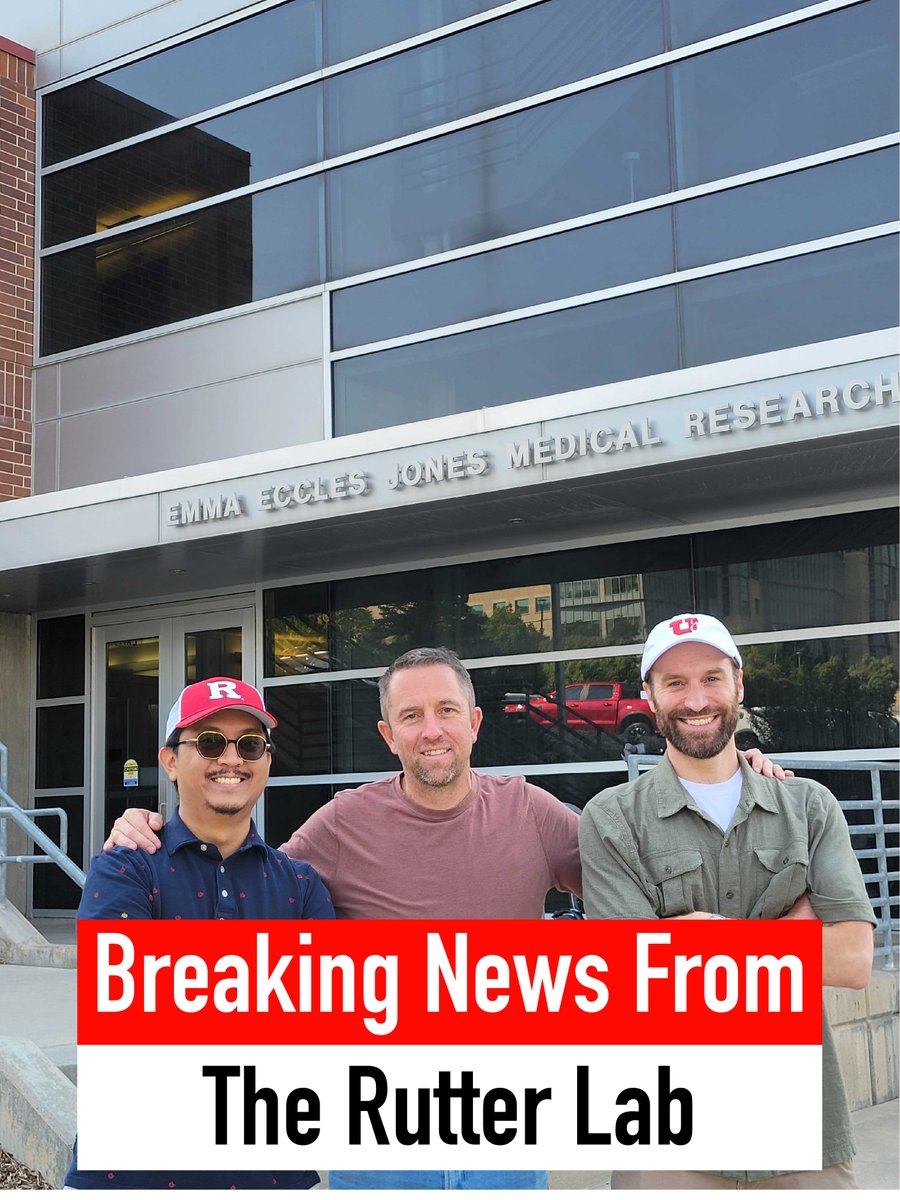
🚨📣Breaking: Sources tell @espn that @RutterLab postdocs Ahmad Cluntun (@molecularpepsi) and Kevin Hicks (@KevinGHicks) have agreed on deals to start their own independent labs.
Cluntun is joining @RutgersU@RWJMS's Department of Biochemistry and Molecular Biology as an Assistant Professor. (@Beatsbylactate)
Meanwhile, Hicks is joining the @UUtah's Department of Nutrition & Integrative Physiology (@uofunuip) also as an Assistant Professor.
🚨Both labs are hiring at all levels!
Exciting times ahead for the Utes and the Scarlet Knights! 🔥🎈🥳🎉 #Utes #Rutgers #NewBeginnings @HHMINEWS @UofUBiochem@wojespn
Beyond excited to share my first paper from my PhD @DPhaz Lab @IMS_MRL now out in @embojournal! Special thanks to Sam from @TVPLab and @dougall_norris for co-leading this project with me. We found that many cell culture models, despite living in 18% oxygen, are hypoxic! 🧵below:
https://t.co/mG8PFGudGT
Happy to share the lab's latest paper where we explored various perturbations that increase mito-membrane potential and identified its mechanisms by exploiting ETC- or ATP synthase-independent machineries.
"Congrats to Yeyun, @Yeyunouyang , (and the rest of the authors) for a beautiful and innovative piece of work!"-JR
https://t.co/ErOhAoefTi
#MitoMonday @HHMINEWS @UofUBiochem@eLife
One of the best courses to learn metabolomics! I have learned so much more about metabolomics approaches and edge-cutting research from this course (and a lot of fun). Big THANK YOU to all the instructors, TAs, and course participants!
It was indeed an intense course but with awesome instructors, the time went by too fast. Made new connections and friends. Thanks to all the instructors and TA’s for making the last two weeks filled with science, discussions and fun parties. @cshlmetabo@CSHL#metabolomics
Jared Rutter @RutterLab, a @UofUBiochem professor, never thought he'd be involved in commercialization, but he said being both an academic and an entrepreneur gives him a valuable perspective into the world of drug development and research.
https://t.co/DCuEsyss3A
"The development and publishing of the MIDAS platform has been a long road. @KevinGHicks deserves the lion’s share of the credit for making it happen. We have had an amazing and large group of collaborators that have contributed in essential ways" -JR https://t.co/U0kfjZoOos 1/2
Our latest Review on Metabolites as signaling molecules is now available @NatRevMCB. Co-Written by the incredible Steve Baker (@BakerLabUtah) @UofUPathology@ARUPLabs
https://t.co/dx8zoBl0va
open access:https://t.co/Y8MD4NbaSF
@HHMINEWS @UofUBiochem
Previously, it has been a challenge to distinguish between motifs for TFs that drive chromatin accessibility and those that follow it. In our latest work from @kaelanbrennan and @MelanieWeilert, we tackled this problem in the early Drosophila embryo. (1/6)
https://t.co/7lq6NtguFu