Bitcoiners pushing to "force" BTC for spending today are missing the historical progression and could actually end up subsidizing fiat.
Gresham's Law, then Thiers Law... in that order
Bitcoin built its value because people HODLed it, not in spite of it. Scarcity + voluntary holding = the moat.
Everything else (institutional ETFs, nation-state buys) is downstream of that.
The HODLers created the demand signal that made everything else possible. If velocity magically spiked tomorrow without more scarcity-driven conviction, you'd just get more volatility and weaker hands.
This is Gresham's Law in effect, but... when we've reached the tipping point, Theirs Law kicks in, and then BTC will reach the Medium of Exchange (MoE) stage.
What are the tipping points?
- Demand side behavior changes
This is something @parkeralewis explained deeply; as someone building merchant payments, we need the merchants to demand BTC to hold it, not just to convert back to fiat.
- Fiat credibility collapse
either through rapid inflation, capital controls become ineffective, or censorship
- Network and Adoption
Significant portion of global trade settles in BTC without fiat intermediaries. People think in and quote prices in sats rather than converting fiat.
Forcing BTC MoE before these risks "subsidizes the fiat network effects." How?
Every time you spend Bitcoin today (pre-shift), the typical flow is:
Sell BTC → receive fiat → spend fiat.
You're injecting fresh demand and liquidity into the fiat system. Banks, payment processors, governments, and the entire dollar network get more transaction volume, more fees, more data, and more reinforcement of their network effects.
You're literally subsidizing the enemy.
HODLing, by contrast, starves fiat of capital. It keeps supply locked, strengthens the scarcity moat, and forces the fiat system to compete on merit (which it can't).
Once the shift happens, the same spending action strengthens Bitcoin's network, because the money flowing is now the good money, and fiat is the one being rejected.
So...
HODL the scarce asset, spend the inflating one, and let the asymmetry work for you.
Forcing velocity prematurely just props up the system we're replacing.
The question is... Are we closer to the Thiers’ Law flip than most realize?
I was watching the government get questioned today, and what struck me was how absurd it was. Someone was coordinating the fuel task force, earning $270,000 over 2.5 months.
FFS, am I the only one? who makes more than $100K a month, and the bureaucrat, when asked, just said oh we looked around. That's the exact problem.
She looked around and saw it was normal to get $100k a month.
That is basically a million-dollar-a-year rate to manage an emergency fuel rationing process. Another person was apparently paid hundreds of thousands for barely a few months of chairing it.
The part that interests me is the symmetry. This is what failing systems seem to do. When the material base starts to crack, a bureaucratic class emerges around the crisis and begins feeding on the management of failure.
That is what happened in France under the Ancien Régime, especially with the rise of the noblesse de robe: the administrative and legal class that converted state office into status, income, and power.
The state became less a machine for solving the problem and more a machine for sustaining the people appointed to manage it.
You can see similar patterns in older collapses, too, such as the Bronze Age. As the real system comes under strain, the coordinating class grows heavier, more expensive, and more detached from the underlying material problem.
And now here we are in Australia, paying near-million-dollar-equivalent rates to people chairing or coordinating emergency fuel arrangements, while the country still has the same physical vulnerability: dependence on imported fuel, weak sovereign refining capacity, and fragile supply chains.
Canberra really does believe they are the Australian nobility. She also might or might not be in charge of Sulphuric Acid. She didn't seem sure.
The crisis becomes a career structure. The emergency becomes a payroll.
There are two other dire consequences of this budget that nobody is talking about. The first is that the budget’s introduction of an effective capital gains tax of up to 45 per cent - 47 per cent – previously capped at 23.5 per cent for assets held more than 12 months – hits younger savers hardest, precisely because they have the highest portfolio exposures to high-growth assets such as listed global equities, Australian shares, crypto, venture capital and private equity.
When anyone builds a portfolio for younger investors, they rationally load them up with the highest-growth and most volatile assets on the basis that a long investment horizon allows them to weather the inevitable volatility storms.
As investors age, these portfolios shift into more stable and income-rich asset classes such as cash and bonds, which are net beneficiaries of the CGT increase, because their post-tax returns now look more attractive relative to growth assets.
As many investors have noted online, why would you allocate to a bunch of high-risk growth companies when Albanese and Chalmers are going to take almost half the upside while wearing none of the downside? Rather than helping younger generations, the highest CGT rate in the developed world will hammer them.
And it is a double whammy because the many early-stage companies that have historically employed 20- and 30-somethings will now consider moving overseas. Their investors will simply not want to trade away half of their upside to the public oligarchs.
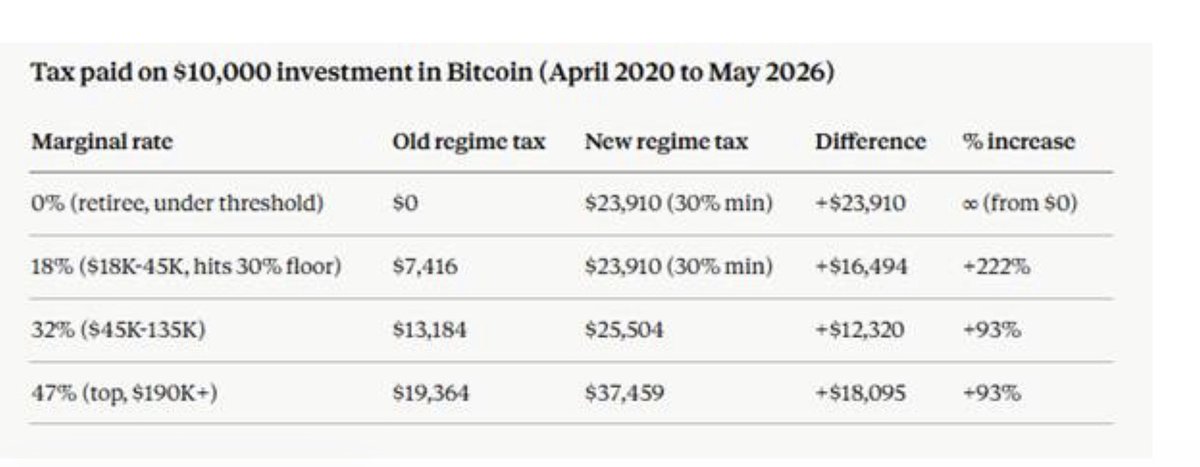
If you allocated $10,000 to bitcoin after the March 2020 pandemic shock – which many young punters did, and which would now be worth approximately $92,000 – the new CGT regime imposes vastly higher amounts of tax.
A self-funded retiree on the tax-free threshold would go from paying nothing to almost $24,000. Somebody earning between $18,000 and $45,000 a year would see their tax bill jump from $7400 to $23,900 – a 222 per cent increase. Those in the $45,000 to $190,000-plus tax brackets would have their bill rise by 93 per cent.
Since the new CGT regime is, by definition, much more costly on higher-growth investments, it will punish younger investors who have much greater risk appetites and lower average incomes.
https://t.co/MJKvQZXvKw
Editorial: Liar Liar Pants on Fire
You want to know WHY people have lost faith with politics in this country. This is why!
The speaker of the house, Milton Dick, is running a protection racket. Credlin
This is why One Nation is on the rise, and Peta knows it.
A must-watch👇
This is crazy: the federal government is using all the NDIS savings and almost all the NDIS savings + tax increases to pay itself due to a massive $19.6 billion cost blow-out on the bureaucracy over the next four years compared to forecasts in last year’s budget.
Put another way, over the four overlapping Budget years from 2025–26 to 2028–29, the government has increased the cost of running the bureaucracy by $19.6bn — enough to consume virtually all (99%) of the $19.8bn in NDIS savings it claims, 93% of those savings plus its negative-gearing/CGT tax grab, and 14.5 times the property/investor tax increase itself...
"The average staffing level increases from 215,900 this year to 217,300 in 2026-27. Since the Albanese government came to power in 2022, the size of the public service has ballooned by a quarter."
https://t.co/tzZFwkUQCF
Capital gains tax shouldn’t exist.
I risk my money. I build the business. I make the investment. I do the work. I take the risk.
So why the hell should the government take a cut of my success?
They risk nothing. They create nothing. They just take.
Parasites. F’en parasites.
I'm running numbers on family trusts. If the trust owned by mum, dad, and 19-year-old daughter earns $180,000 a year and they distribute $60,000 to each the tax will be three times $9,000 = $27000. At 30% flat, it's $54,000. That's double - The only way out is to change distributions to wages, but they must be able to justify the wage. It's a shameful attack on business
Young Australians should be enraged by the new super tax.
The statist talking heads will tell you "it's only on balances above $3M. The rich." Most Aussies will fall for it.
Run the numbers. 35yo today. $200k in super. Contributes $15k a year. Earns 8% returns (long run super average).
In 30 years their balance is $3.7 million. Caught by the tax.
But here's the trick. Australia's money supply has grown about 8% a year for the past two decades. RBA's own data. So that $3.7M buys what $369k buys today. Same groceries. Same house. Same petrol.
You didn't get rich. You ran on the spot.
And the $3M line? Frozen. In 30 years it only buys what $300k buys today. It's lost 90% of its real value. The govt doesn't have to move the line. Inflation does the work for them.
No different from the obscene overreach on anti-money laundering rules. The $10k cash transaction threshold was set in 1988 and never moved. $10k then is $26k in today's money. Adjusted for money supply growth, it's $170k. Same threshold. Almost 3x more transactions caught by CPI, 17x by money supply. That's why you get interrogated at the bank for withdrawing what only covers half a year of school fees.
Same trick with income tax. Wages rise with inflation. Brackets don't. Suddenly the average worker is in a "high earner" bracket they were never meant to be in. You don't earn more. The line moved.
This one policy tells you everything you need to know about the government and its intentions. It's all about grift and theft.
Meanwhile, the kids who get hit hardest are kept busy by an education system arguing about hate speech, social media, and the climate apocalypse promised in 2012. Nobody teaches them how money actually works. The govt likes it that way.
So they vote for more taxes. Bigger govt. More "fairness." Pouring petrol on the fire burning their house down.
The fix isn't communism. It's the opposite.
Smaller govt. Lower taxes. Index every threshold to the actual money supply, not the CPI lie. Decentralise the banks.
Despite everything, Australians are entrepreneurial and predominantly hardworking. Imagine what this country could become without the government's boot on its neck.
The federal Government has the fate of Australia’s startup sector in its hands.
In the next few days we will find out if we have scored a massive own goal and stopped a decade’s remarkable progress in its tracks or if the Government has reflected and changed course ahead of the budget. The mooted policy changes will be a kick in the guts for the economy generally and especially small business but will uniquely impact startup founders and employees.
This is not about a pampered sector wanting to be treated differently but a decision about the sort of country and economy we want. We are sitting on the cusp of the greatest employment transition in our history. AI changes everything. Many, many jobs will disappear and we MUST create new jobs to replace those that will disappear.
Startups are the engine that create large numbers of high paying, highly productive new jobs for young Australians. We don’t want founders building offshore or not building at all as a result of bad policy.
One of the biggest tax changes in decades will be announced in next week’s Federal Budget. The widely expected CGT changes won’t just affect wealthy investors or property owners... they affect anyone trying to build long term wealth through shares, investment property or building a business.
To help Australians understand the potential impact, we’ve built a CGT calculator that estimates how much better or worse off people could be under the proposed rules: https://t.co/WFVQzYuMnt
A few examples from the calculator:
• An ETF investor growing $100k over 10 years could end up with around $26k less after tax
• A property investor could lose more than $50k in after tax wealth
• A founder building and selling a business for $1m could lose more than $225k
If you materially reduce the after-tax reward for taking long term risks, fewer people will invest in businesses and productive assets. Over time that means less investment and innovation, fewer startups, lower productivity growth and ultimately fewer jobs in Australia. I discussed this in The Australian last week. https://t.co/2XmT26CTsd
Instead, more money gets pushed into the family home, super or cash sitting in the bank.
That’s why entrepreneurs and business leaders including @PaulBassat, @GeoffWilsonWAM, @leighjasper, @matt_barrie, @lux_schwab, @lukeanear, @Bron_LeGrice, @MJBiercuk and @craigRblair have all raised concerns about the broader economic consequences these changes could create.
We thought if people could properly quantify what these changes might cost them over time, it would make the broader economic impact much harder to ignore.
The calculator is designed to help Australians model different scenarios before any final rules are announced: https://t.co/WFVQzYuMnt
If the Government abolishes the “discount” on capital gains and replaces it with indexation and don’t carve out startup founders and employees they will set back the startup ecosystem in Australia by a decade or more. Founders will leave Australia in big numbers. Founder’s “cost base” isn’t capital but years and years of sacrifice and toil.
At a time when we are about to see a tsunami of job shedding by existing businesses, Australia’s best hope is a wave of startup innovation. A ~50% tax on gains by founders and team members will have disastrous consequences. We need the Government to provide immediate clarity.
Anthropic CEO: "AI will write 100% of code within a year"
developers spend 4 years in university learning to code
Claude learned it from every book ever written
if the hardest skill is already handled - the gap is no longer about what you know
it's about how well you've configured the tool that knows everything
most people haven't done that yet
the article below is where you start
I actually think the whole "permanent underclass" narrative is wrong.
I think we're about to see the largest EXPLOSION of entrepreneurship in human history.
I get why the fear exists. Jobs are getting cut. AI researchers are privately saying most people are screwed. The models are getting ridiculously better and faster than anyone expected. Project that forward linearly and yeah, it looks BLEAK.
But linear projections are usually wrong during platform shifts. Nobody projected that the internet would create 50 million small businesses. They projected Walmart would eat everything. Nobody projected that mobile would create a million app developers. They projected phones were just phones.
What actually happens is intelligence gets cheap and a flood of new builders enter the market with domain knowledge the incumbents never had. Millions will get laid off or just never hired over the next 24-36 months. Those jobs are not coming back. So they become entrepreneurs. Out of necessity at first. Then out of opportunity.
The underclass idea is VIRAL because it confirms something people have been feeling for a decade. That the ground is shifting and nobody at the top is reaching down. And they're right.
But the interesting thing about this particular technology is that it doesn't check your resume or your zip code. The same tool that eliminates your position hands you the ability to build the thing that replaces it. The weapon and the escape hatch are the same object.
We're about to see more new companies started in the next 5 years than in the previous 50.
And I think we're going to look back at this moment the way we look back at 1995.
Everyone was scared. Everyone was right to be. And the people who built anyway became the next generation of owners.
I know you might be reading about the permanent underclass and it's scary. Who wants to "get stuck in the permanent underclass no one.
My POV is the permanent underclass isn't a foregone conclusion. I know some people are genuinely struggling right now and "just go build" sounds tone deaf when you're worried about rent. I get that.
But the reason I'm optimistic is that the cost to start something just dropped to nearly zero, intelligence on tap, and eveyr category/industry you can think of is getting reshuffled.
The explosion of entrepreneurship is just beginning.
It is also not backed by Bitcoin any more than a USD today is backed by gold.
STRC is equivalent to post 1971 petrodollars. Because unlike gold backed dollars before, you cannot request in kind redemption of BTC for STRC from Strategy. That would be an actual innovation, a real iPhone moment.
And, there is no breakdown of what instruments have what claim on the BTC.
Without proof of reserves or breakdown of claims, it is simply trust that the increasing BTC per share exists AND will be managed properly. Good or bad, from this perspective it is no different than the trust required for Lehman Brothers to function.
Lastly, selling of one part of the capital structure to raise capital structure to pay dividends and raise funding for infrastructure investment is not at all different than what the Govt currently does with its open market operations.
Paul Tudor Jones says the US is more dependent on equity prices than ever, and explains what a 35% correction would trigger in the economy:
"We're 252% of stock market cap to GDP. In 1929 we were 65%. In 1987 we got to ~85-90%. In 2000, 170%.
If you think about the periodicity of significant bear markets. Since 1970, we get a mean reversion about every 10 years.
Let's say mean revert to the past 25 or 30-year PE. That would be a 30, 35% decline. Well, 35% on 250% of GDP is 80, 90% of GDP.
10% of our tax revenues are capital gains, they go to zero. So you can see the budget deficit blowing up. You can see the bond market getting smoked. You can see this kind of negative self-reinforcing effect.
In the stock market, we're over-equitized as a country. We have the highest individual equity weightings in the history of the country.
And then the real problem is if you look at private equity in 2007-2008, that was about 7% of institutional portfolios. Now it's about 16% of the institutional portfolios. We're so much more illiquid than we were in 2008.
The problem is that if you buy the S&P at this current valuation, the 10-year forward return is negative when you buy the S&P with a PE of 22. That's what history shows.
So yes, the S&P is spectacular long-term, if you have a hundred-year view. But that's because that's an average of a hundred years, including times when the S&P 500 PE was 6, 7 and 8, or one third of what it is right now.
Valuation matters a lot, and the stock market's really high and it's gonna be really hard to make money from here with any kind of long-term view."
I just finished reading palantir’s manifesto & I need you to understand what you’re actually looking at because this is the MOST important document the tech world has produced this year
most people came away thinking «wow what a thoughtful essay about patriotism and technology »…I came away thinking this is the most elegant justification for corporate capture of the state apparatus ever written & I want to walk you through why
krp opens with «silicon valley owes a moral debt to the country that made its rise possible » & frames the entire document as a call to civic duty, but read between the lines and what he’s actually saying is that the engineering elite should be embedded inside the defense and intelligence apparatus of the nation, he’s describing exactly what palantir has already done and dressing it up as patriotism
«the question is not whether AI weapons will be built, it is who will build them and for what purpose »sounds like a warning but it’s actually a sales pitch, he’s telling every gov on earth that the choice is binary either you buy from us or your adversaries will build it without you, this is the oldest arms dealer rhetoric in history wrapped in SV vocabulary
« hard power in this century will be built on software »is the key sentence of the entire manifesto because this is where karp reveals the real thesis, he’s saying whoever controls the software layer of national defense controls the nation itself & if you’ve been following my threads you know that palantir’s gotham and foundry platforms are already plugged into the intelligence feeds the satellite data, financial transactions & communications of dozens of govts worldwide through a single ontological knowledge graph that creates a technological dependency so deep that migrating away would mean rebuilding the entire institutional memory of the organization from scratch
this is vendor lockin at the scale of nation states and I’m personally convinced it was designed this way from the beginning
«we should applaud those who attempt to build where the market has failed to act » is karp defending palantir’s expansion into every domain the gov used to handle itself, policing immigration, military targeting intelligence analysis public health, everywhere the state retreats palantir advances and what was once a government function becomes a private service that the government can no longer perform without plantir’s permission
and here’s what I think makes it even more concerning, these systems are increasingly autonomous meaning the AI layer is making targeting recommendations threat assessments & resource allocation decisions that humans inside gov are rubber stamping without fully understanding the underlying logic
a bureaucrat inside the pentagon / DGSI sees a recommendation from the system & approves it because the system has been right 97% of the time and questioning it would require technical expertise that no one in the room has, this is algorithmic governance wearing the mask of human decision making
«the atomic age is ending, a new era of deterrence built on ai is set to begin »is the MOST chilling sentence in the document because karp is explicitly saying that ai based deterrence will replace nuclear deterrence as the organizing principle of global power, and whoever builds that ai deterrence layer owns the 21st century the same way whoever built the bomb owned the 20th & he’s telling you plainly that palantir intends to be that builder
«national service should be a universal duty » & « we should only fight the next war if everyone shares in the risk »sounds noble until you realize that he is proposing a system where citizens serve the state & the state is operationally dependent on palantir, the public bears the risk and palantir captures the value, soldiers fight wars planned by algorithms they can’t audit built by a company they can’t vote out
no matter what your personal view may be on strategy, bitcoin, or corporate treausury, one thing is clear: $STRC attempting to offer semi-monthly dividend is a pretty revolutionary moment for corporate finance
currently there are no issuer-originated corporate instruments that offer semi-monthly dividends. however, we know retail has been loving more frequent payments as demonstrated by the success of weekly pay suite ETFs and daily accrual money market structures. Even blackrock just shifted their money market funds GMMF and PMMF from monthly to weekly payments. thats because the premium for liquidity has never been higher.
even more poetically, this is actually a win for a long-standing thesis in the broader crypto industry
crypto has long imagined various "streaming payment" models where the instantaneous of payments would create a totally new concept of epochs that isn't going to limit digital money by human constraints. people are quick to think that the big revolution is 24/7 trading, but actually i believe the bigger revolution is 24/7 credit. many crypto yield products, and the basis of why tokenization can be so important (and stablecoins), sits on this obvious insight yet to be unleashed
corporate bonds generally pay semi-annually. the logistics of 10b-17 aside, that means the difference in actual cash on cash return for an instrument that pays 10% semi-annually vs semi-monthly is about 25bps in effective yield. that is a big enough spread that can compound materially over 5+ years where investors were due compensation for the risk
and the reason is simple. its because interest payments represents the literal physics of money- specifically the moment money's potential energy becomes kinetic energy. there is simply no reason for digital money to have ex div effects that distort liquidity discretely if the administration of such a system can plan for it. that is why what $STRC is doing matters: it sets a new standard for corporates to do better, for the benefits of their investors to achieve higher liquidity with less cyclicality
one day we may yet again move from weekly to daily payments, and from daily to hourly, to instantaneous. the internet doesn't care whether the sun is rising or setting, nor will the ai agents care either. excited to root for strategy to lead the way to bridge this dream of crypto onto the traditional capital markets-
if volatility is vitality, then liquidity is liberty
There’s $1T up for grabs for agent-first startups and this window is WIDE open. Probably 10,000+ niches.
How it plays out:
1. Every SaaS company follows salesforce and goes headless within 18 months
2. a new category of "agent-native" startups emerges that treat salesforce, HubSpot, workday etc as dumb backends. the startup IS the agent. the SaaS is just the database.
3. the entire consulting/services industry around enterprise SaaS gets compressed into software. the agent replaces the implementation team.
4. outcome-based pricing becomes default. nobody pays per seat when the "seat" is an agent making 10,000 API calls a minute. you pay when revenue hits your account.
5. the winning founders are ex-operators who understand a vertical workflow cold. the code is the easy part. knowing that a property manager spends 14 hours a week on lease renewals? that's the insight worth $100M.
6. distribution becomes the moat. when anyone can wire agents to APIs, the company with the audience and the brand wins. media + agents is the new SaaS. There’s a rush to incubate live/short form shows.
7. Silicon Valley goes all influencer. Roy lee gets this. Pat Walls gets this. Sam Parr gets this.
8. the first $1B agent-native company in each vertical will look nothing like the SaaS it replaced. smaller team, higher margins, no implementation cost, no churn from bad UX because there is no UX.
the fastest path to wealth right now: find an industry that still runs on dashboards, phone calls, and spreadsheets. build the agent-native version. charge per outcome. own the workflow end-to-end.
someone reading this right now is going to build a $100M company off this exact shift. tell me about it on the @startupideaspod when you do. Im rooting for you.
Less reading, less bookmarking, more building.
the last wave rewarded people who built pretty interfaces on top of ugly data.
I think this wave rewards people who build smart agents on top of exposed APIs.
Or who just build the APIs themselves
Here we go
Wow.
A former US Treasury Secretary suggested US authorities prepare a back-up plan in case of a collapse in demand for Treasuries.
This is the same guy who served during the Great Financial Crisis.
Nothing to see here...