Jaron Lanier on how to think about LLMs (and stuff like it doing mathematics).
As a bonus, he connects current doom-talk around AI directly to the loss of optimism in popular Sci-Fi. Memes beginning in Sci-Fi fundamentally affect talk in intellectual/tech communities:
@DavidDeutschOxf@MorEdge_Insight Blake’s disloyalty to the Crown wasn’t sound. I’ll bear him, the friars & the Maquis in mind during audited class—“Nation, République, Laïcité” are Popper: not “who should rule” but “how do we arrange institutions so that bad rulers, and bad ideas, can be removed w/o violence.”
@DavidDeutschOxf@MorEdge_Insight It's historical context on 1 facet of concealment of real conditions (eg w/Potemkin Villages) in the USSR. Jones was murdered in the course of his investigations but it's unknown by whom. Many after WWII thought communism offered a fairer future for humanity, Blake among them.
@DavidDeutschOxf@MorEdge_Insight Related: Frank Close’ book on Klaus Fuchs (Trinity) is very good. Fuchs’ flat when he was at Columbia is near where my daughter lives, planning to see if we can find it sometime.
@DavidDeutschOxf@MorEdge_Insight I recently applied to a Jewish studies fellowship at a catholic university for a similar reason: what might the various paths be to conversion to Judaism, and why did people take them? Thanks @MorEdge_Insight I don’t get the Blake reference David.
While law schools throughout the country are grappling with artificial intelligence use among students, Fordham Law School has met the challenge head on—developing a comprehensive strategy to guide students when considering using AI tools.
Learn more: https://t.co/Fh0yOKQSeR
Harvard has been following the same group of men since 1938.
Eighty-plus years of data on who thrives at 80. The number one predictor was not IQ, income, or fame. 🧵
Paris a longtemps trouvé ses entrées de métro si laides qu'on en a arraché des dizaines. Aujourd'hui, le musée d'Art moderne de New York en expose une comme un trésor.
Ces entrées, tout le monde les reconnaît. Des arches de fonte vert sombre, des lampadaires en forme de tiges de plante, le mot Métropolitain en lettres tordues.
Elles sont l'œuvre d'un seul homme, l'architecte Hector Guimard, à partir de 1900, pour l'ouverture du métro de Paris.
Il dessine des bouches de métro comme des plantes de fer, tout en courbes et en fleurs, dans le style à la mode de l'époque.
Il en installe près de 140 dans la ville.
Très vite, une partie du public déteste. On juge ces courbes molles, on trouve le style trop peu français, on refuse même son projet pour la station de l'Opéra.
Au fil du siècle, on en démolit beaucoup. On leur préfère des entrées sobres, sans fioritures.
Il n'en reste aujourd'hui que 86, protégées comme monuments historiques. Et seulement deux abris d'origine avec leur toit de verre, dont celui de la Porte Dauphine.
Ce que Paris a jeté, d'autres villes l'ont réclamé.
La RATP en a offert de véritables à Montréal, Mexico, Lisbonne, Chicago, Moscou. New York en garde une au musée d'Art moderne.
Ce que la ville trouvait indigne d'elle est devenu, ailleurs, un morceau de Paris qu'on s'arrache.
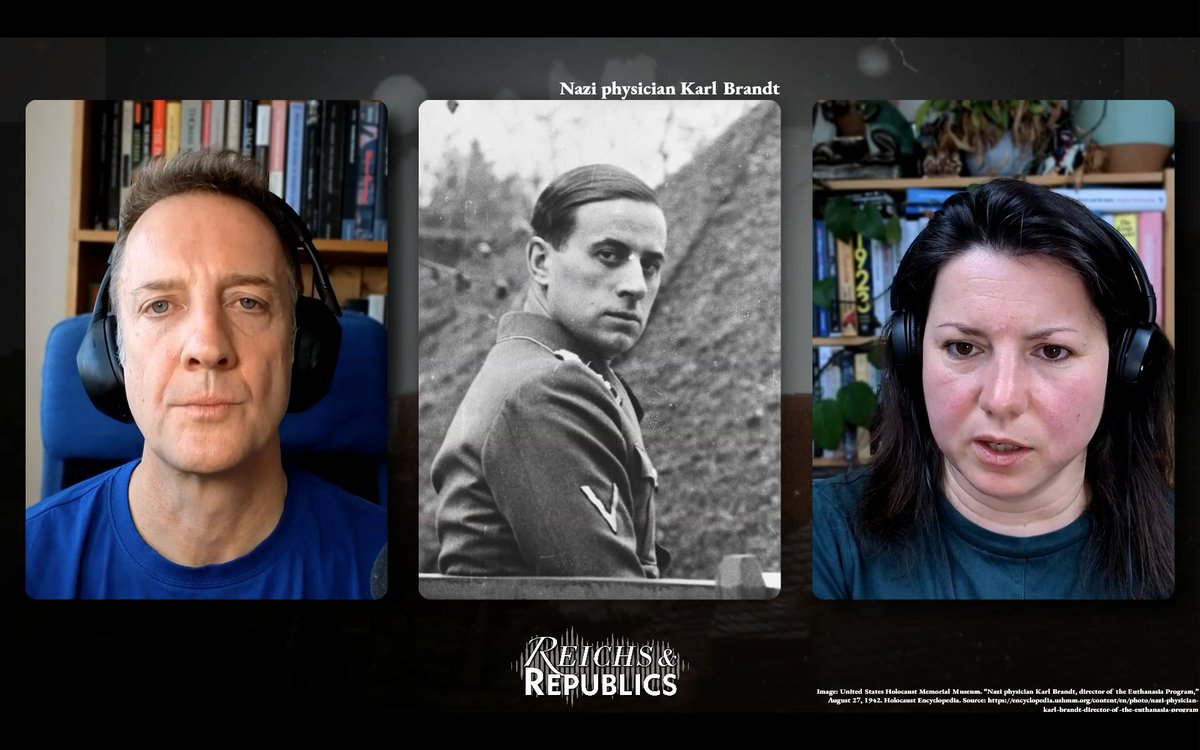
This week, we turn to a dark and difficult subject: Aktion T4, Nazi Germany's mass murder of disabled people. We discuss the programme's origins, how much ordinary people knew, and why German post-war engagement with it was astonishingly slow.
Reichs & Republics E26 is out now.
I'm in Germany (Berlin, Leipzig, Hamburg, Weimar), talking to diplomats, politicians and the public about history and politics. I'm being asked a lot what, if anything, we can learn from Weimar for our times.
If you're interested, here's a recent chat along those lines on the Long History Short Podcast👇
https://t.co/iFMtQYKOon
🚨Haaretz exposé: Israeli Prime Minister Benjamin Netanyahu received an explicit warning from UAE President bin Zayed days before October 7. He didn't brief Israel's security chiefs. @shlomieldar
🔗Link to full exposé in bio
Photos: Haim Goldberg/Flash90, Khalil Hamra/AP, Mandel Ngan/AFP. Editing: Masha Tzur
@pash22@AfshinK91 Some ideas of mine are related (‘The model’s “negative thought territory” is geometrically more complex—more curvy, more bumpy. Positive sentiment flows through smoother terrain.) — https://t.co/7zWEX7wz9K
@DavidDeutschOxf I’m sure it wasn’t intended to do so directly. Its creators know what they’re talking about—eg series 1 ep 7(?) in which character to the R in the photo asks another team member how he does what he does—was not at all sanitized. Everyone’s a real person.
Thomas Sowell on how he taught students:
“I’d spend a great deal of time putting together a reading list, where I’d find the strongest argument on one side and then the best example of the opposing view.”
“I didn’t test students on which side they believed. I tested them on whether they understood the arguments on both sides.”