A new bilateral channel on AI governance is opening just as the single military-AI commitment that the two powers already share – keeping humans in control of nuclear decisions – loses definition. What follows is a guide to the signals worth tracking over the coming year.
Read the latest analysis by Dongyoun Cho, Senior Fellow for Advanced Technologies, National Security and Defence:
➡️https://t.co/xs05Z9ffyp
#Peace frameworks are often judged by their promises; their true test lies in implementation and political will.
Brig (r) Dr. #Tughral#Yamin examines #Pakistan's #mediation role, competing redlines, & future of US-Iran de-escalation. #Read & share your views. #Link in comments.
CISSS Publication | Strategic Forecast
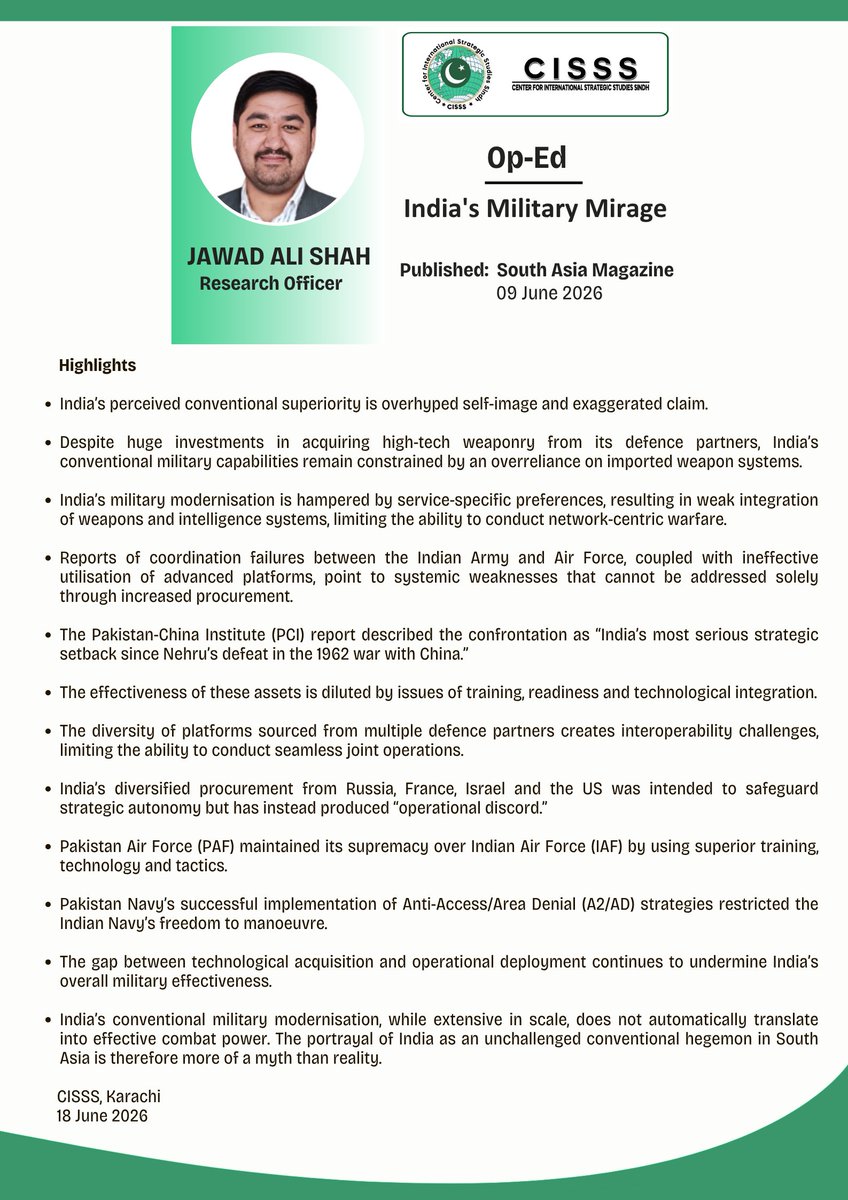
Op-Ed | India’s Military Build-Up: Implications for Regional and Global Security
Author: Research Assistant Sadia Memon
Link ⬇️
https://t.co/12b6EB4A8b
What are the strategic trade-offs of nuclear hedging?
@BrewerEricM examines Iran’s nuclear program from 2023–25 and argues that instead of providing a net advantage, Iran’s threshold status became a critical vulnerability that invited attack rather than deterring it.
I warmly congratulate the US & Iran for having reached a peace deal that provides for an immediate & permanent ceasefire, the reopening of the Strait of Hormuz, as well as a framework for further negotiations. This represents a critical step towards the peaceful settlement of the conflict.
My deep appreciation goes to Pakistan, Qatar, Egypt, Saudi Arabia, Türkiye, and other regional countries, for the constructive role played in supporting the negotiations that led to the peace deal.
Congratulations 🇵🇰 Pakistan for facilitating the #peace#agreement! Your tireless efforts have borne fruit and you have made an enormous beneficial contribution to the region and the world. Mubarak ho and bohot shukriya. 🕊️
CISSS Publication | Islamabad Policy Institute (IPI)
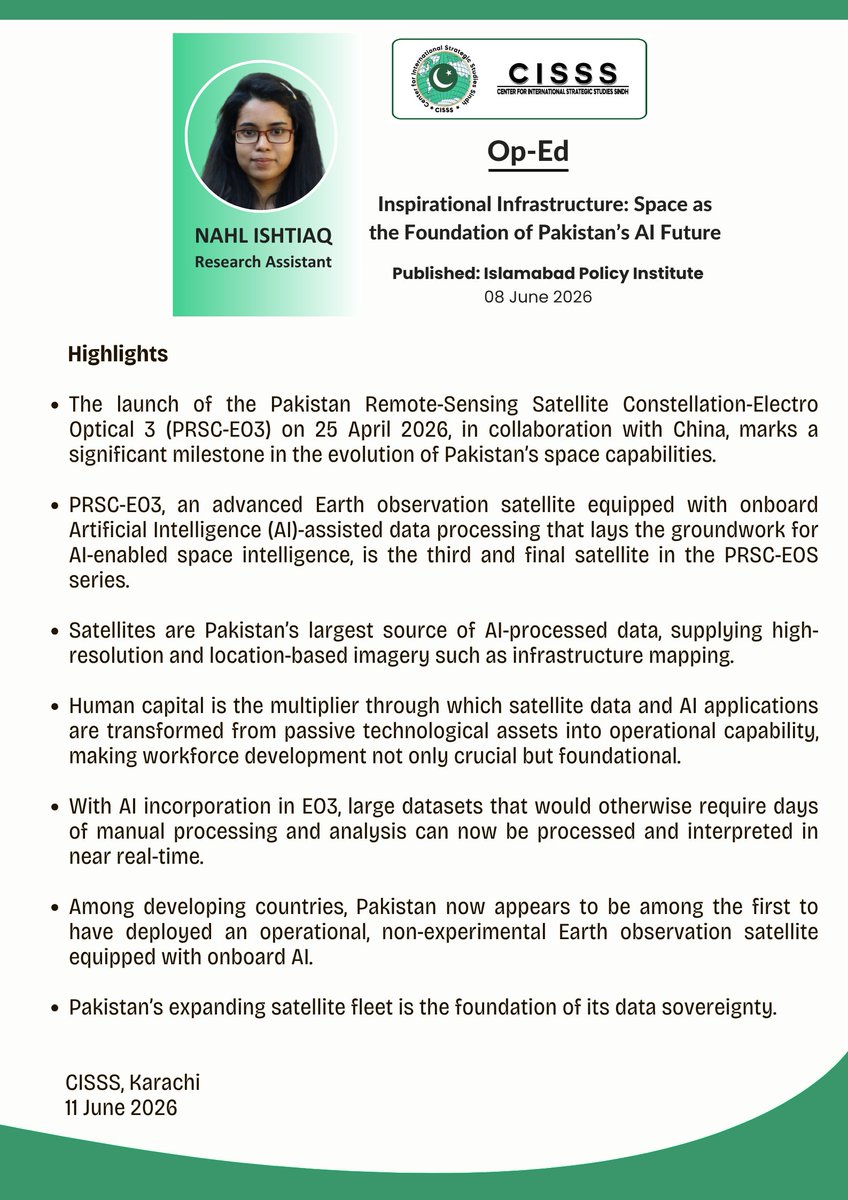
Op-Ed | Inspirational Infrastructure: Space as the Foundation of Pakistan’s AI Future
Author: Research Assistant Nahl Ishtiaq
Link ⬇️
https://t.co/cSp8FGhJOu
SIPRI Yearbook 2026 now vindicates what I have been documenting for years: India has moved from a so-called recessed, de-mated posture toward operational nuclear warhead deployment and peacetime mating with launchers.
12 warheads are now assessed as deployed with operational forces. The “reliable minimum deterrent” narrative just took a hit.
https://t.co/GwYVSiwamp
#SouthAsia #NuclearDeterrence #SIPRI
1/9
@ExecDirCISSS The latest SIPRI data underscores a troubling trend. 🇮🇳’s growing nuclear inventory and deployment of warheads raise important questions for regional & global strategic stability. The international community must not ignore these developments. @SIPRIorg@UnderSecT@CarnegieEndow
@ExecDirCISSS 🇮🇳’s jump to 190 warheads and 12 actively deployed in Jan 2026 combined with global-reaching ICBMs and SLBMs is a massive escalation. 🇮🇳’s irresponsible nuclear behaviour underscores a serious threat to regional and international strategic stability.
CISSS Publication | Modern Diplomacy
Op-Ed | Rethinking Chemical Weapons Governance in the Age of AI
Author: Research Assistant Onzila
Link ⬇️
https://t.co/UVlM4iyhPr
“SIPRI Year Book: Nine Nuclear Weapon States -2026”
This clearly indicates that all major nuclear weapon states are not only modernizing and retaining their nuclear weapons but also increasing vertically.
Others follow suit.
India has consistently been going up the trajectory, becoming the largest and fastest-growing nuclear weapons state in South Asia, threatening Pakistan and others.
No one is willing to disarm their nuclear weapons. There is no sign of nuclear disarmament for obvious security reasons. Others will not be interested in disarming their nuclear weapons despite the efforts for the nonproliferation regimes.
Nuclear weapons will continue to play their deterring role in the international system.
Nuclear deterrence continues to retain its strategic value despite the emergence of disruptive technologies.
@SIPRIorg@SweArmsControl@AlvamyrdalCNTR@RobertEgnell@UNIDIR@nuclearban@scientistsorg@SweMFA@CSparre@ICRC@FOIresearch@hrw@PugwashConfs@Greenpeace@globalzero@antonioguterres
#SIPRIYearbook2026 #NuclearWeapons #ArmsControl #NuclearRisk #Disarmament #NonProliferation
@ExecDirCISSS SIPRI 2026 assessment indicates that 🇮🇳 has continued expanding and modernizing its nuclear forces. The report notes a growing emphasis on long-range systems capable of hitting all major capitals, while competition with 🇵🇰 remains a key factor shaping 🇮🇳's nuclear strategy.
Latest SIPRI Data: India had 180 nuclear warheads with 0 deployed in 2025 and 190 with 12 deployed in Jan 2026-Ominous development for regional & International strategic stability, peace & security, when viewed with 🇮🇳n ICBMs & SLBMs capable of hitting all capitals of the world.