I spoke to @BBCNews about the importance of active revision.
https://t.co/TSGxngmwrz
To really get into the concept, here is the blog post that the article is based on.
https://t.co/nUKX92uWw6
Some extremely profound words of wisdom from Alan Watts.
"One day you'll realize you've already lived through some of the best days of your life and you didn't even know it at the time."
"You were too busy chasing what's next, busy worrying about what's missing. Thinking happiness was something you'd arrive at one day."
"But while you were waiting you were laughing with people who won't always be around. You were making memories in places you'll one day drive past and feel something you can't explain. You were standing in moments that didn't feel like the good old days until they were gone."
"So stop waiting for life to start. You're already living it."
I spent ten years as an assistant principal—some of the hardest and most rewarding years of my career.
And if there’s ever a month that highlights just how critical that role is… it’s April.
Testing season.
Packed activity calendars.
Rising energy levels across the building.
It’s a lot.
And right in the middle of it all are assistant principals—steady, present, and essential.
Teachers experience the daily wins of the classroom—the moments that remind them why they teach.
Principals often stand in the spotlight, representing the school and celebrating its success.
But assistant principals?
They work behind the scenes.
They take on the work others can’t—or won’t:
Discipline and difficult conversations
Parent meetings
Scheduling issues and last-minute coverage
The countless logistics that keep a school running
They are problem-solvers in constant motion.
They are the ones who:
Support a teacher dealing with challenging behavior
Step in when a student is being bullied
Cover a class when no substitute shows up
Listen to frustrated teachers with patience and empathy
Make sure a child without lunch still gets to eat
Stay late for the student who missed the bus
Stand beside teachers in tough parent conferences
Walk the halls, creating calm through their presence
The work isn’t glamorous.
It often goes unnoticed.
And too often, it’s taken for granted.
But it matters.
Assistant principals are the reason schools hold together when things get hard. They do whatever it takes so teachers can teach and students can learn.
I see it.
I appreciate it.
And I hope they know the difference they make.
Because they don’t just support the work…
They make the work possible.
Assistant principals are the backbone of our schools—true unsung heroes.
#APWeek
#AssistantPrincipalWeek
Many of the greatest teachers will never win prestigious awards, amass wealth, or become famous.
They simply show up every day, ignite minds, and change lives—one lesson at a time.
Their impact is quiet, but profound.
If you teach your kids anything, teach them this:
The more you focus on your thoughts and emotions the stronger they grow.
The best way to get out of your head is to move your body.
Many college professors are discovering that students learn less when they have laptops open. Many of us are banning their use in class.
Putting computers and tablets on students desks in K-12 may turn out to be among the costliest mistakes in the history of education
Underrated life skill: Listening without waiting to respond. Most people treat conversation like a competition. If you can truly listen, you'll compress your learning cycles. You'll learn faster, connect more deeply, and adapt more effectively. You stand out without trying.
Ditching Differentiation?
"It’s fair to say that the term ‘differentiation’ has had its day in education (or at least in England). At one point, it was considered to be an integral element of lesson planning, design and delivery to ensure all learners were involved and could succeed.
Adaptive teaching has gained interest and attention within the profession, but with some teachers understandably asking: is this the new differentiation? Is adaptive teaching simply a new label for an old approach?"
Blog by @KateJones_teach https://t.co/Fa77QYeIoA
We have overprotected our children in the real world and underprotected them online. This is not just about phones and iPads; it's about childhood.
Let them have adventurous play, with small risks. It's safer and healthier in the long run.
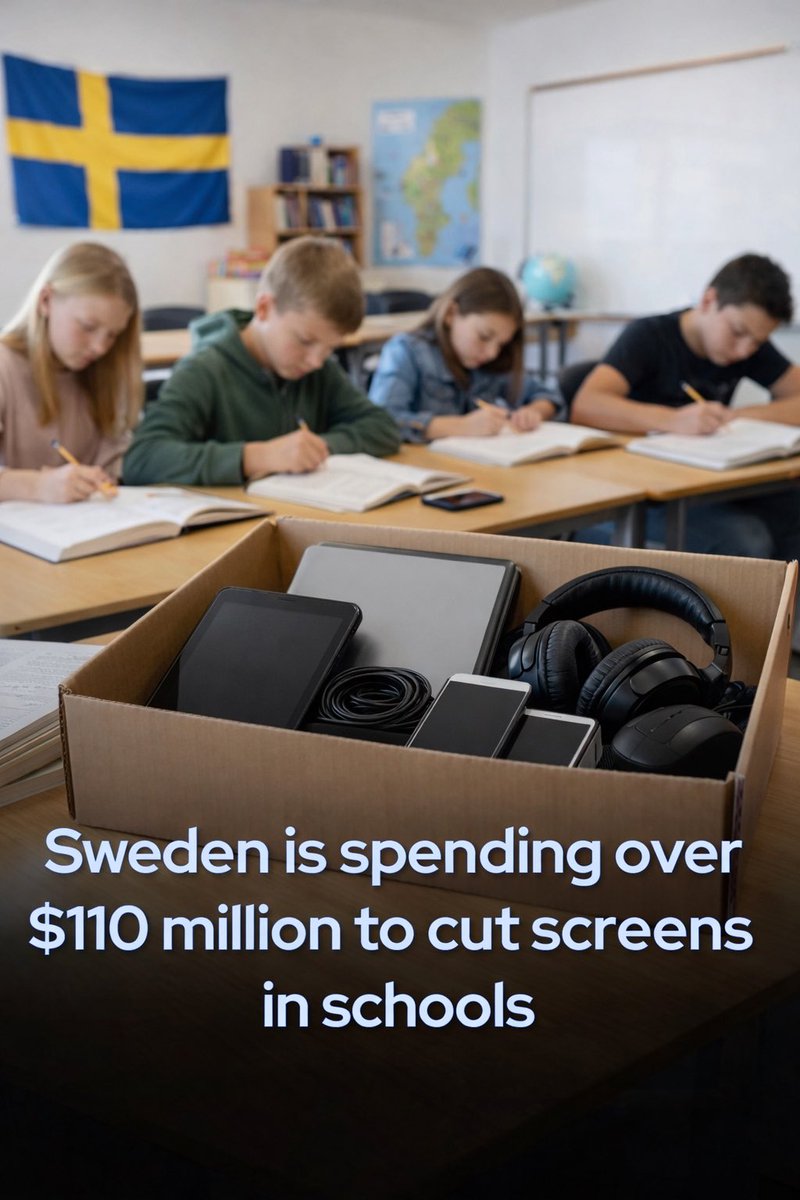
Sweden is investing more than $110 million to bring printed textbooks back into classrooms.
After years of pushing digital learning, the Swedish government is reducing screen use in schools and renewing its focus on physical books. Over the past decade, many schools replaced textbooks with laptops and tablets, moving lessons, homework, grading, and parent communication almost entirely online.
During this period, student performance declined. Results from international assessments such as the OECD’s Programme for International Student Assessment showed drops in reading, math, and science, prompting officials to reconsider the role of screens in learning.
Research indicates that reading on digital displays can demand more mental effort than reading on paper, especially for younger students. Screens also introduce more distractions, and studies have linked heavy digital use to reduced comprehension and memory retention.
In response, Sweden allocated €60 million in 2023 to restore printed textbooks, with another €44 million planned through 2025. The aim is to ensure every student has a physical textbook for each subject.
Officials stress that technology isn’t being removed from schools, but repositioned as a support tool rather than the default. Printed books are now prioritized for core learning, particularly reading.
While Sweden remains highly tech-advanced, this policy shift reflects a growing global debate: whether more technology automatically leads to better education.
✨🇨🇳In China, first-grade children are having a math competition on an interactive whiteboard. They compete in a fun game by solving arithmetic problems, making math learning super engaging!