Our lab's new paper is out!
We introduce ENTRAP-seq, a high-throughput in planta assay for multiplexed profiling of protein-coding libraries. Using ENTRAP-seq and machine learning, we discovered transcriptional regulators from ~1,500 plant viral genomes.
https://t.co/RTNWcYzXtO
Genetically engineered chestnut tree, grown in Syracuse, moves one step closer to release 🧬🌳 | If approved, Darling-54 -a fungus resistant event- would be the first genetically engineered tree made for large-scale reforestation, and could save the American chestnut from the brink of extinction. https://t.co/Vqk0GWA3E0
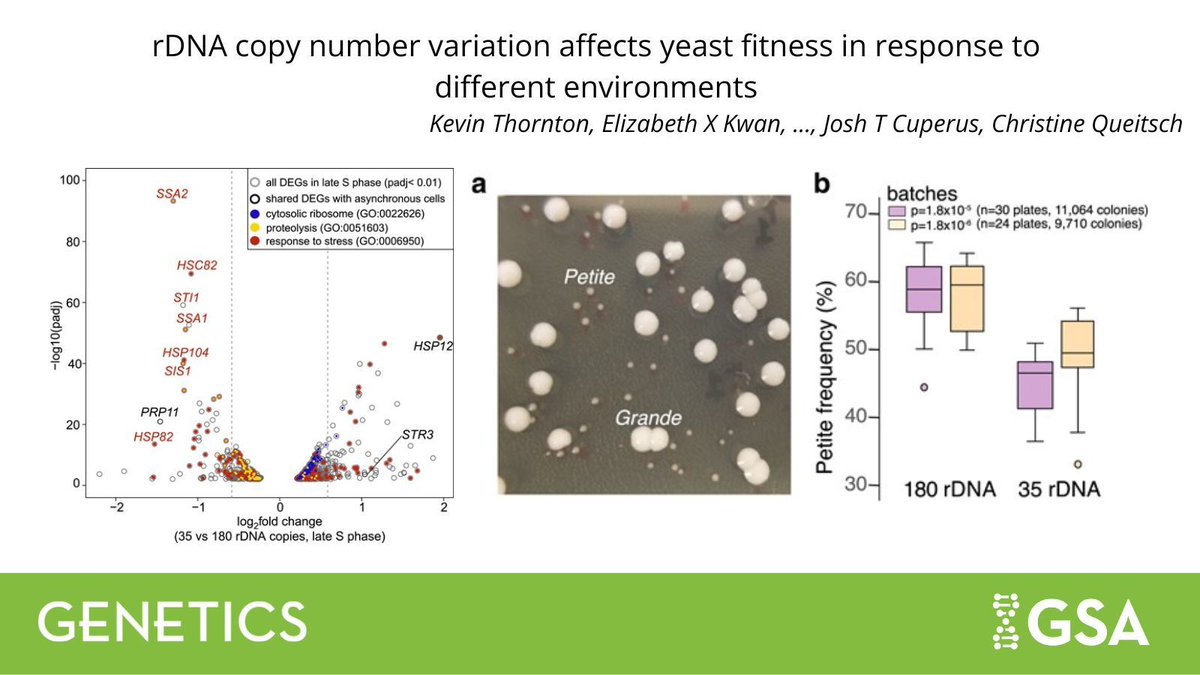
What are the fitness consequences of rDNA copy number variation within and outside the lab conditions? Do fitness effects change when growth conditions differ?
In the new #GENETICS study @RNAnerd and colleagues answer these questions using #yeast: https://t.co/pe5gi8oO9W
Our latest paper is out in its final form in
@ThePlantCell
We show that in plants the same DNA sequence can act as an insulator or silencer depending on the surrounding regulatory context. Read the full paper at: https://t.co/uFVo5ztrCO
New preprint! An atlas of conserved TF binding sites across flowering plants generated with multiplexed DAP-seq. When integrated with multi-species snRNA- and snATAC-seq reveals how TF activity shapes development and stress responses at the cellular level.https://t.co/fRvt1Jrg9I
Our lab is looking for a postdoc @uwgenome/@UW/@UWISCRM!
We tackle a wide range of biological Qs from cell-specific responses to perturbation to molecular consequences of aging.
We also work hard on new #TeamMassSpec methods to scale the # of proteomics samples we can analyze.
Out now on biorxiv: We studied the activity of enhancer-blocking insulators in plants and found that they also act as silencers when placed upstream of moderate to weak enhancers.
https://t.co/nX2JtVi2ge
Excited to share our latest work investigating the consequences of extant genetic variation in cis-regulatory elements at single-cell resolution.
A short 🧵
https://t.co/fdq9U83Csf
Are CpG methylation and chromatin accessibility polar opposites? #Fiberseq proves they are not in #maize – transposon enhancers can have simultaneous single-molecule hyper-mCpG AND chromatin accessibility. Wonderful collaboration w/ Queitsch lab & @RNAnerd
https://t.co/OpiVBzVNf8
Climate change be damned! Out in @NatureComms, we interrogated over 54k plant terminator sequences to synthetically design robust terminators for crop engineering. https://t.co/uzVJkiZGa0
Thrilled to present our collaboration w/ @stergachislab members “The regulatory potential of transposable elements in maize”. Single-molecule Fiber-seq - accurate and sensitive accessibility in maize. New open chromatin regions in LTRs and much more! https://t.co/I7zlqlNkCZ
I'm thrilled to announce the complete program for #ICAR2024SanDiego!
👉🏽Please check out the amazing line of up over 300 speakers in nearly 50 sessions! I hope to see you soon in San Diego..
https://t.co/AFa9qcvHfo
I understand imitation is the sincerest form of flattery, but as junior faculty it is frustrating when @nanopore copies the figures of your work verbatim without any credit.
https://t.co/nkq23gTdXs
Figure 1: https://t.co/csv1LuT3Kv
Figure 4: https://t.co/vHMs0AySfn