My latest industry survey indicates Google has cut 2027 shipments of the Broadcom-designed TPU 8i series by ~1M units (mostly the higher-priced 8i Max / Whalefish). The cut amounts to roughly 20% of 2027 TPU 8i series shipments.
The survey also indicates Google plans to increase 2027 shipments of the MediaTek-designed TPU 8t series, though details aren't final yet. Google has repeatedly stressed in recent months that frontier model development gets first call on compute, and this shift in the 8t and 8i shipment mix is precisely the adjustment it's making amid a tight supply chain and data center power constraints.
I'm still short, but looking for a spot to cover and take profits, possibly sooner than later.
Why?
Because an impending push up is growing likely.
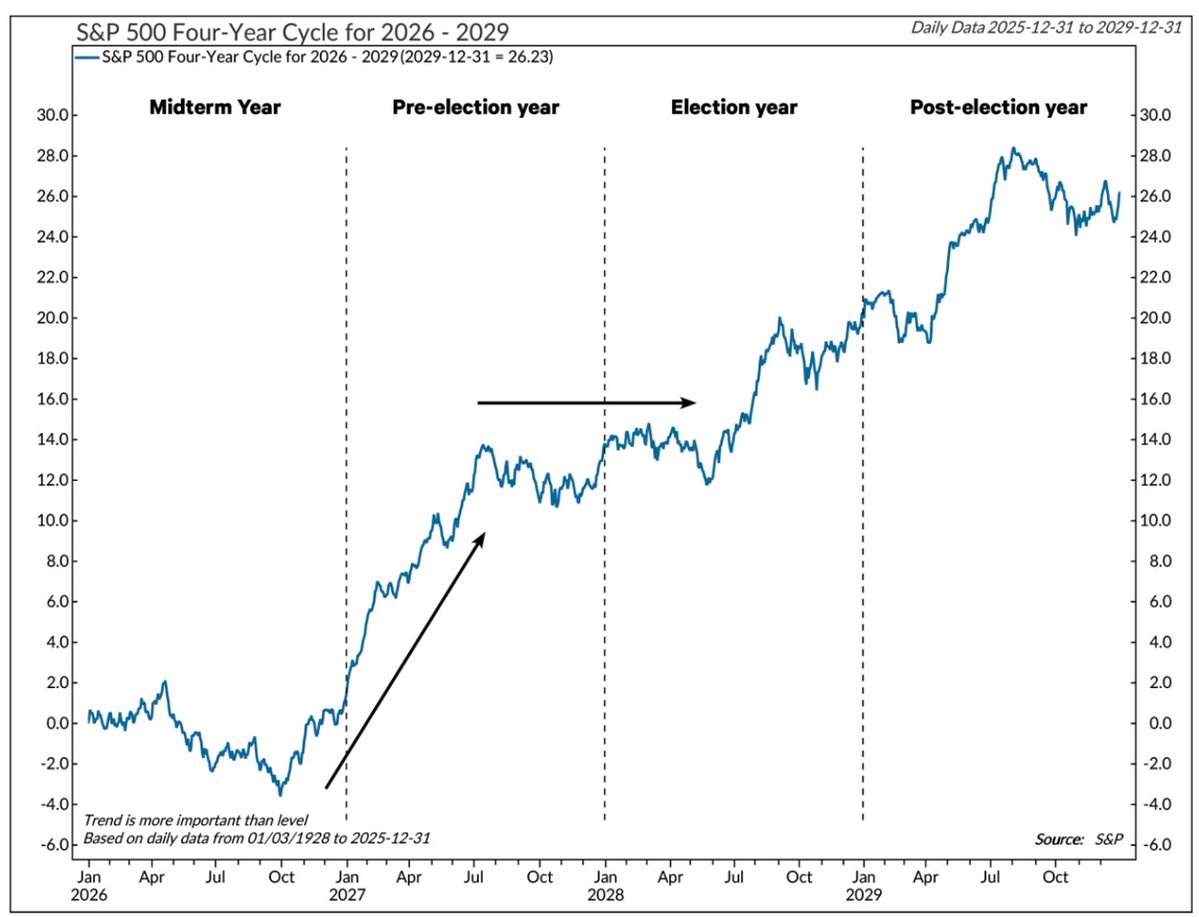
Based on history, the current bull market is long in the tooth; the fifth longest on record. However, since 1950 the S&P 500 has never declined in the year after mid-terms elections. The average S&P 500 gain in pre-election years is 17.2%. What is noteworthy is: most of the gains have come in the first half of pre-election years. The S&P 500 has been flat-to-down in the second half (see chart).
We are heading into a period with multiple bullish tendencies working in the market’s favor. Year-end seasonality is one. The historically strong first half of the Presidential cycle is another (see charts).
If we can get through this period without the Fed moving into a fast tightening cycle, those tailwinds should remain intact. Under that scenario, I would expect the current correction to be relatively short-lived and ultimately give way to a resumption of the broader uptrend.
Could we bottom soon?
There is an interesting historical precedent worth keeping in mind as we approach Thursday's scheduled meeting between the U.S., Russia and China. Going back to some of the most significant meetings between the world's major powers, the stock market was higher following nearly every one of them—sometimes substantially higher.
In 1945, Roosevelt, Churchill and Stalin met at Yalta. Stocks rallied immediately following the meeting and continued higher over the next several weeks.
In 1972, Nixon's historic meeting with Mao in China was also followed by a rising market and new highs in the weeks that followed.
The Reagan-Gorbachev summits show a similar pattern. Following Geneva in November 1985, stocks moved higher.
Reykjavik in October 1986 actually ended without an agreement, yet the market shrugged off the disappointment and gained roughly 5% over the next three weeks.
Following the Washington summit in December 1987, where Reagan and Gorbachev signed the INF Treaty, the market rallied sharply, gaining roughly 7% within a week and continuing higher.
After their Moscow summit in 1988, stocks again rallied strongly, gaining roughly 7% over the next couple of weeks and close to 10% within a month.
Obviously, this is a small sample and every period had a different economic and market backdrop. But the pattern is noteworthy: these major superpower meetings were generally followed by higher stock prices over the ensuing days and weeks.
That matters to us because we're currently short the S&P 500 and sitting on a profitable trade. If the market gives us additional downside going into Thursday, I will likely use that weakness to cover some or potentially all of our short exposure ahead of the meeting.
There's enough historical precedent for a positive reaction that I don't see a reason to overstay a profitable short going into the event.
I have not made the decision to cover my shorts just yet, but a decline from here could be just the opportunity to cover right into weakness at peak equity.
https://t.co/JXzFFTmMtn
According to Korean media, foreign investors made a HUGE split between Korea's two memory giants this week.
From November 9 to 13, foreigners bought a net 1.70 trillion won of Samsung Electronics, about $1.2 billion.
Over the same five days, they sold a net 1.14 trillion won of SK Hynix, about $840 million.
That is a 2.84 trillion won swing between two companies that are riding the exact same memory boom.
I think this is foreign money rotating into the name that has more catching up to do.
SK Hynix has been the HBM leader for two years, while Samsung is just now proving itself with HBM4 and is pouring tens of trillions of won into new HBM capacity.
I don't think this is a bearish call on SK Hynix but rather a bet that Samsung is the bigger upside story from here.
[ 네비우스(NBIS), 영업이익보다 이자비용이 2배 이상…2027년 450억 달러 투자에 외부 자금조달 의존 ]
AI 클라우드 기업 네비우스가 11월 12일 발표한 3분기 실적에서 급격한 매출 성장에도 불구하고 상당한 금융비용 부담을 드러냈다.
3분기 매출은 9억 8,080만 달러로 전년 동기 대비 571% 증가.
조정 EBITDA 역시 4억 6,580만 달러를 기록했다.
그러나 실제 영업이익은 5,040만 달러에 그쳤고.. 같은 기간 이자비용은 1억 1,250만 달러에 달했다.
영업활동에서 벌어���인 이익보다 부채에 따른 이자비용이 약 2.2배 많았다는 의미..
결국 3분기 순손실은 3,750만 달러를 기록했다.
현금흐름에서도 상당한 부담이 확인됐다.
3분기 영업활동 현금흐름은 2억 7,300만 달러의 순유출을 기록했으며.. 유형자산과 무형자산 취득에 사용한 현금은 73억 달러에 달했다.
이러한 상황에서 네비우스는 2027년 설비투자 규모를 400억~450억 달러로 제시..
2027년 예상 매출이 120억130억 달러라는 점을 고려하면.. 연간 매출의 약 34배에 해당하는 자금을 데이터센터와 AI 인프라에 투자하겠다는 계획이다.
특히 회사는 2027년 설비투자의 75~85%를 투자등급 신용도를 보유한 고객들의 선수금과 기존 고객 계약을 기반으로 한 금융조달로 충당하겠다고 밝혔다.
이는 약 300억~382억 5,000만 달러에 해당하는 규모..
다만 해당 금액 전체가 고객으로부터 직접 지급받는 선수금은 아니다.
고객 계약을 활용해 금융기관에서 빌리는 자금도 포함되어 있다.
회사는 충분한 현금과 전략적 지분투자 자산을 보유하고 있으며, 조달 비용이 유리하다면 추가 외부 자본도 확보하겠다고 설명했다.
한편 2026년 매출 전망도 기존 30억~34억 달러 범위의 하단인 약 30억 달러로 조정했다.
당초 12월에 달성할 것으로 예상했던 연환산 매출 목표 역시 내년 2월로 연기됐다.
일부 매출이 내년 초로 이연되는 영향..
회사는 2027년 말까지 세전 손익분기점에 도달하겠다는 목표를 제시했다.
Regarding $NBIS earnings results:
To show you how fast they're growing... from Q2 to Q3:
Revenue: $582.3M -> $980.8M (+68% QoQ)
Adjusted EBITDA: $236.2M -> $465.8M (+97% QoQ)
AI cloud adj. EBITDA margin: 49.7% -> 53.2%
Net Income: −$190.4M -> −$37.5M
ARR has reached $6.4B at the end of Sep. In terms of management commentary:
- Since start of Q3, Nebius signed $12B+ of new contracts
- Average GPU pricing rose 20%+ sequentially, payback shortened from 22M -> 19M
- On Q3 deals, prepayments covered 100% of associated capex, up from 50–60% in Q2 (insane for financing)
- Contract value per MW exceeded $25M+ from Q3 up from ~$20M Q2
- 5GW contracted power year end
With $10B of committed customer prepayments in 2026 and $17B-$20B in 2027. Now, prepayments and borrowing against existing contracts covers ~75-85% of 2027 capex.
On subsidiaries:
1. Avride - 250 autonomous vehicles fleet, over 100,000 passenger rides (with companies like $UBER). Fully driverless robotaxi targeted H1 2027.
2. Toloka - Revenue doubled sequentially
3. Enterprise cloud - Databricks and Datadog selected Neibus. Along with a new agreement with Snowflake.
4. Tavily - Over 3M developers now with $IBM post-training a core partner.
5. ClickHouse - Nothing about new secondary valuations, but we can see valuations growing
6. TokenFactory - Contract value grew 17x sequentially
The primary negative I saw was that 2026 guidance is now on the lower end (near ~$3B), due to $MSFT capacity deliveries slipping to Q2 2027.
Apparently there was an execution miss with a third party partner DataOne. Temporary generators were retired amid permitting issues before enough $BE fuel cell capacity came online.
Capex also increased in 2026 from $20B-$25B to $27B, while revising revenue expectations downward.
So near-term unfortunate headwinds kinda reminiscent of AOI earnings; however long term I think Nebius will take care of you.
For 2027 outlook:
- $12-13 billion revenue, capex of $40-45 billion, pre-tax breakeven by the end of 2027.
Very operationally bullish, as seen with prepayments covering capex, GPU premiums increasing. Main downside is near-term execution risk from third parties, causing near-term delays and revenue recognition.
Great quarter from Nebius overall.
LG AI연구원, 'K-엑사원 2.5' 무료 개방…프런티어 AI 개발 가속
] LG AI 연구원이 독자 인공지능(AI) 파운데이션 모델인 ‘K-엑사원’��� 누구나 무료로 활용할 수 있도록 개방한다. 글로벌 최상위권 AI 모델과 경쟁할 수 있는 기술력을 확보하는 동시에 실사용 검증을 위해서다.
LG AI연구원은 9일 서울 코엑스에서 열린 ‘엔비디아 AI 데이 서울 2026’에서 ‘K-엑사원 2.5’의 응용프로그램 인터페이스(API)를 자체 플랫폼을 통해 이날부터 전면 무료 개방한다고 밝혔다. 개발자와 스타트업, 기업, 연구기관 등 누구나 API 키를 발급받아 서비스 개발과 연구에 활용할 수 있다. 엔비디아와 기술 협력도 추진한다. LG AI연구원은 AI 모델의 추론 효율과 서비스 확장성을 높이기 위해 엔비디아의 ‘다이나모’ 기술 적용을 검토하고 있다.
BREAKING NEWS🚨: OpenAI just announced that it will deprecate GPT-5.6 Sol Ultra Fast. This is the same model that Cerebras publicly announced it ran at ultra-fast speeds for.
Cyberoffense/defense is probably going to eat up a TON of compute and end up a continuous compute-intensive arms race.
Even $AMZN CEO thinks cybersecurity would take up 20% of tokens consumed for the next year.
It's literally a problem of how much you throw at compute for vulnerability discovery + model capability, from of my chats w/ Horizon3.
And this is going to become a nation state issue, as seen with the implications already with PHP to vulnerabilities with banks/infrastructure from AI swarms.
But people see this and throw money at $CRWD, $NET, and others, which I was saying was a bubble.
If it's a compute issue, the economics go to the infra, from neoclouds to $NBIS to networking like $AAOI.
We'll likely see swarms go wild from aggressor nation states in the next few years.
And any country, whether that's Japan or EU that don't have their own capabilities might suffer severe damage.
US spent $11T+ cumulatively (inflation adjusted) on Nuclear weapons and we're like ~$1.8T into the the "cyber-nuclear weapon" equivalent of that
And this is not even including the endless other economic implications from AI in other fields from advancing cancer discovery to workforce automation with physical AI.
It's hard to measure AI sustainability if $50K in compute spend from a foreign actor can take down $10B of your own infrastructure.
AI has become a bipartisan national security issue, and even Democrats would not want China overtake the US in this field.
Last week, a short seller, @CulperResearch, published a report arguing that @cerebras wafers wear out after about two years, and based on that premise the report suggested that the economics of our business are fundamentally challenged.
That number is wrong, and given that the basis of the entire report is built upon that assumption, all of the assertions that follow are also wrong.
We do agree that the question of how long our systems last is a fair question, so we want to address the topic plainly.
If you have a few minutes, I would encourage you to click on the link below, which will provide you with a better understanding of the pioneering work done by our engineering team over the past decade to ensure that the operating lifetime of our solutions is many, many years.
Link Here: https://t.co/mGKI3dSHiw
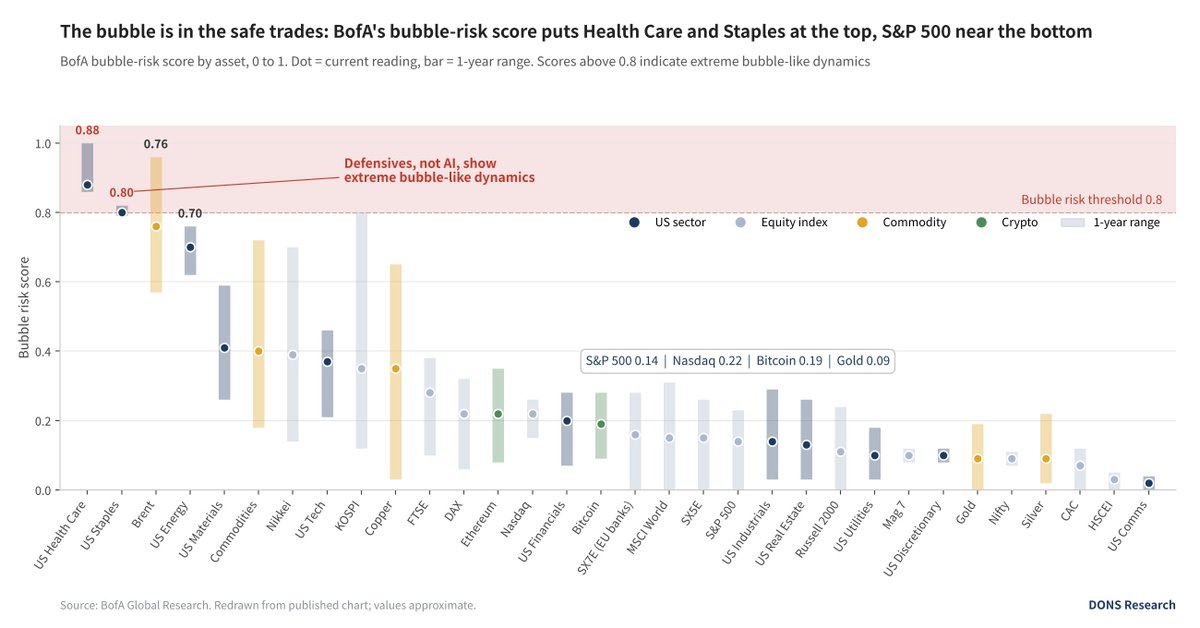
[ 버블은 AI가 아니라 다른 곳에 있다.. BofA 버블 점수 1위는 헬스케어 0.88 ]
BofA의 버블 위험 점수에서 0.8 이상 극단적 버블 구간에 들어간 자산은 하나뿐이다.
미국 헬스케어 섹터가 0.88로 가장 높고, 필수소비재가 0.80, 브렌트유가 0.76으로 뒤를 잇는다.
에너지도 0.70
반면 모두가 버블이라고 말하는 쪽은 낮다.
S&P 500은 0.14, 나스닥은 0.22, 매그니피센트 7은 0.10이다.
비트코인은 0.19, 금은 0.09
코스피는 0.35인데 1년 범위 상단이 0.80까지 갔다가 내려온 상태...
AI 거품 ���쟁이 두 달 내내 이어졌지만.. 점수로 보면 가장 과열된 곳은 사람들이 안전하다고 생각해 몰려간 방어주다.
헬스케어와 필수소비재는 AI 매도 국면에서 피난처 역할을 했는데.. 이 쏠림 자체가 다음 위험이 될 수 있다는 뜻이다.