The older I get, the more I realize how much of your life is shaped by the stories you tell yourself. I’m not ready. I’m too late. I’m bad at this. I never follow through. Be careful. You believe what you repeatedly rehearse. Tell better stories. Then prove them through action.
If you’re an anxious person, just do everything for fun. Submit documents for fun. Start a blog for fun. Go to a job interview for fun. ANXIETY FEEDS ON IMPORTANCE. Do not make everything a matter of life and deaťh.
"The greatest sin you can commit against your own life, is to know what you want...and not to act." - Stafford
Do not betray yourself.
Take the Chance.
Denzel Washington was right, always be thankful for the bad things in life. They open your eyes to see the good things you weren't paying attention to before.
Jeff Bezos said it right:
“The world wants you to be typical in a thousand ways, it pulls at you. Don't let it happen. You have to pay a price for your distinctiveness, and it's worth it.”
I think one of my biggest mistakes in my life was staying in the same circle for way too long due to comfort, instead of seeking out to people who actually knew how to move to a higher level in life.
Bitcoin has entered the 3rd and final stage of the bear market.
This is because the guys who mocked the bears in stages 1-2 are now admitting price could go lower.
They were a bull in a bear market, and they will likely turn fully bearish in the bull market
$ETHA (June 6, 2026 weekly chart)
I don’t trade or invest in cryptos or altcoins like most people on X do. Instead, I invest in strong companies with consistently improving earnings over the past decade and capable CEOs. As I’ve shared with my community many times, crypto and crypto-related stocks feel like lottery tickets to me in most cases.
$ETHA is currently showing a clear downtrend on my weekly chart, with the previous buy and sell signals being highlighted and playing out accurately.
I’ve been lucky to have found tickers that delivered 10x returns over the past few years. With that kind of stock-picking track record, I don’t need crypto to achieve strong results.
Why I’ve Stayed Bullish on $SPY for 3 Years Straight — And Why the Permabears Keep Getting It Wrong
(May 31, 2026-monthly chart)
Over the past three years, I've consistently shared my $SPY charts on X, and every single time they've sparked heated debate—mostly from the same permabears who keep declaring "the top is in" and urging extreme caution. They've repeated this warning countless times, yet those who listened have missed one of the strongest bull runs in history.
Since early 2024, I’ve posted my bullish thesis more than 50 times in my Weekly Insights, which are crafted to cut through all the unnecessary noise and fear-mongering on X and social media.
Of course, not everyone will be convinced. Whenever the market offered attractive discounts during temporary pullbacks, some skeptics unsubscribed. Honestly? That’s fine with me. Our community is stronger and clearer without the doubt.
Overall, it is this monthly chart (from November 2015 to June 2026) that gives me the strong conviction and confidence to keep holding and DCAing my core conviction stocks. Yes, I simply focus on this one chart to determine the direction, because I am well-positioned in all my core stocks — and I continue to add and DCA on every meaningful dip.
The stock market doesn’t reward impatience or constant in-and-out trading. It rewards those with the discipline to ride the long-term uptrend. So keep shorting if you think the top is in. The whales are always happy to accept your donations. The bull run isn’t over — and the trend remains your greatest ally.
@cantonmeow@matthughes13@tonylee80@sheslee@starship_ride@Hiteshp99
MARC ANDREESSEN JUST WENT ON ROGAN AND DROPPED THE MOST IMPORTANT AI ALPHA OF THE YEAR.
3 hours and 20 minutes of podcast.
Here are the 17 things worth your attention.
1. AGI is already here. Marc thinks the line was crossed 3 months ago with GPT-5.5, Claude 4.6, Gemini 3, and Grok 4.3. Nobody noticed because the field moves too fast for anyone to register the milestones anymore.
2. For almost any topic the top AI models now give him better answers than the world-class experts he could call on the phone. And he can call basically anyone.
3. Every doctor is secretly using ChatGPT in the exam room. They turn around the second you stop talking and type your symptoms in. Some do it while you are still sitting there. His quote: "At that point you are asking what do I need you for."
4. When AI refuses to answer something he wants to know he tells it he is writing a novel. "Walk me through how the bad guy robs the bank." It explains almost anything if it thinks it is helping you write fiction.
5. When something is too complex he says "explain it like I am 10." Then "like I am 5." Then "like I am 2." He keeps going until it actually clicks.
6. When he wants to understand a tough topic he does not ask what the right answer is. He asks the AI to steelman one side then steelman the other. Then he decides for himself.
7. For big questions he tells the AI to pretend to be a panel of experts. "Be a doctor, a lawyer, a historian, a psychologist, and argue this out with each other." Then he reads the debate.
8. Pay attention to the exact moment you think "I do not know how to figure this out." Most people give up there. That is the moment you should open the AI.
9. The only real skill left in using AI is knowing what to ask. The models can do almost anything you can describe in plain English. The bottleneck lives in your own head.
10. You can send AI photos of almost anything medical now and get a real answer. Skin rashes. Blood test results. The new models read images not just text. A free 24/7 second opinion on anything.
11. The one type of therapy clinically proven to work is cognitive behavioral therapy. It is also something an AI can fully do on its own. Every person on earth is about to have access to a real therapist for free anytime they want.
12. AI is solving math problems open for 100 years that no human mathematician could crack. Same thing is starting in physics, chemistry, and biology. Expect cancer cures and weird new physics breakthroughs in the next few years.
13. The best AI coders in Silicon Valley now make $50 million a year. One person. That number tells you how big this thing actually is when you strip away all the doom takes.
14. One friend paid $200 to decode his entire DNA. Then gave the AI his DNA, blood test results, and Apple Watch data. The AI built him a full health dashboard and started telling him exactly what to fix.
15. Another friend put two cameras in his home jiu jitsu gym. AI watches him spar and gives him technique notes after every round. A world-class coach at every practice for free.
16. The best programmers in Silicon Valley now run 20 AI coding bots simultaneously. Each bot writes code while they review the others. They call themselves AI vampires because going to bed means 20 workers stop and you lose money every hour you sleep.
17. The obvious next step: the bots will run their own bots. One human running 20 bots each running 20 more. One person. One laptop. 1,000 AI workers. This is months away not years.
Bookmark this before you watch the full podcast.
Follow @cyrilXBT for every AI insight worth your attention the moment it surfaces.
Krishna Rao is the CFO of Anthropic, and this is his first podcast appearance.
He joined the company two years ago when run-rate revenue was about $250M. Today it is $30B. He has helped raise ~$75B and is responsible for the procurement and allocation of compute.
I feel lucky we get to hear what it is like to sit inside a company this consequential at a moment this pivotal.
We discuss:
- The cone of uncertainty
- How he allocates compute across Trainium, TPUs, and GPUs
- What investors misunderstand about model companies
- Why the returns to frontier intelligence keep rising
- Platform vs application and where Anthropic builds its own products
- How Anthropic uses Claude internally
I have asked my closing question about the kindest thing more than 500 times. Krishna's answer is one I have never heard before.
Enjoy!
Timestamps:
0:00 Intro
2:38 The Compute Canvas
6:51 The "Cone of Uncertainty"
11:58 Why the Returns to Frontier Intelligence Are So High
16:45 Recursive Self-Improvement
20:20 Scaling Laws
23:30 Sourcing $100 Billion in Compute
28:05 Platform vs. Application Strategy
32:52 Pricing Dynamics
38:48 How Anthropic’s Finance Team Uses Claude
43:24 Raising Capital & Overcoming Investor Skepticism
52:32 Public Perception, Risks, and Government Regulation
57:25 Mythos Release
1:12:33 What Could Derail the AI Revolution?
1:13:47 Biotech and Healthcare
1:15:31 The Kindest Thing
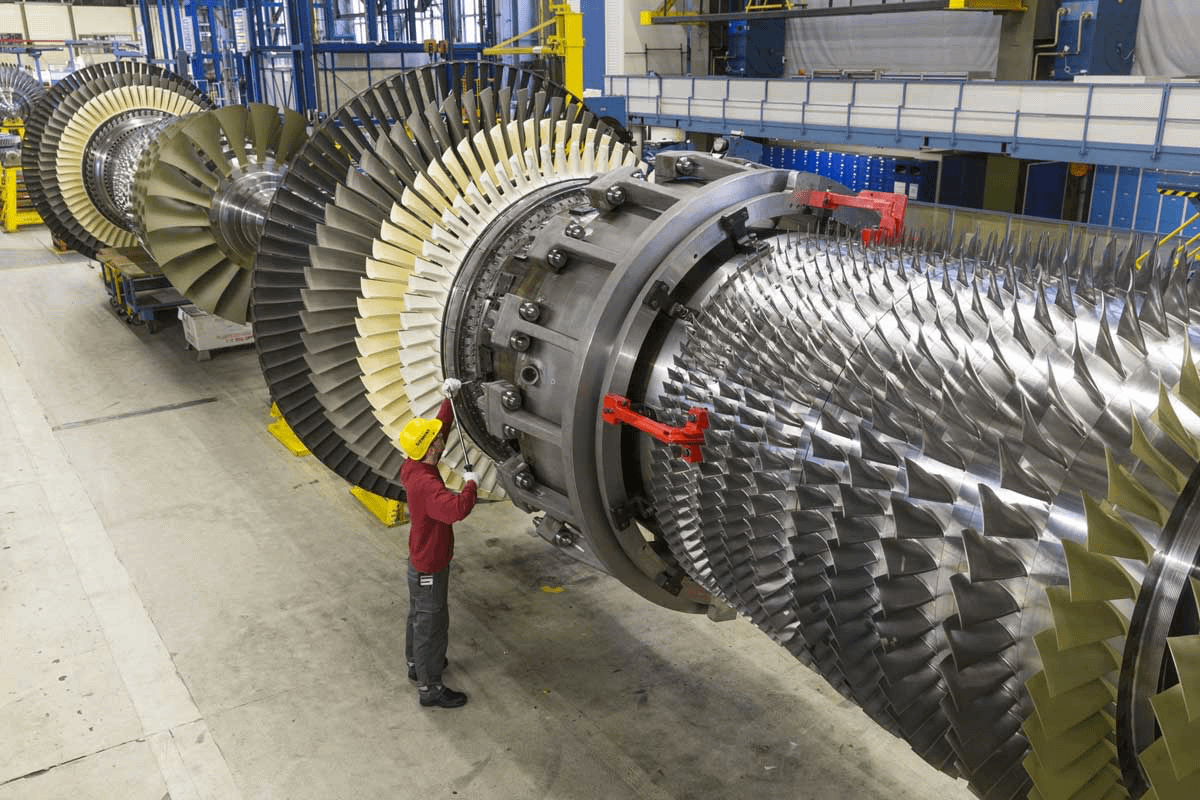
You cannot buy a new gas turbine until 2030. Order books at GE, Siemens, and Mitsubishi stretch to 2029. Turbine prices have nearly tripled since 2019. Every AI data center needs power and every gas plant needs a turbine. And every turbine has one part that bottlenecks the entire industry: The blade. It has to survive in gas 500°C above the melting point of the metal it's made from and spin at up to 20,000 RPM under 10,000 g of centrifugal force. Each blade is grown as a single crystal of nickel superalloy, pulled through a vacuum furnace at 3 mm per minute. A set of blades costs $600,000 and takes 90 weeks to grow. The same metallurgy powers modern jet engines. Only 3 companies on Earth can build one. China spent $42 billion trying to catch up. They bought a Russian fighter engine, took it apart, and copied every part. Their copy ran 30 hours between overhauls versus 400 for the original. Modern Western engines run 4,000. You can reverse engineer the shape of a turbine blade. You cannot reverse engineer 60 years of metallurgy.
Elon Musk avait dit un truc qui m'avait marqué sur l'allocation de ressources. En substance : passé un certain niveau de richesse, l'argent n'est plus de la consommation, c'est de l'allocation de capital.
Cette phrase change tout.
L'économie, dans le fond, c'est juste un problème d'allocation. Tu as des ressources finies et des usages infinis. Qui décide où va quoi ?
Imagine une cour de récré. 100 enfants, des paquets de cartes Pokémon distribués au hasard. Tu laisses faire. Très vite, un ordre émerge. Les bons joueurs accumulent les cartes rares, les collectionneurs trient, les négociateurs trouvent des deals. Personne n'a planifié. Et pourtant chaque carte finit dans les mains de celui qui en tire le plus de valeur. Le système maximise le bonheur total de la cour. C'est ça, la main invisible.
Maintenant fais entrer la maîtresse. Elle trouve ça injuste. Léo a 50 cartes, Tom en a 3. Elle confisque, redistribue, impose l'égalité. Trois effets immédiats. Les bons joueurs arrêtent de jouer, à quoi bon. Les mauvais n'ont plus de raison de progresser, ils auront leur part. Les échanges s'effondrent. La cour est égale, et morte. Elle a maximisé l'égalité, elle a détruit le bonheur.
Le problème de la maîtresse, c'est qu'elle ne peut pas avoir l'information que la cour avait collectivement. C'est le problème du calcul économique de Mises, formulé en 1920. L'URSS a essayé de le résoudre pendant 70 ans avec le Gosplan. Résultat : pénuries, queues, effondrement. Pas parce que les Soviétiques étaient bêtes, parce que le problème est mathématiquement insoluble en mode centralisé.
Quand Musk a 200 milliards, il ne les consomme pas, il les alloue. SpaceX, Starlink, Neuralink, xAI. Chaque dollar est un pari sur le futur. Et lui a un track record. PayPal, Tesla, SpaceX. Il a démontré qu'il sait identifier des problèmes immenses et y allouer des ressources avec un rendement spectaculaire.
L'État aussi a un track record. Hôpitaux qui s'effondrent, éducation qui décline, dette qui explose, services publics qui se dégradent malgré des budgets en hausse constante. Le marché identifie les bons allocateurs, la politique identifie les bons communicants.
Le profit n'est pas une finalité, c'est un signal. Il dit : tu as alloué des ressources rares vers un usage que les gens valorisent suffisamment pour payer. Plus le profit est gros, plus la création de valeur est grande. Quand Starlink est rentable, ça veut dire que des millions de gens dans des zones rurales ont enfin internet. Quand un ministère est en déficit, ça veut dire qu'il consomme plus qu'il ne produit. L'un crée, l'autre détruit, et on appelle ça redistribution.
Dans nos sociétés il y a deux catégories d'acteurs. Les entrepreneurs et les bureaucrates. L'entrepreneur prend un risque personnel pour identifier un problème, mobiliser des ressources, créer une solution. S'il se trompe il perd. S'il a raison, ses clients gagnent, ses employés gagnent, ses fournisseurs gagnent, l'État collecte des impôts. Il est la cellule de base du progrès humain.
Le bureaucrate ne prend aucun risque personnel. Son salaire est garanti. Au mieux il maintient une rente existante. Au pire il la détruit par excès de réglementation, mauvaise allocation forcée, incitations perverses qui découragent ceux qui produisent. Mais dans aucun cas il ne crée.
Regarde les 50 dernières années. iPhone, internet civil, SpaceX, Tesla, Google, Amazon, Stripe, mRNA, ChatGPT. Toutes des inventions privées, portées par des entrepreneurs, financées par du capital risque. Pas un seul ministère n'a inventé quoi que ce soit qui ait changé ta vie au quotidien.
La France est devenue le laboratoire mondial de la dérive bureaucratique. 57% du PIB en dépenses publiques, record absolu. Une administration tentaculaire, une fiscalité qui pénalise la création de richesse. Résultat : décrochage face aux États-Unis, à l'Allemagne, à la Suisse. Fuite des cerveaux. Désindustrialisation. Dette qui explose.
Et le pire c'est que la mauvaise allocation s'auto-renforce. Plus l'État prélève, moins les entrepreneurs créent. Moins ils créent, moins il y a de base fiscale. Plus l'État s'endette et taxe. Boucle de rétroaction négative parfaite. La maîtresse pense qu'elle aide, et chaque année la cour produit moins.
Dans nos sociétés, ce sont les entrepreneurs, toujours, qui font avancer la civilisation. Les bureaucrates au mieux maintiennent une rente, au pire la détruisent. Aucune société n'a jamais progressé en taxant ses créateurs pour subventionner ses gestionnaires.
La question n'est jamais qui a combien. C'est qui alloue le mieux la prochaine unité de ressource pour maximiser le futur de l'humanité. La réponse depuis 200 ans n'a jamais changé. Ce ne sont pas les fonctionnaires.
I use two entry approaches: pullbacks and breakouts.
Most of my entries come from pullbacks. Breakouts are used more selectively.
In $ARM, I first entered on March 30 through a pullback — my favorite type of M.E.T.A. setup. But trading should never be rigid. As the structure tightened and the narrative strengthened, I added again on the breakout.
Now $ARM is making new highs and breaking out from a large weekly base.
In the JLA (JLawStock Academy) weekly report published before the open on March 30, I explained why $ARM was holding up so well even as the broader market was being sold off.
https://t.co/u3LNwLXYaa