Emergency Medicine / Pre Hospital Care / Vascular Surgery / Vascular US / Fire & HEMS Military Doctor / Flight Doc / Human Factor / Aviation Safety / EMS
VENTO FORTE 🌬️|
Na última hora (05h-06h), houve registro de rajada de vento forte na estações Forte de Copacabana (72,4 km/h) e Vila Militar (59,4 km/h). Fonte: INMET.
Over the last 40 years, Most prehospital airway failures/disasters I have witnessed were sins of commission, not sins of omission.
The absolute most valuable airway skill is knowing when not, and how not to perform advanced airway procedures. It is difficult to teach. This comes almost exclusively with experience
https://t.co/dIBr4Yv2BZ
ECPR for refractory OHCA reaches >35% survival in well-organized systems — and far lower elsewhere.
That gap is largely system design.
Which means it's something we can fix.
New contemporary review in @JAHA_AHA on how to build one. 🧵
In 2000, there were 377 medical helicopters in the US transporting 197,000 patients.
That is an average of 522 patients per helicopter per year.
in 2025, according to FAA data, there were 1351 helicopters transporting 385,000 patients.
That is 285 patients per helicopter per year - that is well under one transport a day
So.. we have 360% more helicopters over the last 25 years transporting 45% less patients per ship per year
A 20-30% decrease in the number of medical helicopters would only improve cost, efficiency and overall medical/aviation quality with no effect on availability for our patients
#CullTheHerd @AMPAdocs@AAMS
🫀Is your septic shock truly refractory... or have you missed a reversible cause?
One of the greatest challenges in critical care is recognizing when septic shock is genuinely refractory versus when persistent hypotension simply reflects an unresolved physiological problem.
A new Critical Care Perspective proposes a practical bedside framework that changes the question from "How much norepinephrine is the patient receiving?" to "Why does this patient still require increasing norepinephrine?"
The authors argue that apparent refractory septic shock should trigger a structured reassessment rather than immediate acceptance that the patient has entered irreversible vasoplegia. Refractoriness is not defined solely by vasopressor dose. Instead, it results from the interaction between time in shock, severity of circulatory failure, and whether reversible contributors have already been identified and optimized.
Their framework highlights the "usual suspects" that should be evaluated simultaneously.
First, confirm that the infection is truly under control. Appropriate antimicrobial therapy and effective source control remain the foundation of successful resuscitation.
Next, reconsider fluids, not simply asking whether the patient is fluid responsive, but whether additional fluids are tolerated and whether they will produce a meaningful improvement in tissue perfusion. Fluid responsiveness alone is no longer enough.
Then evaluate endocrine, metabolic, and iatrogenic contributors. Relative corticosteroid insufficiency, delayed vasopressin initiation, severe metabolic acidosis, and excessive sedation can all increase vasopressor requirements without representing irreversible shock.
Finally, never forget the heart. Septic cardiomyopathy, right ventricular dysfunction, ventriculo arterial uncoupling, and dynamic left ventricular outflow tract obstruction may all present as "vasopressor resistant" shock but require completely different treatments. Point-of-care echocardiography becomes essential in this phase.
Perhaps the most important message is that refractory septic shock is a diagnosis reached only after a systematic search for reversible physiology, not simply after reaching a high norepinephrine dose.
This article reinforces an important principle in modern critical care: physiology should guide escalation, not vasopressor dose alone.
Reference 📚
Melo, P., Wendel-Garcia, P. D., Leone, M., Khanna, A. K., Morales, S., Ospina-Tascón, G. A., Castro, R., Hernández, G., & Kattan, E. (2026). The usual suspects: A pragmatic framework to identify and address reversible contributors in apparent refractory septic shock. Critical Care, 30, 378. https://t.co/ZOAKw5hgoU
This retweet is an endorsement 😁
Lentz equation:
✨ PEEP = BMI / 3 ✨
Stop underpeeping high-BMI patients and then expecting them to be easily extubated.
When scientists put slime mold over a map of Tokyo, they used food to represent urban areas.
After a day the mold created a network nearly identical to Tokyo's rail network: all this without any brain.
Fabrication remains a major weakness of EBM.
I think this may be what happened with Marik's initial paper about vitamin C for septic shock in CHEST.
Fabrication is extremely hard to detect and we rarely consider this when analyzing studies.
https://t.co/09c8bF5kZ6
Pulmonology deep dive- 🫁 2️⃣
🚨 32-year-old. Viral fever last week.
Now persistent cough + streaks of blood in sputum what is this?
Vitals stable. SpO₂ 98%
Diagnosis?
1️⃣ 🟢 Acute viral bronchitis with trivial hemoptysis.
Mechanism?
🔸 Inflamed bronchial mucosa
🔸 Capillary fragility
🔸 Forceful cough → Small superficial bleed.
Not every blood streak = bacteria.
Acute bronchitis is viral in >90% cases.
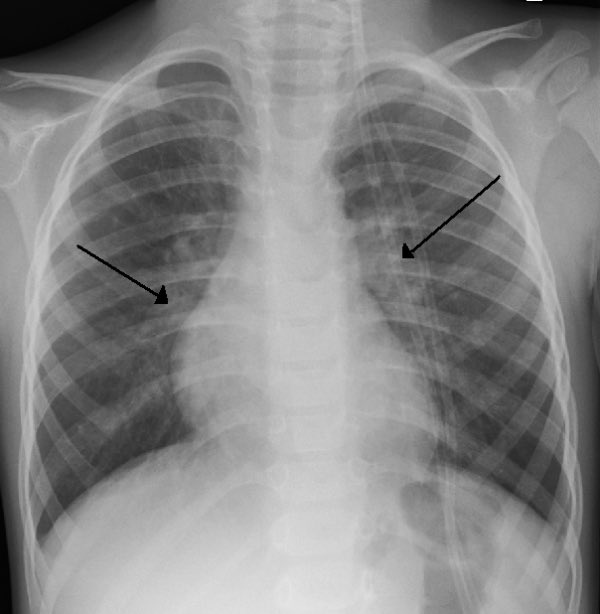
CXR- X ray will show no evidence of lung infiltrates or consolidation. Occasionally, chest x-ray shows increased interstitial markings consistent with thickening of bronchial walls.
2️⃣ Cough lasts 2–4 weeks.
That is NORMAL.
Guidelines (NICE/CDC):
❌ No routine antibiotics
❌ Sputum color ≠ infection severity
❌ Trivial hemoptysis alone ≠ pneumonia
Inflammation ≠ indication for antibiotics.
3️⃣Management:
🟢 Reassurance
🟢 Hydration
🟢 NSAIDs
🟢 Antitussive if needed
🟢 Bronchodilators
Repeated unnecessary antibiotics →
🔴 Antimicrobial resistance
🔴 Adverse effects
🔴 Microbiome damage
Treat the patient.
Not the anxiety.
#MedTwitter #MedX #Pulmonology
If publications / grants are the metric for promotion, people will game the system.
We need to rewire the system on impact. I am a strong believer that Internet Book of Critical Care has been the single most impactful initiative in critical care in the past 2 decades.
The problem, impact takes many forms. "You know it when you see it". How do you compare impact from a publication vs. KM platform like IBCC.
Publications/grants are important because they facilitate science and knowledge sharing, but they have become the outcome that researchers strive towards.
O que conhecemos de ECG sobre infarto é, hoje, muito diferente do que conhecíamos cinco anos atrás.
Neste estudo, definimos um sinal de infarto do miocárdio por oclusão coronária aguda (OCA) tão bom quanto o supra de ST: a onda T hiperaguda. Segue o fio.
https://t.co/CWPxHpadf6
ECPR improves outcomes in refractory OHCA, but most patients never reach an ECMO center in time.
📍New systems are expanding access by initiating ECPR in the prehospital 🚑🚁 or non-ECMO center setting.
But what happens after cannulation?
🧵👇 (1/5)