GM X!
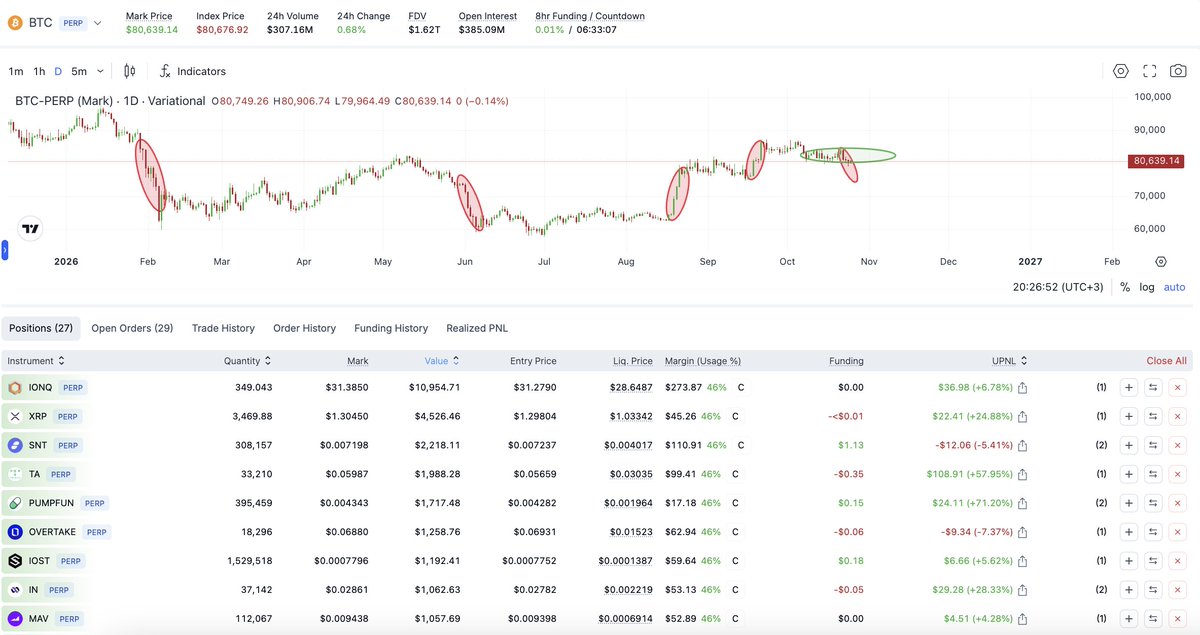
We can stay within a range, both bulls and bears are weak, while the kangaroo is stronger than ever!
Did you know that a kangaroo symbolizes a sideways market?
✅ Brazil voted on Sunday.
- Polymarket had Flávio at 78% with $189m traded while the poll average was 51.2 to 48.8.
- Lula won.
- The market didn't read the polls better, it read its own crowd.
✅ That is the interesting weekend gap.
- Robinhood Chain says almost 60% of stock token trading happens outside Wall Street hours, $532m on weekends in one month.
- Variational swaps still close on Friday. Why and when?
✅ Extended prints first this autumn
- 30% to points, tokenomics Oct 31, token in Nov.
- its $ per point becomes the benchmark for Variational OTC
GM X!
The First Frost 🥶
- Is this the end for crypto, now that even a16z is trimming its portfolio and looking away from the sector?
- Everyone is waiting for the cycles to return, but what’s actually happening?
- Almost nothing, just local events, a few ups and downs and mostly sideways movement.
- Are you still expecting any life-changing involvements from crypto, dex perps, from meme or NFTs?
- Personally my main focus is only Variational and the periodically trading of memecoins play that manages to take off.
@kriptoshum Oh no... never love bitcoin or ethereum spot...
If I had a million dollars, I’d most likely get into Bitcoin or Ethereum, but I don’t have a million dollars.
Hayes is wrong!
Everyone is expecting $BTC dump below 80k, but the strength of the sideways movement and the passive inertia of market are very powerful.
I still hold out hope that even if a war with Iran breaks out, we along with the altcoins will manage to hold the 80k level.
As for me, I’m loading up on more at this moment.
Plural partnerships, yes.
- On Variational Omni you never trade against a dealer
OLP is the sole counterparty and hedges outside.
-On Pro there is no OLP at all
a fund posts an RFQ, several dealers quote, both sides lock $USDC in a settlement pool, risk stays bilateral. Pro cannot launch with one partner.
It needs a quoting consortium, anchor takers and someone to clear and finance OLP's hedges.
- The same settlement pools serve both products: Omni, Pro and TradFi in one breath.
My suggestions
✅ A dealer consortium that quotes Pro and feeds Omni's swaps
DRW/Cumberland
IMC
Flow Traders
Optiver
Chicago and Amsterdam, the cities Lucas named
✅ Anchor takers where the pain is Asia, where OTC still trades by phone.
The 2025 strategic round (Mirana, Caladan, Zoku) was already described as Pro design partners.
✅ One clearing and financing counterparty behind OLP Marex
StoneX
or a bank swap desk.
✅ A bank, if any, as a closed pilot
Citi for on-chain FX, Goldman for OTC options.
✅ 100% of treasury revenue to buybacks,
Pro is the revenue and a dealer seat priced in $VAR explains why the 50% team and investor split is still unpublished.
The dealer and the investor are the same name
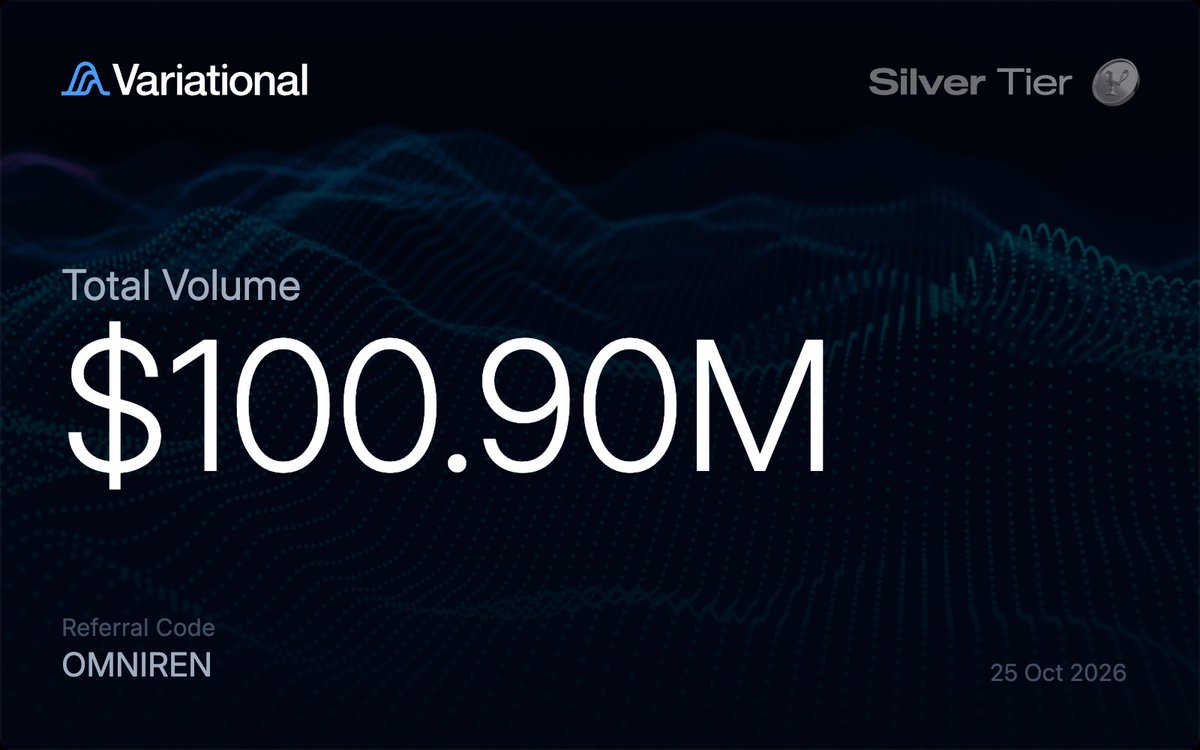
Reached $100m.
On one hand, you look forward to the big Variational TGE event.
But on the other, there’s a gut feeling that Variational is the last solid, substantial crypto airdrop for cryptans, but after that - nothing.
Plural partnerships, yes.
- On Variational Omni you never trade against a dealer
OLP is the sole counterparty and hedges outside.
-On Pro there is no OLP at all
a fund posts an RFQ, several dealers quote, both sides lock $USDC in a settlement pool, risk stays bilateral. Pro cannot launch with one partner.
It needs a quoting consortium, anchor takers and someone to clear and finance OLP's hedges.
- The same settlement pools serve both products: Omni, Pro and TradFi in one breath.
My suggestions
✅ A dealer consortium that quotes Pro and feeds Omni's swaps
DRW/Cumberland
IMC
Flow Traders
Optiver
Chicago and Amsterdam, the cities Lucas named
✅ Anchor takers where the pain is Asia, where OTC still trades by phone.
The 2025 strategic round (Mirana, Caladan, Zoku) was already described as Pro design partners.
✅ One clearing and financing counterparty behind OLP Marex
StoneX
or a bank swap desk.
✅ A bank, if any, as a closed pilot
Citi for on-chain FX, Goldman for OTC options.
✅ 100% of treasury revenue to buybacks,
Pro is the revenue and a dealer seat priced in $VAR explains why the 50% team and investor split is still unpublished.
The dealer and the investor are the same name
@GOJO_CHAIN@variational_io Every year since 2021, we’ve said,
Well, that’s it, nothing interesting left, the era of airdrops is over,but then something new would always pop up.
This time, however, it really does feel like the end of the airdrop narrative.
Who pays when the agent buys the wrong thing in Web4?
41 cents.
Average agent payment on x402 over twelve months: $73m across 176m transactions,
98.6% in $USDC
87% < $0.1
Instinct, the largest consumer agent, is nearing $1b a year of purchases on the user's own card, founder-reported.
Two economies of Web4
✅ Cents go in stablecoins.
A card cannot charge two cents per model call, so x402 today is mostly a meter for API, data and compute
✅ Dollars go on cards
- saved credential
-credit line
- fraud controls
-refunds
- millions of merchants.
Instinct's terms say it is not a party to the purchase. OpenAI pulled its first checkout after six months, 30 live merchants against a million promised
✅ The rails converge.
Mastercard already signs a voucher inside a mandate and settles in $USDC.
The card keeps the trust layer, the chain gets the cheap settlement
✅ The primitive is a budget, not a wallet:
amount,
period,
scope,
price cap,
refund rule,
revocation,
loss bearer.
MetaMask, Coinbase and the card mandates are building the same object.
The bottleneck is no longer intelligence, it is permission
✅ Agent tokens sit outside both rails.
Virtuals
$479m of agent GDP, $1.16m of agent revenue, jobs settle in USDC.
Volume is not income
The unsolved market is liability.
who pays when the agent buys the wrong thing.
I think the first Web4 scandal will not be a hack.
It will be a personal agent paid up to 30% by the hotel it recommended.
Whose agent is it then?
Thoughs on Web4
$2.2b - 100% crypto on May 5.
The same $2.2b - A16z frontier on Oct 22.
The money did not move.
Read Dixon's letter for what stayed
- stablecoins
- programmable rails
- machine to machine transactions
- networks built for machines.
Everything that stayed is money.
- Web3 was own.
- Web4 is act, the actor is not you.
- Web4 is the internet where the counterparty is a machine with a budget.
What money looks like when the user is a AI agent
✅ The primitive is a budget, not a wallet.
An agent needs a unit that does not move while the task runs and a rule that reserves the cost before the call. Stablecoins win by default.
A volatile token cannot be a budget
✅ Markets go RFQ first.
An agent asks for a firm price for a size, it does not sit in a book.
Order books become the human legacy UI.
✅ The log becomes collateral.
Agents will need credit, credit needs history, an agent's history is its receipts.
Know your agent replaces know your customer
✅ Airdrop points die.
An airdrop assumes a human on the other side.
With agents as users Sybil is free and infinite, so incentives move to rebates on fees actually paid.
This cycle is the last one designed for people (Variational is last)
✅ A token per agent is payroll and payroll gets sold. Agent tokens will graduate at pump rates, 1 in 58
The money does not go to Web4 tokens.
It goes to whoever holds the agent's budget:
- the rails
- the permission layer
- the venue that quotes,
- the card in the agent's pocket.
Whoever manages your agent’s budget effectively is the clear winner of this new era.