I would argue an applicant with a GENIUS Act business plan built on a solid fiduciary services foundation, a demonstrable culture of compliance, strong governance framework and capital, and highly qualified board and management has four to five months to file and still have a realistic prospect of conditional approval by late Q4 2027 and final preliminary approval to charter by late Q4 2028. It’s certainly not out of the question.
@nicolas_a4@rrhoover@Wise Faster, easier and less expensive. It is a classic flywheel enterprise. Its business model relies on a self-reinforcing feedback loop: scale lowers unit costs, which allows lower prices, which attracts more volume, driving further scale. Onwards.
The Millionaire Next Door: The Surprising Secrets of America's Wealthy, written by Thomas J. Stanley and William D. Danko, was first published in October 1996 by Longstreet Press.
Plus ça change, plus c'est la même chose.
Underrated life advice: Keep your personal burn rate low. Cheaper car. Smaller house than the bank says you can afford. No payment you'd panic about if work got weird. Low expenses aren't about being cheap. Low expenses give you options. And options = freedom.
ADP and the folks who guided ADP to their charter (and the Federal Reserve Master Account that followed) deserve a world of credit for the structure they created. The fed master account is “unobtanium” these days. But the bankruptcy remote Delaware Trust to hold customer funds that ADP pioneered in the trust bank context has great utility. And I continue to think ADP, followed by the other payroll companies in their wake, has established a precedent payments company will exploit eventually. Or so I hope.
On October 6, 1979, Federal Reserve Chairman Paul Volcker orchestrated a shocking and historic change in monetary policy. Volcker called an unscheduled weekend meeting of the Federal Open Market Committee (FOMC) to launch a radical offensive against runaway stagflation raising the discount rate to 12%, and abandoning interest rate targeting.
By prioritizing how much money was circulating in the system over the actual cost of borrowing, Volcker essentially allowed interest rates to float to whatever sky-high levels the market demanded to clear out inflation.
Despite severe political blowback and public protests, Volcker held the line. By 1983, the back of inflation was definitively broken. His October 6 decision restored the institutional credibility of the Federal Reserve and laid the macroeconomic runway for the prolonged economic expansion of the late 1980s and 1990s.
Volcker was a great American.
@mikulaja When do blockchain-centric companies come to the realization the reputational risk of transacting with Tether is simply too high? Especially the digital asset firms entering the governmental perimeter with de novo bank charters and as regulated exchange operators.
Wise uses the mid-market rate 24/7 and charges a separate, visible fee (often ~0.4–0.6% on major pairs). You can check the rate against Google before you send. In Wise, I trust.
Yesterday I learned that 0% fx fee could mean no additional fx fee on top of the fx fee that you have to pay to do fx, and that fx fee is higher than traditional fx
Fun
Take the Leap, @Anthropic
There's been a lot of debate about whether now is the right moment for Anthropic to complete its IPO. Markets are jittery, the calendar is crowded, the valuation conversation is loud. And most importantly, there are valid, serious concerns about the safety of these technologies. But I want to make the case for why going public will be a net good for society. Not as a bystander, but as someone who took a company through this exact door fifteen months ago, in a sector that was contested.
When Circle listed on the NYSE, we were operating critical financial infrastructure in a space defined by technical complexity, fast-moving regulation, and deep public skepticism. A lot of people thought the smart move was to stay private, keep our heads down, and let the noise settle.
What we found was the reverse. Going public didn't expose us to scrutiny we couldn't handle. It gave us the highest-standard framework in the world for demonstrating that we deserved trust. Audited financials. Quarterly disclosure. Independent board governance. Sarbanes-Oxley controls. Real-time accountability to millions of shareholders and to regulators in every market we serve.
The result wasn't fragility. It was confidence. Banks, governments, and enterprise partners who had been cautious about stablecoins could finally look at us through a lens they already understood.
Going public wasn't just good for us and our shareholders.
Public-market discipline turned a novel technology into legible infrastructure. But public-market discipline is only half of that equation. The other half is clear rules of the road. Innovation at infrastructure scale needs both: companies willing to subject themselves to transparency and accountability, and policymakers willing to define durable standards for how that technology can operate. For stablecoins, the GENIUS Act helped provide that regulatory architecture - moving the conversation from whether the technology belonged inside the regulated financial system to the standards under which it could operate there.
That distinction matters for AI. An IPO cannot substitute for fit-for-purpose public policy, and regulation cannot substitute for the discipline of public markets. They are complements. One makes companies legible to investors and the public; the other establishes the obligations, protections, and boundaries that allow an emerging technology to earn durable institutional trust.
AI is at precisely that moment now, and the stakes are higher.
Frontier AI companies are becoming core infrastructure for the global economy. Their model capabilities, safety practices, compute commitments, revenue concentration, and governance structures are matters of genuine public interest. Right now, most of that lives inside private companies, visible to a handful of investors and whoever reads the leaks.
An IPO changes that. It brings a frontier lab into the most rigorous disclosure and governance regime humanity has built. It forces clarity about risks, dependencies, and how decisions get made. It gives the public, policymakers, and the market a durable way to hold the company accountable, not through episodic drama, but through the boring, relentless cadence of public reporting.
Anthropic has built its identity around safety and transparency. The public markets are the institutional embodiment of those values. Yes, the timing is never perfect. It wasn't for us either. But there's a window right now where the world is asking hard questions about who controls the most powerful technology of our era and how. The best answer isn't a press release. It's an S-1, a listed ticker, and the accountability that comes with them.
We should be encouraging these great companies to take the leap to public markets, to subject themselves to public scrutiny and accountability, and we as a society need to do our part to hold them to the highest standards.
“(Fed) Staff believed it was personally safer to take no action unless they were certain the action was exactly right,” Vice Chair for Supervision Michelle W. Bowman stated when discussing regulatory failings leading up to Silicon Valley Bank’s collapse.
Institutional dysfunction at its peak in my view. And yet so-called Tier Three institutions are effectively barred from direct access to the Fed and a Federal Reserve master account.
Great essay from @clarabcollier: https://t.co/H1LpUNid9O.
(You should subscribe to @asteriskmgzn, in addition to @WorksInProgMag of course. They have a very good print edition.)
Previously, there were three different layers of "fraud" (and its corollary, validation) on the Internet. These are important in case a transaction is litigated:
1. Is this a real identity/user
Think: this is a valid government document, the profile is real and maps to a government database, etc.
2. Is the "person" I am interacting with the valid owner of this identity/user/credential
Think: identity not stolen, so the credential user maps to the credential identity.
3. Is the person of sound mind to make this decision?
Think: casino not letting you gamble while clearly intoxicated.
1 and 2 are the most common, but for particularly large "card not present" transactions where issues of friendly fraud arise ("Oh, I never made that OnlyFans or Zynga Poker $10,000 purchase!") there's some validation of 3.
Agents complicate all of this. An agent can have delegated authority, but how? How is the whole validation chain preserved for the ultimate transaction? Who bears the risk?
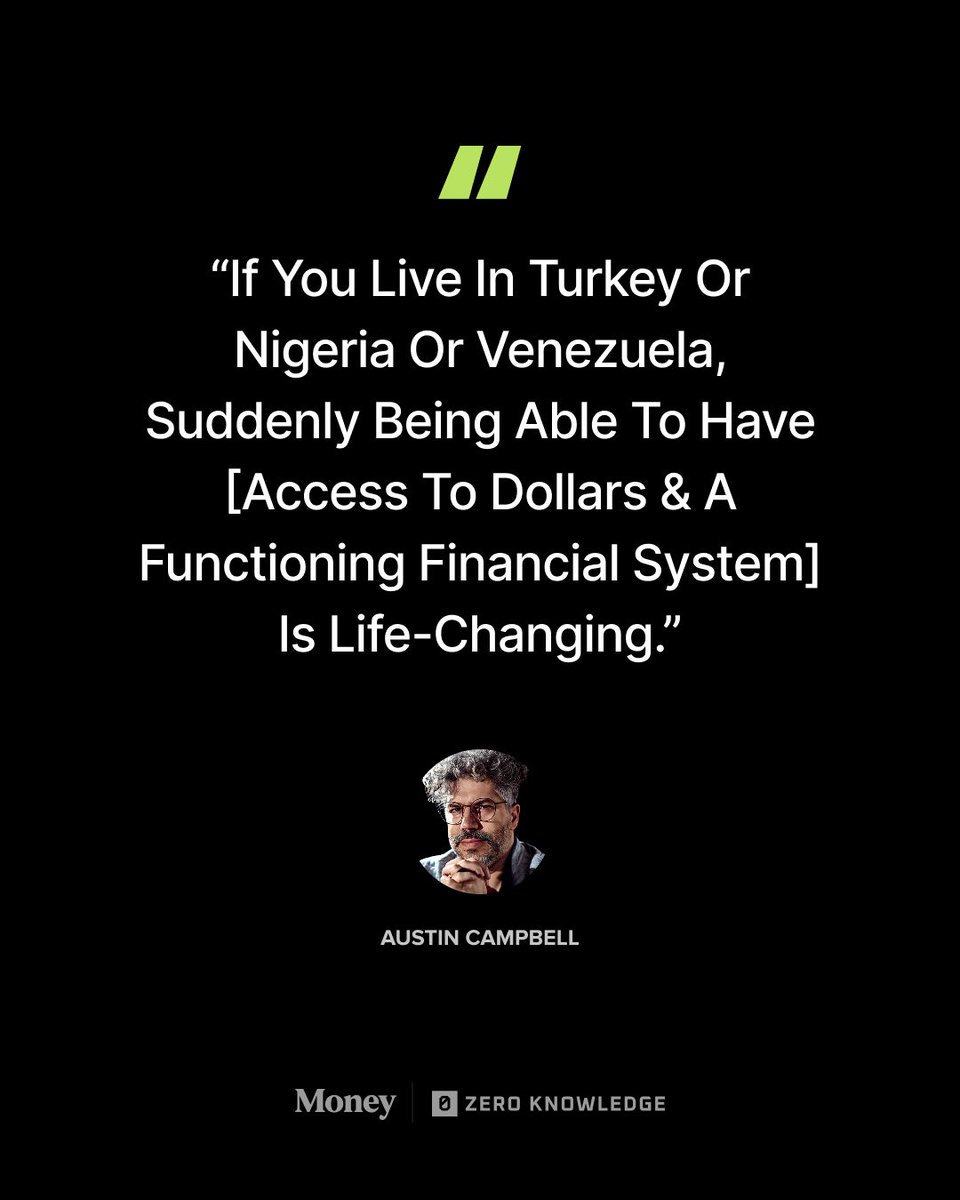
Besides you and me, billions of people call "crypto" a escape hatch for broken currencies.
📣 @austincampbell to @money :
"if you’re in Turkey, Nigeria, or Venezuela, that's life-changing"
https://t.co/mgkg3SXcbO
But I suggest the more interesting applicant to receive preliminary conditional approval from the OCC to charter a full service insured national bank this week will turn out to be @OpenReserveBank. It’s worth a look.
Simon is right. @Revolut is a beast.
But more importantly: the long-term winner here is US consumers. Just as I support stablecoins as a form of competition, I also support this.
Nobody has a divine right to a business model. Let them compete!