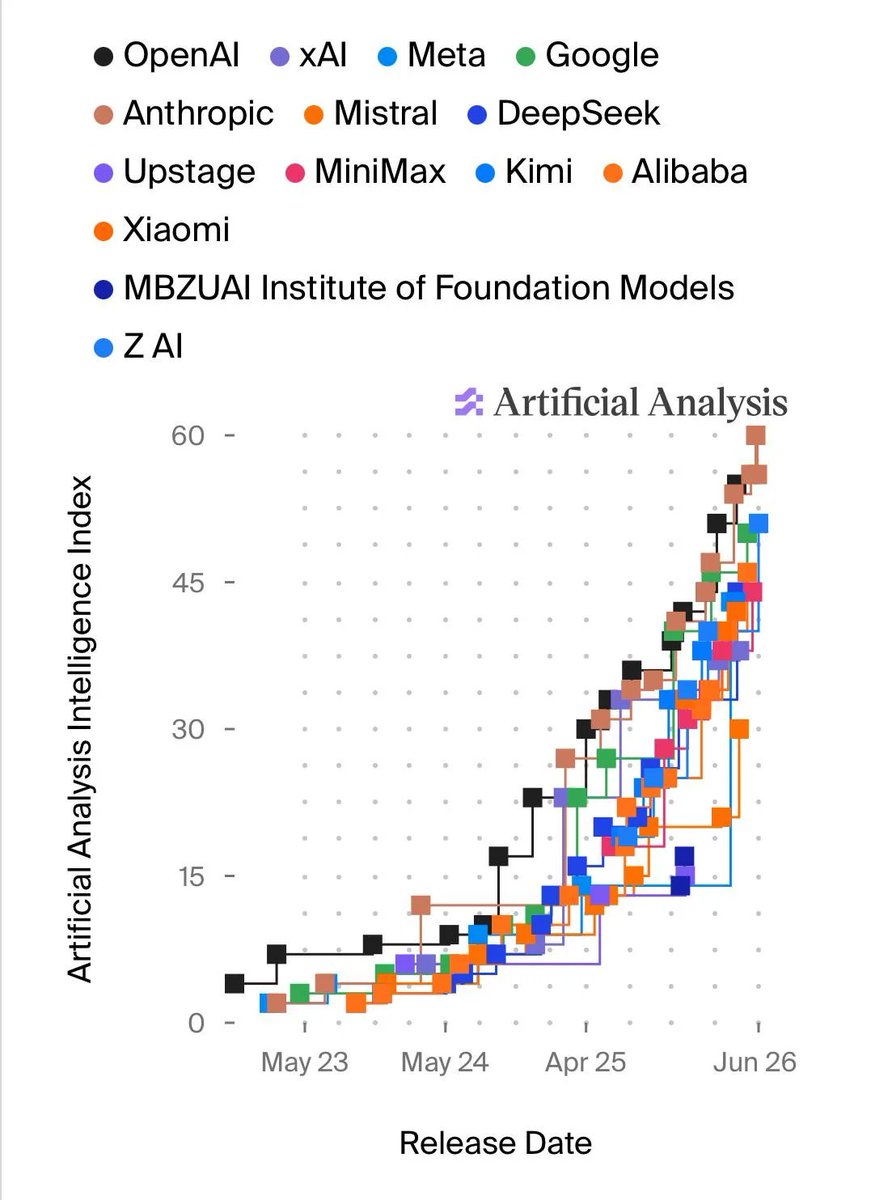
Another exponential, the Artificial Analysis one.
It is that almost the entire field is moving upward at the same time.
OpenAI, Anthropic, Google, xAI, Meta, DeepSeek, Alibaba, Mistral, Kimi and others are now *clustered much closer together* than they were two years ago. h/t @ArtificialAnlys
Codex can now hand off threads between local and remote hosts.
Start work on your laptop, send it to a remote box before you close the lid, bring it back later.
And yes, Codex can orchestrate the handoff for you.
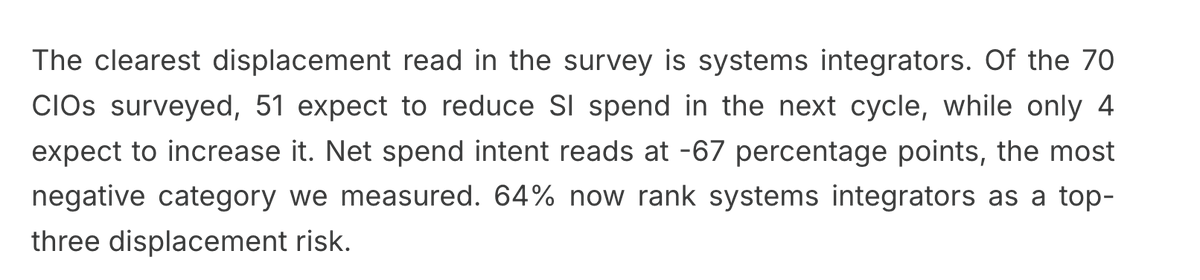
Not going to call the death of services/ISVs, but on the back of Accenture's stock plunge, our CIO/CTO survey seems directionally consistent.
https://t.co/q8I4QW5HCo
“People underestimate how long it takes to win big.
You struggle for 10 years. Eventually, in one day, you achieve more than you did your entire life.
Be patiently aggressive.”
— Patrick Bet-David
Someone on Reddit built a WoW private server with 1,800 bots and AI chat via the DeepSeek API.
Dead Internet Theory, but playable.
An MMORPG with no real players, yet somehow it still feels human.
Breaking down TSMC's glass core substrate slide
On June 11, at JPCA Show 2026 in Japan, TSMC gave a roughly 40-slide presentation titled "Advanced Packaging Technology Essential to the Evolution of AI" (AIの進化に不可欠な先端パッケージング技術). One slide from the deck, titled "Glass Substrate Development for CoWoS," has since leaked online and widespread attention.
Here's a closer read of that slide (see attached image). I'll skip the technical background that is already widely available. One thing to flag: the "COP" on the slide does not stand for Chip-on-Package. It means Coplanarity.
▌ Key conclusions:
1. TSMC has officially announced a partnership with Ibiden and Innolux to develop a glass core substrate. The structure is a three-layer design, a glass core sandwiched between two ABF build-up layers. This is the "oS" in CoPoS.
2. The market underestimates how important the glass core substrate is. It's a must-have capability for TSMC. In other words, within CoPoS the "oS" matters more than the "CoP", which is also why, when it was tested, it was paired with the existing CoW rather than with CoP.
3. The glass core substrate costs several times more per unit than existing ABF substrates. The glass processed by Innolux is very expensive per unit and is the single most critical material. Besides Nvidia, two US-based customers have also expressed strong interest.
▌ Industry checks tied to this slide:
1. The glass core substrate shown on the slide is cut from a full-size 250×250mm one. The ABF build-up layers mainly use Ajinomoto's GL107, mixed with ABF-GCP, and were tested at 24–28 layers, which is the mainstream ABF spec for AI chips in 2027–2028.
2. The CoW used in TSMC's experiment is a test vehicle. It is sufficient to validate the most challenging mechanical-structure issues that arise when working with composite materials. Good results mean TSMC, Ibiden, and Innolux have together broken through the critical technical bottleneck.
3. Ibiden currently handles cutting the 250×250mm glass core substrate. When the 510×515mm format is used for pre-mass-production simulation in 2H27, if Ibiden still wants to reduce production complexity to protect its ultra-high gross margins, it may hand the cutting over to Innolux, which is more familiar with the properties of glass.
▌ The leaked slide shows the validation results of pairing CoW with the "oS" in CoPoS, i.e., the glass core substrate (labeled "glass-SBT" on the slide). This addresses the "Substrate mechanical and electrical Dilemma" raised on the previous slide, and it strongly underscores how important the "oS" is within CoPoS.
1. Within CoPoS, what CoP solves is production efficiency / cutting economics, which ties to cost and price. What the oS solves is warpage and durability, which determines whether the chip can be made at all, and whether it can work.
2. CoP and oS complement each other well when integrated, but looking out over the next few years their technical roles still differ. CoP is a very-nice-to-have optimization, and going without it simply means a more expensive chip. But the oS is a must-have. Without it, even being able to make a usable chip is in doubt.
3. Comparing their roles isn't about elevating oS at the expense of CoP. It comes down to the practical question of which technical piece customers are willing to pay for. Details below.
▌ The real gold here is the power integrity (PI) improvement shown on the slide. This matters a great deal to customers, and it means that once glass core substrate production stabilizes, TSMC's profitability and competitive edge should rise in tandem.
1. How it works: the glass core substrate is thin → the vertical conduction path through TGV (through-glass vias) is short → conduction-path resistance (R) and loop inductance (L) both drop → PI improves.
2. Why it matters to customers: better PI → more stable power delivery → frees up power headroom → room to integrate more transistors, or to push clock speeds higher → more AI compute.
3. For customers, production efficiency is TSMC's basic responsibility, so they won't pay extra for it. But gains in AI compute translate directly into the customer's own competitiveness and profit, so customers are willing to pay for that. This is why Nvidia is so positive on the glass core substrate.
4. For TSMC, the glass core substrate raises yield and lowers cost while also boosting both the compute and the selling price of AI chips. It's both a cost-cutting tool and a pricing lever, a plus for profitability and competitiveness alike.
5. Substrate cost currently accounts for a low single-digit percentage of an AI chip's BOM, while losses from packaging yield run roughly 5–10× the substrate cost. So even if the glass core substrate ends up costing several times more than today's, its share of the BOM stays low, and it can cut the losses from packaging yield. The high unit price is therefore not expected to dampen customers' willingness to adopt it.
▌ In the Q&A after the presentation, an audience member asked about TGV details for the glass core substrate. TSMC declined to answer on the spot, because TGV is the key technology behind the glass core substrate, and the core know-how currently sits with TSMC and Innolux. By contrast, when another attendee asked about integrating IVR, eDTC, and LSI, TSMC answered at length.
▌ According to industry checks, if all goes well, TSMC is aiming to start mass production of the glass core substrate in 4Q28–1Q29, to match the cadence of Nvidia's AI chip iterations. As a side note: the Ibiden earnings presentation slide that many people have been circulating lists the glass core substrate timeline as CY30. My read is this: Ibiden, which has always been conservative and cautious in public, has now formally put the glass core substrate on its roadmap, which further confirms the long-term trend for this technology. That said, some other details on Ibiden's slide don't fully line up with what's known in the market. For example, its reticle timeline is off from TSMC's public claims by about a generation, and the Rubin Ultra substrate size is clearly larger than the 90×90 it marked for CY26–27. It's a reminder to always cross-check across multiple sources when forecasting the future.
OpenAI just killed the worst part of building iOS apps with AI.
The new Codex "Build iOS Apps" plugin can now:
→ run your app in an in-app browser
→ open SwiftUI previews
→ hot reload edits
all without leaving Codex.
No more copy-paste-build-screenshot loop. The agent sees what it ships.
This is the loop indie devs have been begging for.
today we're launching @Palmier_io, a video editor Claude can edit.
use AI to edit, organize, and generate footage directly in the timeline.
finally, a video editor built for AI.
open-source. mac native. available now.
Show Codex a workflow once. Reuse it as a skill.
Record & Replay lets you show Codex a recurring task, like filing an expense report or submitting a time-off request.
Codex turns that demo into an inspectable, editable skill.
You control when recording starts and stops.
Introducing Goal Mode in Kimi Work
Goal lets your desktop agent run 24/7 until the task is done, built for long-horizon tasks and complex multi-step workflows.
GLM-5.2 delivers a substantial leap in app development capabilities, which also represent demanding long-horizon tasks.
Results:
- GLM-5.1: 21/70
- GLM-5.2: 48/70
- Claude Fable 5: 56/70
That's more than a twofold improvement from GLM-5.1 to GLM-5.2.
These come from an internal benchmark of 35 challenging mobile development tasks, each run twice for a total of 70 trials. We measured task completion, defined as core features working without major issues.
Z ai’s GLM-5.2 is the new leading open weights model on the Artificial Analysis Intelligence Index scoring 51 and it sits on the Pareto frontier of Intelligence vs Cost per Task
@Zai_org’s GLM-5.2 is the same size as GLM-5.1 (744B total / 40B active parameters) but scores 11 points higher on the Intelligence Index v4.1, placing ahead of MiniMax-M3 (44) and DeepSeek V4 Pro (max, 44). On the first-party API it is priced in line with GLM-5.1 at $1.4/$4.4/$0.26 per 1M input/output/cache hit tokens
Key results:
➤ GLM-5.2 is the leading open weights model on the Intelligence Index v4.1. At 51, it leads MiniMax-M3 (44), DeepSeek V4 Pro (max, 44) and Kimi K2.6 (43)
➤ Improvements across most evaluations, particularly scientific reasoning: GLM-5.2 gains over GLM-5.1 on most evaluations, led by scientific reasoning on CritPt (+16 points to 21%) and HLE (+12 points to 40%), alongside AA-LCR (+9 points to 71%), tau3 banking (+15 points to 27%) and SciCode (+7 points to 50%). TerminalBench v2.1 also improves (+16 points to 78%) and GPQA Diamond gains 3 points to 89%
➤ Leading open weights model on GDPval-AA v2 and competitive with proprietary models: GLM-5.2 scores 1524 on GDPval-AA v2, ahead of MiniMax-M3 (1418) and DeepSeek V4 Pro (max, 1328). This impressive result places GLM-5.2 in-line with proprietary models including GPT-5.5 (xhigh reasoning). GDPval-AA v2 builds on the original GDPval-AA by baselining Elo to human performance at 1000, introducing a rotating panel of frontier-model judges, and raising the turn limit from 100 to 250 for longer-horizon agent trajectories
➤ GLM-5.2 uses more output tokens per task than other leading open weights models: the model uses 43k output tokens per Intelligence Index task, up from GLM-5.1 (26k) and above MiniMax-M3 (24k), Kimi K2.6 (35k) and DeepSeek V4 Pro (max, 37k)
➤ On the Intelligence vs. Cost per Task Pareto Frontier: GLM-5.2 is on the Pareto frontier of the Intelligence vs Cost per Task chart, with the lowest cost per task among models at its intelligence level. GLM-5.2 costs ~$0.46 per task, compared to GLM-5.1 ($0.25), Kimi K2.6 ($0.31), MiniMax-M3 ($0.18) and DeepSeek V4 Pro (max, $0.05)
Additional Model Details:
➤ License: MIT
➤ Size: 744B total parameters, 40B active parameters, equivalent to GLM-5.1
➤ Context window: 1M tokens, up from 200K on GLM-5.1
➤ Pricing: $1.4/$0.26/$4.4 per 1M input/cache hit/output tokens
➤ Availability: Alongside Z ai's first-party API, GLM-5.2 is available across third-party providers including @DeepInfra, @novita_labs, @nebiusai, @parasailnetwork , @SiliconFlowAI , @gmi_cloud , @Baseten and @FireworksAI_HQ
Introducing the Open Knowledge Format (OKF), an open specification that formalizes the LLM-wiki pattern into a portable, interoperable format.
AI is only as smart as the context we give it. As we build more advanced, agentic AI systems, they need accurate metadata and context to be useful. But in most organizations, that context is locked inside fragmented data catalogs, isolated wikis, scattered code comments, or the minds of senior engineers. Every time a new AI agent is built, teams are forced to solve the exact same context-assembly problem from scratch.
To solve this, we've announced OKF, a vendor-neutral, open specification that formalizes the "LLM-wiki pattern" into a portable, interoperable format. It provides a standardized way to represent the enterprise knowledge that modern AI systems rely on.
— Just markdown: readable in any editor, renderable on GitHub, indexable by any search tool
— Just files: shippable as a tarball, hostable in any git repo, mountable on any filesystem
— Just YAML frontmatter: for the small set of structured fields that need to be queryable: type, title, description, resource, tags, and timestamp
We’ve also shipped reference implementations to help you hit the ground running, including an enrichment agent for BigQuery, a static HTML visualizer, and live sample bundles on @github → https://t.co/ilhAMCrcTc
➕ Knowledge Catalog can now natively ingest OKF!
Stop reinventing data models and building bespoke integrations for every new AI tool. Here's more about how OKF works → https://t.co/FR4kJRsgEH
Introducing GLM-5.2: Frontier Intelligence, Open Weights
- Significant improvements in coding and agentic tasks
- Strong long-horizon capabilities with a 1M context window
- Two levels of reasoning effort: GLM-5.2 (max) pushes the limits, while GLM-5.2 (high) strikes a strong balance between performance and token efficiency
- MIT-licensed open weights
- Same API pricing as GLM-5.1
Tech Blog: https://t.co/LAsxUdN0JZ
Weights: https://t.co/g0A1C4UWx4
API: https://t.co/Kc3E22cbN7
Coding Plan: https://t.co/Nk8Y98HNhU
Chat: https://t.co/WCqWT0qCQb