I gave a reading recommendation to a student that, as we enter a long weekend when some might have free time for reading outside the beaten path, I thought could be worth sharing:
The Raven of Zurich: The Memoirs of Felix Somary.
The student was intrigued by a passing remark I made here on X:
“Hegemons are run by the Sir Richard Whartons of the world, not by the Felix Somarys.”
Sir Richard Wharton is the Permanent Secretary at the Foreign and Commonwealth Office in Yes, Prime Minister, the archetype of the civil servant more interested in protecting his own turf than in advancing the UK’s foreign policy. I used him to illustrate how many foreign-policy decisions reflect short-sighted bureaucratic incentives, not careful strategic deliberation.
Felix Somary, on the other hand, is a real person, although one who deserves to be better known. For many decades, he was an economist and a banker, and he was ahead of his time and his contemporaries (including Keynes) in forecasting future events. His analysis of the coming great depression in Europe in January 1930 was particularly prescient (and contrary to the consensus at the time).
Soon known by insiders as “The Raven of Zurich,” Somary did not get everything right (who could?), but his batting average was impressive, perhaps the best in the first half of the 20th century.
A product of the remarkably creative Vienna of the early 20th century, Somary was able to borrow from economics (he was a student of Carl Menger, which makes him a distant relative of mine; if you go up in my doctoral advisor genealogy to get to Menger as well), history, political science, and psychology to understand the deep forces underlaying daily events (the effects of mass democracy, of balance of powers, etc.) and, as he would put it, “connect the dots.”
His memoirs are a fantastic summary of his life, full of brilliant insights. If you are an hegemon, you need Somarys to run the foreign policy.
Unfortunately, the academic literature on Somary is remarkably thin. If you are a graduate student or an assistant professor interested in the history of economic thought or intellectual history (and you can read German), writing a scholarly biography of Somary would be a fantastic project. Feel free to take up the idea; I certainly do not have the time to do so.
In the meantime, you can at least read the book:
https://t.co/OROZVqmB7n
or a shorter summary:
https://t.co/YiyBD2C4Y9
Happy Thanksgiving! I hope you enjoy a well-deserved break, good food, and some quiet time.
Important questions raised by Professor @JesusFerna7026 as universities need to reflect on their role in the age of AI. And please don’t cut your personal interactions by 90% as this would be a big loss for all of us!
⏳ Time to reorganize universities from scratch?
I have been thinking a lot about what it means to be a university in 2025, once AI has arrived. My approach to learning new topics has undergone a significant change. Instead of relying only on textbooks or papers, I now integrate LLMs into my self-education.
The result? My learning productivity has skyrocketed. Even more striking: I have reduced by 90% my dependence on colleagues and friends when exploring a new subject. Gone are the days of sending an email to a friend at University X asking, “What’s a good way to start learning about Y?”
But this raises a deeper question: what is the added value of my lectures? Why should students take my course when LLMs already perform so well in 2025 and will likely perform even better in 2035?
The problem is that most universities are not ready to face this challenge. Again and again, I see how vested interests slow down change, while layers of bureaucrats and administrators with limited vision remain in charge. Of course, there are exceptions—great leaders in some institutions—but I could fill a book with anecdotes of creeping bureaucratization that slows innovation, increases costs, and prioritizes meaningless “procedures” over real progress at a place like UPenn.
History gives us a warning: think of Kodaks and Polaroids. When a fundamental change in a business model arrives, large organizations face almost insurmountable barriers to adapt. In higher education, these barriers are even greater: the absence of clear metrics for success (how do we measure the value of a new major?), the barriers to entry (accreditation, alumni networks), and the ideological biases of many stakeholders (not only political, but also a lack of responsiveness to change).
If it were up to me, a top university should create its own Skunk Works to explore what higher education should look like in 2035.
The original Skunk Works at Lockheed was an autonomous unit tasked with developing new technologies without the layers of managerial supervision that typically paralyze large organizations. For decades, Skunk Works produced some of the most innovative aircraft—the F-104, the U-2, the SR-71, the F-117—delivered on time and usually without cost overruns. The model was so successful that many other organizations have tried to replicate it, with varying degrees of success.
Creating a Skunk Works inside a university is not without risks. See, for example, the insights of Rebecca M. Henderson and Kim B. Clark in “Architectural Innovation: The Reconfiguration of Existing Product Technologies and the Failure of Established Firms.”
But right now, I cannot see another way for a large, inertial institution to move forward. By contrast, I am skeptical that creating entirely new institutions from scratch is the most promising path (for reasons I’ll explain another day).
And if you want to know more about the original Skunk Works, I highly recommend “Skunk Works: A Personal Memoir of My Years at Lockheed” by Ben Rich and Leo Janos. A delightful book—especially if, like me, you love planes. ✈️
📢 Call for Papers
Global Spillovers Amid Shifting Policies
Joint BIS • BoE • ECB • IMF • JIE Conference
📍 Washington, D.C. | 🗓 April 28–29, 2026
📝 Submit by Nov 30, 2025
@BIS_org@BankofEngland@ECB@IMFNews
Happy to share some new work with @JorgoGeorgiadis, Peter McQuade, Vlad Burian and @Schmitz_BoP on the role of geopolitics for foreign holdings of euro area government debt.
https://t.co/SCW0FlFxVE
@OxfordFrom@hajoonchang@FT@augustinlandier@ThomasPHI2 @jan_eeckhout @zingales And on your question dear @OxfordFrom in view of the budget constraint, I would think more work on the big picture and less technical refinements of very narrow questions (which are what the most journals reward though).
@OxfordFrom@hajoonchang@FT@augustinlandier@ThomasPHI2 @jan_eeckhout @zingales I teach a Masters course on the limits of markets and find that students are more or less equipped with the first two welfare theorems subject to few standard market failures and that’s it.
@OxfordFrom@hajoonchang@FT Yes, good points by @OxfordFrom but should the academic profession do more to advertise a more nuanced view of markets and economic thinking among policy makers and the general public?
Happy to share some new work with @JorgoGeorgiadis, Peter McQuade, Vlad Burian and @Schmitz_BoP on the role of geopolitics for foreign holdings of euro area government debt.
https://t.co/SCW0FlFxVE
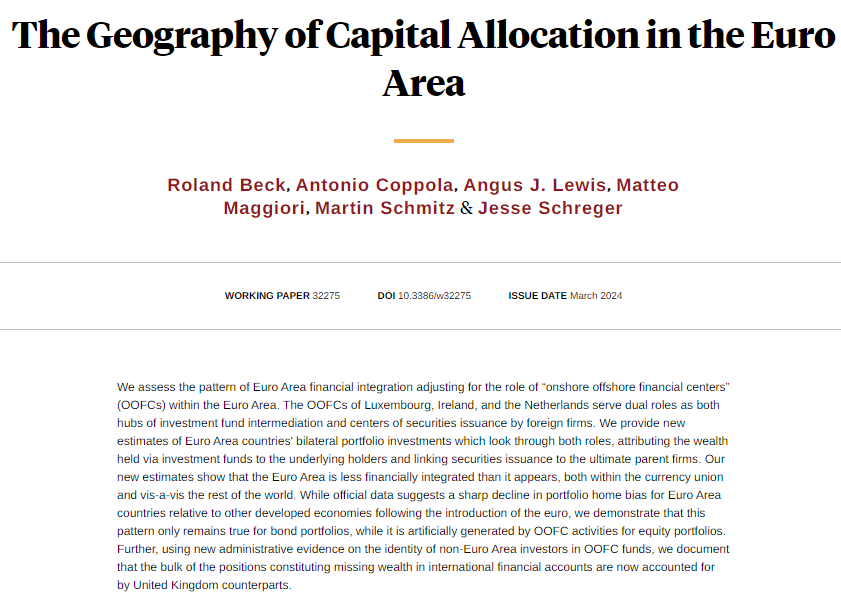
Assessing the pattern of Euro area financial integration adjusting for the role of “on-shore offshore financial centers” within the Area, from Roland Beck, @acoppola4, Angus J. Lewis, @m_maggiori, Martin Schmitz, and @jschreger https://t.co/pgaGo56FNo
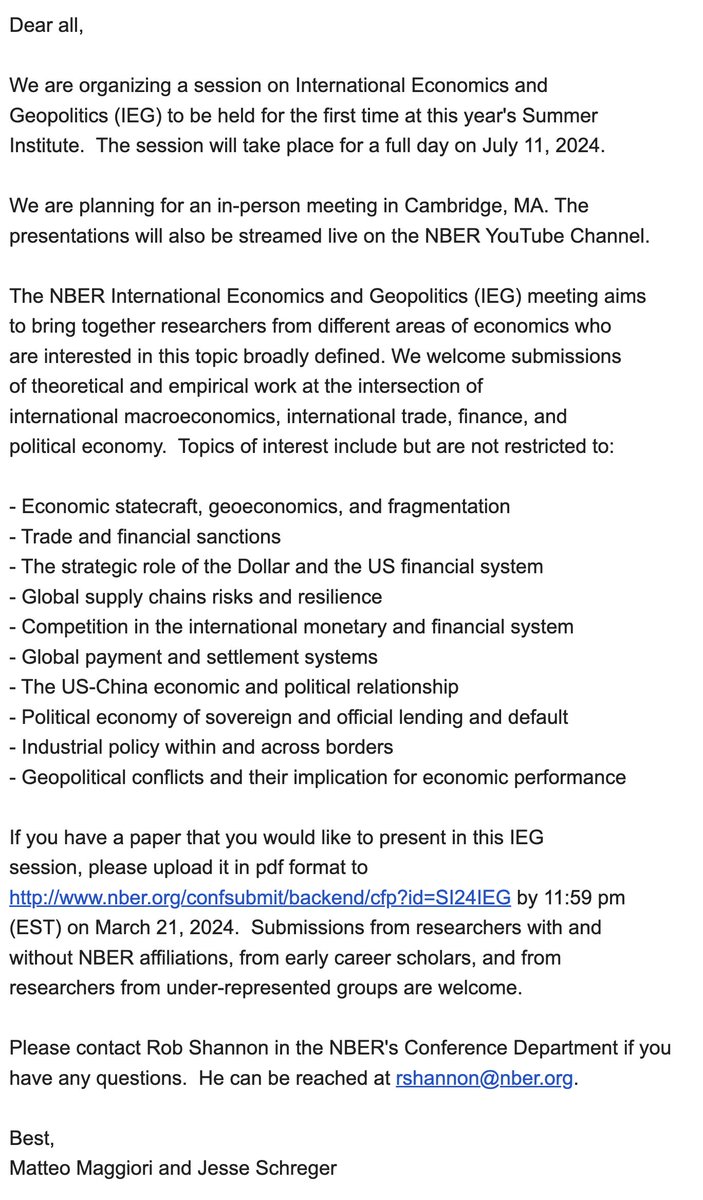
NEW NBER SUMMER INSTITUTE SESSION
INTERNATIONAL ECONOMICS and GEOPOLITICS
Our directors @m_maggiori and @JSchreger will organize a new session on this topic on July 11th. See below the call for papers.