This is a subtweet of one of our DC city council members. Which one? It could be almost any of them, because so many of them are making public statements that are just pure magical thinking about how the city can spend our way out of a fiscal and economic crisis.
so:
1) cyberattacks on US water infrastructure in August
2) cyberattacks on US military base freezers in August
3) Hacks of French supermarket fridges and freezers mid-October
4) Microsoft Outlook outage last week
5) FAA outage last week
6) Banks outage today
US grounding all flights nationwide is serious.
Makes me wonder if it’s connected to the small town water stations across the Midwest that were locked out of their control panels, the network breaches on those Texas-bound oil tankers as they crossed the Atlantic, or the hundreds of refrigerators in European grocery stores that were remotely cranked up to a blistering 120 deg F
These disruptions feel less like isolated incidents and more like the new baseline in a world where critical infrastructure is widely connected yet still lightly defended and certain tools are now becoming widely available.
Unpopular but true: Bitcoin is the most significant monetary advance since the creation of coinage.
If you don't believe me or don't get it, I don't have time to try to convince you, sorry.
Republicans seem to have gerrymandered themselves out of seats by creating close districts that they are losing in a blue wave. If this result holds, the poetic justice will live in infamy forever.
Engineers have finally had to face reality this year. We built our castles on foundations of sand and now we have to pay the price.
https://t.co/alFlEfeGaU
Someone asked me yesterday why mainstream media so often descends into mindless groupthink when it’s supposed to be staffed by critically minded individuals.
Fair question.
Having given it some thought, I’ve decided the probable cause is that morning editorial conferences across the industry operate along the lines of the Traitors TV show. Specifically, the roundtable element.
Every morning, editors and journalists attending these conferences have to second-guess where the group consensus will land on a particular angle to x or y story. Also, who or what the group will throw under the bus to make “the story bleed”.
What they actually think often has little bearing on what they say in these meetings. The objective, too often, isn’t to tell the truth. It’s to ingratiate themselves with fellow editors and establish that they can be trusted to operate as responsible thought leaders or distillers of news in their own capacity throughout the day (thus keeping their jobs and/or getting promoted).
The objective becomes sussing out what the consensus will be before you even enter the room, then signalling your alignment as early as possible. The earlier the better.
Failing to do so, say by sticking to a neutral interpretation even when the consensus is heading the other way, risks getting you banished. You can plead your case, but there’s always the risk that your “counter angle” or “theory” will backfire on you. In many cases, it’s better to say nothing at all than to say something that falls too far outside the consensus (a strategy deployed by many participants, though there are also drawbacks to being too quiet).
In the end, internal survival depends far more on alignment with the consensus than on getting the interpretation of the story right.
This despite the fact that… just like in Traitors… the consensus often turns out to be dead wrong.
@spiral_xyz@jack@blocks the true moonshot is changing the US tax treatment.
it can't spend like money until it is treated like money.
everything changes when that penalty lifts.
We will wish we had listened to these warnings before the massive attack that is coming. To summarize: all code has bugs, continuous attacks by thousand of AI agents guarantees that they WILL eventually find their way into any website/database/system. So we need a new way of thinking about defense.
Frontier AI companies trained on vulns for years, built a digital nuke, then:
1. Posted about humanity being wiped out
2. Asked the Pope to call AI sentient
3. White House to ban rivals instead of helping.
Instead of distributing the tools to fix code.
It is not complicated.
We believe voice is the most natural way to interact with intelligence, so we created Dessa, the most authentic full-duplex speech model ever built. Talking with it feels like talking with a person…full of emotion, nuance, pauses, and a natural cadence.
https://t.co/r0qFLdvd6c
😱 Xi Jinping seems to have completely lost his mind! Internet censorship in China has reached an unprecedented level—one that may never be surpassed!
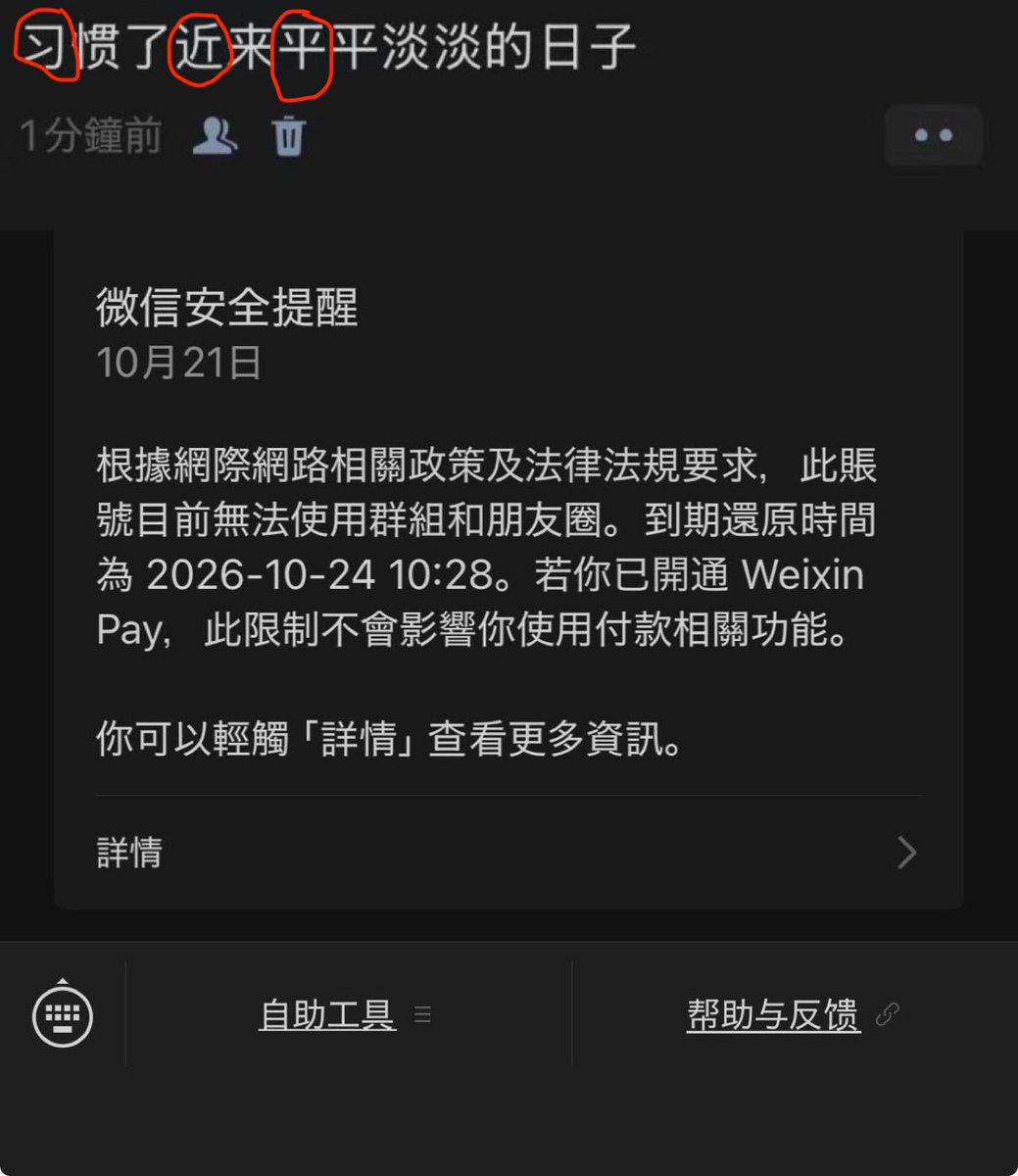
At least several Chinese internet users have been banned from posting anything further on WeChat Moments simply because they posted this innocent sentence:
"习惯了近来平平淡淡的日子"
("I've gotten used to the quiet, uneventful days lately.")
Even worse, one user had his/her WeChat Moments posting privileges permanently revoked after filing an appeal. (See Images 1 and 2.)
What's wrong with this sentence?
Well, the first Chinese character is "习" (Xi), the fourth is "近" (Jin), and the sixth is "平" (Ping). Put them together, and you get Xi Jinping's name!
(The three characters circled in red are "习," "近," and "平," respectively.)
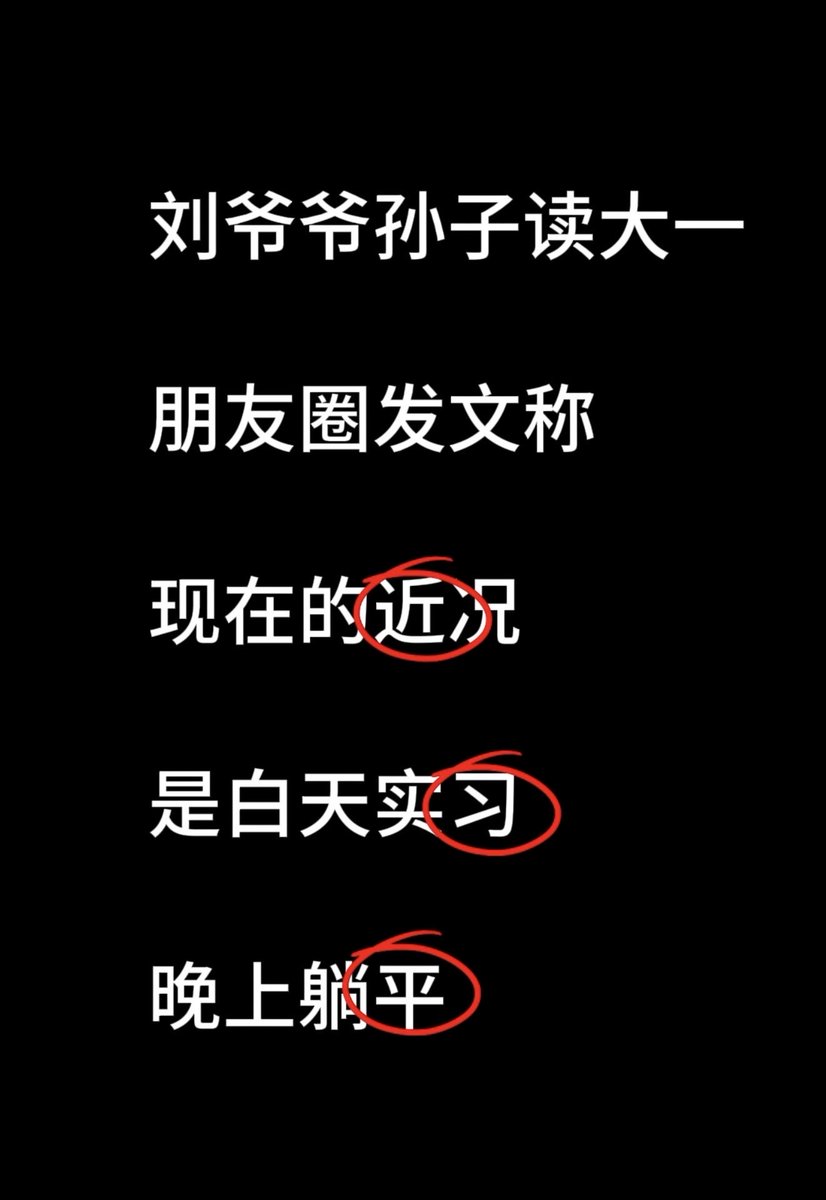
Another case involves a college student named Liu Kai, who is only 20 years old. He was detained simply for posting the message shown in Image 3 on WeChat Moments!
His post read:
"现在的近况
是白天实习
晚上躺平"
Which translates to:
"My current situation: Internship during the day, Lying flat at night."
("Lying flat" is a popular Chinese expression referring to opting out of relentless competition and societal pressures.)
Each of these three lines contains one character from Xi Jinping's name: "近" (Jin), "习" (Xi), and "平" (Ping).
Although the characters don't appear in the same order as Xi Jinping's name, the post still triggered the CCP's internet censorship system.
Four police officers showed up at Liu's home in the middle of the night, arrested him, and confiscated his computer, phone, and tablet.
After investigating him, the police discovered that he followed several anti-CCP YouTubers and had downloaded their videos and shared them with classmates. Authorities deemed this to constitute "de facto anti-CCP propaganda."
Beijing police decided to make an example of him, ordering a thorough investigation and a harsh sentence. His family has been barred from visiting him, and he has been denied legal representation.
Image 4 shows his detention notice, issued by the Haidian Branch of the Beijing Municipal Public Security Bureau. It reads:
To the Family of Liu Kai:
In accordance with Article 105, Paragraph 2, of the Criminal Law of the People's Republic of China, our bureau placed Liu Kai (male, born September 14, 2006, residing at Wenquan Town, Haidian District, Beijing) under criminal detention at 2:00 a.m. on October 19, 2026, on suspicion of inciting subversion of state power and the overthrow of the socialist system.
He is currently being held at the Haidian District Detention Center.
Detention Center Address: Haidian Detention Center, No. 2 Wenyang Road, Haidian District, Beijing.
Another vulnerability few are talking about: I found my Claude Code exposing personal data in http headers because the sites it curled politely asked agents to identify their users 😊
Epistemic cybersecurity is the hot new category for 2027.
The GRU hacked into Jared Kushner's iPhone. Dutch military intelligence (MIVD) then recruited a GRU spy who gave them access to the hacked phone. What MIVD discovered was that Kushner had access to two bank accounts --one Azerbaijani, the other Israeli --where Saudi Crown Prince Mohammed bin Salman and Emirati ruler Mohammed bin Zayed deposited money. It sounds like a slightly far-fetched episode of "Slow Horses," but it's real. And it proves just how eye-poppingly corrupt this administration was and continues to be as its "special envoy" decides the fate of tens of millions in Europe in the Middle East. Simply incredible reporting by Matthew Cole, drawn from his new book on Kushner. https://t.co/8AyV60gg1X
CodePink is visiting China this week. This is such a priceless photo of their ignorance of the country. Here's the "anti-war activists" standing in front of a sign about Red Army Village, a reference to a place named after the People's Liberation Army.
Today I was in Washington DC to talk about financial privacy and the narrow path to non-dystopian digital ID. It was great to see @valkenburgh and @secparam, but I want to now expand on a point from our panel:
I think it is likely the BSA, as applied today, is unconstitional.
This is probably going to be surprising to a lot of you. After all, didn't the Supreme Court uphold the BSA as constitutional when it was challenged in 1974? Why yes, it most certainly did.
Have you read that opinion? I have. That same court said that the fact pattern today is likely unconstitional.
The case, for those unfamiliar, is California Bankers Assn. v. Shultz (416 U.S. 21). In it, when you read the actual decision, you find some interesting tidbits:
Title I recordkeeping requirements were upheld because mere recordkeeping was not a search, and the authorities asking a third party for individual pieces of data was thus not a search. Government access in that case still required orderly legal process.
Title II domestic reporting was largely a standing issue, pointing out there were not customers specifically challenging this at the time who had been clearly impacted.
Fifth amendment claims by depositors or the ACLU were considered speculative at the time, and did not note specific facts (nor privacy concerns) or even clear intent to engage in transactions in some cases.
Powell, who was joined by Blackmun, concurring with the majority, in fact specifically noted that “A significant extension of the regulations’ reporting requirements… would pose substantial and difficult constitutional questions.”
First: I think this case was correctly decided on the facts at the time, in the world where banking was largely done on paper, records searches were one at a time or at most small batches, and the amount of information a bank collected was far more limited. On the standing and non-ripeness points, those were probably also correct at the time, but I will note that doesn't make something constitutional, just that SCOTUS has a long history of punting on things until they have to confront it.
Second: the fact pattern today looks absolutely nothing like the fact pattern at the time. The expansiveness of a search is far greater, with banks involved in every asset of digital life and the transaction monitoring far more comprehensive than before. Previously, a BSA request could not get every purchase you had made over the past three months (thus also geolocating you at all those times), because that was all done in cash. Now it can.
In light of things like the recent Flock decisions at district courts finding Flock database searches without a warrant to be unconstitutional and the cell phone tower decision showing that non-particularized geofence warrants are also unconstitutional, it's hard for me to see how "we see your location constantly through your card always and then we turn tens of thousands of people's wroth of information over to the government with no individual suspicion" is going to pass muster.
The second point is in light of government pressure to close accounts, like the @USOCC just found in their report about the debanking of digital asset companies, the standing and ripeness arguments now look very different. There was, in fact, an actual nationwide dragnet at big banks to debank certain customers, partially pushed by regulators leaning on reputational risk, and the standing, harm, and ripeness issues created might be overcome here.
The third point is that the reporting requirements have expanded dramatically, exactly the thing the court itself cautioned against. "Hey gives us this one customer's info for transactions over $10k" is now "give us all transactions for all customers at all thresholds", and by waving their hands and screaming "third party doctrine", the Feds think this is somehow magically constitutional.
My view: it's not.
I think the time is right for someone to challenge this, and win.
bombshell report from the OCC out today confirming what we all suspected:
between 2020 and 2025, based on a review of 100,000 complaints, America’s largest banks systematically denied banking to lawful businesses based on political and reputational considerations rather than objective financial risk, effectively appointing themselves arbiters of which industries deserved access to the financial system. digital assets was specifically named as one of the six most affected industries.
TLDR: we weren't imagining it. OCP2.0 was real.