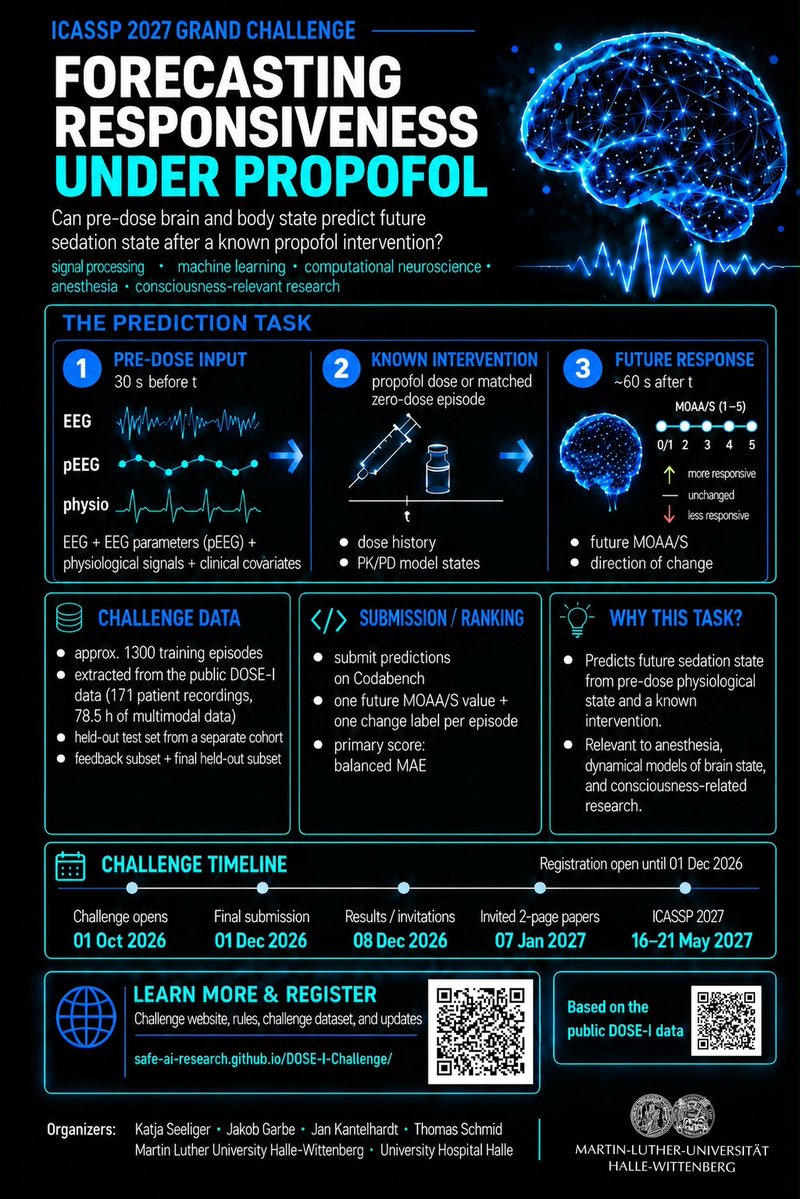
Consciousness remains difficult to define. Loss of responsiveness under propofol is more amenable to benchmarking.
Our ICASSP 2027 EEG prediction challenge:
https://t.co/iUF2VkBKs3
Registrations open.
Are brains and artificial neural networks converging onto universal representations?
There is a seductive idea making the rounds in NeuroAI / ML: train systems well enough, and they'll converge on the same representation of reality (i.e. unique world model).
We have Thoughts™
Our article "The Umwelt Representation Hypothesis: rethinking Universality" is out now in
@TrendsCognSci , with my amazing colleagues:
@RowanSommers@AdrienDoerig@TimKietzmann
Many thanks to the journal and reviewers for their thoughtful feedback!
https://t.co/3M7992DIHx
@gershbrain RL didn't start with TD learning. It started with the work from psychologists without whom it's not clear that the TD algorithm would have been discovered (Pavlov, Watson, Skinner, Rescorla and Wagner)
@raphaelmilliere In my view, this parallel input is what affords LLMs access to compositional/symbolic computations over tokens and it is what makes them superior to LSTMs. It is therefore an important data point in your discussion on the symbolism vs. connectionism debate!
@raphaelmilliere Memory capacity is an important aspect because the way LLMs receive their input tokens in parallel affords them a form of attention which would be too costly for humans. Humans don't read entire book chapters in parallel and then compute attention over all words in the chapter!
@neuralreckoning@cian_neuro@dlevenstein Emotional valence increases the chance that an episode sticks in memory, so it seems that emotions help with this triage process. So does attention.
@norvid_studies@SuryaGanguli I think most philosophers would say that mental states are not unlike your example of immune defense actually. But, you're right that multiple realizability does not follow from functionalism. Instead, functionalism was created to deal with the problem of multiple realizability.
@norvid_studies@SuryaGanguli I should add: what ties these different brain states together is that they realise the same functional role. Hence, functionalism.
For further reading see: https://t.co/zjIdN4FVft
@norvid_studies@SuryaGanguli For instance, humans and squids have rather different neural anatomy, yet both can have pain. And so, for every mental state (pain), there can be many brain states (human, dog, ..., squid neural firing). Thus, mind relates to body in a one-to-many manner 1/2
@SuryaGanguli Another example from philosophy of mind is embodied cognition, which started in the phenomenological tradition (m.n. Heidegger, Merleau-Ponty)
As some of you have asked, here is a link to my CCN keynote from this year.
Main topic: how we use ANNs as a language to describe, implement, and test theories of brain computations. #neuroconnectionism
https://t.co/zcA4OQT809
@NesslerBernhard@spiantado You make a fair point, but I still think one of the reasons why attention is successful and other multiplicative interactions aren't is because it allows for combination of discrete token binding. This is more merge-like than a simple (recurrent) matrix multiplication.
@spiantado Not denying that there are differences, e.g. multiple heads, but what strikes me as similar is that a priori any token can be the key to the value of any other token. This allows the network to learn a syntax in which words can be dynamically combined, e.g. coreferential words.