Introducing CorText: a framework that fuses brain data directly into a large language model, allowing for interactive neural readout using natural language.
tl;dr: you can now chat with a brain scan 🧠💬
1/n
I have a lot of respect for @nickcammarata and Goodfire, but I will add some thoughts from brains/neuroscience.
First, polysemanticity and distributed representations are ~widely~ seen in biological brains. (In some ways this is what I have spent my career on.) 1/
Delighted to share that this work is now accepted to @NeuroCellPress's Neuroview! 🎉
Key changes:
[1] considering wider variety of simulators, behavioral, neural and task-specific cognitive models
[2] highlighting the use of neural and other physiological measurements for calibration and adjudication.
[3] expanding on the weaknesses of current methods (e.g. bias towards WEIRD population in dataset used to derive foundation models)
For more details, check the full article ⬇️
To learn how brains compute, we need to experimentally adjudicate among competing computational hypotheses. How do we do this in the age of complex neural network models? New review paper: “Making models disagree to learn how brains compute” with @TalGolanNeuro, @SchuettHeiko
How can we design experiments that make models disagree? One section of our new @NatRevNeurosci Review with @KriegeskorteLab and @SchuettHeiko examines studies that used stimulus sets designed to elicit distinct predictions from competing models. Full text link at the end. 1/14
@dyamins So, to synthesize my thoughts: the contravariance principle explains how alignment arises between systems operating under shared constraints; the URH asks which constraints are shared and predicts multiple clusters of alignment rather than convergence to one optimal world model.
@dyamins We argue it is not, for mainly pragmatist reasons, and propose that there are many valid optima that differ because they serve different purposes, which are shaped by the environment, goals, perceptual interfaces, effectors, and other constraints.
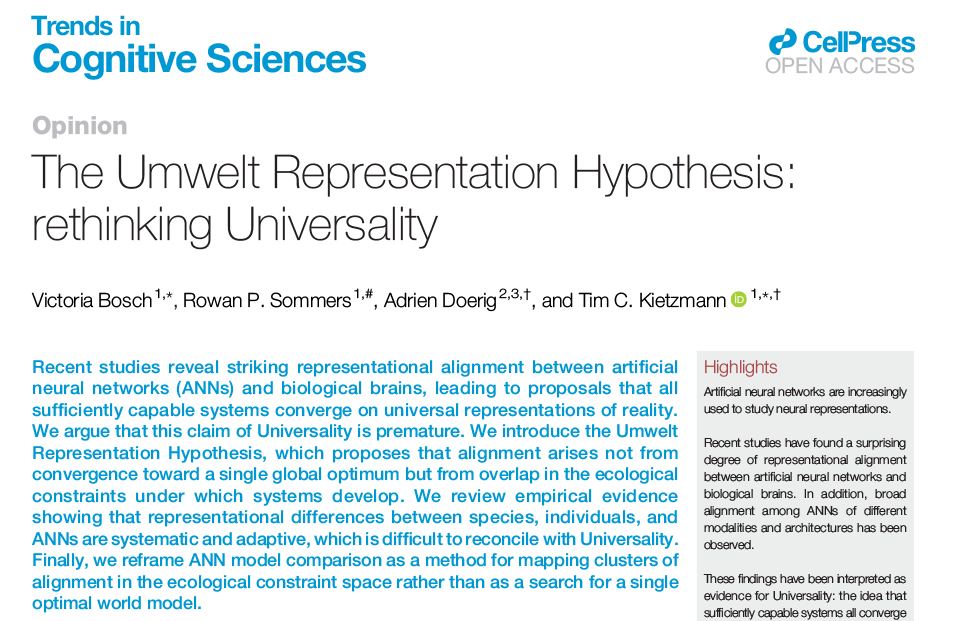
Our article "The Umwelt Representation Hypothesis: rethinking Universality" is out now in
@TrendsCognSci , with my amazing colleagues:
@RowanSommers@AdrienDoerig@TimKietzmann
Many thanks to the journal and reviewers for their thoughtful feedback!
https://t.co/3M7992DIHx
Are brains and artificial neural networks converging onto universal representations?
There is a seductive idea making the rounds in NeuroAI / ML: train systems well enough, and they'll converge on the same representation of reality (i.e. unique world model).
We have Thoughts™
Our proposal: To understand representational alignment between artificial neural networks and brains, don't look for the *one world model*, but use the toolbox of neuroconnectionism to map the space of ecological constraints that lead to systematic (mis)alignment instead.
The Umwelt Representation Hypothesis: Rethinking Universality
Opinion by Victoria Bosch (@__init_self), Rowan Sommers, Adrien Doerig (@AdrienDoerig), & Tim Kietzmann (@TimKietzmann)
https://t.co/0IUPnsfZBS
We're excited to announce we're starting a Journal Club. And our first meeting is scheduled for tomorrow!
@__init_self will present her work, CorText: Brain-Language Fusion Enables Interactive Neural Readout and In-Silico Experimentation
Tomorrow at 10:15am ET, join Discord!


![akjagadish's tweet photo. Delighted to share that this work is now accepted to @NeuroCellPress's Neuroview! 🎉
Key changes:
[1] considering wider variety of simulators, behavioral, neural and task-specific cognitive models
[2] highlighting the use of neural and other physiological measurements for calibration and adjudication.
[3] expanding on the weaknesses of current methods (e.g. bias towards WEIRD population in dataset used to derive foundation models)
For more details, check the full article ⬇️](https://pbs.twimg.com/media/HUC4u9YbwAAwfR3.jpg)