A lesson I wish I learned earlier: Think in decades (even while you act in days).
Daily discipline without long-term direction is dangerous. You get so focused on moving that you stop asking what you're moving toward. You optimize for the days and forget the decades. And slowly, without realizing it, you drift away from what you were actually trying to build.
There's a question I often ask myself:
How would you approach what you're doing right now if you knew you'd be doing it for the next ten years?
The question helps you avoid the short-term traps that plague every endeavor. Chasing trends at the expense of authenticity. Chasing value extraction at the expense of value creation. Chasing money at the expense of energy.
The question can be applied to every area of life:
How would you approach this relationship if you knew you'd be in it for the next ten years? You wouldn't approach it as a transaction, with your hand out, looking to extract value.
How would you approach this workout if you knew you'd be training for the next ten years? You wouldn't push yourself to injury chasing a single session.
How would you approach this work if you knew you'd be doing it for the next ten years? You wouldn't cut corners to hit an arbitrary quarterly result.
Think long. Act now.
What a quote from Wemby to end his media availability:
"I can go through hurdles that I didn't know those hurdles could get so high. It's just pushing through, I found resources inside of me, relentlessness. I already knew that, but doing it at this level, I mean, this is the best basketball on the planet that's being played right now... and the crazy thing is, maybe I'm crazy, but I want to do that 15-20 more times. Let's hope it doesn't become an addiction... maybe it already is."
.@ericries explains why former Costco CEO Jim Sinegal refused to raise the price of everything in the store by $.03, despite the fact that Costco knew it wouldn't decrease sales, and would increase their net income by 50%:
"He says, 'It's like the business equivalent of taking heroin. You do it once, and then you got to do it again, and again, and again. Next thing you know, you're not the low-price leader.'"
"You can get away with screwing people over. You always do it, no matter what. You raise margins. Margins are a source of strength."
"But Costco is built on a very different philosophy, which is that margins can be a source of weakness. @JeffBezos understood it. He used to always say, 'Your margin is my opportunity.'"
"When you're making too much money, when you are being too extractive, you're actually harming your competitive position in the long run."
Thanks to the @oasishealthapp I’ve switched from poisonous FairLife Protein Milk to Bourbon and I can’t even begin to explain how much healthier I feel.
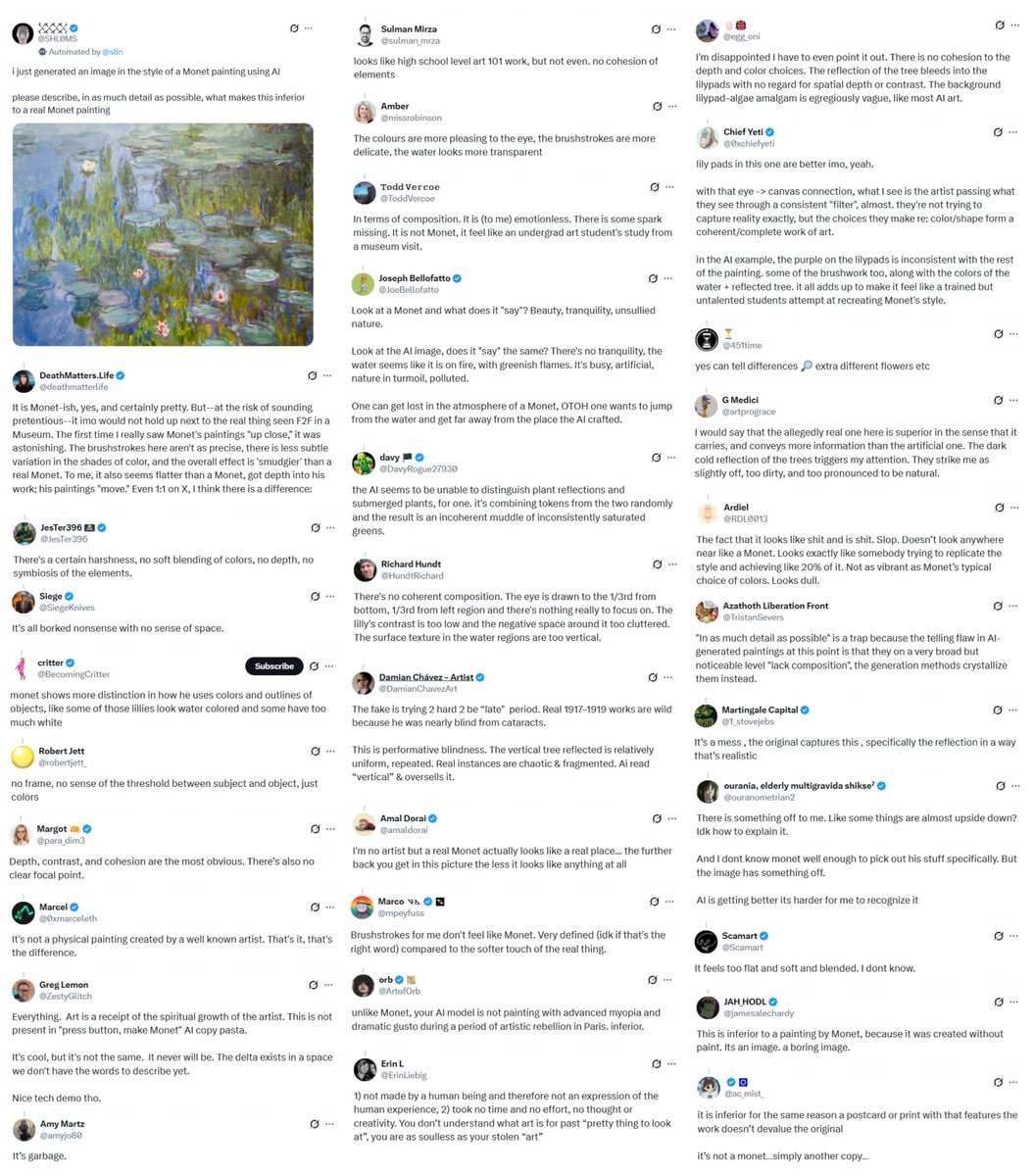
Since its been 24 hours, i can finally say, i love how SHL0MS baited everyone into responding to this, many art experts saying how badly the ai did when in reality its a cropped real monet painting they are critiquing as ai 😭
Incredible bit. Rory Mcilroy guessing the golfer by only looking at a swing silhouette. Even nails Lebron and Charles Barkley (lol).
Every sport needs to do have their top athletes do this challenge.
A nurse in Australia named Bronnie Ware spent 8 years sitting with people in their final weeks of life. She'd ask each patient what they regretted most. Across thousands of conversations, the same answer kept coming back.
The number one regret was this: "I wish I'd had the courage to live a life true to myself, not the life others expected of me." Her notes became a book that has been read by millions of people in 32 languages.
Cornell psychologist Tom Gilovich found the same pattern in the lab. In the short run, action regrets sting harder. People replay the drunk text they sent, the wrong job they took, the fight they started, and the words they couldn't take back. Over years, the pattern flips. In American samples, two thirds of long-term regrets were chances people never took. The same pattern showed up in the US, China, Japan, and Russia.
Around 43% of what you do in a typical day is running on automatic. You aren't really deciding to do those things. That figure comes from Wendy Wood, a social psychologist at USC. Once a routine sets in, a small region deep in your brain called the basal ganglia takes over and runs it on autopilot. Ann Graybiel, a neuroscientist at MIT, found that the basal ganglia handles your morning coffee the same way it handles your worst habit. It doesn't care what the routine is. It just rewards repetition.
In a 1978 study, researchers compared 22 lottery winners against people who had been paralyzed in accidents. The lottery winners were no happier than ordinary people. They got less pleasure from small daily things, because nothing felt special after that high. The people who became paralyzed had adapted. Their daily mood had returned close to normal. Both groups had drifted back toward where they started, despite the magnitude of what had happened to them. Your mood works like a thermostat. Life events are just weather passing over the setting.
The tweet is describing how the human brain works under the hood. You build a routine, your basal ganglia learns it, your mood adjusts to it, and your sense of "this is fine" creeps in over months and years. By the time you notice you have been coasting, your brain has already adapted to the coasting. The discomfort that would have warned you is gone. And the bill arrives at the end, when there is no time left to live the life you keep telling yourself you'll start one day.
Major life hack: Don't complain, ever. Nobody likes a complainer. They drain the energy of everyone around them. It's exhausting spending time around someone who constantly complains about things outside their control. If it’s within your control, go do something about it. If it’s not, you’re just wasting energy thinking about it. Complaining gives too much power to the thing. Take back that power.