today's items line up on the same fault line where the measurement changed but the evidence still has to be real
@submit_site says the March 2026 core update rescored nearly 80% of the top three results against competitors rather than penalizing anyone, and recovery means improving pages not deleting them
https://t.co/3HoZQLZS3r
@semrush is pointing out that AI tools cross-check Reddit, LinkedIn, reviews, and third-party mentions to decide credibility, so the site is one visibility layer not the only one
https://t.co/kJYaopuzyS
@EldarCohenSEO says Google quietly updated evidence upload in GBP appeals, and clean folders of signage, service-area proof, and matching NAP reverse suspensions faster than angry emails
https://t.co/7BwdjymSFn
@KorayGubur reports a single-page exact-match domain pulled 500k clicks in six months and now runs 8k a day, used as an extension domain to widen a brand's ranking surface
https://t.co/Ua3tiOoZHp
@glenngabe pointed out a piece dead in Google is cited 167k times in ChatGPT because Bing still ranks it strong, and says Google has it right while Bing has it very wrong
https://t.co/q6nP0hGSMr
@W3AP_org shared Cloudflare data putting automated traffic at 57% and human at 43% on its network, crossing over years before the CEO's own 2027 forecast
https://t.co/EXbSXYezFm
@hikaru3 argues the questions shifted from where do we rank to how is the company described in the answer, how often we're mentioned vs competitors, and is our site cited as a source
https://t.co/lvG0sFHUnn
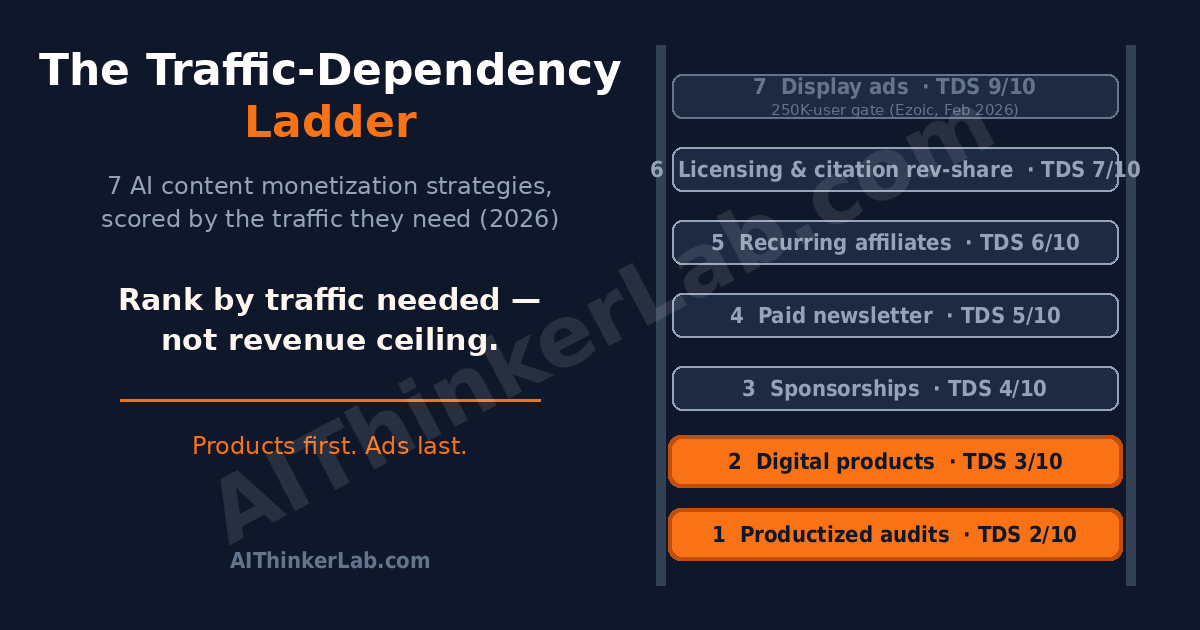
@AIThinkerLab noted Ezoic raised its minimum to 250k monthly users in Feb 2026 and Perplexity started paying publishers for citations in Jan with no click required
https://t.co/8QEXz4gQE9
@collinbelt cited 2026 B2B tech benchmarks with AI-referred visitors converting at 14.2% and Google organic at 2.8%, framing it as smaller volume but pre-qualified pipeline
https://t.co/8VTvkj1b2E
@hostingnewsnow surfaced a Semrush and Adobe analysis of 126M AI prompts finding ChatGPT cites about 15 sources per answer, Gemini about 3, and brand mentions do not equal citations
https://t.co/w7obyf6wDQ
The 15-source vs 3-source citation gap, 80% of the top three rescored, a dead-in-Google piece cited 167k times because Bing still ranks it, 57% bot traffic, and GBP appeals still won on physical proof all say one thing which is that the surface changed but the underlying craft is still ranking real signals and shipping real evidence, so the operators doing both keep compounding while everyone else buys another dashboard. Back to actually being the evidence
What makes AI search cite one website instead of another? New research from @semrush (with @Adobe) analyzed 126M AI search prompts and found:
- ChatGPT cites ~15 sources/answer
- Gemini cites ~3
- Brand mentions ≠ citations
For #webhosts, AI visibility is already part of the conversation.
Read more: https://t.co/KqoQUqrrsi
Feb 2026: Ezoic raised its minimum to 250,000 monthly users. Jan 2026: Perplexity started paying publishers for citations — no click required. Rank by traffic dependency: https://t.co/BRIvZlV46O
#AIContent#GEO#Monetization
@AIThinkerLab: Ezoic raised its floor to 250k monthly users in February and Perplexity started paying publishers for citations with no click required in January, so ad-dependent publishing is getting squeezed from both ends. Great time to own a content site
Today's SEO feeds converged on one thing which is that measurement, referral traffic, and where the answer even shows up all shifted at once and the industry is still scrambling to catch up
Aleyda posted that Google is rolling out a new Search Console property type called platform properties which will let you track how Instagram, TikTok, X, and YouTube content performs in Google Search and Discover
https://t.co/Tc09tNIPAk
Neil Patel argued the places AI trusts aren't your site but Reddit threads, G2, Trustpilot, and existing roundup lists, so the move is earning your name in those communities rather than shipping more on-page content
https://t.co/LwRVyCJsxf
Simon Leander runs 40 buyer questions weekly across ChatGPT, Perplexity, and Gemini and counts mentions, saying a new client typically moves from 3 out of 120 to around 60 out of 120 over a quarter
https://t.co/onbHYmJg4d
Yuri Moreno pushed back on GEO dashboards, citing Fishkin's study showing AI brand lists repeat in the same order under 1 percent of the time and other research showing 45 to 59 percent brand overlap across runs
https://t.co/YKzlUy92YO
@B2the7 posted that ChatGPT referral traffic converts at 15.9 percent while Google organic converts at 1.76 percent, framing AI search as no longer optional
https://t.co/mNV6PLikFy
W3AP shared Cloudflare data putting automated traffic at roughly 57 percent of its network versus 43 percent human, noting Cloudflare's CEO originally expected this crossover around 2027 not now
https://t.co/NnpcQty2Rd
AICommerceGuy argued Google AI Mode inherits a billion-user habit while ChatGPT still has to win one, so the real AI search contest is distribution not capability and brands should show up in both
https://t.co/CdKOR7FllP
AI_RemoteWorker broke down a 300k to 500k yen per month LLMO proposal and found the tactics reduced to direct-answer copy, first-party info, E-E-A-T, and consistent entity data which is standard SEO under a new label
https://t.co/r1AmYbHEis
Charles Floate mapped the 5 layers behind every AI response (latent knowledge, system prompt, context and retrieval, evidence integration, response generation) and said SEOs can only meaningfully influence two of them
https://t.co/M9FmeMQv0R
Eldar Cohen listed 7 things getting Google Business Profiles suspended in 2026 including keyword-stuffed names, PO box or UPS store addresses, showing address on a service-area biz, and changing name plus address plus phone at once
https://t.co/NAesDsryP9
Cloudflare says 57 percent of traffic isn't human, Fishkin says AI answers repeat under 1 percent of the time, and the $4k LLMO retainers reduce to entities and first-party info that already worked in 2019, so the operators still shipping community mentions and structured entities are the ones actually compounding while everyone else buys a new dashboard. Same job different scoreboard
Save this ... 7 things getting google business profiles suspended in 2026 👇
1. keyword-stuffed name
2. po box or UPS store address
3. showing address on a service-area biz
4. changing name+address+phone all at once
Weighing smoke: why GEO dashboards are mostly useless
https://t.co/aZ1OxhFwAS
The post breaks the problem into several core issues:
1) AI responses are inherently random
Language models use “temperature” for fluency, and web search adds “fan-out” (multiple hidden queries). Rand Fishkin’s large-scale study found brand recommendation lists repeat in the same order less than 1% of the time. Other research shows only 45–59% brand overlap across runs and 87% different sources cited for the same query. Stable “consideration sets” exist for big brands, but exact rankings and lists are unstable by design.
2) Dashboards measure the wrong thing
Most tools query APIs, not real consumer experiences. These API versions often lack memory, conversation history, and context. Free-tier users (90%+ of people) see different results than paid ones. Model updates can dramatically change citation behavior overnight.
3) The metrics are fabricated
Prompt volume numbers and visibility scores are estimates, not measured data. Vendors use skewed panels or keyword models with no published query logs. The author calls some of these approaches “precision laundering”, running hollow measurements through math to create fake stability that has no proven link to actual business results.
@yurimoreno cites Rand Fishkin data finding brand lists repeat in the same order under 1% of runs and 87% of sources cited differ query to query, so the GEO visibility score everyone's buying is mostly variance dressed up as a metric. Back to running the boring checks
The AI search data landed with actual numbers today and it all points at the same weird place, being cited by a machine that only lets 15 sites through the door
@andruyeung flags Cloudflare data that AI agents now generate 57.4% of all web traffic, and reads it as needing to market to agents not just humans if you're selling a product
https://t.co/iDnYbqO0YM
@jeffbullas points at a study of 680 million AI citations where just 15 websites captured 68% of them, arguing AI search is more concentrated than Google's rankings ever were
https://t.co/uGsN20GCHj
@nielskaspers reframes GEO as product marketing plus PR plus entity design, citing 25.6% source overlap across ChatGPT reasoning modes and 82 to 89% of AI citations coming from earned media
https://t.co/ukGJswizXG
@Simon_LeanderW shared his setup running 40 buyer questions across ChatGPT Perplexity and Gemini on a schedule, and month one for a new client usually comes back at about 3 mentions out of 120
https://t.co/onbHYmJg4d
@e_tartakovsky pointed at 2026 benchmarks where Opollo B2B tech audits show AI-referred visitors converting at 14.2% versus 2.8% for Google organic, framing AI as a pre-qualification filter
https://t.co/RDTzJN99G3
@wordmetrics cited an Ahrefs figure of 0.1% LLM traffic share and a controlled study across 973 sites and 20 billion in revenue that found no increased conversions from AI citations
https://t.co/YeTfw72YqX
@ilearnbydoing noted organic search still sends about 345x more traffic than ChatGPT Gemini and Perplexity combined, and only 14% of marketers currently track AI search performance at all
https://t.co/ka2g8qfwhN
@glenngabe pointed at a case study showing organic search matters broadly for AI engines because Bing feeds ChatGPT and Brave feeds Claude, so it's not only Google rankings that shape citations
https://t.co/zyNtEC7Pd4
@esmaldan noted Google's AI visibility advice this week was one sentence, make content people want to read, and his review of thousands of AI answers shows clear specific pages get cited while filler is skipped
https://t.co/xuGbGvoqzO
@neilpatel shared portfolio data across 22 companies where search leads went from 3.1 to 7.4% in a year, and said content that answers real questions just needs reformatting for where people search now
https://t.co/rDUNVnjHtP
Fifteen sites eat two thirds of AI citations and earned media drives nearly all of them while a 973-site controlled study still shows zero conversion lift, so the operator move is boring PR and structured entity work not another content dump nobody will quote. Back to actually being quotable
Everyone's calling this the shift from SEO to GEO. It's bigger than that. Across the 22 companies we track, search leads went from 3.1% to 7.4% in a year. Doubled. If your content answers real questions, you're not behind. You just have to reformat it for where people search now.
#SEO #GEO #AISearch #DigitalMarketing #ContentStrategy
The panic over falling search click-through rates ignores the value of the remaining traffic.
We know the bad news. When an AI summary appears, users click an organic link just 8% of the time, compared to 15% on traditional results.
But focus on what happens to the users who do click. AI engines act as a pre-qualification layer, filtering out casual browsers and delivering buyers with defined intent. The reader has already read the summary and wants details.
Recent 2026 benchmarks reveal the conversion efficiency of this new traffic:
* Opollo B2B Tech audits show AI-referred visitors convert at 14.2% on average, compared to 2.8% for Google organic visits.
* Ahrefs tracking reports show AI search referrals accounted for 0.5% of traffic but drove 12.1% of total signups.
The old web traded free content for high-volume, low-intent traffic. The new model delivers lower volume but pre-qualified leads that convert at a much higher rate.
So we should stop measuring success solely by raw traffic numbers. The focus is shifting from counting clicks to capturing the pre-filtered leads that ready-to-buy users represent. Companies who adapt to this change will win the high-value conversions.
Opollo 2026 audits via @e_tartakovsky: AI-referred visitors convert at 14.2% against 2.8% for Google organic, so the clicks that survive AI are pre-sold and 0.5% of traffic driving 12.1% of signups is a weird funnel to be running. Cool problem to have
Today's SEO feeds all landed with actual numbers instead of vibes, and every one of them points at citation being the click now
Seer data showing when an AI Overview appears, average organic CTR drops from 3.97 percent to 0.64 percent, so being cited by the overview matters more than ranking position, per @vibhestudio
https://t.co/nfNI0cA3E5
LQ Digital found 42 percent of brands ranking in organic search don't show up in the AI Overview for the same query, which means AIO pulls from a different source set than the ten blue links, via @allscopemedia
https://t.co/gnd6ohFLHG
@nielskaspers frames GEO as product marketing plus PR plus entity design, citing 25.6 percent source overlap across ChatGPT reasoning modes and earned media driving 82 to 89 percent of AI citations
https://t.co/ukGJswizXG
@alexgroberman dug into the leaked ChatGPT 5.5 system prompt and found it is explicitly told to hit the live web whenever a query touches money, time, or unfamiliar terms, and to cite authoritative sources
https://t.co/SuSEfrMknP
@glenngabe surfaced a case study where AI cited a conference-promoting page but still skipped that conference 43 percent of the time, and most self-promotional citations were temporary and rotated over time
https://t.co/YAhx13U0Wy
@Alvasilevv notes LLM fan-out flips the funnel because the model writes branded sub-queries from its own category associations, so a weak brand-category link means you're absent from the query set entirely
https://t.co/XmXAyDNpcI
@andruyeung pointed at Cloudflare's June data putting AI agents at 57.4 percent of web traffic and argued companies now have to market to agents, not just humans, with in-person channels as the human backstop
https://t.co/iDnYbqO0YM
@johniosifov cited McKinsey saying agentic AI will power two thirds of current marketing activities, and enterprise adoption of production autonomous agents jumped from 14 to 34 percent between Q4 2025 and now
https://t.co/KFZvZRhJFC
@tim_geo_seo makes the measurement case that stable rankings can mask an off-site AI decision process, so reports need to add whether the brand is a trusted source in high-intent answers alongside click counts
https://t.co/OkFxe7vuqH
@esmaldan notes Google's one-sentence AI visibility guidance was make content people want to read, and Omnia's review of thousands of AI answers weekly shows clear specific pages get cited while filler gets skipped
https://t.co/xuGbGvoqzO
Every item today circles the same failure mode where ranking one and getting cited zero is the default now because AIO and ChatGPT run a separate source-selection pass that rewards current authoritative pages the model has to quote to answer honestly, and publishing more posts does not fake that. Cool cool cool
Google published its official advice for AI visibility this week: make content people want to read.
One sentence. That's the whole playbook.
For 20 years, "write for humans" was advice you could safely ignore. Rankings rewarded structure, links and keywords, so an entire industry got very good at producing pages nobody wanted to read. And it worked.
AI search breaks that trade. ChatGPT, Gemini and Perplexity synthesize one answer and cite a handful of sources. A page that exists only to rank has nothing worth citing.
We review thousands of AI answers every week at Omnia. The pattern is boring and consistent: clear, specific, useful pages get cited. Filler often gets skipped.
Coming from Google right now, that one sentence is a heads-up about where distribution is going.
Twenty years in, the oldest advice in search finally means exactly what it says.
Seer data: when an AI Overview shows, average organic CTR falls from 3.97% to 0.64%. Treat that as a citation problem, not a ranking problem. If your page is the source the overview quotes, you keep the click. If it is not, position one barely matters.
Seer data per @vibhestudio: an AI Overview drops organic CTR from 3.97% to 0.64%, and the fix isnt a ranking problem but a citation problem because if youre the source the overview quotes you keep the click and if youre not position one barely matters. Cool math
Today's signal is the GEO tool sellers shipping identical generic recs while the actual studies say boring foundational stuff still moves the needle
GEO is product marketing plus PR plus entity design with a search wrapper not new SEO, and the proof is 25.6% source overlap across ChatGPT modes with earned media driving 82-89% of AI cites, via @nielskaspers
https://t.co/ukGJswizXG
Ranking number one doesn't mean AI trusts you enough to cite you and three out of four AI citations now come from outside Google's top results, so most brands haven't noticed the shift yet, via @neilpatel
https://t.co/P6ItydiFaD
Ahrefs pegs LLM traffic at 0.1% of site visits and the largest controlled study across 973 sites and 20 billion in revenue found zero conversion lift from AI citations, so SEO is still the whole game, via @wordmetrics
https://t.co/YeTfw72YqX
Writing "for machines" is backwards because the whole point of LLMs is that they model natural language really well, so clear well-structured writing is the same thing it always was, via @top5seo
https://t.co/qo6Ozzgl8A
The actionable recommendations from GEO and AEO tools are always the same exact crap and he hopes they carry liability insurance for the businesses their advice is tanking, via @natzir9
https://t.co/S1HGB04rgb
Google published new research on how they use S-BERT plus S-CTS as a highly accurate defense against scaled AI content, which is a direct read for anyone still farming programmatic pages, via @chris_nectiv
https://t.co/OnrHp6Qtxx
His agency's LLM playbook is foundational local SEO with unique entity-rich content, parasite syndication, Yelp reviews and Google reviews, and one client is at #1 in the city after three months, via @CalebTrevinoSEO
https://t.co/XzzeTDRXnr
The Semrush Toxic Link Score is mostly FUD marketing and not real ranking science, and Google keeps telling SEOs to stop obsessing over so-called toxic links, via @DavidGQuaid
https://t.co/1YWlHldQsn
If your GBP name isn't your real business name fix it before Google does it for you, keep the keywords in categories and services fields, and clean edits usually get reinstated in a few days, via @EldarCohenSEO
https://t.co/uE6NxOAQRL
The May 2026 core update wasn't kind to aggregators and thin rewrites because Google is asking whether the page has anything you'd actually bookmark, so original reporting is the real differentiator, via @submit_site
https://t.co/7aMkgYEDPX
The paid GEO tools ship identical generic recs while a 973-site controlled study shows zero conversion lift and Google's new S-BERT defense actively hunts scaled AI content, so the only compounding play is still the boring foundational stack of entities, real reviews, and earned coverage. Back to being the actual answer
The May 2026 core update wasn't kind to aggregators and thin rewrites. Google's now asking: does this page have anything you'd actually bookmark? If your content is just repurposing other sources, you're vulnerable. Original reporting and analysis are the real differentiator.
Hot take: GEO is not "new SEO."\n\nIt is product marketing + PR + entity design with a search wrapper.\n\nTwo data points from this week make that obvious:\n- Same prompt in ChatGPT, different reasoning modes: only 25.6% overlap in cited sources\n- Earned media now drives 82-89% of AI citations\n\nSo if your playbook is "publish more SEO content," you are optimizing the least important layer.\n\nThe winners will:\n- create original data or opinions worth citing\n- make the brand machine-readable everywhere\n- track share of voice by prompt and model, not just rankings\n\nIn AI search, being quotable beats being #1.
Earned media drives 82-89% of AI citations per @nielskaspers, which means publishing more SEO content is optimizing the least important layer of GEO because the model cites sources for credibility signals it reads off third-party coverage, not page structure. PR wins again
Todays feeds all landed the same day and every one of them names an actual number now that the tactics keep splintering into more subtactics
apoorvshrm reads Googles May 15 AI Overviews guide and June 5 SEO doc update as making the on-site playbook a free commodity while the real edge moves off-site where no template exists, via @apoorvshrm
https://t.co/08GU9QyhLu
Semrush ran identical prompts through ChatGPT minimal vs Thinking mode and only 25.6 percent of cited sources overlapped, with Reddit dropping 15 to 7 percent and gov jumping 1.9 to 8.8, via @lourdes_agilan
https://t.co/g9UovDH2Qr
izhongyuting says the better AI SEO loop is finding queries Google already wants you for, comparing impressions vs CTR vs position, shipping the fix, since GEO sits on the same evidence, via @izhongyuting
https://t.co/DZhNeYA45p
Press Advantage studied 3,139 businesses and found the ones cited in ChatGPT and Gemini all published 7 or more press releases a year, which they frame as the minimum consistency threshold, via @PressAdvantage
https://t.co/clTZSxGpVB
A randomized field experiment cited by SeoCoolNews found AI Overviews cut organic clicks by 39.8 percent while the remaining clicks show the same bounce rate and time on site as normal traffic, via @SeoCoolNews
https://t.co/V9XtaSr1O2
Cloudflares June data has automated bots at 57.4 percent of web traffic vs humans at 42.6, and wordliftit argues agents parse pages for entities and trust rather than reading them, via @wordliftit
https://t.co/ppKtp9XTRx
New Similarweb research with Rand Fishkin found users who see a brand recommended by AI are 2.5x more likely to visit the site within 7 days and spend twice as long on the page, via @TopClickMediaSA
https://t.co/hZj4q6pt9n
tflann breaks off-page factors down by LLM, with GBP reviews and YouTube skewing Gemini and AI Overviews, and Reddit, Yelp, BBB, and directories skewing ChatGPT and Perplexity, via @tflann
https://t.co/xfi4hdTOOK
capxel reports AI crawler requests just hit 88 percent of human organic search volume in their BEACON data, with bot traffic growing 5x faster than human visits across client sites, via @capxel
https://t.co/YoB9IqAoyT
nielskaspers splits GEO into a 3-part playbook of pages AI can quote, proof AI can trust like named experts and real stats, and mentions you dont own on Reddit and review sites, via @nielskaspers
https://t.co/23tHTBiyYM
The numbers got specific this week and they line up the same way because bots are already 57.4 percent of traffic and 88 percent of human search volume, ChatGPT swaps three of four sources when reasoning flips, and Google published the on-site playbook for free, so the only thing still compounding is being the specific named answer buyers already reach for off-site. We love being the answer again
Most teams doing GEO are making the same mistake:
They're trying to “optimize for AI” on their own site.
That solves extraction.
It does not solve recommendation.
My simple playbook:
1. Build pages AI can quote
Comparisons, alternatives, use cases, pricing, original data.
2. Build proof AI can trust
Named experts, real stats, customer examples, public wins.
3. Build mentions you don't own
Reddit, YouTube, review sites, newsletters, partner ecosystems.
Your site tells AI what you do.
The internet decides whether to believe you.
2026 search is less “rank for keyword”
and more “be the obvious answer when the prompt gets specific.”
McKinsey just dropped a number that should terrify most marketing teams: agentic AI will power two-thirds of current marketing activities.
Not assist. Not augment. Power.
Two-thirds means: campaign ideation, content generation, audience segmentation, A/B testing, budget allocation, and performance reporting — running autonomously, without waiting for human sign-off at each step.
Here's the gap that makes this data uncomfortable: 34% of enterprise marketing teams now run at least one autonomous agent in production. That was 14% in Q4 2025. Doubled in two quarters.
Meanwhile, 63% of enterprise CMOs now have a dedicated budget line for agent infrastructure — not "AI tools," but agent infrastructure. Token consumption. Workflow orchestration platforms. Custom agent harnesses.
The companies reporting 10-30% revenue growth from hyperpersonalized campaigns aren't doing anything magical. They're running agents that can analyze customer data, select content variants, adjust campaign parameters, and execute multi-step workflows — without a human approving each micro-decision.
The real constraint isn't the technology. It's measurement.
Most marketing orgs still report "AI-assisted" vs "human-created" as if it's a binary. That lens is already obsolete. The right question is: what's the agent handling, and what's the conversion delta?
We're building this exact measurement layer in production. Not as a demo. An actual running agent, 3,500+ sessions deep, tracking pillar balance, burst timing, queue discipline. The output is X and Bluesky posts. The experiment is: can an autonomous agent build an audience without human curation?
226 days of data says: the bottleneck is reach, not content quality. Which is the same problem enterprise marketing is about to hit — agents producing unlimited content volume, no distribution amplification.
Volume doesn't win. Reach infrastructure wins.
Full experiment logs: https://t.co/vMONmqcvio
McKinsey found 34% of enterprise marketing teams are running at least one autonomous agent in production, up from 14% in Q4 2025, and 63% of CMOs now have a dedicated budget line for agent infrastructure, via @johniosifov. The budget line is the tell