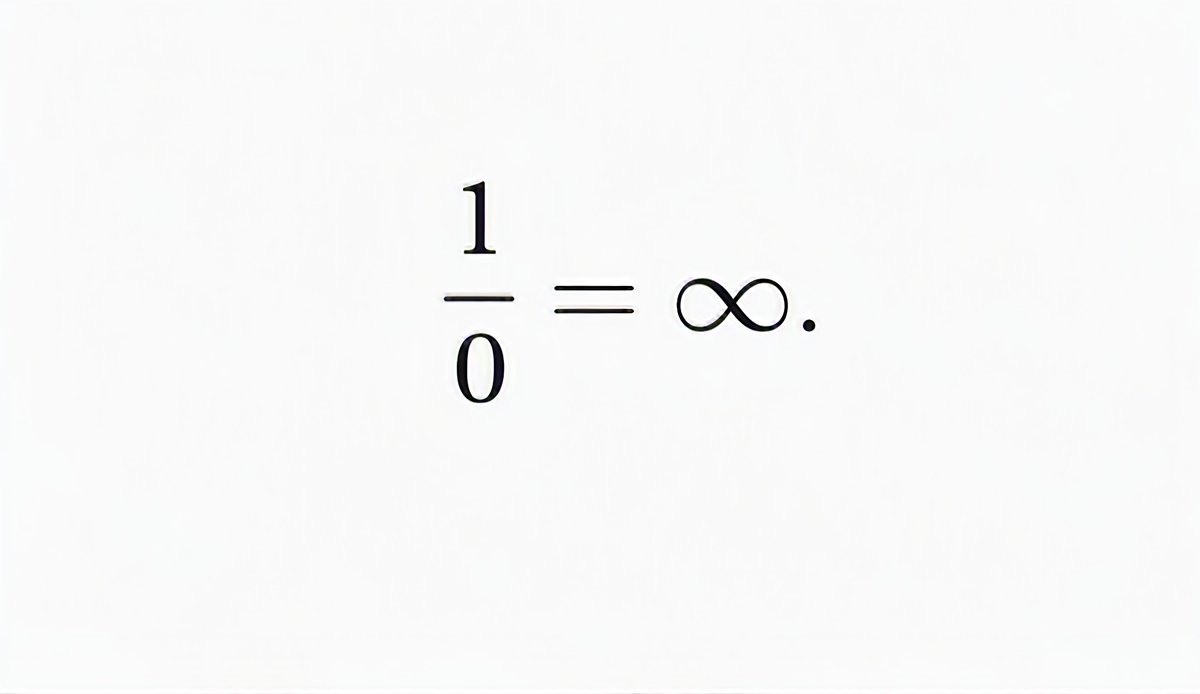
Whenever I hear someone say 1/0 = ∞, I think it is important to clarify what mathematics actually says. In standard arithmetic, 1/0 is undefined. Division asks us to find a number that, when multiplied by 0, gives 1. No such number exists.
However, as the denominator gets closer to zero from the positive side, 1 divided by that number becomes larger and larger without bound. This is why infinity appears when we discuss the limit, but infinity is not the value of 1/0.
So, 1/0 = ∞ is not mathematically correct. The correct idea is that 1/x → ∞ as x → 0⁺. The distinction between a value and a limit is small in notation but very important in mathematics.
To quote a veteran Naval aviator, "Two of the greatest feelings in the world are an orgasm and a good bowel movement."
But only landing a helicopter on a ship's deck in rough weather can give you both the feelings simultaneously.
A tribute to all "Chopper Pilots" on World Helicopter Day.
#Helicopter #WorldHelicopterDay #Aviation #Flying #Viral #ViralVideo #ViralPost #ViralVideos #ViralVideoes
Read books. Read everything. Read history to learn how societies grow strong and then fall apart. Read physics to understand that the universe doesn't care what you think. Read biology to see how amazing and delicate your body is. Read psychology to learn how often your brain tricks you. Read philosophy to ask better questions. Read economics to understand what motivates people. Read literature to experience thousands of lives while you live just one. Read poetry when regular words aren't enough for how you feel.
In the 1960s, a direct flight to Neptune would have taken nearly 30 years. That was longer than most spacecraft could survive. Reaching the outer planets seemed almost impossible.
But one engineer, working quietly with a pencil, found a way around this problem.
Gary Flandro, a scientist at NASA’s Jet Propulsion Laboratory, was asked to study how spacecraft might travel to the distant planets despite the limits of rocket technology at the time. Fuel was scarce, and engines were not powerful enough for such long journeys.
Flandro turned to a clever idea from physics called a gravity assist, sometimes known as a planetary slingshot. The concept is simple in principle. When a spacecraft passes close to a large planet, the planet’s gravity pulls it in and then flings it forward. In doing so, the spacecraft steals a tiny bit of the planet’s motion around the Sun. The planet slows down by an amount too small to notice, but the spacecraft gains a huge increase in speed without using any fuel.
With only paper, pencil, and the limited computers of 1965, Flandro calculated the future positions of Jupiter, Saturn, Uranus, and Neptune. What he found was remarkable. In the late 1970s, these giant planets would line up in a rare formation. This alignment would allow a single spacecraft to travel from one planet to the next, gaining speed at each step.
This opportunity appears only once every 176 years.
Flandro showed that a spacecraft could use Jupiter’s gravity to reach Saturn, then use Saturn to reach Uranus, and finally use Uranus to reach Neptune. This chain of boosts would cut the travel time to Neptune from about 30 years down to just 12.
This elegant piece of mathematics changed everything.
It became the foundation for the Voyager 1 and Voyager 2 missions, both launched in 1977. Thanks to this precise planning, the two spacecraft sent back the first close images of the outer planets. They later continued their journey beyond the solar system, becoming the first human-made objects to enter interstellar space.
All of it began with a simple insight, worked out by hand, that turned an impossible journey into a reachable one.