For leaders in operations and sustainability, embedding sustainability into laboratory processes is no longer just optional.
It’s a strategic imperative that supports efficiency, cost savings, risk reduction, and enhances both brand reputation and employee engagement.
A substantial portion of the environmental footprint for pharma and biotech companies, particularly Scope 3 carbon emissions, often lies within their value chain. Addressing this requires a holistic strategy that extends beyond internal operations.
We've put together a playbook outlining a clear and proven strategic approach to improving lab sustainability - aligned with global climate goals, #Scope3 emissions reporting, and operational excellence.
Based on more than a decade of experience working with the world’s largest pharma and biotech companies, this playbook will help leverage partnerships and certification for measurable gains in your lab.
Find it here: https://t.co/ZAhN94pWPf
9 out of 10 people who suffer cardiac arrest outside the hospital don’t survive. Most of the time, it’s because no one nearby performed CPR. But together, we can change that ❤️
Join Heart Walk today.
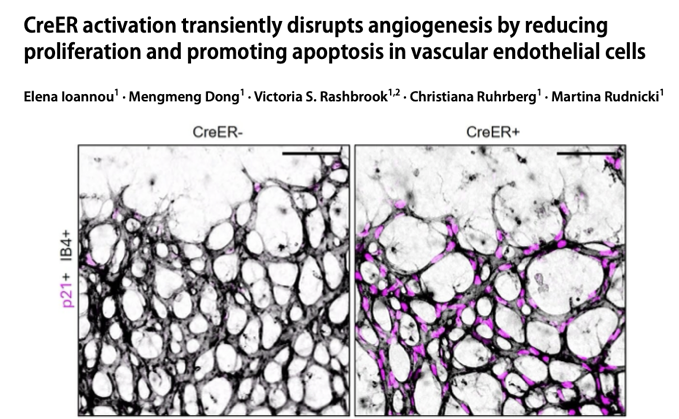
Do you use Cre-LoxP for genetic modification? Or study the molecular mechanisms of angiogenesis? Please read about CreER toxicity at https://t.co/ye2lXL7IYW in Springer Nature's Angiogenesis journal.
The American Heart Association mourns the passing of the legendary cardiologist Eugene Braunwald, M.D., widely recognized as one of the most influential figures in the history of cardiovascular medicine. Over seven decades, his work reshaped the understanding and treatment of heart disease, leading many to call him the father of modern cardiology.
Braunwald was a lifelong contributor to the American Heart Association, helping advance its research and scientific mission, and was honored with some of the Association’s highest honors for his lasting influence on cardiovascular care and research. His influence extended well beyond his own discoveries, as generations of Association‑supported investigators, clinicians and academic leaders were trained by Braunwald or guided by the clinical trial standards and mentorship models he helped establish.
https://t.co/ieZuHYMyOP
An Artemis II astronaut gave a shoutout to NASA’s Glenn Research Center while in space, which helped power the mission from Earth to the Moon and back with precision.
The Cleveland-based center contributes to propulsion, power systems, and testing that support NASA’s deep space missions.
You share 98.8% of your DNA with chimpanzees. A group of 200 of them just tore itself apart in a Ugandan rainforest, and researchers have been watching it happen for a decade.
A study came out yesterday in Science, one of the top research journals in the world. For 30 years, scientists tracked the Ngogo chimps in Uganda's Kibale National Park. This was the largest known chimp group on the planet, around 200 animals all living, hunting, and raising families together. Then around 2015, the group started splitting down the middle. Two clusters, one on the west side of the territory and one in the center, stopped spending time together. Males stopped mating with females from the other side. By 2018, they'd drawn a line through the forest and refused to cross it.
The Western chimps started raiding. Between 2018 and 2024, they killed 7 adult males and 17 babies from the Central group. They ripped infants straight off their mothers' chests. Fourteen more Central males vanished during that stretch, bodies never found, while Western's population climbed from 76 to 108. John Mitani, a University of Michigan researcher who spent over 20 years with these chimps, told NBC he believes the Central group is "doomed." He used the phrase "extinction event."
This almost never happens. DNA evidence suggests chimp communities fracture like this roughly once every 500 years. The only other time anyone saw it was in the 1970s with Jane Goodall's chimps in Tanzania, but researchers questioned that case because Goodall's team had been feeding bananas to the animals for years, which may have warped their natural behavior. Ngogo is the first split observed with zero human interference.
The cause dates back to 2014. Five males died that year, likely from disease. These weren't random chimps. They had close bonds on both sides of the group, the kind of friendships that kept 200 animals functioning as one unit. Once they were gone, a new top male seized control in 2015, a disease swept through and killed 25 more in 2017, and the two sides just kept drifting until there was nothing connecting them anymore.
One part of the paper sat with me. These chimps have no ethnicity. No religion. No political parties. The war started because friendships broke down, cliques solidified, and new group identities replaced years of cooperation. Aaron Sandel, the lead researcher from UT Austin, argued that keeping relationships alive across group lines may be the actual recipe for preventing this kind of collapse. In a species 98.8% identical to us, that recipe failed in under ten years.
🔬 Do you love microscopy and working with imaging data? We have a new seed funding opportunity in biomedical imaging and optics 🔬
This call supports creative and exploratory projects across areas such as optical imaging, fluorescence and bioluminescence, photoacoustics, Raman methods, OCT, and light tissue interactions and related topics. Projects can be fundamental or translational and may include reanalysis of existing datasets or cross disciplinary approaches.
We would like to enable early career researchers to test new ideas that can generate proof of concept within 6 months and lead to follow up funding, publications, or translational work.
💰 Seed funding:
$5,000 USD to support data analysis, experiments, or personnel.
👩🔬 Eligibility:
BS, MS, PhD, MD, postdocs, and early stage faculty worldwide
⏱ Timeline:
Projects should be completed within 6 months and generate meaningful preliminary insights.
Applications are short, typically 1–3 pages, and we encourage you to apply within the next two weeks. More details and the application link are in the comments. This call is led by @IliaRasskazov , feel free to reach out to him directly with any questions.
Feel free to share with your network if you know someone who should apply.
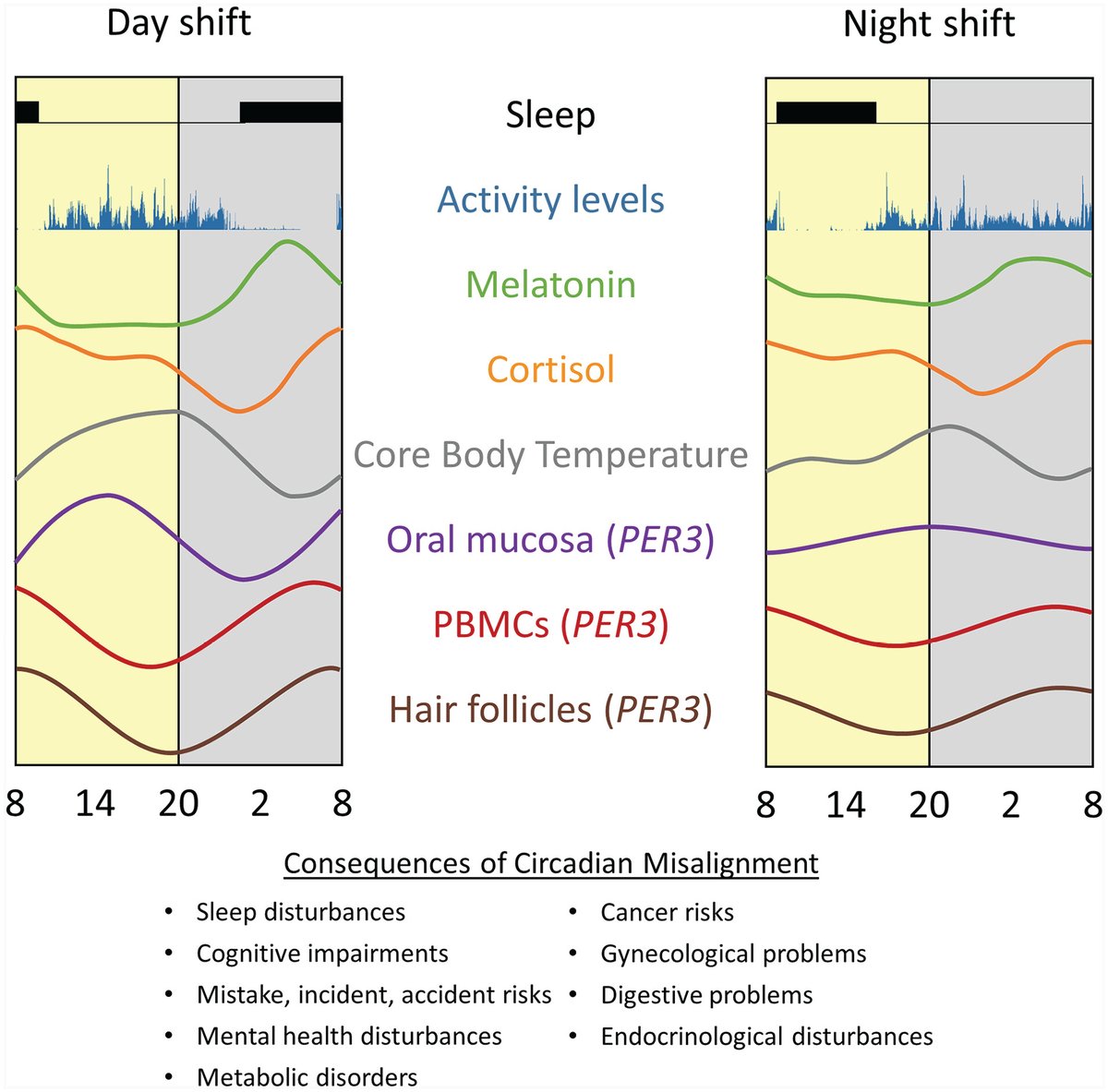
Throwback to this great review: shift work chronically disrupts circadian rhythms because our internal clocks don’t fully adapt to the inverted sleep schedule and light exposure, with detrimental effects on metabolic, cardiovascular, and mental health. https://t.co/vLA4JcvyPy..
Our paper is now out in Science! Super excited to share our discovery that #mitochondria#pearling is the elusive mechanism driving the regular distribution and inheritance of #mtDNA nucleoids 🧬 [1/6]
We see our home planet as a whole, lit up in spectacular blues and browns. A green aurora even lights up the atmosphere. That's us, together, watching as our astronauts make their journey to the Moon.
We're going around the Moon. Come watch with us. Artemis II's four-astronaut crew is lifting off from @NASAKennedy on an approximately 10-day mission that will bring us closer to living on the Moon and Mars. The launch window opens at 6:24pm ET (2224 UTC). https://t.co/X27QJejNDt
Tomorrow, we launch.
At sunset tonight, Artemis II waits on the pad, ready to carry astronauts potentially farther than any humans have traveled in more than half a century.
The next era of exploration begins.
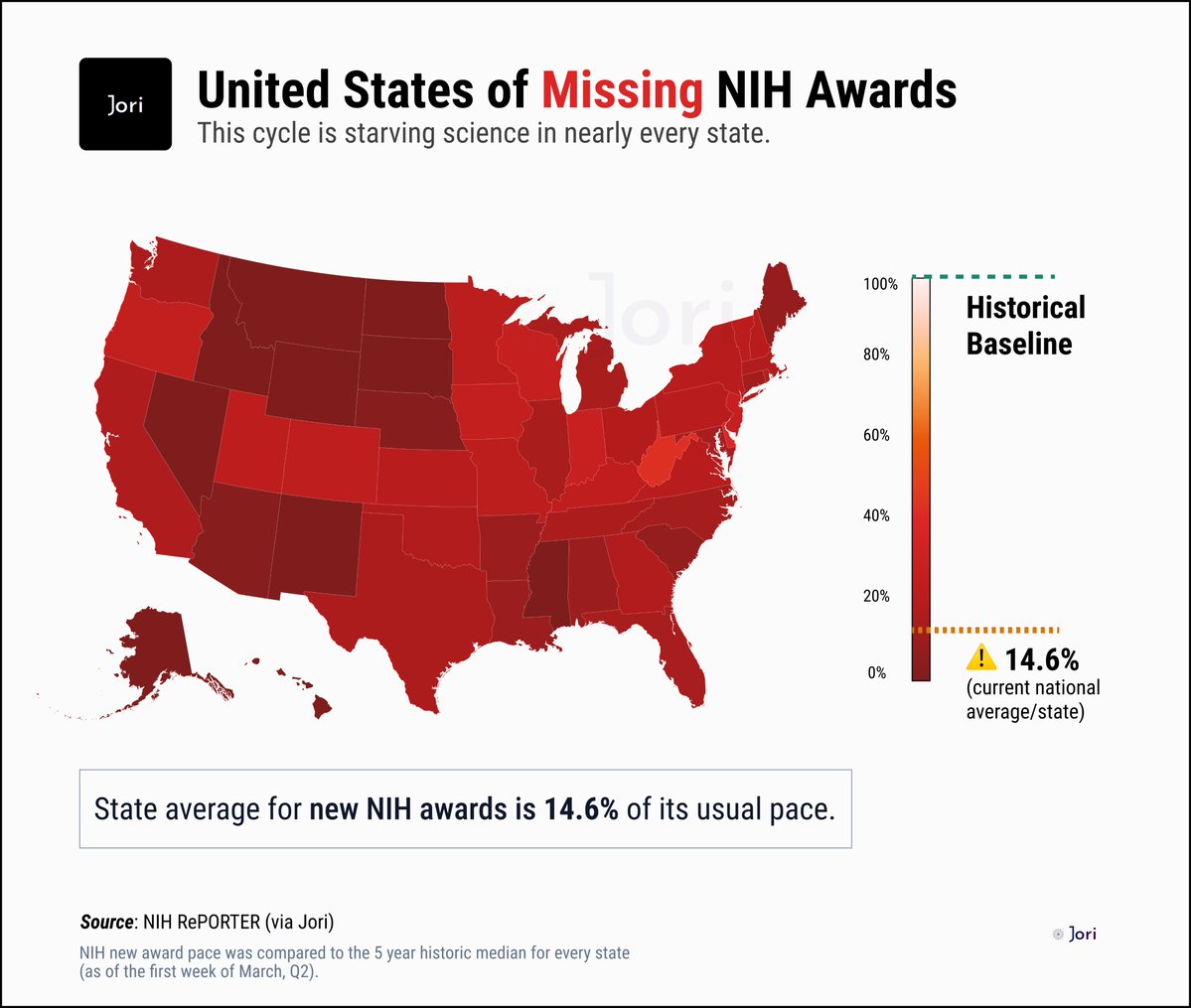
U.S. bioscience research is collapsing.
This is the map of a systemic rot.
NIH new award pace this year: 14.6% of normal.
If you wanted to stall science, you don't pick & choose states.
You just freeze the entire map.
In case you missed it:
▫️ ~95,000 scientists gone (@nytimes)
▪️ ~$2.4B in NIH research wiped out
▫️ ~$6B in economic loss (@DrCatharineY / PNAS)
This is what (predictably) follows next:
⇣ early-career scientists exit for good
⇣ breakthrough discoveries never made
⇣ trials that never open
⇣ labs that quietly shut down
⇣ global talent choosing other countries
⇣ the next decade of innovation erased before it starts
Sadly, you don’t "bounce back" from 14%
you just hollow out the system.
For a country that leads in science, this is the mo(u)rning after “National Science Appreciation Day”
==========
Source: NIH RePORTER via @Jori_health
Plot note: NIH new-award counts were compared to the 5-year historic median for every state (as of the first week of March, Q2).
==========
This is truly insane, and it should be front page news across America.
Denmark secretly deployed soldiers to Greenland prepared to blow up airport runways to stop a U.S. invasion.
They brought blood supplies to treat the wounded. France, Germany, Norway, and Sweden quietly coordinated against us.
This was not a drill.
This was our closest allies preparing to fight Americans.
Let that sink in. NATO allies. Countries whose soldiers have fought and died alongside ours for decades. They looked at this president and decided they had to prepare for the worst.
Fewer allies does not make America great. It makes us more isolated, more vulnerable, and it hands Russia and China exactly what they have always wanted: an America abandoned by its friends.
The American people deserve to know how badly this president has damaged our standing in the world. https://t.co/lxQD3X8jaM
Many good biology ideas never get tested because the researcher can't afford $2,000 in lab supplies.
At @PrimordiaGrants we aim to close that gap by funding tightly scoped experiments that can de-risk impactful ideas in 3-6 months. Apply now 👇
Scientists have plenty of ideas about why aging impairs memory. Reductions in blood flow in the brain, shrinking brain volume, and malfunctioning neural repair systems have all been blamed. Now, new research in mice points to another possible culprit: microbes in the gut.
In a new study, scientists show how a bacterium that is particularly common in older animals can drive memory loss. This microbe makes compounds that impair signaling along neurons connecting the gut with the brain, dampening activity in brain regions associated with learning and memory, the team found.
Learn more: https://t.co/WeS7y2ZXne
Researchers at the University of Pennsylvania have developed an innovative antiviral chewing gum that neutralizes over 95% of certain viruses in saliva, offering a simple, plant-based way to potentially curb transmission through everyday chewing.
Led by Henry Daniell at Penn's School of Dental Medicine, the team created a clinical-grade gum incorporating a natural antiviral trap protein called FRIL (Flt3 Receptor Interacting Lectin), derived from lablab beans (Lablab purpureus, also known as hyacinth beans). This protein binds to complex-type N-glycans on the envelopes of various viruses, entrapping them and preventing infection or spread.
Building on earlier work with a different gum containing plant-produced ACE2 (which reduced SARS-CoV-2 in saliva samples by >95% and is now in clinical trials), the latest formulation targets a broader range of pathogens. Lab tests showed that just 40 mg of the bean-based gum (from a 2-gram tablet) achieved more than 95% reduction in viral loads for influenza A strains (H1N1 and H3N2) and herpes simplex viruses (HSV-1 and HSV-2). The gum releases FRIL effectively during chewing, acting as a molecular decoy right at the site of viral replication in the mouth—key for limiting spread via talking, coughing, sneezing, or close contact.
The product is engineered for real-world practicality: it remains stable and fully functional at room temperature for over 790 days, meets FDA clinical-grade standards, and uses safe, natural ingredients. While the ACE2 version (targeting COVID-19) has advanced to human trials, this FRIL-based gum shows strong promise for seasonal threats like flu and herpes, and researchers are even exploring lablab bean powder against bird flu (H5N1) in animal feed.
If proven effective in upcoming clinical studies, this could become a low-cost, non-invasive tool for high-risk settings—schools, dental offices, public transport, or during outbreaks—helping reduce oral viral transmission without drugs or vaccines.
[Daniell et al., "Debulking influenza and herpes simplex virus strains by a wide-spectrum anti-viral protein formulated in clinical grade chewing gum," Molecular Therapy (2024). DOI: 10.1016/j.ymthe.2024.12.008]
BREAKING: A letter from Alex Pretti’s Final Nursing Student:
“I was Alex Pretti’s final nursing student. He was my friend and my nursing mentor. For the past four months, I stood shoulder to shoulder with him during my capstone preceptorship at the Minneapolis VA Hospital. There he trained me to care for the sickest of the sick as an ICU nurse. He taught me how to care for arterial and central lines, the intricacies of managing multiple IVs filled with lifesaving solutions, and how to watch over every heartbeat, every breath, and every flicker of life, ready to act the moment they wavered. Techniques intended to heal.
Alex carried patience, compassion and calm as a steady light within him. Even at the very end, that light was there. I recognized his familiar stillness and signature calm composure shining through during those unbearable final moments captured on camera.
It does not surprise me that his final words were, “Are you okay?” Caring for people was at the core of who he was. He was incapable of causing harm. He lived a life of healing, and he lived it well.
Alex believed strongly in the Second Amendment and in the rights rooted in our Constitution and its amendments. He spoke out for justice and peace whenever he could, not only out of obligation, but out of a belief that we are more connected than divided, and that communication would bring us together.
I want his family to know his legacy lives on. I am a better nurse because of the wisdom and skills he instilled in me. I carry his light with me into every room, letting it guide and steady my hands as I heal and care for those in need.
Please honor my friend by standing up for peace, preferably with a cup of black coffee in hand and a couple of pieces of candy in your pocket, just as he would. He would remind you that caring for others is hard work, and we must do whatever it takes to get through the long shifts. Step outside with your dog, breathe in the world, hike or bike as he loved to do, and let yourself find peace in the quiet moments within nature. Stand up for justice and speak with those whose views differ from your own. Hold your beliefs with strength, but always extend love outward, even in the face of adversity.
Take one step, no matter how small, to help heal our world. Through these acts, carry his light forward in his name. Let his legacy continue to heal.”




![jclandoni's tweet photo. Our paper is now out in Science! Super excited to share our discovery that #mitochondria #pearling is the elusive mechanism driving the regular distribution and inheritance of #mtDNA nucleoids 🧬 [1/6] https://t.co/eT6JJZkyVE](https://pbs.twimg.com/media/HE-3eJ3bIAA4BrQ.jpg)



![Rainmaker1973's tweet photo. Researchers at the University of Pennsylvania have developed an innovative antiviral chewing gum that neutralizes over 95% of certain viruses in saliva, offering a simple, plant-based way to potentially curb transmission through everyday chewing.
Led by Henry Daniell at Penn's School of Dental Medicine, the team created a clinical-grade gum incorporating a natural antiviral trap protein called FRIL (Flt3 Receptor Interacting Lectin), derived from lablab beans (Lablab purpureus, also known as hyacinth beans). This protein binds to complex-type N-glycans on the envelopes of various viruses, entrapping them and preventing infection or spread.
Building on earlier work with a different gum containing plant-produced ACE2 (which reduced SARS-CoV-2 in saliva samples by >95% and is now in clinical trials), the latest formulation targets a broader range of pathogens. Lab tests showed that just 40 mg of the bean-based gum (from a 2-gram tablet) achieved more than 95% reduction in viral loads for influenza A strains (H1N1 and H3N2) and herpes simplex viruses (HSV-1 and HSV-2). The gum releases FRIL effectively during chewing, acting as a molecular decoy right at the site of viral replication in the mouth—key for limiting spread via talking, coughing, sneezing, or close contact.
The product is engineered for real-world practicality: it remains stable and fully functional at room temperature for over 790 days, meets FDA clinical-grade standards, and uses safe, natural ingredients. While the ACE2 version (targeting COVID-19) has advanced to human trials, this FRIL-based gum shows strong promise for seasonal threats like flu and herpes, and researchers are even exploring lablab bean powder against bird flu (H5N1) in animal feed.
If proven effective in upcoming clinical studies, this could become a low-cost, non-invasive tool for high-risk settings—schools, dental offices, public transport, or during outbreaks—helping reduce oral viral transmission without drugs or vaccines.
[Daniell et al., "Debulking influenza and herpes simplex virus strains by a wide-spectrum anti-viral protein formulated in clinical grade chewing gum," Molecular Therapy (2024). DOI: 10.1016/j.ymthe.2024.12.008]](https://pbs.twimg.com/media/G_wsfqWXgAAicxU.jpg)