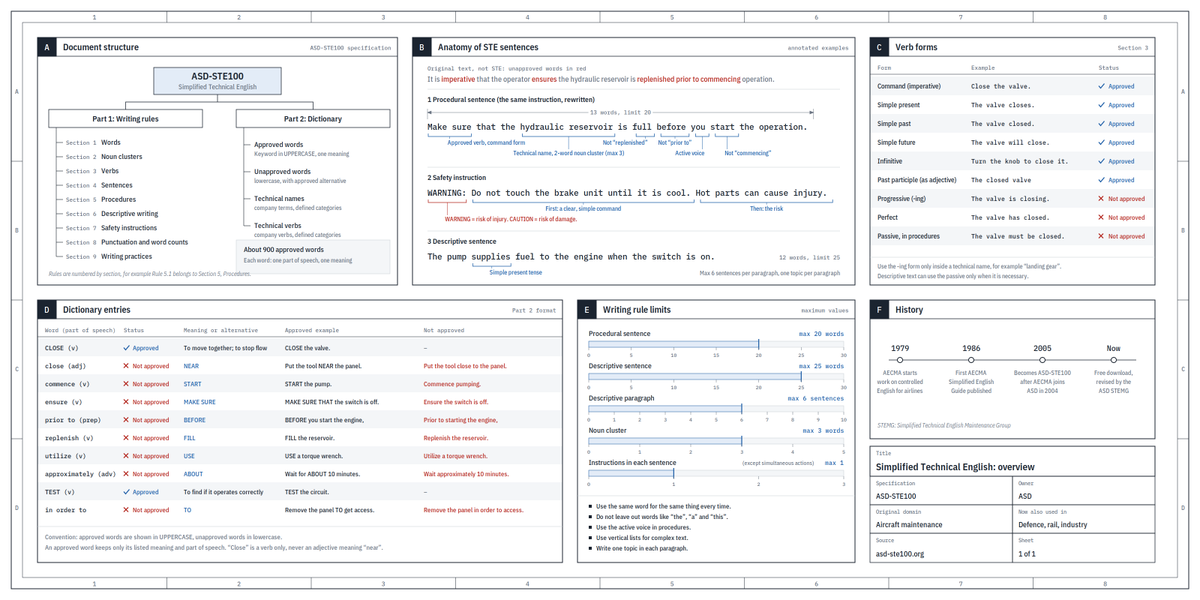
Using ASD-STE100 in Hermes via skill creative/simple-english. Rewriting all my tech docs — repos, Obsidian notes, LLM output. Far easier to read.
Persistent docs in Markdown; interim outputs/reports as HTML pages for me. Better reading experience.
We'll be spending a lot more time trying to understand the outputs of language models. A few thoughts, tips & tricks:
Writing. Something I've had success with: Ask your LLM to explain something in ASD-STE100, it's a controlled language specification originally developed for aerospace maintenance documentation. LLMs well-versed in this language and it comes with heavy constraints on clean writing style that I often find a lot more readable. Sometimes I've tried to soften it a bit e.g. ask for "80% of the way to ASD-STE100" because the spec is quite stringent. But even better:
Diagrams / images. Instead of writing, ask your LLM to create a diagram. These can be a lot easier to process, parse, and understand. But even better:
Web pages. Ask for output "in HTML" to get a beautiful, interactive webpage. LLMs are getting really good at frontend and can create beautiful experiences, animations, etc. But even better:
Explainer videos. The output format I am most bullish on is fully custom / bespoke explainer videos generated on any arbitrary topic. Experiment with things like "Create a 3b1b style video explainer on X. Use my ElevenLabs API key for audio narration". (you'd need an API key for the latter or you can ask your LLM to find you decent free alternatives that use your local compute). This is actually starting to work!
In summary:
- As LLMs get better, they will do more and more of the legwork autonomously, and a lot more of our work will rise up the abstractions into oversight and understanding.
- Luckily, LLMs can help here too because as intelligence and code are increasingly abundant, you can ask for large, custom, discardable software artifacts (e.g. web apps, video explainers) that would have never made sense to create before. Push the boundaries here and you'll be surprised.
@mattshumer_ 😆 solid controversial line for triggering attention 😉
- enterprise models are useless for privacy focused cases
- local models will always be useful for enterprises charging ridiculous $ for tokens - which often needs an “advisor” for burning more tokens and exhaust limits
I can feel the FOMO and telling myself it’s another Tulip mania. Qwen3.8-flash-next on 1 DGX Spark has been good enough for running my personal assistant - accessible anytime, anywhere, no weekly budgets.
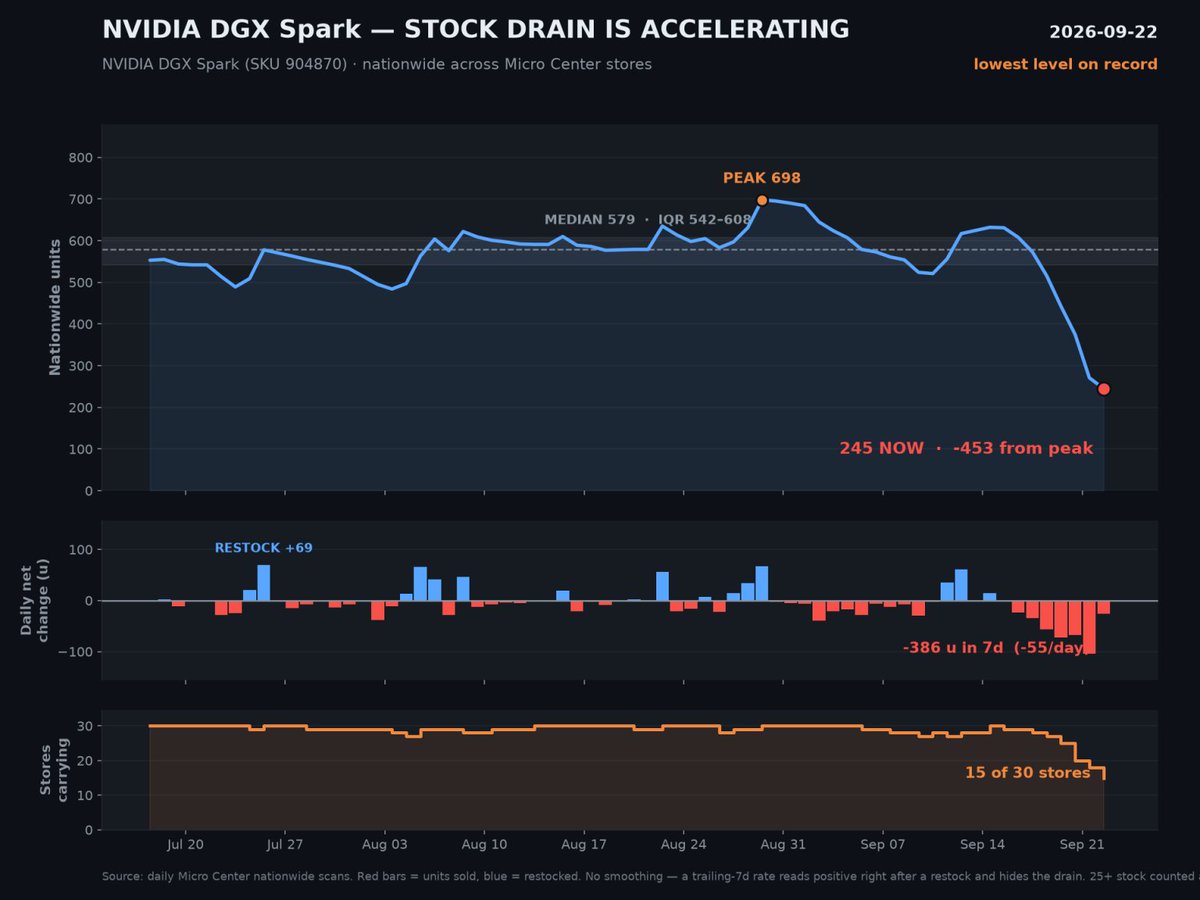
Report from 9:30 Sparks down from 278 to 245 left in the US at Microcenters.
Wonder if we'll see a stock bump or not. They've never been this low though.
No patched chat template needed. Qwen3.6 required a custom Jinja template (froggeric v20) mounted in the container. Qwen3.8 just uses vLLM's OpenAI content format and works out of the box.
KV cache is now fp8 vs bfloat16. Qwen3.6's checkpoint lacked FP8 calibration data (q_scale/prob_scale), so I pinned bfloat16. Qwen3.8 ships calibrated static FP8 KV scales, so fp8 works out of the box - halving KV memory.
Context is now 1M (YaRN) vs the 150K-190K I capped Qwen3.6 at. I'd capped it to avoid losing context and keep DGX Spark fast. On my setup (fp8 KV, 0.90 GPU mem) no meaningful speed loss. Big win: on long tasks the harness no longer has to compact context as often.
No more thinking loops. Qwen3.6 would occasionally get stuck in an endless thinking loop — Qwen3.8 didn't for me. It still overthinks a bit, but the fix is easy: run it in instruct mode with reasoning off. For my day-to-day, nearly all workflows are pre-defined as harness skills.
@herdrdev is so good; it's been a week since I started using it and never missed `tmux`. All the customizations I did on `tmux` including resurrections, ssh session aliases, keyboard/mouse global settings seems out of the box/not required in `herdr`.