As engineering, product, design, DS, etc. melt into a new kind of role, I was reflecting on what roles might look like in the future. For example, when I look at the Claude Code team I see what I think is five archetypes:
1. Prototyper: comes up with brand new ideas; churns out many ideas, most of which don't ship
2. Builder: quickly turns a prototype/idea into production-grade product/infra
3. Sweeper: cleans up the UI, simplifies the code and system, unships, optimizes performance
4. Grower: takes a product that has been built and iterates on it to improve Product-Market Fit
5. Maintainer: owns a mature system to make it secure, reliable, fast, and efficient as it scales
Many people span across 2 roles, and sometimes 3 roles. I also notice that these roles are not really tied to job function -- eg. across Anthropic, some designers match category 1, some 2, some 3; same for engineers, PM, DS.
A healthy team needs a mix of these, depending on the product:
- A product that is new and pre-PMF needs people that are strong at 1+2+3
- A product that is growing and has found PMF needs 2+3+4 and some 5
- A product that has strong PMF needs 3+4+5 and some 2
Maybe product roles of the future will look more like this, and less like the domain-specific roles of today?
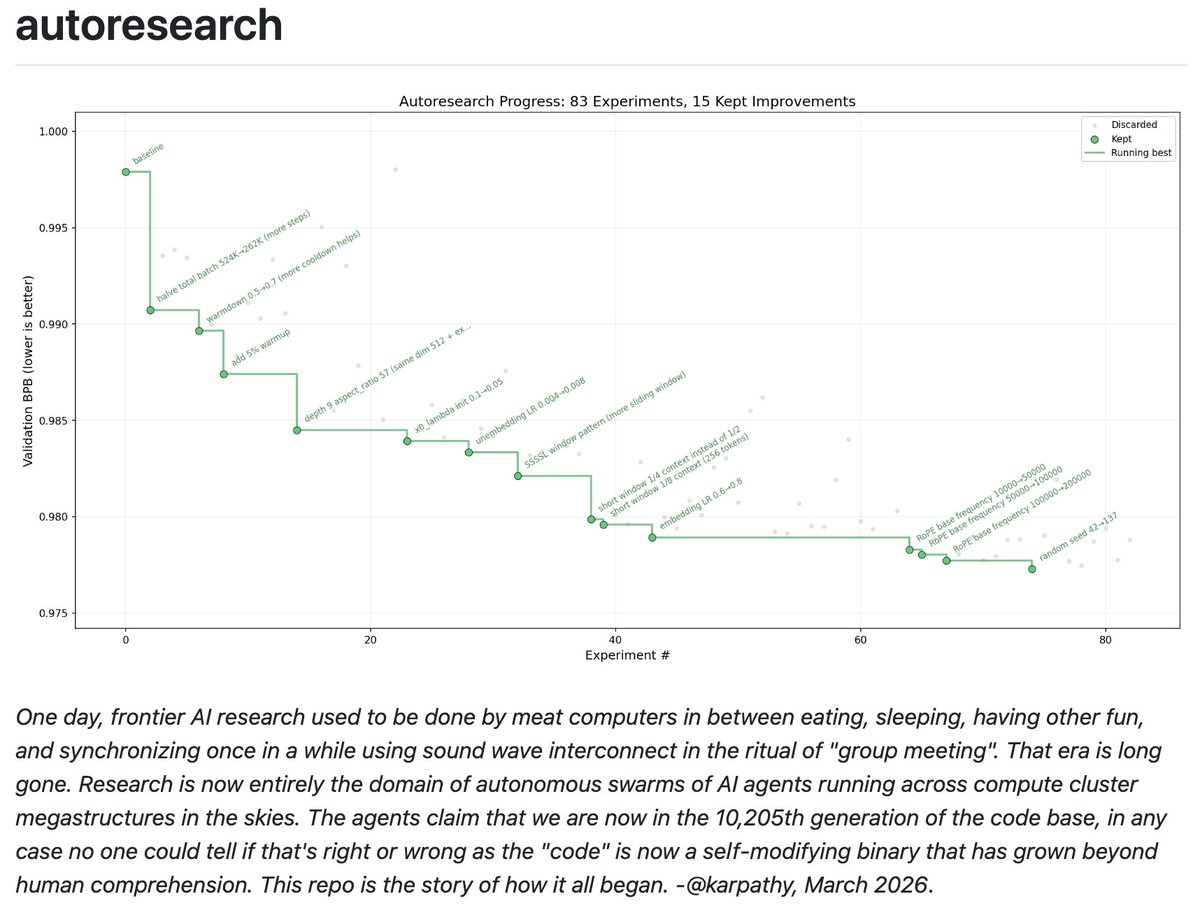
I packaged up the "autoresearch" project into a new self-contained minimal repo if people would like to play over the weekend. It's basically nanochat LLM training core stripped down to a single-GPU, one file version of ~630 lines of code, then:
- the human iterates on the prompt (.md)
- the AI agent iterates on the training code (.py)
The goal is to engineer your agents to make the fastest research progress indefinitely and without any of your own involvement. In the image, every dot is a complete LLM training run that lasts exactly 5 minutes. The agent works in an autonomous loop on a git feature branch and accumulates git commits to the training script as it finds better settings (of lower validation loss by the end) of the neural network architecture, the optimizer, all the hyperparameters, etc. You can imagine comparing the research progress of different prompts, different agents, etc.
https://t.co/YCvOwwjOzF
Part code, part sci-fi, and a pinch of psychosis :)
Introducing Claude Opus 4.6. Our smartest model got an upgrade.
Opus 4.6 plans more carefully, sustains agentic tasks for longer, operates reliably in massive codebases, and catches its own mistakes.
It’s also our first Opus-class model with 1M token context in beta.
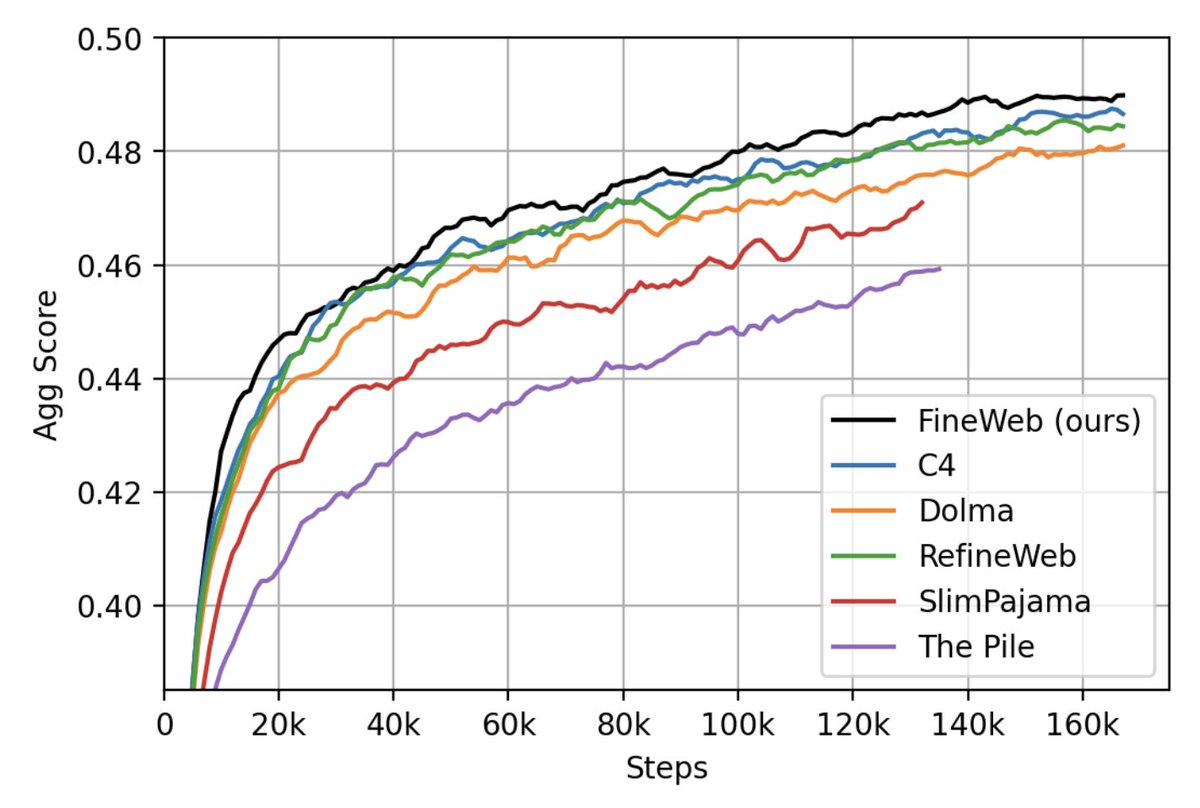
We have just released 🍷 FineWeb: 15 trillion tokens of high quality web data.
We filtered and deduplicated all CommonCrawl between 2013 and 2024.
Models trained on FineWeb outperform RefinedWeb, C4, DolmaV1.6, The Pile and SlimPajama!
Our work on topics models using topic-word distribution in variational auto-encoders will be live on #ACL2021NLP in less than half-hour. (16:50 UTC Aug3 Tuesday Session: 11D).
Paper: https://t.co/TG8VRUnHDa
ACL Video: https://t.co/Y4rOvKJczy
95% rom stories end with commitment bc evrth after that is a blank morass- J Green
NOT MINE
I killed her. That day, I died too.
Thought I was forgiven when Ira came and healed me. I was wrong.
After 15 loving yrs, she said she wanted to die.
I agreed.
#PitMad#NA#CR#POC#MH#ND
KnowGraph@IITK at SemEval-2021 Task 11: Building KnowledgeGraph for NLP Research
https://t.co/II4AbN6LNI
by Shashank Shailabh et al. including @ashuMod#Heuristics#KnowledgeGraph
I will be taking #PhD students in Fall 2021 at @UCSanDiego@ucsd_cse (Deadline Dec 16, no GRE required). https://t.co/CzeZtFEmi9
Come to the beautiful La Jolla to work with us on #Physics -Guided #AI, #spatiotemporal#ML, #Tensor methods, and more!
Grateful for RT!
The Self-Organizing Conference on Machine Learning is returning as a 100% online event for 2020. Nov 30-Dec 4. It will still be small to maintain the group discussion feel. Apply at https://t.co/99gVaqmhJd