🚨This just killed the voice AI business model.
ElevenLabs charges up to $1,320/month.
An open-source model just beat it.
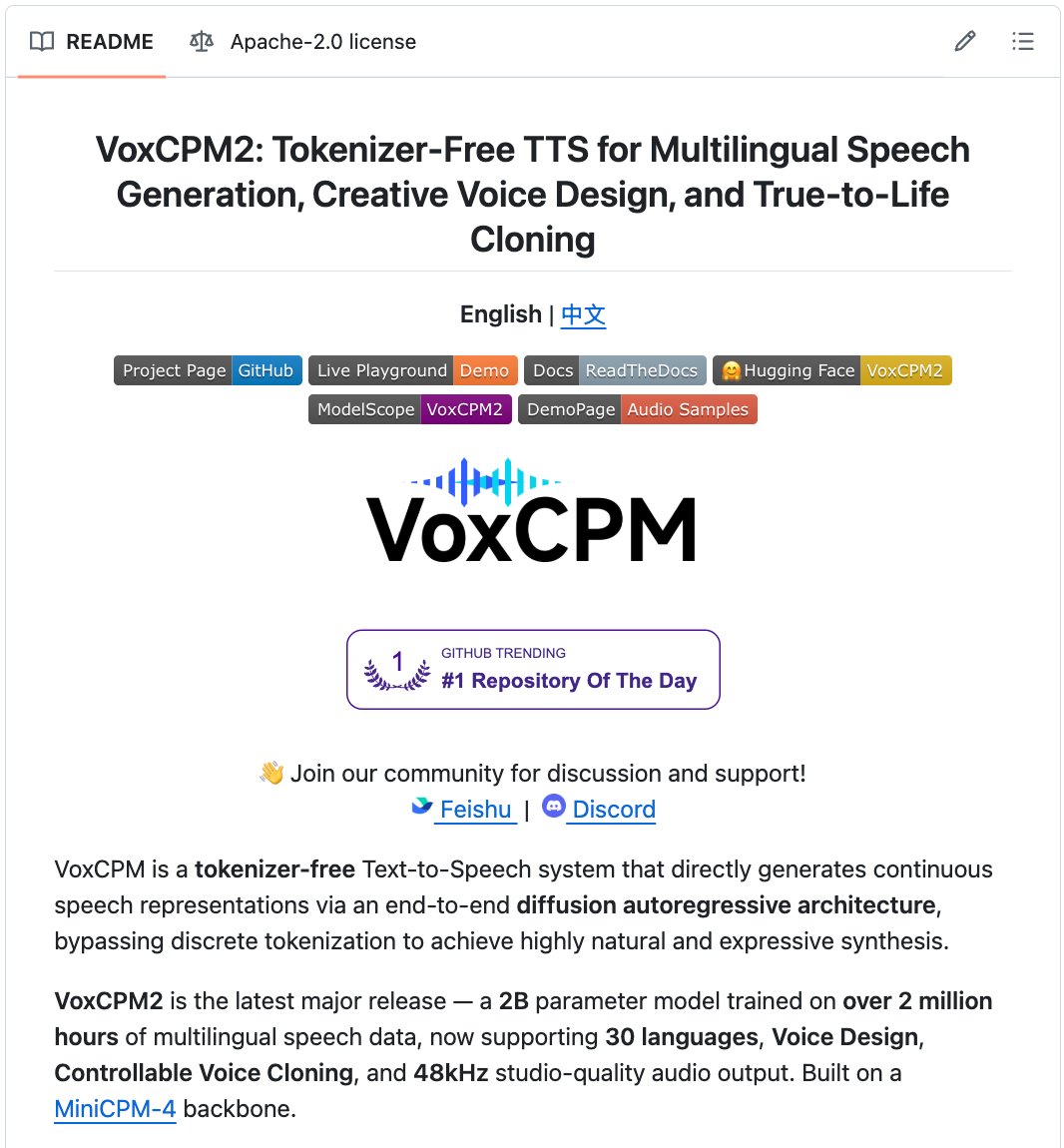
Meet VoxCPM2:
Clone any voice
From seconds of audio
In 30 languages
At studio quality
For $0.
No API.
No subscription.
Runs locally.
Even crazier:
It can invent voices from text
“Soft, calm female voice” → generated instantly
And benchmarks?
VoxCPM2: 85% similarity
ElevenLabs: 61%
Let that sink in.
A free model
just outperformed
a $1,300/month product.
Voice actors.
Studios.
SaaS platforms.
Everything just changed.
Repo https://t.co/syeAxOea8C
Introducing a new method to teach LLMs to reason like Bayesians. By training models to mimic optimal probabilistic inference, we improved their ability to update their predictions and generalize across new domains. Learn more: https://t.co/EU5nFbBaxn
When u stand on principle regardless of who is asking you to break it, that shuts down all those people who said @DarioAmodei only talks about security when fundraising Great job @Anthropic. You have one more longterm user & customer today.
#aiforgood#anthropic#TechForGood
This stopped me.
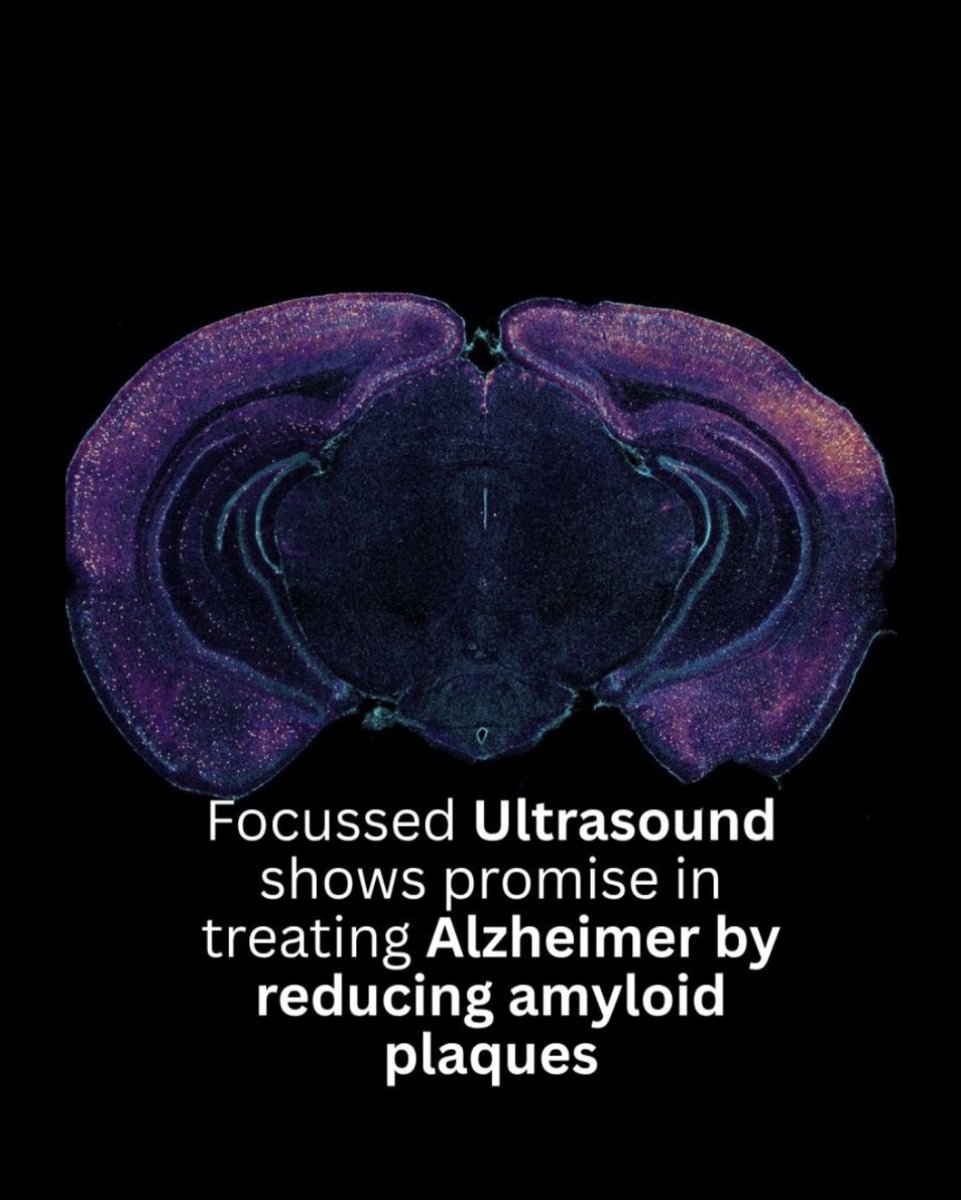
MIT researchers cleared 50% of Alzheimer’s plaques
using 40 Hz sound waves.
No drugs.
No surgery.
Just frequency.
For decades, we tried to fight Alzheimer’s chemically.
Billions spent.
Minimal progress.
Then something different happened.
Expose the brain to 40 Hz gamma waves.
Microglia activate.
Plaques get cleared.
The brain cleans itself.
As someone who has spent years studying automation and systems, this fascinates me.
We are not attacking disease anymore.
We are tuning the system.
Focused ultrasound can:
→ Reduce tremors in one session
→ Open the blood-brain barrier for hours
→ Deliver treatment precisely where needed
Not by cutting.
Not by poisoning.
By orchestrating.
That shift feels bigger than one breakthrough.
It suggests something deeper.
What if the future of medicine is not force…
but frequency?
So here is the question I cannot ignore:
If we can tune biology instead of fighting it, what else have we misunderstood about healing?
#AI #HealthTech #Neuroscience #Innovation #FutureOfMedicine #Technology
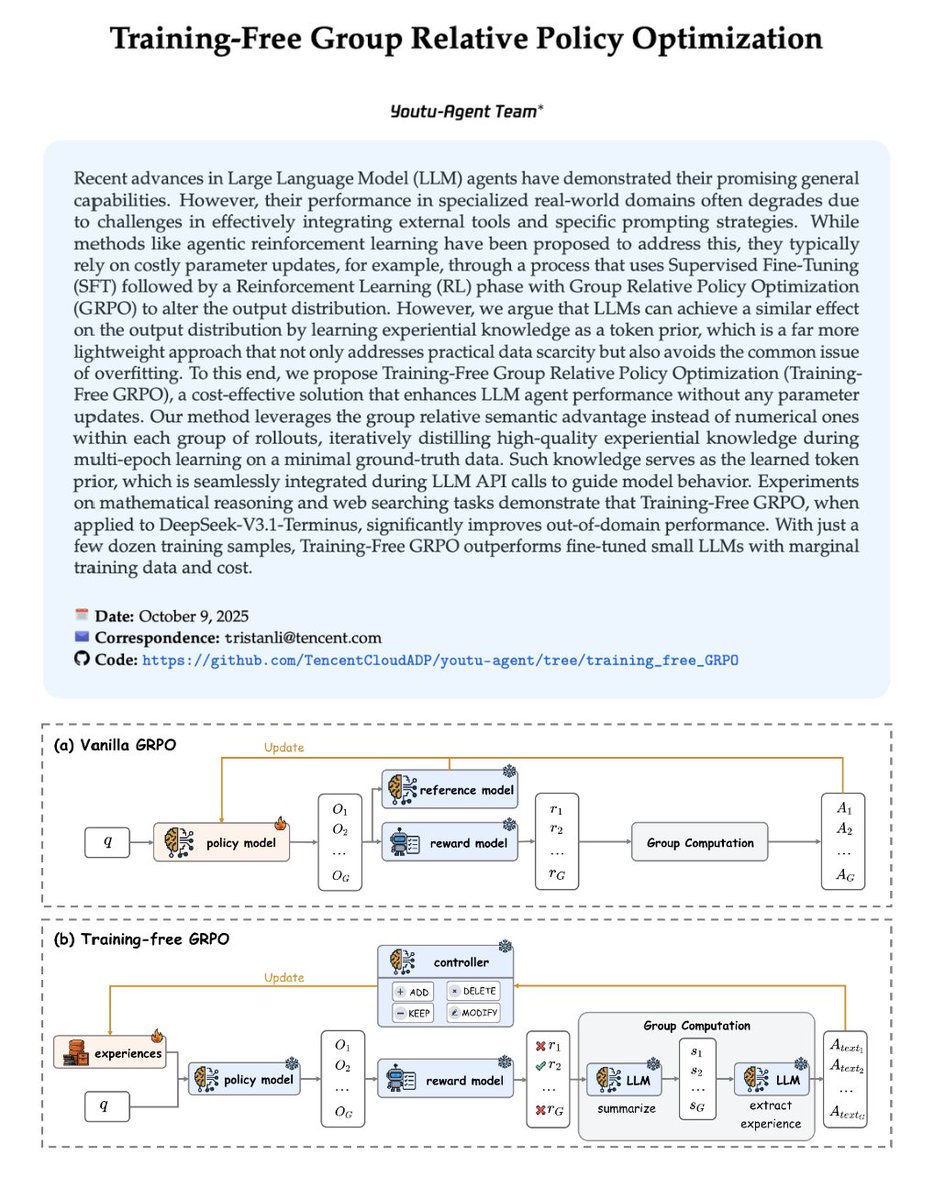
Did researchers at Tencent just kill fine-tuning?
A new paper called Training-Free GRPO shows you can get the same results as reinforcement learning for $18 instead of $10,000, with zero parameter updates.
The idea is surprisingly simple:
Instead of updating the model's weights through RL, you let the model practice on a few problems, compare what worked and what didn't across multiple attempts, and distill that into natural language "experiences" that get injected into the prompt.
The model stays completely frozen. All the learning happens in what the model reads, not what the model is.
Here's how it works:
↳ For each problem, generate multiple outputs and score them
↳ Compare the winners and losers within each group
↳ Ask the LLM to articulate WHY certain attempts succeeded
↳ Store those insights in an evolving experience library
↳ Inject the experiences into future prompts
The results are wild.
Training-Free GRPO applied to DeepSeek-V3.1-Terminus (671B) outperformed fine-tuned 32B models on the AIME math benchmarks.
It used 100 training samples instead of 17,000. It cost $18 instead of $10,000. And because the base model is never touched, it generalizes across both math AND web searching simultaneously.
Fine-tuned models can't do that. ReTool, trained on math, dropped from 67% to 18% when tested on web tasks. Worse than the baseline.
But I want to be clear on something:
This isn't just prompt engineering.
Directly asking an LLM to generate helpful tips doesn't work. Performance actually dropped when they tried that.
The experiences only become useful when they're distilled through the structured loop of trying, failing, comparing, and reflecting. That's what makes this different from self-reflection or few-shot prompting.
You might wonder: aren't we just bloating the context window?
Not really. Each experience is capped at 32 words. The math experiments produced 48 total. That's roughly 1,500 tokens for a model with a 128K context window.
And tool calls actually decrease after learning. The agent takes fewer wrong turns, so the small context cost saves tokens downstream.
I've shared link to the paper in the next tweet.
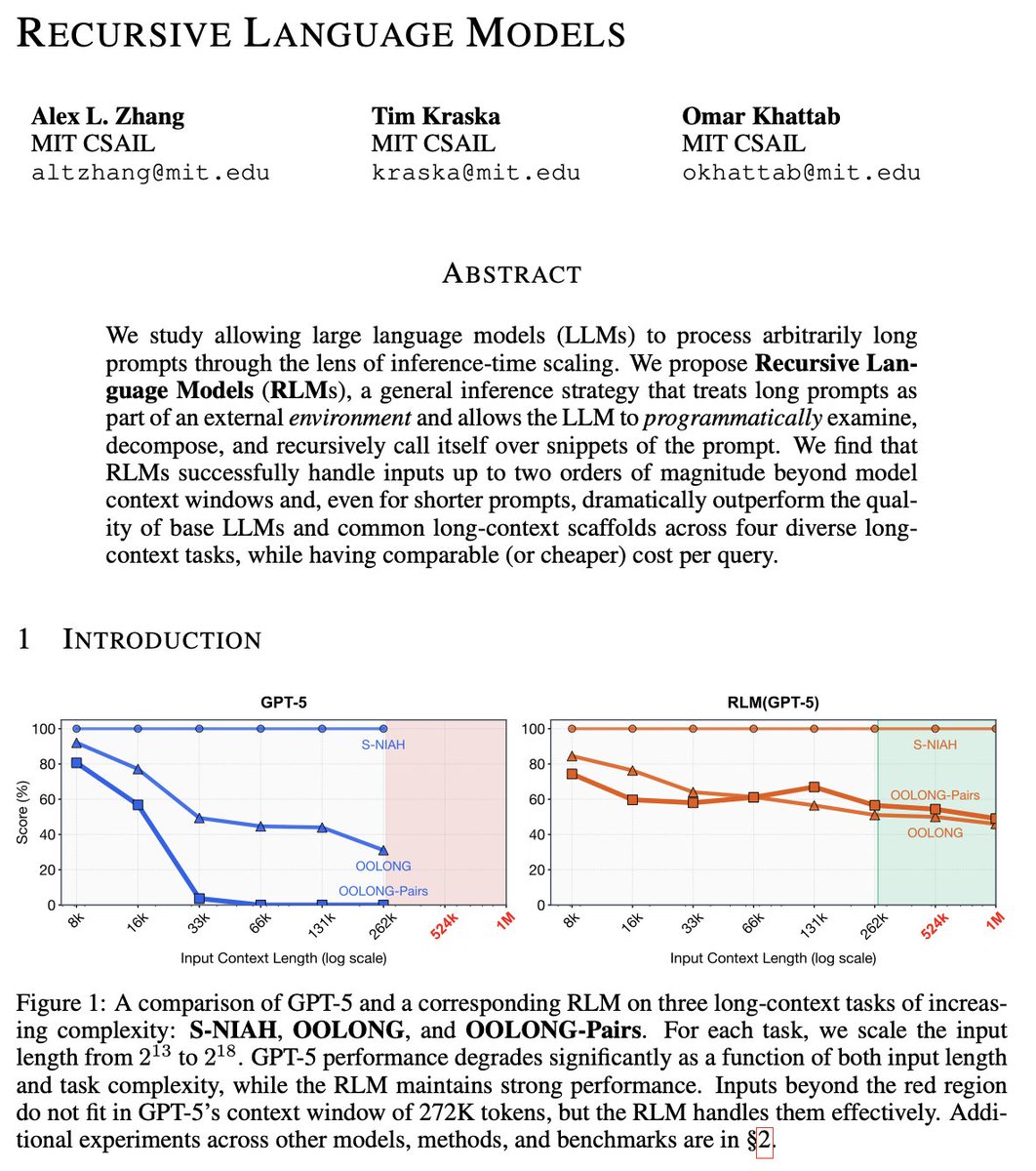
Much like the switch in 2025 from language models to reasoning models, we think 2026 will be all about the switch to Recursive Language Models (RLMs).
It turns out that models can be far more powerful if you allow them to treat *their own prompts* as an object in an external environment, which they understand and manipulate by writing code that invokes LLMs!
Our full paper on RLMs is now available—with much more expansive experiments compared to our initial blogpost from October 2025!
https://t.co/x47pIfIkTb
New art project.
Train and inference GPT in 243 lines of pure, dependency-free Python. This is the *full* algorithmic content of what is needed. Everything else is just for efficiency. I cannot simplify this any further.
https://t.co/HmiRrQugnP
Gemini 3 Flash now uses an agentic "think-act-observe" loop to solve complex visual tasks 🤖
@GoogleDeepMind engineer @ptruiz_dev demonstrates how the model runs Python code automatically to zoom and inspect items, annotate images, and re-visualize data into charts.
The drug design engine we’re building at @IsomorphicLabs is extending the SOTA further across key benchmarks, showing huge progress in accuracy and capabilities critical for in-silico drug discovery. Incredible work from @maxjaderberg and the entire team at Isomorphic Labs!
For truly realistic conversational research, we must rethink fully autonomous agent design.
DialogLab, our new open-source prototyping framework, uses a human-in-the-loop control strategy to achieve realistic human-AI group simulation, offering a necessary alternative to fully autonomous agents.
Recursive Language Models (RLMs) let agents manage 10M+ tokens by delegating tasks recursively.
This Google Cloud Community Article explains why ADK was the perfect choice for re-implementing the original RLM codebase in a more enterprise-ready format →https://t.co/p3MsNtLVJL
If you have ever made a film using AI, read this carefully.
InVideo is hosting the world’s largest AI Film Festival.
Your film will be screened in front of PM Modi, President Macron, Jensen Huang, Sam Altman, and Sundar Pichai at one of the most iconic monuments in the world.
Submissions are open to everyone right now.
Here is exactly how to submit:
New Engineering blog: We tasked Opus 4.6 using agent teams to build a C compiler. Then we (mostly) walked away. Two weeks later, it worked on the Linux kernel.
Here's what it taught us about the future of autonomous software development.
Read more: https://t.co/htX0wl4wIf
Prop 50 was a tough decision, do we gerrymander because another state did it? I voted No. There should be non partisan redistricting in all states.
#prop50#gerrymandering
Excited to share early results about CodeMender, our new AI agent that automatically fixes critical software vulnerabilities. AI could be a huge boost for developer productivity and security. Amazing work from the team - congrats!
It is hard to even comprehend the numbers or wrap our mind around the scale of AI token growth - a quadrillion - a million billion 🤯 @google@demishassabis#google#ai
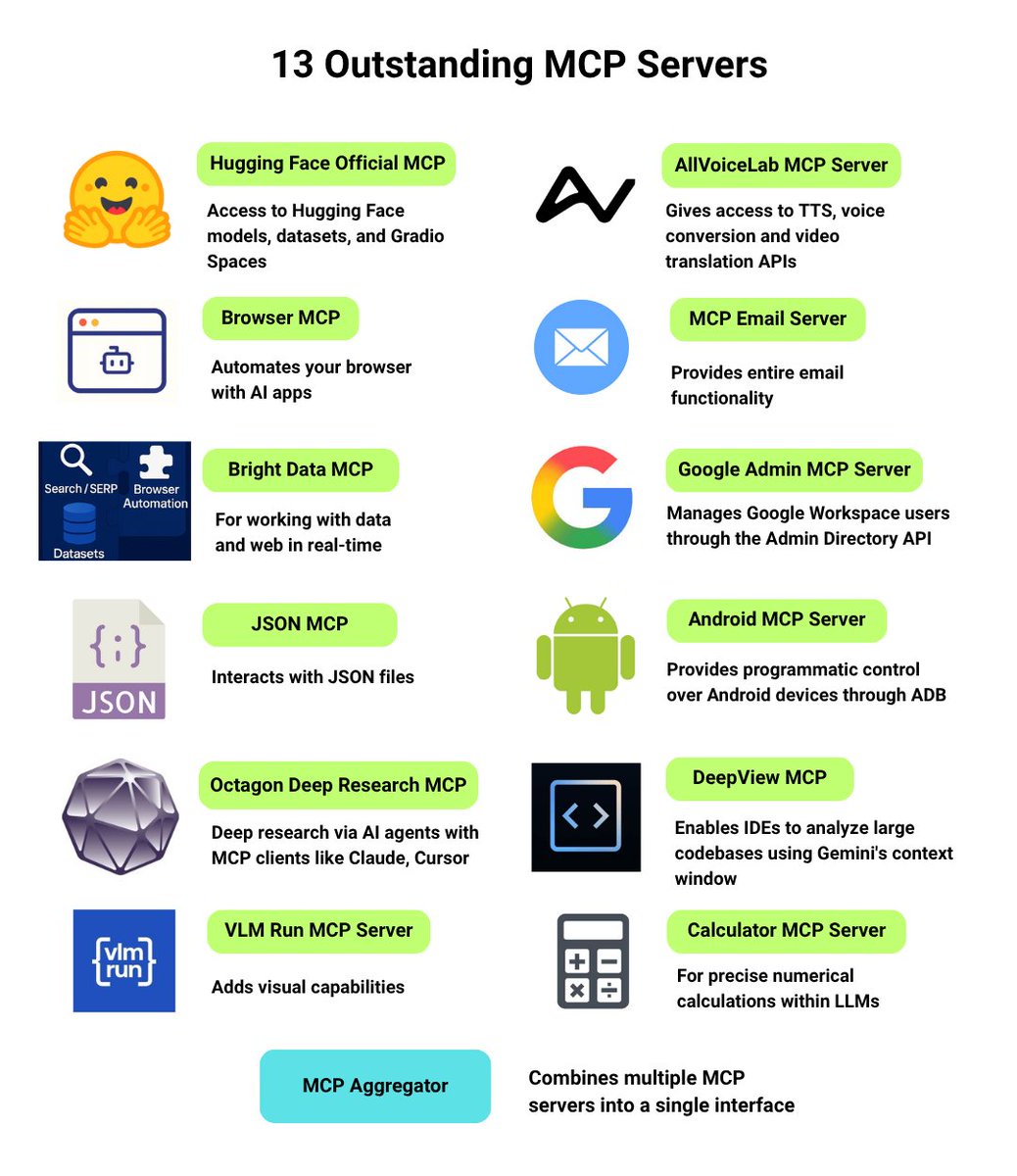
13 Outstanding MCP Servers:
▪️ Hugging Face Official MCP Server
▪️ Browser MCP
▪️ Bright Data
▪️ JSON MCP
▪️ Octagon Deep Research
▪️ VLM Run MCP
▪️ AllVoiceLab MCP Server
▪️ MCP Email Server
▪️ Google Admin MCP
▪️ Android MCP
▪️ DeepView
▪️ Calculator
▪️ MCP Aggregator
Save the list and check this out for the links and more info: https://t.co/DC8mnhiFaD