A Software Engineer specialized in building visually appealing and functional scalable applications. Effective collaborator with designers, product managers
Not everyone will type, but everyone can speak.
Today, we are introducing VoiceMaker, our voice-first creativity platform for Africa.
VoiceMaker allows creators to generate localized content, natural voiceovers, audiobooks, dubbed videos, animations, and transcriptions across Yoruba, Igbo, Hausa, Nigerian Pidgin, and Nigerian English, with dialect-level precision from places like Ijebu, Kano, Aba, and Lagos.
“Yoruba” is not just Yoruba; Kano doesn’t sound like Lagos, and real conversations don’t stay in one language.
With natural code-switching, accent-aware speech recognition, a rich selection of voices for different dialects. VoiceMaker is built for how Nigerians actually speak.
Creators, agencies, and media houses can generate voiceovers, transcribe audio, and clone voices for content that finally sounds local.
We’re currently in closed beta and would love to get your feedback.
Try it for free at https://t.co/TvizutEg62
@TryVoiceAI@VoiceAI_Global@QhalaHQ@Deloitte@DeloitteDigital@Google@Microsoft@AfricaAI_@women_in_ai@CARE@N984TW@OpenSpaceInst@OpenAI@toladata@datanetstracon@LanguageCoach@languageaicorp@aimultimediaNG@aiexpoafrica
#EqualyzAI #VoiceMaker #VoiceAI #AfricanAI #NigerianLanguages #Yoruba #Igbo #Hausa #SpeechTechnology #TextToSpeech #AIForAfrica #ConversationalAI #VoiceMaker
It's so great, there are so many of them!
Here are more fellowships, that were not mentioned in the list:
- MARS, Cambridge AI Safety Hub
- AI Safety Camp (AISC)
- PRISM
- CAIS AI & Society Fellowship @CAIS
- Cooperative AI Research Fellowship: CAIF / PIBBSS / UCT / AI Safety South Africa @AI_Safety_SA@coop_ai
- GovAI Summer/Winter Fellowship in Oxford @GovAIOrg
- Future Impact Group Fellowship
- Arcadia Impact: AI Governance Taskforce
- Sydney AI Safety Fellowship
- LawAI / Law & AI Institute Summer Research Fellowship @law_ai_
Also, check out this post with even more fellowships: https://t.co/Mb3WBenl5H
Such a good list! I'd also add:
- Astra Fellowship by @ConstellOrg
- SPAR by @KairosAIS
- LASR Labs
- AI Safety Research Fellowship by @pivotal_org
- Cambridge ERA:AI Fellowship (@era_cambridge)
- Algoverse AI Safety Fellowship
- PIBBSS
- CHAI
There's a host of non-technical fellowships as well, lmk if it'd be useful to compile such list
Stanford CS336: Large Language Models from Scratch (2026) is now fully on YouTube, with a few additions beyond the 2025 playlist.
If you want to understand LLMs beyond prompting and APIs, this is worth taking.
https://t.co/QWx8iLcMpR
Anthropic's most viral feature is now open-source!
Until now, Anthropic's Generative UI capabilities only existed inside its own products.
@CopilotKit just shipped Open Generative UI, an open-source implementation of Claude Artifacts that works in any app.
The agent generates HTML/SVG at runtime, and CopilotKit streams it token-by-token into a sandboxed iframe inside the app's chat.
So the user can watch the UI assemble itself in real time, not after the full response is ready.
The sandbox is fully isolated with no access to the parent app, the DOM, or user data. So if the agent hallucinates broken markup or unexpected JavaScript, nothing leaks outside the iframe.
Under the hood, the agent does not select from pre-built components. Instead, it generates arbitrary visuals from scratch every time.
The output is unconstrained by default, but you can shape it by defining prompt-based skills that teach the agent specific visual formats or guidelines.
For instance, a skill prompt can guide the agent toward producing a Chart.js dashboard with proper axis labels and responsive sizing, or an interactive 3D model with rotation controls.
The video below shows this in action, and the output quality you see actually comes from the skills layer.
Open Generative UI runs on AG-UI, so it works out of the box with LangGraph, CrewAI, Mastra, Google ADK, AWS Strands, and more.
It also ships with a standalone MCP server that plugs into Claude Code, Cursor, or any MCP-compatible client.
And the entire stack is built on top of CopilotKit, the open-source frontend framework for agents and generative UI. 30k+ GitHub stars, with SDKs for React, Next.js, Angular, and Vue.
I have shared the GitHub repo and a live playground in the replies!
🚨 OpenAI 's own engineers just showed how to actually use OpenAI Codex properly.
60 minutes. free. built by the people who contribute to made it.
watch the masterclass. bookmark it.
worth more than every $900 coding course you almost bought.
you’ve been using Codex like a simple coding tool…
while it’s actually a full software engineering system.
watch this, it could the best 62 minutes of your life:
Hello everyone, hunting startups for SWIT, the tech investment arm of Odu’a Group, backed by the 6 Southwest Nigerian states.
We’re deploying $500K into 10 pre-seed companies this May/June. Defensible tech or tech-enabled businesses with a real shot at category leadership and clear potential impact for the region.
If you’re working with anything that fits or know a founder who should talk to at us [email protected]
https://t.co/9Gq6qLwbtw
APIs every Nigerian fintech developer should know exists:
- NIBSS instant payment API (real-time interbank transfers)
- Paystack Transfer API (bulk disbursements)
- Flutterwave BVN verification
- Mono for bank account data and statements
- Okra for transaction history and identity
- Smile Identity for KYC and document verification
- Remita for government payment collections
- VFD for virtual account issuance
Most devs building fintech products in Nigeria are reinventing wheels that already exist.
Save this.
One of the biggest bottlenecks for AI data centers is skilled labor to build them.
Meta can’t hire fiber technicians fast enough, so now they’re training them for free.
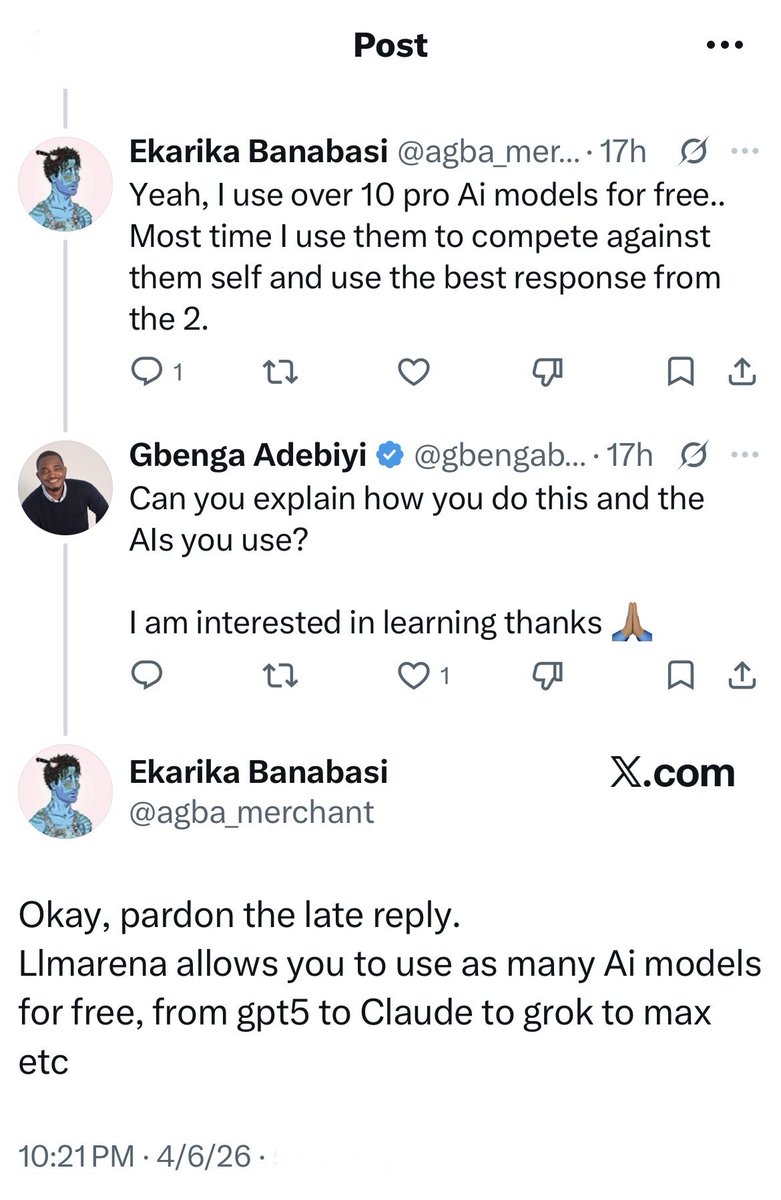
I am still fascinated by this interaction that happened yesterday
Someone shared how he uses AI Pro Models for FREE.
I was impressed by that, and I asked, “HOW?”
He mentioned his process
He used Llmarena
I went on my deep dive research as usual, and boy, was I stunned
So a Platform exists like that
And it’s not just a vibe code or indie hacker stuffs
This is a full-blown startup that has raised funding.
If you are an AI enthusiast like I am, You can check it out
Llmarena
Let me hear your feedback
@kenkenlewu She could have called her husband so they could discuss it properly. But since he’s always at home, it’s unfair for her to work, return, and still handle all the cooking all the time, he should ease the cooking burden in some ways.
A Stanford student got reported for academic misconduct last semester.
His research paper was so good his professor assumed he bought it.
The academic integrity hearing lasted 3 hours.
Here's what happened in that room.
The panel asked him to explain his methodology from scratch. He opened his laptop, pulled up https://t.co/LaaeCA6lbD, and started rebuilding the entire paper live in front of them.
First he fed it his raw notes and asked: "You are a research methodology expert. Here are my raw notes. Identify the 3 strongest arguments buried in this data, rank them by originality, and show me exactly where each one challenges or extends existing literature."
The professors went quiet.
Then he ran: "Now simulate a hostile peer reviewer with a PhD in this field. Generate every serious objection they would raise against my thesis. Then tell me which objections actually have merit and which ones I can dismantle."
One professor leaned forward and asked him to stop so she could write down the prompt.
He kept going. "Take my weakest argument and steelman it harder than I did. Show me what it would look like if it were airtight. Then tell me what I'd need to prove to get it there."
Then the one that ended the hearing. "You are my thesis advisor. I have 24 hours before submission. Read this draft and tell me the single change that would move this from a B+ to an A. Be brutal."
He walked them through how he'd used that last output to rewrite his conclusion three times until it held up under every objection in the room.
What took most PhD candidates 6 months of back-and-forth with advisors, he was doing in real-time inside a single workflow.
The panel didn't just clear him.
They gave him the highest grade in the department's history and asked him to present the workflow to faculty.
The irony is beautiful. The paper looked too good to be human because he'd found a way to think harder than most humans bother to.
That's not cheating. That's the new ceiling.
Let me put it in perspective: If he earns 200k/month and you take out 70k, what is left of his salary is 130k.
Let’s say he spends 3k on food daily (almost impossible), 3,000 x 30 =90,000
130,000-90000 =40,000.
10k for data and he’s left with 30k.
Now tell me how one can save their rent, pay other utility bills, send money home and save from a salary like this?
Mind you, this is me assuming he earns 200k/month. On top of this he’ll come back home and meet darkness because no electricity.
We are not angry enough. They are stealing our future from us before our very eyes. This is not life we are living.
It is hard to communicate how much programming has changed due to AI in the last 2 months: not gradually and over time in the "progress as usual" way, but specifically this last December. There are a number of asterisks but imo coding agents basically didn’t work before December and basically work since - the models have significantly higher quality, long-term coherence and tenacity and they can power through large and long tasks, well past enough that it is extremely disruptive to the default programming workflow.
Just to give an example, over the weekend I was building a local video analysis dashboard for the cameras of my home so I wrote: “Here is the local IP and username/password of my DGX Spark. Log in, set up ssh keys, set up vLLM, download and bench Qwen3-VL, set up a server endpoint to inference videos, a basic web ui dashboard, test everything, set it up with systemd, record memory notes for yourself and write up a markdown report for me”. The agent went off for ~30 minutes, ran into multiple issues, researched solutions online, resolved them one by one, wrote the code, tested it, debugged it, set up the services, and came back with the report and it was just done. I didn’t touch anything. All of this could easily have been a weekend project just 3 months ago but today it’s something you kick off and forget about for 30 minutes.
As a result, programming is becoming unrecognizable. You’re not typing computer code into an editor like the way things were since computers were invented, that era is over. You're spinning up AI agents, giving them tasks *in English* and managing and reviewing their work in parallel. The biggest prize is in figuring out how you can keep ascending the layers of abstraction to set up long-running orchestrator Claws with all of the right tools, memory and instructions that productively manage multiple parallel Code instances for you. The leverage achievable via top tier "agentic engineering" feels very high right now.
It’s not perfect, it needs high-level direction, judgement, taste, oversight, iteration and hints and ideas. It works a lot better in some scenarios than others (e.g. especially for tasks that are well-specified and where you can verify/test functionality). The key is to build intuition to decompose the task just right to hand off the parts that work and help out around the edges. But imo, this is nowhere near "business as usual" time in software.