New Research: Expanding the C-S-R framework to incorporate microbial interactions: evidence from methane-consuming communities https://t.co/mdZO67OCQB #FrontiersIn#Microbiology
📊 Open data fuels scientific progress! Our latest work provides abundance & composition data of microbiomes in agricultural biogas plants in Germany. 🌱🔬
🔗 Access the data here: https://t.co/SBzCScse6X
#OpenScience#MicrobialEcology#Bioenergy#DataSharing#Agriculture
The new global CH4 budget currently under review, featuring an expanded section on freshwaters, particularly ponds. Also nice to see ditches getting a few mentions.
📢 Our latest publication dives into the fascinating world of methanotrophy in rice field soils, unraveling the impact of lanthanum. 🌾🔍 Explore the intricate connections that shape our environment! 🌏
https://t.co/NC481torUa
#ecology#methane#science#Frontiers 📚🔬
🌾 Don't let the hidden gems in microbial ecology research slip through the cracks! 📚 Check out this intriguing article on Microbial trait-based approaches for agroecosystems https://t.co/i18BLDV4oO via @OSFramework 🌱🔬 #Agroecosystem#MicrobialTraits#ResearchUncovered
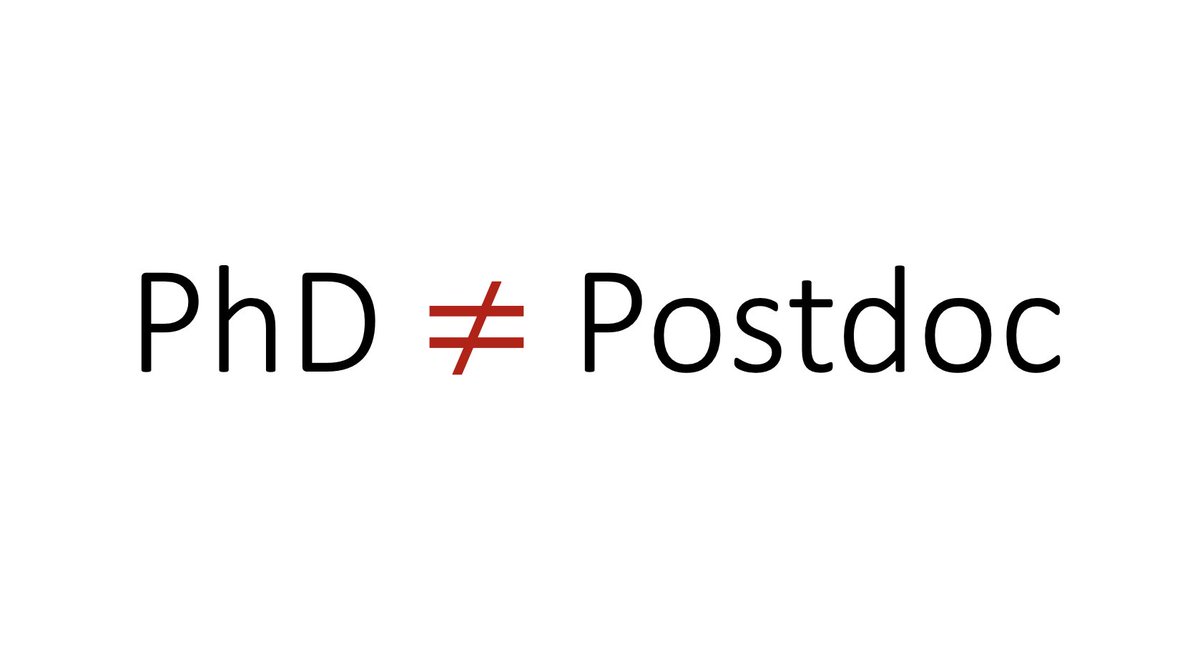
Postdoc is conceptually different from a #PhD position. Below are some key points to keep in mind before starting postdoc.
1️⃣ The harsh reality of being a postdoc:
1. Postdoc is a contractual (not educational) position. Your postdoc duties are defined by your contract & agreement with your advisor.
2. Usually, a contract is given for 1 year and renewed annually. It does NOT offer the same job security that PhD students enjoy. Be prepared to start searching for a new position in 1st year and leave anytime.
3. Postdoc is inherently a position for academia (with a few exceptions like in bio). Often, companies will assume that you’ve chosen an academic track, not industry. They’d rather hire a fresh PhD graduate from the same field than a postdoc. So, your job search outside academia may become challenging, especially if you do fundamental research.
4. If you want to be a faculty, your postdoc may require a lot more efforts than you originally expected, making it the most intense time of your life. Be prepared.
_________
2️⃣ If you take postdoc because you want to be more competitive for senior academic positions, keep in mind that:
0. Choosing the right lab & advisor is statistically MORE important than simply working hard and publishing papers during postdoc (esp. in the U.S.). However, working with an advisor who can write an excellent recommendation letter does NOT mean that you will also get prepared for a faculty life and become a great scientist. Your advisor should be a good mentor for this.
1. As the competition for faculty positions can easily reach over 1/300 and you have ~1 year before applying for positions, postdoc time often turns into a “race”. The worst part is that hard work does NOT necessarily lead to success.
2. Postdoc is NOT a must for being a faculty. Some students secure professor positions at the end of their PhDs (esp. at the top universities in the U.S.).
3. Postdoc lasts 1-3 years. If you’re a first-year postdoc and apply for faculty positions, committees will be OK with you showing your PhD work during interview. But starting from your 2nd year, they expect you to show successful postdoc results.
4. Some committees expect that a 3-year postdoc should complete as much work as a 5-year PhD student. It’s like a fast-track PhD.
5. Often (esp. in STEM), the expected number of “postdoc papers” is on average 1 paper per 1 year, unless the work is unusually complex. NOT 10 papers/year.
6. Publishing a lot of papers is normally viewed negatively. Coauthoring tens of papers will send a RED flag to the committee. For decent universities, it's (almost always) quality over quantity.
7. Doing a second postdoc is rarely helpful in landing a faculty position.
8. Ideally, postdoc should be in a different field than your PhD. Switching fields is viewed positively and can be helpful in landing a faculty position. But it is much more challenging because your time is very limited but you must do outstanding research. Also, I know many people who didn’t change fields but became faculties nonetheless.
Good luck!
#AcademicTwitter #AcademicChatter
We have a new preprint up! A widespread methylotroph acyl-homoserine lactone synthase produces an atypical quorum sensing signal.
https://t.co/tivVS5Jef7
PhD on trace gas oxidising bacteria in volcanos! 🌋
The link is now available! Come and join us in beautiful Norwich at @biouea
Deadline: 11 January 2023
Please #RT#PhDposition
https://t.co/jtdWn01WE4
Today, we’re introducing a new model that eliminates accept/reject decisions.
By publishing every paper with eLife reviews as a Reviewed Preprint, we plan to restore autonomy to authors, ensuring that they will be judged by what, not where, they publish. https://t.co/OAsiOVFStI
We're thrilled to properly present the Borgs to you. Check out our analysis of these enigmatic organisms here: https://t.co/RkKEracXHx @themicrobeguy @MScholmerich @luis_valentin26 @Jwestrob@archaeaologist @acritschristoph @BanfieldLab@doudna_lab
A short thread about “multi-stressor” or “multiple driver” experimental design, based on a recent paper I wrote with Sinéad Collins & Harriet Whittaker.
I’d love for this to reach students doing these experiments, so please share! (1/n)
https://t.co/M6vPzKGVlc
Methanotrophs are vigorous H2S oxidizers using a sulfide:quinone oxidoreductase and a ba3-type terminal oxidase https://t.co/2nXVcmfXpn #biorxiv_micrbio
Microbial trait-based approaches for agroecosystems https://t.co/i18BLDV4oO via @OSFramework It is finally published in Advances in Agronomy! Great collaborative project! #microbiome#Ecology