Today we're also opening the weights for Muse Glimmer, a great 30B parameter dense model that can run locally. Soon we'll also release the weights for Muse Spark 1.2, our latest foundation model. Meta is a strong supporter of open source and I'm proud of these releases. Congrats to @alexandr_wang and the MSL team for all your great work on these models.
X now shows if you’re live on the timeline
Could be a huge growth unlock for live shows on the platform
Have a post popping off? Go live and capture that traffic
Is this new?
Shoutout @Vexian even tho your MacBook opinion is straight up wrong :p
For those of us who got through our initial wave of future shock in 2022/23, it's easy to forget that many other people will be experiencing that same feeling in the near future
when people see cosmic-1 in person, the first reaction is always shock at how big it is. which is funny, because it's small in comparison to a bulldozer or excavator
then there's the follow-up question: "so how do these get to a jobsite?"
we sized cosmic-1 to fit within tracker arrays and be easily mobilized to site. when we first started cosmic, we rented an F-250 and a 24ft utility trailer and hauled cosmic-1 to sites ourselves. no lowboy trailer, permits, or week of logistics planning required
Good news for those of us with a penchant for sweets and space: astronomers have detected an actual sugar molecule drifting through interstellar space—a discovery that strengthens the idea that some of life's essential ingredients may have formed long before Earth itself.
The finding, reported this week in Nature Astronomy, suggests that the chemistry leading to biology was already underway in the cold clouds between the stars. "This is a real, bona fide sugar," said Brett McGuire, an astrochemist at MIT who was not involved in the study. "It's just incredibly exciting."
👉️ https://t.co/0eSeET35it
Somewhat more doctrinaire than I'd be but this is close to where I'm at: use AI very very aggressively to research and inform yourself, but do your own writing
https://t.co/dO5zb6QEAq
When someone says "save the bees", they're almost always talking about honeybees. But - while there are real issues plaguing honeybees - the bees that REALLY need saving are the 4,000 native bee species that are in REAL trouble...
Honeybees are NOT native to North America. They were brought from Europe in the 1600s. It's best to think of them more as livestock than a native species that needs to be protected
That's not to say there aren't real issues with honeybees. Colony collapse disorder, varroa mites, and so on
A few years back, I interviewed Peter Nelson, who directed The Pollinators documentary, for my @epicgardening podcast. He opened my eyes tot he world of "managed beekeeping." This is an entire industry where people literally truck honeybee colonies across the country to pollinate almonds, apples, you name it
But why would you need to do this? Surely there are already bees in the area to pollinate these crops? Well, there WERE, but monocropping, pesticide use, and many other "modern" practices wiped out the native species in those areas
North America has roughly 4,000 native bee species, most of which don't live in hives. Many are fully solitary creators. The craziest part is how specialized they are: up to 45% are "pollen specialists," meaning they feed from ONE plant or ONE plant family. If that plant disappears from your area, those bees are gone...forever
So, while it's fine to add a honeybee hive to your property and harvest delicious raw honey, it's also possible they're outcompeting native wild bees for resources
At the very least you should be planting for native species too:
To do this, choose local native flowers that bloom at different times of year. Leave nesting areas, bare ground, dead stems left standing in fall. You can add a bee house too with sticks, logs with holes drilled in them, and so on to provide potential nesting habitat for native bee species
So - the "save the bees" conversation NEEDS to include the 4,000 species nobody's talking about, but are a crucial part of North American ecosystems
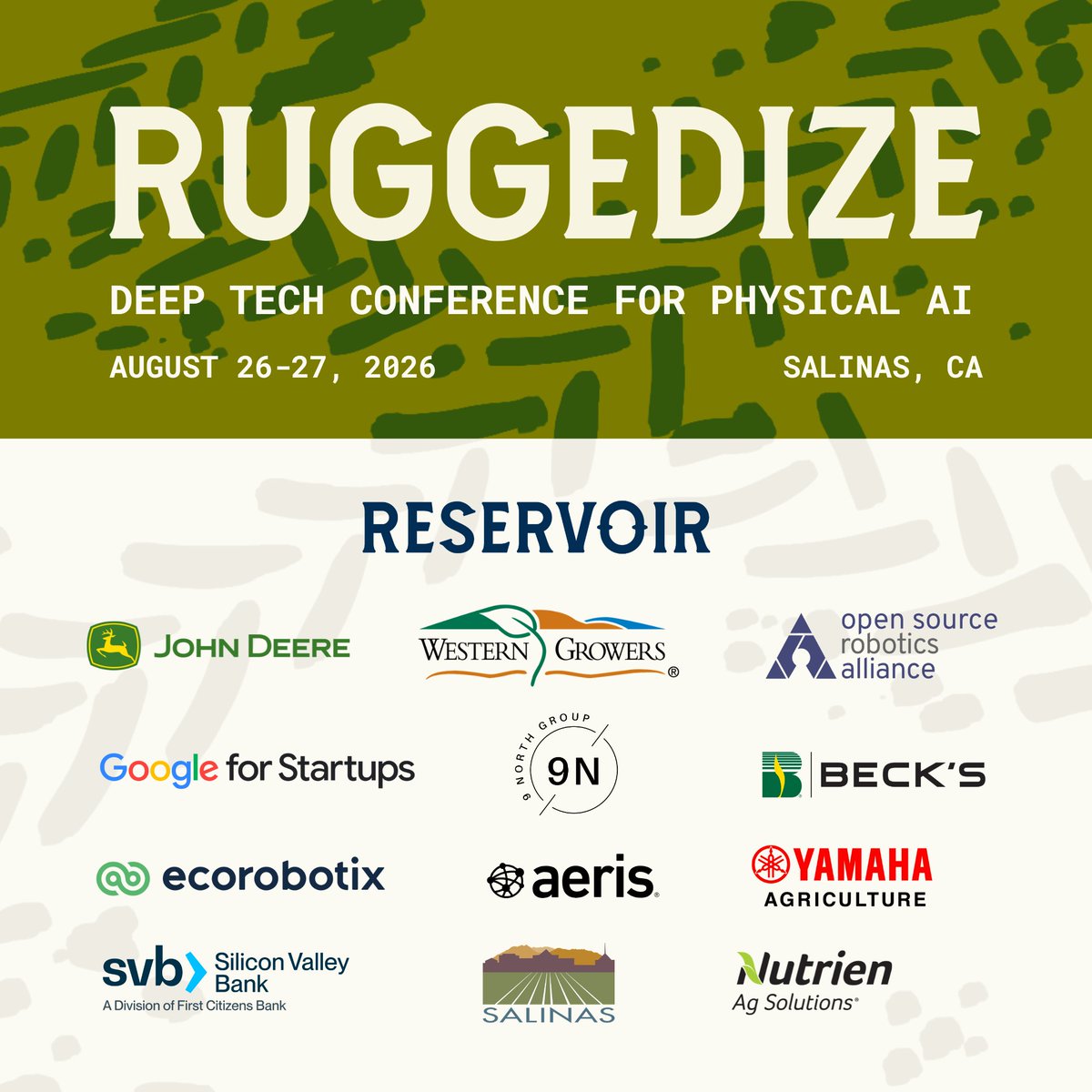
Ruggedize has exceeded every metric we set ahead of time. Sponsors, speakers, registrations. And we're still a few weeks out. Here's how it started.
Last October we gathered a group of friends and talked about the moment we're living through. Agriculture is in the deepest tech moment in its history. Rugged physical AI can finally work outdoors, in dust, heat, and mud. A golden age of ag robotics is arriving exactly when the labor to scale these industries isn't available.
We also saw a bigger opportunity: bridging tech with ag. Silicon Valley and the Salinas Valley sit an hour apart and operate as separate worlds. The robotics conversation in SF needs a proving ground. The growers who feed the country need what that conversation is building.
So we started from a blank page, with input from @JohnDeere, @Walt_Duflock from @WesternGrowers, and the CEOs we lean on for advice on our own journey: @TimBucher, @paulmikesell, @niday_tyler, @Ben_Andros_Eng and many others.
The outcome: Ruggedize. A first of its kind deep tech conference in Salinas, the Salad Bowl of the World. Along the way we met people we never expected in the room, from USDA to the FBI, and what we saw as an opportunity turned out to be a movement.
Our whole thesis is technology as resilience. This is what it looks like when the people building that future get in one room (err one farm).
Aug 26-27. https://t.co/5XDtuNF6y1. DMs open.
New nightmare fuel just dropped: Subatomic black holes left over from the Big Bang may be wandering through the Milky Way and detonating white dwarfs into supernovae.
Bonus: If this new paper in ApJ holds up, the missing mass of the universe and our galactic chemical anomalies share the exact same microscopic culprit.
https://t.co/OaDo0l0Ly8