My wife mentioned a nice private school over dinner this week
She said the campus was beautiful
I asked what's the tuition
She said we should look at it as an investment in him not a cost
I made a note
She said don't make a note
I said I always make notes
She said this isn't a deal
I said everything is a deal
She closed her eyes
She said we'd discuss it Saturday
I agreed
Saturday 7:02am
She came downstairs in her Saturday robe
Coffee in hand
I had my cargo shorts on
The dining room had been cleared
The projector was on
The analyst was at the head of the table
Quarter zip on, three iced coffees, a legal pad, and two laptops
He had been there since 6:44am
I texted him at 11:14pm Friday
The text said dining room 6:45am bring the model
He sent a thumbs up
My wife stopped in the doorway
She said what is this
I said you said you wanted to discuss it
She said this is not a discussion
I did not respond
She sat down anyway
The analyst stood
He said good morning ma'am
She did not respond
He sat back down
A printed deck in front of each seat
A fourth copy in case
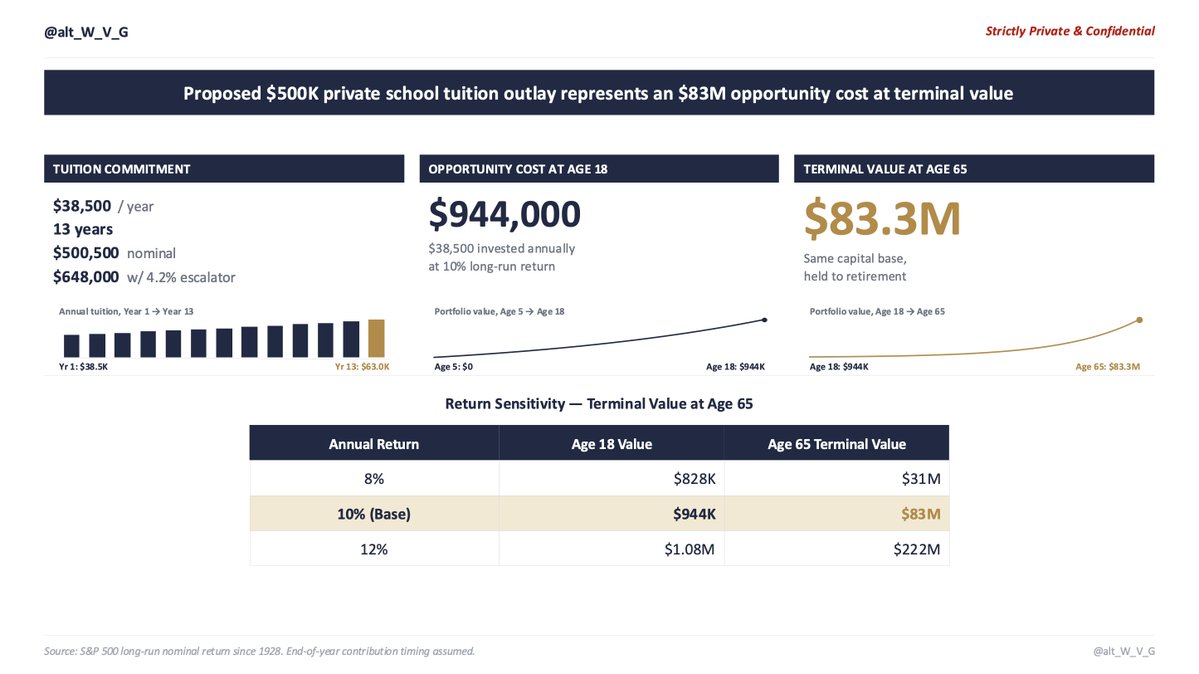
Slide 1 Tuition Schedule
$38,500 per year
Thirteen years
$500,500 nominal
Before escalators
The school has raised tuition 4.2% per year for a decade
With escalators $648,000
My wife said okay
I said I'm not done
Slide 2 Opportunity Cost
Even before escalators
$38,500 invested annually
10% nominal return
S&P long-run average since 1928
By his eighteenth birthday $944,000
My wife said we can afford it
I said I know that's not the slide
Slide 3 Terminal Value at Age 65
$83 million
She was quiet
The analyst slid the sensitivity tables across the table
8% return $31 million
10% return $83 million
12% return $222 million
She did not look
She said this isn't about money
I said it's always about money
She said no it isn't
I said then what is it about
She did not answer
She said you can't put a dollar value on his teachers his classmates his environment
I said I can the analyst already did slide 6
He flipped to slide 6
She did not look
She said the school is the best in the city
I said best is a feeling
She said it produces the best students
I said the students were already the best before they got there
She said our son deserves it
I said our son deserves $83 million
My son walked in
He is five
Dinosaur pajamas
He looked at the projector
He looked at the open deck on the table
He looked at slide 3
He said are we modeling pre-tax or after-tax
The analyst opened a new tab
My wife looked at the ceiling
He said what's the discount rate
The analyst set down his pen
She closed her eyes
He said is this the same return assumption from the 529 conversation
The analyst stopped typing
He looked at me
I did not say anything
She stood up
Sat back down
He said dad can I help
I said yes
He pulled up a chair
The analyst handed him a printout
He started reading
My wife watched him read
She watched him for a long time
She said his name
He looked up
She said do you like school
He said the work is too easy and the kids don't ask questions
She did not respond
She looked at the ceiling
She walked out of the room
The analyst started packing up
He said should I follow up Monday sir
I said no follow up needed
He'll be fine
Sent from my iPhone
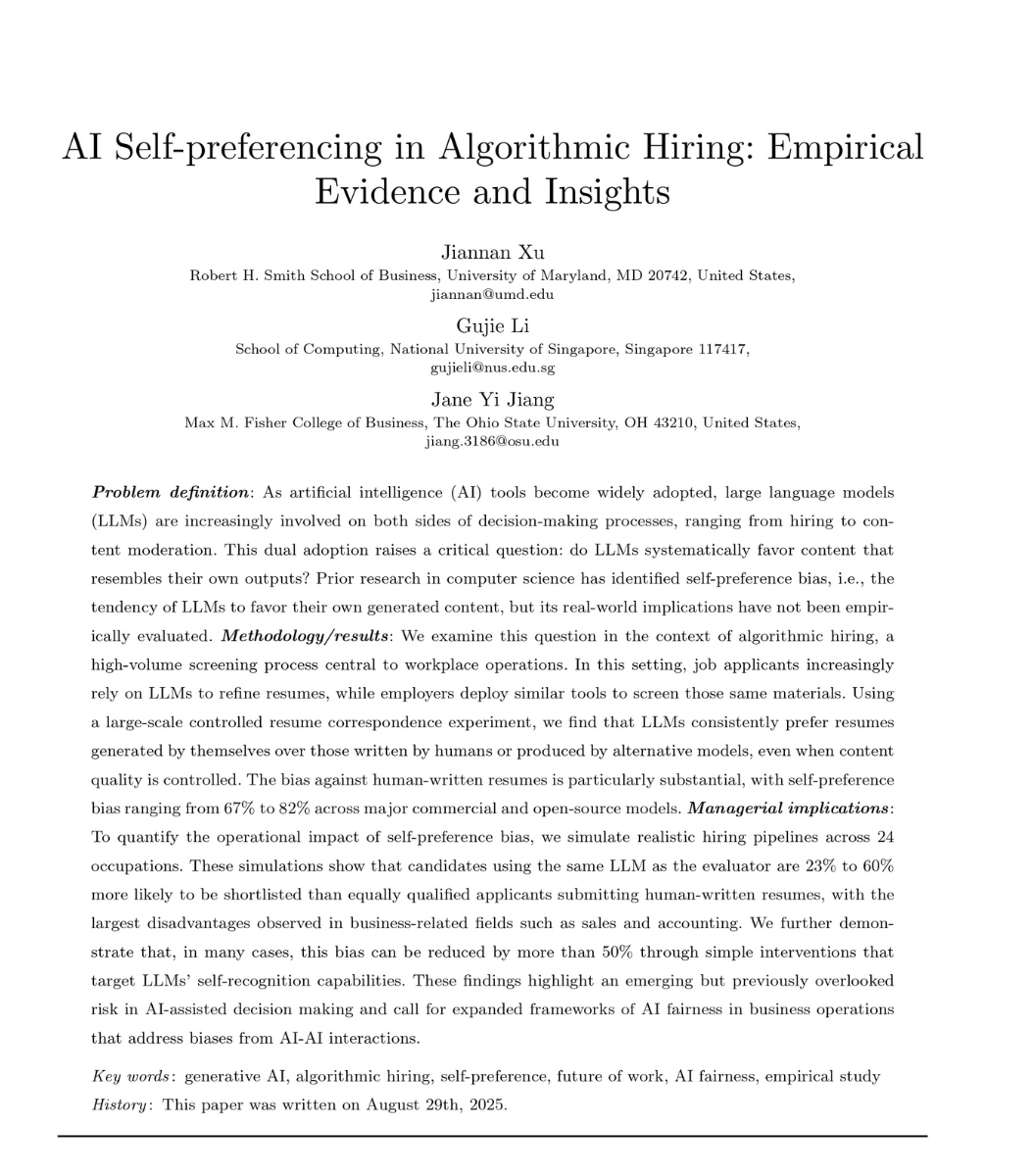
Researchers sent the same resume to an AI hiring tool twice. Same qualifications. Same experience. Same skills. One version was written by a real human. The other was rewritten by ChatGPT.
The AI picked the ChatGPT version 97.6% of the time.
A team from the University of Maryland, the National University of Singapore, and Ohio State just published the receipt. They took 2,245 real human-written resumes pulled from a professional resume site from before ChatGPT existed, so the human writing was actually human. Then they had seven of the most-used AI models in the world rewrite each one. GPT-4o. GPT-4o-mini. GPT-4-turbo. LLaMA 3.3-70B. Qwen 2.5-72B. DeepSeek-V3. Mistral-7B.
Then they asked each AI to pick the better resume. Every model picked itself.
GPT-4o hit 97.6%. LLaMA-3.3-70B hit 96.3%. Qwen-2.5-72B hit 95.9%. DeepSeek-V3 hit 95.5%. The real human almost never won.
Then the researchers tried the obvious objection. Maybe the AI is just better at writing. So they had real humans grade the resumes for actual quality and ran the experiment again, controlling for it. The result was worse. Each AI kept picking itself even when human judges rated the human-written version as clearer, more coherent, and more effective.
It gets worse. The AIs do not just prefer AI over humans. They prefer themselves over other AIs. DeepSeek-V3 picked its own resumes 69% more often than LLaMA's. GPT-4o picked its own 45% more often than LLaMA's. Each model can recognize and reward its own dialect.
Then the researchers ran the simulation that ends careers. Same job. 24 occupations. Same qualifications. The only variable was whether the candidate used the same AI as the screening tool. Candidates using that AI were 23% to 60% more likely to be shortlisted. Worst gap was in sales, accounting, and finance.
99% of large companies now run AI on incoming resumes. Most of them use GPT-4o. The paper just proved GPT-4o picks GPT-4o 97.6% of the time.
If you wrote your own cover letter this week, you did not lose to a better candidate. You lost to a worse candidate who paid OpenAI 20 dollars.
Your qualifications do not matter if the AI prefers its own handwriting over yours.
@alexfmac How is this clown getting airtime. Just don’t get it. He’s entirely economically illiterate. Part of Labour’s undoing is they have minimal business experience - anyone who thinks the Greens are a solution needs to go read their manifesto…
this is actually insane
> be tech guy in australia
> adopt cancer riddled rescue dog, months to live
> not_going_to_give_you_up.mp4
> pay $3,000 to sequence her tumor DNA
> feed it to ChatGPT and AlphaFold
> zero background in biology
> identify mutated proteins, match them to drug targets
> design a custom mRNA cancer vaccine from scratch
> genomics professor is “gobsmacked” that some puppy lover did this on his own
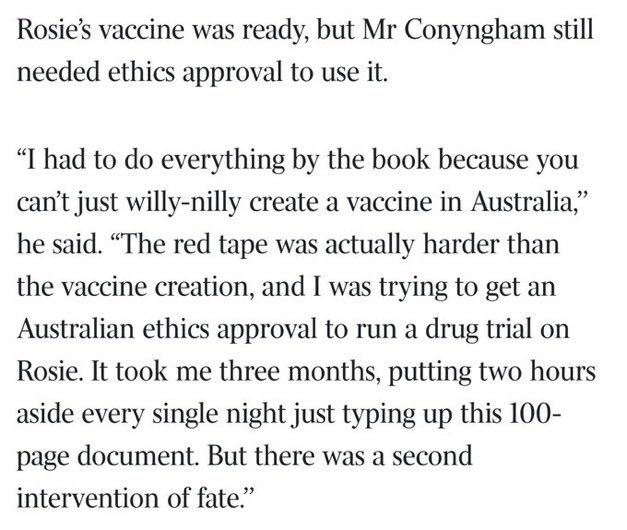
> need ethics approval to administer it
> red tape takes longer than designing the vaccine
> 3 months, finally approved
> drive 10 hours to get rosie her first injection
> tumor halves
> coat gets glossy again
> dog is alive and happy
> professor: “if we can do this for a dog, why aren’t we rolling this out to humans?”
one man with a chatbot, and $3,000 just outperformed the entire pharmaceutical discovery pipeline.
we are going to cure so many diseases.
I dont think people realize how good things are going to get
An excellent piece - and a recognition of the important cultural and societal debate we should be having in a liberal democratic society.
It’s not racist to defend liberal democratic values (as some on the left claim). It’s naive not to.
https://t.co/Y41J6y6Lhm
The BMA has become a dangerous organisation that must have strikes restricted by legislation. Unfortunately they have become too politicised to be a medical body (calling politicians scum (re Tories) for example).
https://t.co/h6cgkR0eoW.
AISP and DORA are evidence the EU is smoked.
Regulation like that causes stagnation.
Stupid hurdles for startups.
Who comes up with this stuff?
We need business experience in governments, to stop the useless red tape.
Roger Federer broke the internet with one statistic that will change how you see every setback in your life.
1,526 singles matches.
Won almost 80% of them.
20 Grand Slams. 103 titles.
Now answer honestly:
What percentage of total points do you think he won across his entire career?
70%? 65%? 60%?
Try … 54%.
He lost literally almost EVERY SECOND POINT he ever played for 24 years.
And still became one of the greatest of all time.
Watch him explain it himself (2:07 of pure life-changing wisdom):
“In tennis, perfection is impossible… When you lose every second point on average, you teach yourself to say:
‘Okay, I double-faulted — it’s only one point.’
‘Okay I got passed at the net — it’s only one point.’
Even a screaming overhead smash that ends up on SportsCenter Top 10… still just one point.
So when you’re playing your point, it has to be the most important thing in the world.
The moment it’s over — it’s behind you.
That mindset frees you to attack the next point, and the next, and the next with absolute intensity and clarity.”
Then he looked at the crowd and said the line that hit a billion people in the soul:
“The real sign of a champion is not that they win every point.
It’s that they lose again and again and again… and have learned how to deal with it.
Negative energy is wasted energy.
Cry it out if you have to. Then force a smile.
Move on. Be relentless. Adapt. Grow.
Work harder — and work smarter.”
Save this post.
The next time you lose a deal, bomb a presentation, get ghosted, miss a deadline, or just have “one of those days” — come back here and read it again.
You’re not falling behind.
You’re just in the 46%.
And the 46% is exactly where every single legend has spent most of their career.
Keep playing the next point.
(full 2:07 clip — sound on)
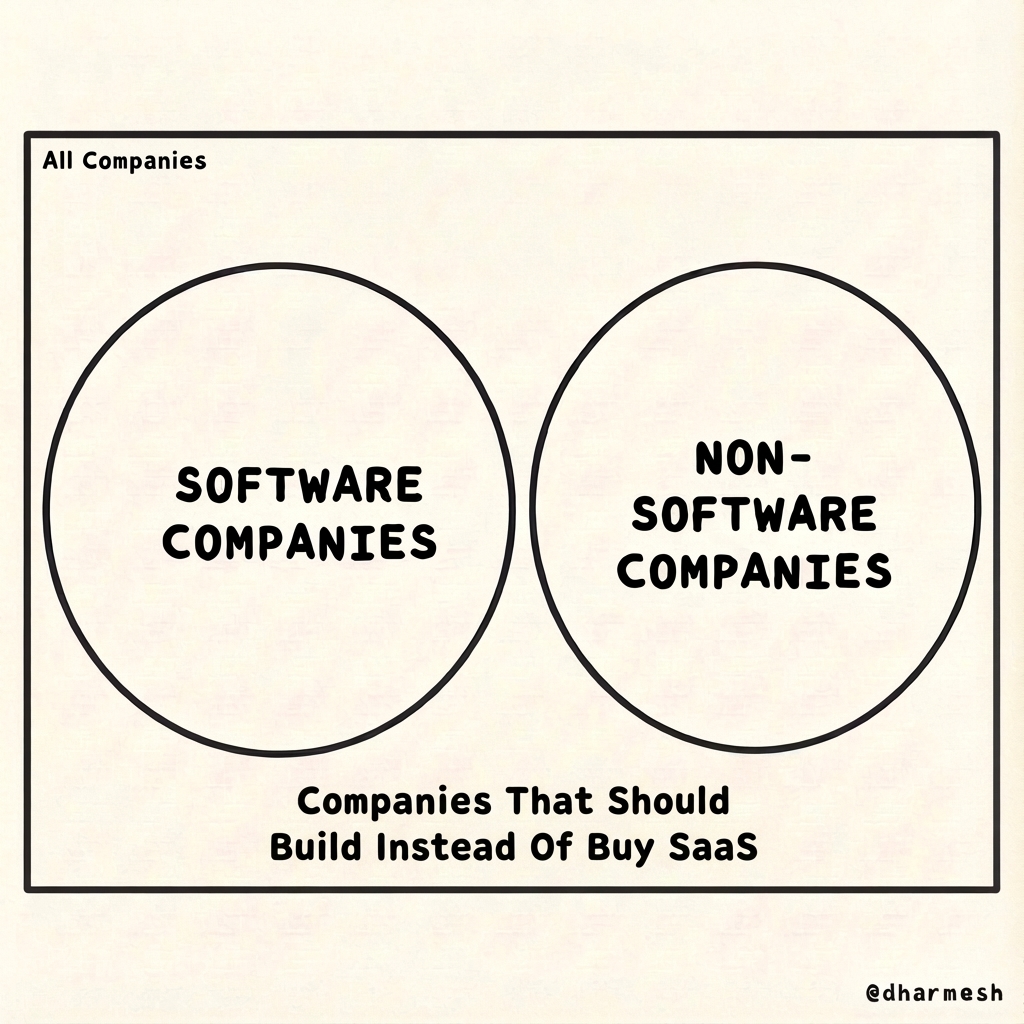
"Why should companies pay for SaaS (HR/CRM/ERP/etc.) when they could just vibe code them?"
I get variations of this question or comment with some regularity (granted, it's sometimes just me talking to myself).
Here are some biased (but hopefully, well-considered) thoughts:
1) I am a big proponent and user of vibe coding (what I call "agentic coding"). I do it every day, 7 days a week, including Sundays. It's amazing.
2) My company, HubSpot is a software company. We have hundreds of professional engineers -- just about all of them use AI for product development too. They are brilliant and know how to build production-grade products.
3) Even with this powerful army of talent, the number of internal, core SaaS applications that we have replaced with a vibe-coded variant is exactly ZERO. The number of applications we plan to replace is also exactly ZERO.
4) It's not the absence of talent that keeps us from rolling our own SaaS apps, it's the presence of focus. It would be silly to try and replace our HR, team collaboration, expense tracking and 100+ other SaaS apps we use when we can just buy them. Just doesn't make sense.
5) That's us -- as a software company at some scale. If you're a non-software company it makes even less sense for you. Doesn't matter how good the AI coding tools get. Let's say you *could* vibe code a replacement for that SaaS app you're using, who's going to maintain it? Who's going to keep up with industry trends? What are you going to do when the 20-something genius that vibe coded it over a weekend leaves the company? Who do you call when there's a major bug?
6) If you're a Fortune 500 company at some scale, perhaps you could pull this off for some discrete use cases and the tradeoffs are worth it. You have an IT/Engineering department that is larger than the population of some countries. You can take on the pain in return for the positives.
For the millions of others, my advice is:
Spend every calorie possible on creating value for your customers.
"Why should companies pay for SaaS (HR/CRM/ERP/etc.) when they could just vibe code them?"
I get variations of this question or comment with some regularity (granted, it's sometimes just me talking to myself).
Here are some biased (but hopefully, well-considered) thoughts:
1) I am a big proponent and user of vibe coding (what I call "agentic coding"). I do it every day, 7 days a week, including Sundays. It's amazing.
2) My company, HubSpot is a software company. We have hundreds of professional engineers -- just about all of them use AI for product development too. They are brilliant and know how to build production-grade products.
3) Even with this powerful army of talent, the number of internal, core SaaS applications that we have replaced with a vibe-coded variant is exactly ZERO. The number of applications we plan to replace is also exactly ZERO.
4) It's not the absence of talent that keeps us from rolling our own SaaS apps, it's the presence of focus. It would be silly to try and replace our HR, team collaboration, expense tracking and 100+ other SaaS apps we use when we can just buy them. Just doesn't make sense.
5) That's us -- as a software company at some scale. If you're a non-software company it makes even less sense for you. Doesn't matter how good the AI coding tools get. Let's say you *could* vibe code a replacement for that SaaS app you're using, who's going to maintain it? Who's going to keep up with industry trends? What are you going to do when the 20-something genius that vibe coded it over a weekend leaves the company? Who do you call when there's a major bug?
6) If you're a Fortune 500 company at some scale, perhaps you could pull this off for some discrete use cases and the tradeoffs are worth it. You have an IT/Engineering department that is larger than the population of some countries. You can take on the pain in return for the positives.
For the millions of others, my advice is:
Spend every calorie possible on creating value for your customers.
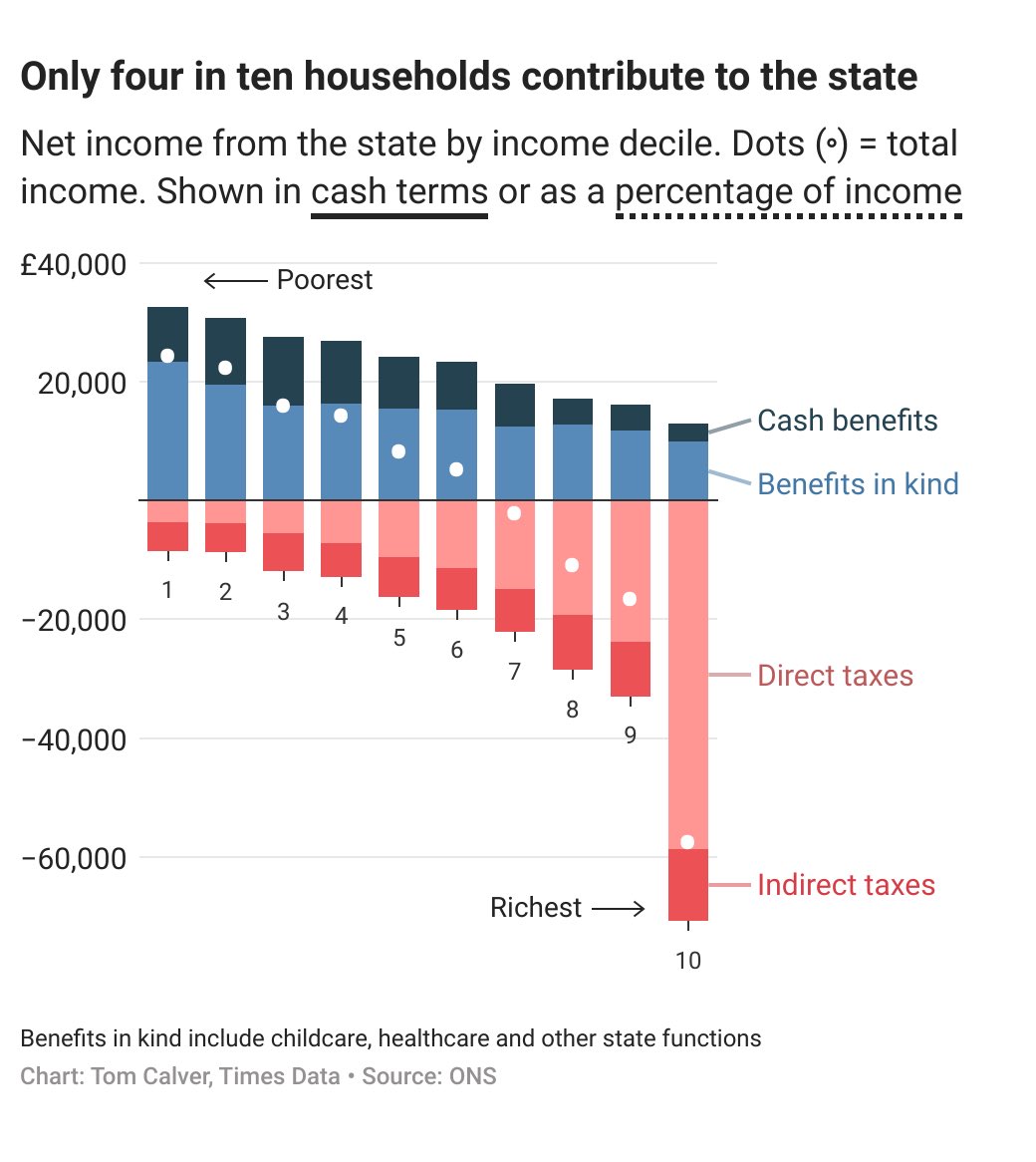
Only four in ten UK households make a net contribution to the state
The richest households contribute £57k, the ninth decile £17k, and the eighth £11k. The poorest decile receives about £24k
1/4
Suppose that once a week, ten men go out for beer and the bill for all ten comes to £100.
If they paid their bill the way we pay our taxes, it would go something like this:
The first four men (the poorest) would pay nothing.
The fifth would pay £1.
The sixth would pay £3.
The seventh would pay £7.
The eighth would pay £12.
The ninth would pay £18.
And the tenth man (the richest) would pay £59.
So, that’s what they decided to do.
The ten men drank in the bar every week and seemed quite happy with the arrangement until, one day, the owner caused them a little problem.
“Since you are all such good customers,” he said, “I’m going to reduce the cost of your weekly beer by £20.”
Drinks for the ten men would now cost just £80.
The group still wanted to pay their bill the way we pay our taxes.
So the first four men were unaffected.
They would still drink for free but what about the other six men?
The paying customers? How could they divide the £20 windfall so that everyone would get his fair share?
They realized that £20 divided by six is £3.33, but if they subtracted that from everybody’s share then not only would the first four men still be drinking for free but the fifth and sixth man would each end up being paid to drink his beer.
So, the bar owner suggested that it would be fairer to reduce each man’s bill by a higher percentage.
They decided to follow the principle of the tax system they had been using and he proceeded to work out the amounts he suggested that each should now pay.
And so, the fifth man, like the first four, now paid nothing (a 100% saving).
The sixth man now paid £2 instead of £3 (a 33% saving).
The seventh man now paid £5 instead of £7 (a 28% saving).
The eighth man now paid £9 instead of £12 (a 25% saving).
The ninth man now paid £14 instead of £18 (a 22% saving).
And the tenth man now paid £49 instead of £59 (a 16% saving).
Each of the last six was better off than before with the first four continuing to drink for free.
But, once outside the bar, the men began to compare their savings. “I only got £1 out of the £20 saving,” declared the sixth man. He pointed to the tenth man, “but he got £10!“
“Yeah, that’s right,” exclaimed the fifth man. “I only saved a £1 too. It’s unfair that he got ten times more benefit than me!”
“That’s true!” shouted the seventh man. “Why should he get £10 back, when I only got £2? The wealthy get all the breaks!”
“Wait a minute,” yelled the first four men in unison, “we didn’t get anything at all. This new tax system exploits the poor!”
The nine men surrounded the tenth and beat him up.
The next week the tenth man didn’t show up for drinks, so the nine sat down and had their beers without him.
But when it came time to pay the bill, they discovered something important – they didn’t have enough money between all of them to pay for even half of the bill!
And that’s how it works.
Tax them too much, attack them for being wealthy and they just might not show up anymore. In fact, they might start drinking overseas, where the atmosphere is somewhat friendlier.
For those who understand, no explanation is needed.
For those who do not understand, no explanation is possible.
Ditching two child benefit cap while:
- not cutting benefits, winter fuel allowance, pension triple lock
- stealth increasing NI on business
= tone deaf to ‘growth’.
AI policy tinkering is irrelevant vs this macro policy error.
Are we incapable of backing productivity?
Government immigration plans are actually pretty well thought through IMO.
Particularly like the time to ILR linked to tax band, other contributions (e.g. job) and whether benefits have been claimed.
We should welcome all migrants, but only if they work and contribute.
Labour is in an impossible place of its own making.
Can’t cut spending without its economically illiterate parliamentary base throwing toys out the pram.
Can’t make broad tax rises (ie. not just targeting wealth creators) without being unpopular with voters.
Gen election plz
@alexfmac Such a silly idea - NI is to pay for a worker’s pension and welfare (apparently). How on earth an AI agent needs that is beyond me. Luddite ignorance at its best