@Digi_Ingenuity That methodology change is an important caveat! The broader takeaway is still useful though, top-10 ranking and AI citation clearly shouldn’t be treated as the same signal
Your friendly reminder that you need to be visible in AI-driven search surfaces like Google’s AI Overviews and ChatGPT 💭
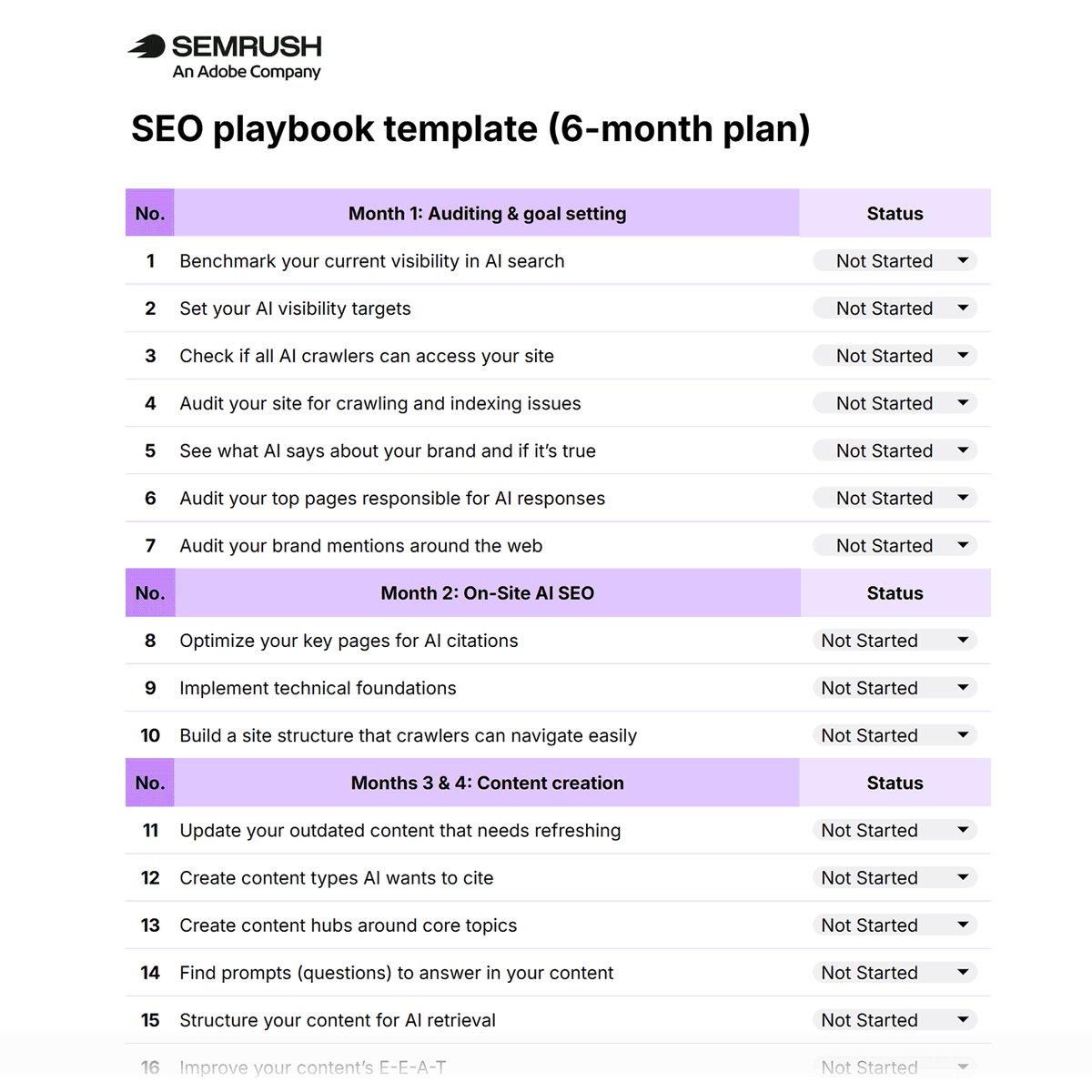
This checklist covers tasks that can help you gain visibility, no matter where your audience is searching! (If you have limited time or resources, focus on the most relevant tasks. Then, return to this guide whenever you’re ready to move on) ⬇️ https://t.co/NAbYIgsHvV.
@Nick_seoasis That split is exactly what makes step 2 actionable! A competitor blog citation points to a content gap, while a product or category page points to a different kind of visibility problem 🤝
AI visibility data becomes more useful when you turn it into clear, repeatable reporting.
Use this 6-step framework to audit your brand and communicate findings across marketing, PR, and leadership:
1. Benchmark overall visibility – measure mentions, share of voice, and competitor presence.
2. Identify cited content – find which pages AI systems use and where your brand is missed.
3. Find topical gaps – uncover prompts where competitors appear but your brand doesn’t.
4. Analyze brand sentiment – evaluate how AI platforms describe your brand and identify perception gaps.
5. Assess external sources – track third-party domains shaping AI answers and brand recommendations.
6. Check technical readiness – identify site issues that affect AI access and content interpretation.
Turn scattered search signals into measurable priorities and clearer decisions 👇
https://t.co/sUt0sWflXE.
@itsSanwalZia The modifier matters as much as the overall coverage! “Best X for Y” sits much closer to a shortlist decision than a generic research query
@prompt_insider That’s a much better place to start than rewriting everything! Existing citations can show which pages already have the right ingredients 🤝
Google’s new AI shopping features could change both how customers discover products and how they buy them.
Information Agents may mean fewer visits to your website, but the visitors who do arrive could be closer to making a purchase. That makes conversion readiness just as important as visibility.
For ecommerce brands, there’s another priority: getting UCP-ready to be eligible for Google’s Universal Cart.
Here’s what these changes mean for your strategy and how to prepare 👇
https://t.co/4VRraLChUK.
@getmcpads We don’t have a page-type breakdown behind this post. To test that hypothesis, we’d compare category-page losses with other templates, accounting for query intent and demand changes.
AI Overviews now appear for 88% of the commercial keywords in our study, up from 45.75% in September 2025.
Which commercial queries trigger AI Overviews most often, and where could your brand be missing from the answers?
Find out which modifiers matter most 👇
https://t.co/YCT41xGFFt.
@onreact You’re right to call out the history here. AI adds another place to investigate, but the case for looking at the whole online presence was already there.
SEO used to be about pages, rankings, and backlinks. That foundation still matters, but it’s no longer the whole truth 🤓
Now it’s:
• UGC
• Communities
• LinkedIn
• Reddit
• AI search modes
• Autonomous agents
Here's how it's moved from website to a full-on ecosystem 👇
@AlexCarterLinks Looking beyond traffic totals makes sense. For this study’s findings, the next check is which publisher pages actually get cited for your target buying questions.
@ZynVossLLC That firsthand knowledge is valuable. The opportunity is getting it out of the owner’s head and onto the pages customers use to make decisions.
@pirwot Original numbers can give readers something worth referencing. We’d be cautious about saying they automatically beat a bigger domain, though—relevance, evidence quality and the specific query still need examining.
@shuizhuyu A broader ecosystem, yes. That also means more reason for SEO, PR, content and social teams to compare what they’re learning about the same audience.