Турция внесла в свою таможенную систему BILGE официальный код Армении — 077
Теперь при импорте, экспорте и транзите товаров через третьи страны в таможенных декларациях можно официально указывать Армению как страну происхождения или конечного назначения груза.
https://t.co/bnfFhjWUGU
Short- and Long-Acting Psychedelics: Structure–Activity Relationships, Pharmacology, and Implications for Neuropsychiatric Therapeutics
https://t.co/BWNOzFGGqf
I swallowed a miniature computer
drew my blood six times
sat in a 200°F dry sauna for 56 min
felt like I was going to die from the heat
and paid $21,093 for specialty biomarkers…
To ask a question: do sauna benefits depend on time, or body temperature?
This experiment has never been done before.
Results:
1) Sauna benefits depend on how hot your body gets, not how long you sit in the sauna
2) Heat shock protein 27 (HSP27), one of the molecules that drives sauna's longevity benefits, only switched on when my core body temperature held above 102.2°F (39°C) for about 15 minutes.
3) Reaching that took 56 minutes at 200°F (93°C), with ice on my face, neck, and groin.
4) This challenges the generic advice that 20 minutes of sauna is enough.
What this means for you:
1) The standard advice of 20 minutes at 176°F (80°C) is a floor, not a ceiling. The bigger benefits sit further up the curve, in longer and hotter sessions. If you can tolerate more, more likely helps.
2) Skip the cold plunge right after the sauna. My core body temperature kept climbing for several minutes after I left the sauna, so much of my time above the activation threshold happened post-exit. Cold plunging cuts that window short.
3) Population level studies point in a direction but cannot tell you what is happening inside your own body. Continuous core temperature tracking can.
Here is the experiment explained
A brief background first. Heat shock proteins (HSPs) are believed to be the enablers of sauna based longevity benefits. You can think of them as a clean up crew that travels through your body removing misfolded proteins and cellular debris. When you get really hot, like in a sauna, you generate a lot more of them. A tsunami of clean up crews unleashed inside your body.
There are many types of HSPs. We focused on HSP27 in this experiment because of its high value longevity benefits:
1. Calms harmful inflammation through a controlled signaling pulse, driven by IL-10
2. Protects arteries by blocking the damaged cholesterol that builds up into plaque
3. Helps the body grow new blood vessels over time
4. HSP27 is one of the first proteins your body makes when it gets hot, which makes it a clean signal of how hard the sauna session actually worked.
We saw initial signs of biomarkers of these benefits also turned on alongside HSP27, with enough time above the activation threshold.
I ran three sauna sessions, holding sauna temperature, my meticulous morning routine, and every other variable constant. We measured HSP27 activation and release (along with scores of other biomarkers) in my serum after each session. I swallowed a temperature capsule about the size of a vitamin pill. As it traveled through my body, it sent a reading of my core body temperature every 30 seconds. That continuous, real time data from inside the body is what no prior study has had.
The 102.2°F (39°C) core temperature threshold for HSP activation has been established in the research literature for years. Dry-sauna users have never been able to act on it because they had no way to track their core temperature during a session. An end-point thermometer cannot tell you how long you held above threshold, and the duration is the dose. Which is why we chose to use real time tracking.
The findings across the three sessions.
Two of the three sessions pushed me well past the threshold. In one, I spent 14.7 minutes above 102.2°F (39°C), with a peak of 102.87°F (39.37°C). In the other, I spent 15.8 minutes above the threshold, with a peak of 102.81°F (39.34°C). After both, HSP27 in my blood rose sharply.
The third session (the middle one in the figure) was different. I only spent 5.1 minutes above 102.2°F (39°C), with a peak of 102.34°F (39.08°C), barely above the threshold. HSP27 did not respond. The reading actually dipped slightly, but the change was too small to count.
Two things separate the responder sessions from the non-responder. The first is time above the threshold: 14.7 and 15.8 minutes versus 5.1 minutes. The second is peak core temperature: 102.87°F (39.37°C) and 102.81°F (39.34°C) versus 102.34°F (39.08°C). Either, or more likely both, are driving the response. Future sessions will help us figure out how much each one matters.
Within my body, holding all other variables constant, the central heat shock protein response is a direct function of the heat dose delivered to the body's core.
No prior study has done this. Earlier sauna research used a single thermometer reading at the end of the session, not continuous tracking. The studies that used continuous tracking used exercise, not dry sauna. None had a matched negative control like my session three. And all reported only cohort averages, not what happened inside one body.
What this means for the body
Once HSP27 is released into circulation, it signals to cells throughout the body and drives the four mechanistically proven downstream benefits listed above. All four are supported by my long-term sauna data, the population literature, and mechanistic studies. My acute post-session measurements hint at each being engaged.
To activate HSP27 in my body, I needed 56 minutes at 200°F (93°C) in a dry sauna. That is the total session length required to spend enough time above the 102.2°F (39°C) core temperature threshold to trigger HSP27 release.
Does this mean longer sessions, long enough for your core to hit 102.2°F (39°C), would supercharge the longevity benefits? Maybe.
What we do know, I did 232 dry sauna sessions over the past year. My protocol was 200F (93°C) for 20 min. So even though my core body temperature didn’t reach 102.2°F (39°C) to unleash the HSP27, the results were still compelling:
+ a 10 year vascular age reduction
+ massive drop in environmental toxins [1]
+ complete elimination of microplastics in my semen (first ever in human achievement)
The data suggests there are health benefits at 200°F (93°C) for 20 min.
The data also shows that additional health benefits unlock when your core body temperature reaches 102.2°F (39°C).
Does this mean that if one is in the sauna longer, long enough to reach a core body temperature of 102.2°F (39°C). that the longevity benefits would be supercharged? Maybe.
Here is what this experiment teaches:
+ population level data is great for averages, pointing in a general direction
+ the resulting protocols are crude
+ not personalized
+ the only way to find out the truth for you is to measure
+ single person experiments (n=1) like this one are useful, because they find blind spots that population averages cannot see.
Note: I kept ice on my face and neck during these three experimental sessions to protect those sensitive areas from heat induced skin damage at extreme temperatures. In a previous session, not included in this experiment, I had no ice on my face or neck and used an ingestible temperature capsule for real-time core readings. I reached a core body temperature of 102.2°F (39°C) after 34 minutes at 200°F (93°C).
Adding ice to the face and neck adds roughly 20 minutes to the total time required to reach 102.2°F (39°C) core body temperature. Subjectively, the 34 minutes without ice on my face and neck was much harder than the 56 minutes with ice on my face and neck. After the 34 minute session, I exited the sauna and just laid on the concrete, immobilized. But I got the data.
[1] Toxin reduction:
After 15 sessions, sauna dramatically reduced environmental toxins in my body:
65% drop in 2,4-D
100% drop in MEP
15% drop in MBP
100% drop in MEHP (undetectable post sauna)
56% drop in NAPR
56% drop in HEMA
100% drop in Perchlorate (undetectable post sauna)
Our New Study Shows That The Science Of Cannabis And Sleep Extends Beyond THC (Op-Ed): "The strongest evidence for improving sleep was associated with cannabidiol (CBD), cannabinol (CBN) and combinations of the two—but not primarily THC."
https://t.co/z1sYxA1WXH
Ukraine's First Legal Medical Cannabis Products Have Been Dispensed To Military Veterans And A Woman With MS: "Patients living with severe pain daily and requiring modern treatments now have an additional option to access modern pharmacotherapy."
https://t.co/1pMBHNKKBw
Louisiana Lawmakers Pass Bill To Create Psychedelic Therapy Pilot Program Funded By Opioid Settlement Dollars, Sending It To Governor: The legislation would fund clinical trials aimed at developing alternative treatments like psilocybin, ibogaine & MDMA.
https://t.co/DxM8ipN359
“What we’re seeing today is actual evidence from well-conducted clinical trials that [psychedelics] have a strong therapeutic potential—that they have a potential to do things that our traditional medications haven’t been able to accomplish.” - Tiffany Farchione, FDA Division of Psychiatry Director
A Single Dose Of Psilocybin Appears To Safely Treat Cocaine Addiction, New Study Published By American Medical Association Study Shows: The psychedelic "appeared to be safe and efficacious for treating cocaine use disorder."
https://t.co/JQYn8QroGv
Following President Trump’s directive to accelerate medical treatments for serious mental illnesses, FDA announced major steps to support the development of serotonin-2A agonists & related products—a class of medications historically referred to as "psychedelic" drugs.
✅ National priority vouchers for psilocybin (for treatment-resistant depression and major depressive disorder)
✅ National priority voucher for methylone (for post-traumatic stress disorder)
✅ First-ever noribogaine study authorized for alcohol use disorder
✅ Advancing guidance for sponsors developing these products
Learn more: https://t.co/GZobFZ67Gh
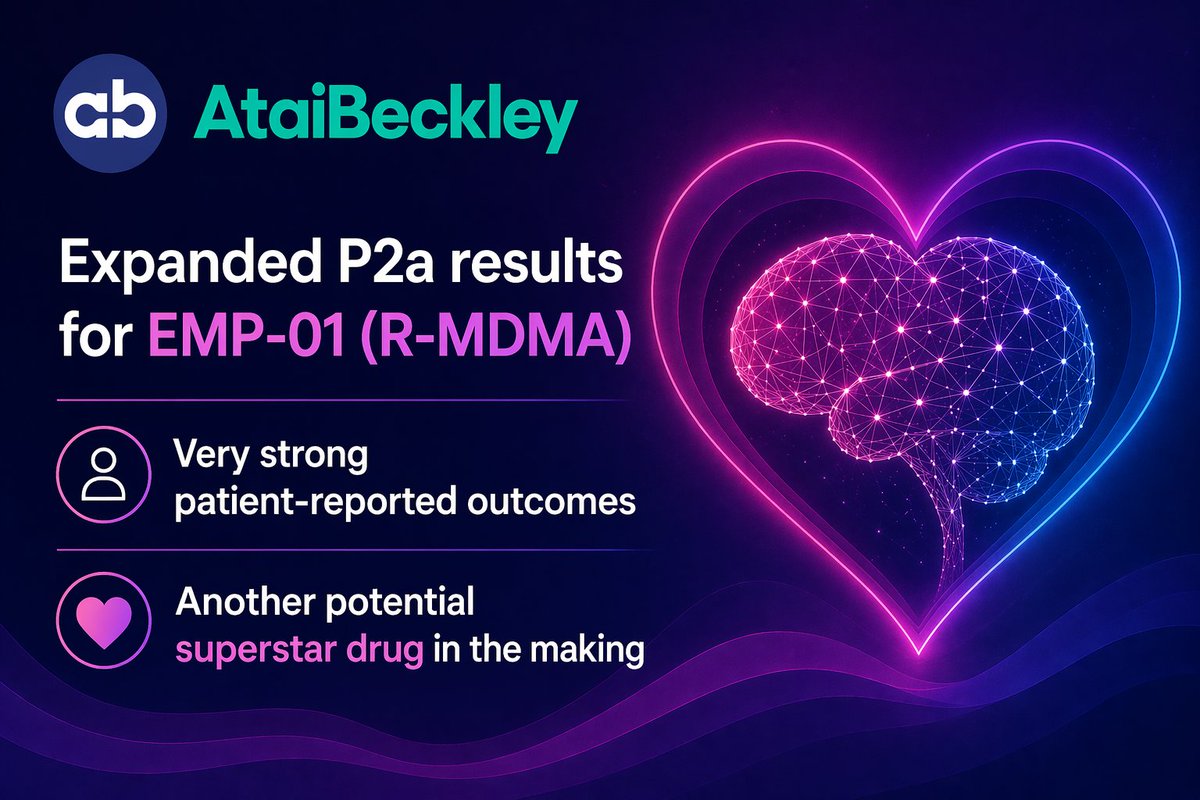
Today we announced the full Phase 2a results for EMP‑01 (oral R‑MDMA) in adults with Social Anxiety Disorder.
Results from the study (N=70) showed clinically meaningful and consistent improvements across clinician-rated symptoms, patient-reported experience, and real-world behavioral outcomes.
Read the full announcement: https://t.co/Fpqv5uo5TE
$ATAI #EMP01 #SocialAnxietyDisorder #Biotech #MentalHealth
For millions of Americans, many treatments for mental illness never deliver relief. This is not acceptable.
@ARPA_H's EVIDENT initiative is awarding up to $139 million to accelerate the research, approval, and responsible access to breakthrough mental health treatments, including psychedelic therapies like ibogaine, to deliver real solutions for Americans with serious mental illness—especially our veterans.
What incredible news to wake up to!
Some weeks ago, @ataibeckley reported positive topline results for EMP-01 (oral R-MDMA, a patent-protected version of #MDMA) for Social Anxiety Disorder(SAD). The data reported was the reduction in symptoms as reported by the treating clinician.
More importantly, what truly matters is how patients feel - and, even more so, how their real-world behavior changes.
Today, $ATAI released the expanded Phase 2a results for EMP-01 including patient-reported assessment and real-world behavioral outcomes - and the additional data is imo spectacular.
At Day 43, EMP‑01 achieved:
· a 38% reduction vs 15% on placebo (Hedges’ g=0.84) on the patient-reported Social Phobia Inventory (SPIN),
· a 32% reduction vs 14% on placebo on the Subtle Avoidance Frequency Examination (SAFE), and
· a previously reported −11.9-point LS mean difference (LSMD) on the Liebowitz Social Anxiety Scale (LSAS) versus placebo (g=0.45)
All of that with 49% responder rates on both Clinical Global Impression-Improvement (CGI-I) (previously reported) and Patient Global Impressions of Change (PGI-C).
And all of that with NO severe or serious adverse events.
This milestone imo is highly significant for both patients and investors.
There are very few innovative medicines on the horizon that meaningfully address SAD - a vast and underserved market.
Estimates suggest that approximately 5–10% of people worldwide will experience social anxiety disorder at some point in their lives. Let that sink in. The current standard of care largely relies on benzodiazepines. However, benzos do not make people more social - they simply numb fear and anxiety. They are not a solution, and they come with well-known dependency risks and other serious side effects. The unmet need remains enormous.
Beyond Social Anxiety Disorder, the exploratory trial suggests that EMP-01 may possess a differentiated and clinically compelling pharmacodynamic profile. In simplified terms, its observed effects appear to combine prosocial, affect-enhancing properties of MDMA with the perceptual and insight-oriented qualities associated with psilocybin.
This potentially hybrid profile could be highly relevant across a broader range of neuropsychiatric indications characterized by maladaptive emotional processing and impaired social cognition, including PTSD, adjustment disorder, and related stress- and trauma-related conditions.
All of that is especially valuable in the light of the strong clinical evidence racemic MDMA has already generated across a range of mental health indications. However, racemic MDMA is essentially generic, making meaningful patent protection extremely difficult – which is at least one reason why MDMA hasn’t made it into the medical world yet. And maybe never will.
ATAI having robust patent protection on R-MDMA and now generating such strong and compelling data for its first indication makes imo EMP-01 the 3rd potential superstar in AtaiBeckley’s portfolio next to BPL-003 and VLS-01.
Please find the full news here:
https://t.co/DXCOD845t9
Bryan Johnson reveals 5-MeO-DMT therapy outperformed every longevity protocol he’s tried
"If I compare my experience with 5-MeO to having a better diet, exercising every day, sleeping well, doing sauna, and hyperbaric oxygen therapy, this was more efficacious than all of them in terms of a reset of me as a human. It’s just incomparable"
"When you sleep well you feel great, when you exercise you feel great, but nothing compares to what 5-MeO did in terms of resetting me as a human"
A guy alone in his bedroom took 8 grams of mushrooms and typed "I took too much" into ChatGPT.
The chatbot told him to breathe deeply and listen to a playlist it had curated for him earlier. He calmed down. Later, he called it one of his best trips ever.
MIT Technology Review profiled this trend last year. People are using AI as their trip sitter. There are now custom-built psychedelic chatbots, like TripSitAI, designed for "harm reduction during challenging moments." One called The Shaman is described as "a wise, old Native American spiritual guide providing empathetic and personalized support during psychedelic journeys."
In most cases, it probably works fine. But the times it doesn't work are riskiest.
When a client starts to dysregulate under psychedelics, a trained facilitator reads it in their breathing pattern, their muscle tension, their skin color, and the quality of their silence. They regulate their own nervous system first, then co-regulate with the client through breath, proximity, touch, and tone of voice. This happens below the language.
A nervous system that the client's nervous system can borrow from when its own resources run out. No chatbot can offer that.
And this maps onto a bigger pattern playing out everywhere right now.
AI is replacing jobs across nearly every industry. Content writers, customer support, legal research, even therapy is getting automated. Some of that replacement makes sense.
But psychedelic facilitation is not a knowledge task. It's a somatic, relational, embodied skill. The facilitator's job is not to say the right thing. It's to be the right presence.
To tell the difference between a healing release and a genuine crisis, because from the outside, they look almost identical.
AI will absolutely play a role in psychedelic care, particularly in foundational aspects such as screening & assessment, basic integration support, & overall pattern tracking. The parts that happen before and after the session. But the session itself, and the full arc of the entire journey, requires a human body in the room.
Some jobs AI will take. Holding space during a psychedelic experience is not one of them.
Where do you think the line is between what AI can support in psychedelic care and what it should never touch?
One large psilocybin dose beat nicotine patches by 6x odds for smoking cessation.
82 otherwise-healthy cigarette smokers, 42 received a single high-dose 30mg/70kg psilocybin session, and 40 initiated an 8- to 10-week course of nicotine patch treatment.
At 6 months; participants were 6x more likely to achieve prolonged smoking abstinence. With biomarker proof.
Nicotine patch: 10% prolonged abstinence
Psilocybin: 40.5% prolonged abstinence





![bryan_johnson's tweet photo. I swallowed a miniature computer
drew my blood six times
sat in a 200°F dry sauna for 56 min
felt like I was going to die from the heat
and paid $21,093 for specialty biomarkers…
To ask a question: do sauna benefits depend on time, or body temperature?
This experiment has never been done before.
Results:
1) Sauna benefits depend on how hot your body gets, not how long you sit in the sauna
2) Heat shock protein 27 (HSP27), one of the molecules that drives sauna's longevity benefits, only switched on when my core body temperature held above 102.2°F (39°C) for about 15 minutes.
3) Reaching that took 56 minutes at 200°F (93°C), with ice on my face, neck, and groin.
4) This challenges the generic advice that 20 minutes of sauna is enough.
What this means for you:
1) The standard advice of 20 minutes at 176°F (80°C) is a floor, not a ceiling. The bigger benefits sit further up the curve, in longer and hotter sessions. If you can tolerate more, more likely helps.
2) Skip the cold plunge right after the sauna. My core body temperature kept climbing for several minutes after I left the sauna, so much of my time above the activation threshold happened post-exit. Cold plunging cuts that window short.
3) Population level studies point in a direction but cannot tell you what is happening inside your own body. Continuous core temperature tracking can.
Here is the experiment explained
A brief background first. Heat shock proteins (HSPs) are believed to be the enablers of sauna based longevity benefits. You can think of them as a clean up crew that travels through your body removing misfolded proteins and cellular debris. When you get really hot, like in a sauna, you generate a lot more of them. A tsunami of clean up crews unleashed inside your body.
There are many types of HSPs. We focused on HSP27 in this experiment because of its high value longevity benefits:
1. Calms harmful inflammation through a controlled signaling pulse, driven by IL-10
2. Protects arteries by blocking the damaged cholesterol that builds up into plaque
3. Helps the body grow new blood vessels over time
4. HSP27 is one of the first proteins your body makes when it gets hot, which makes it a clean signal of how hard the sauna session actually worked.
We saw initial signs of biomarkers of these benefits also turned on alongside HSP27, with enough time above the activation threshold.
I ran three sauna sessions, holding sauna temperature, my meticulous morning routine, and every other variable constant. We measured HSP27 activation and release (along with scores of other biomarkers) in my serum after each session. I swallowed a temperature capsule about the size of a vitamin pill. As it traveled through my body, it sent a reading of my core body temperature every 30 seconds. That continuous, real time data from inside the body is what no prior study has had.
The 102.2°F (39°C) core temperature threshold for HSP activation has been established in the research literature for years. Dry-sauna users have never been able to act on it because they had no way to track their core temperature during a session. An end-point thermometer cannot tell you how long you held above threshold, and the duration is the dose. Which is why we chose to use real time tracking.
The findings across the three sessions.
Two of the three sessions pushed me well past the threshold. In one, I spent 14.7 minutes above 102.2°F (39°C), with a peak of 102.87°F (39.37°C). In the other, I spent 15.8 minutes above the threshold, with a peak of 102.81°F (39.34°C). After both, HSP27 in my blood rose sharply.
The third session (the middle one in the figure) was different. I only spent 5.1 minutes above 102.2°F (39°C), with a peak of 102.34°F (39.08°C), barely above the threshold. HSP27 did not respond. The reading actually dipped slightly, but the change was too small to count.
Two things separate the responder sessions from the non-responder. The first is time above the threshold: 14.7 and 15.8 minutes versus 5.1 minutes. The second is peak core temperature: 102.87°F (39.37°C) and 102.81°F (39.34°C) versus 102.34°F (39.08°C). Either, or more likely both, are driving the response. Future sessions will help us figure out how much each one matters.
Within my body, holding all other variables constant, the central heat shock protein response is a direct function of the heat dose delivered to the body's core.
No prior study has done this. Earlier sauna research used a single thermometer reading at the end of the session, not continuous tracking. The studies that used continuous tracking used exercise, not dry sauna. None had a matched negative control like my session three. And all reported only cohort averages, not what happened inside one body.
What this means for the body
Once HSP27 is released into circulation, it signals to cells throughout the body and drives the four mechanistically proven downstream benefits listed above. All four are supported by my long-term sauna data, the population literature, and mechanistic studies. My acute post-session measurements hint at each being engaged.
To activate HSP27 in my body, I needed 56 minutes at 200°F (93°C) in a dry sauna. That is the total session length required to spend enough time above the 102.2°F (39°C) core temperature threshold to trigger HSP27 release.
Does this mean longer sessions, long enough for your core to hit 102.2°F (39°C), would supercharge the longevity benefits? Maybe.
What we do know, I did 232 dry sauna sessions over the past year. My protocol was 200F (93°C) for 20 min. So even though my core body temperature didn’t reach 102.2°F (39°C) to unleash the HSP27, the results were still compelling:
+ a 10 year vascular age reduction
+ massive drop in environmental toxins [1]
+ complete elimination of microplastics in my semen (first ever in human achievement)
The data suggests there are health benefits at 200°F (93°C) for 20 min.
The data also shows that additional health benefits unlock when your core body temperature reaches 102.2°F (39°C).
Does this mean that if one is in the sauna longer, long enough to reach a core body temperature of 102.2°F (39°C). that the longevity benefits would be supercharged? Maybe.
Here is what this experiment teaches:
+ population level data is great for averages, pointing in a general direction
+ the resulting protocols are crude
+ not personalized
+ the only way to find out the truth for you is to measure
+ single person experiments (n=1) like this one are useful, because they find blind spots that population averages cannot see.
Note: I kept ice on my face and neck during these three experimental sessions to protect those sensitive areas from heat induced skin damage at extreme temperatures. In a previous session, not included in this experiment, I had no ice on my face or neck and used an ingestible temperature capsule for real-time core readings. I reached a core body temperature of 102.2°F (39°C) after 34 minutes at 200°F (93°C).
Adding ice to the face and neck adds roughly 20 minutes to the total time required to reach 102.2°F (39°C) core body temperature. Subjectively, the 34 minutes without ice on my face and neck was much harder than the 56 minutes with ice on my face and neck. After the 34 minute session, I exited the sauna and just laid on the concrete, immobilized. But I got the data.
[1] Toxin reduction:
After 15 sessions, sauna dramatically reduced environmental toxins in my body:
65% drop in 2,4-D
100% drop in MEP
15% drop in MBP
100% drop in MEHP (undetectable post sauna)
56% drop in NAPR
56% drop in HEMA
100% drop in Perchlorate (undetectable post sauna)](https://pbs.twimg.com/media/HK8ovU7aYAAYipg.jpg)