MD-Phd student by day👩🔬 Aspiring Artist by night👩🎨 Currently doing a bit of both in Slutsky lab at @TelAvivUni. #electrophysiology 🧠 #Alzheimers#in_vivo
1/ It feels weird (and almost wrong) to post about science again in the midst of everything happening here in Israel, but precisely in these difficult times good news should also be shared: My PhD work has been published in @NatureComms:
https://t.co/FUoTjQBWaw
A proud mentor moment.
Congratulations to my brilliant PhD student, @haliti_b, on receiving the Alzheimer's research prize in memory of Prof. Daniel Michaelson. Well-deserved, Halit! Excited to see what comes next!
#AlzheimersResearch#Neuroscience@TAUMedFaculty
Excited to share my Ph.D. paper, now published at @NatureComms!
We uncovered a transcriptional role for Tfii-i in oligodendrocytes, its loss resulting in enhanced myelin thickness and signal conduction.
https://t.co/8Xwq7mIBhu
🚨 New paper alert! 🚨(1/6)
Excited to share our work, out now in Science Advances
We show that a rapid norepinephrine surge along a brainstem pathway (LC→PRN) is a key driver of sound-evoked awakenings
https://t.co/O9q4qWOmzR
Very excited to share the first paper from my lab. We engineered a new PTEN sensor that permits dynamic imaging in living cells. We showed that this allows to visualize PTEN activity with subcellular resolution in the intact brain. Now published in Nature Methods
Excited to share our new preprint out on biorxiv! We found a specific LC pathway that influences sensory evoked awakenings from NREM sleep. @LabNir https://t.co/6wLOF2WVEb
Had such a great time at #ISFN! 3 full days of neuroscience and meeting old and new friends-what else could I ask for? Turns out, the Best Poster Award😉
I didnt take any pictures during the meeting, so here’s one from this morning, just before going back to the medical clerkship
Mice lacking microglia (Csf1r∆FIRE/∆FIRE) have normal
-synapse number and maturation
-seizure susceptibility and hippocampal-prefrontal cortex coherence
-segregation of inputs into the lateral geniculate nucleus
-neuronal and astrocytic gene expression
https://t.co/C6FBRqwwMA
Let’s share some data! @LabNir 🧵
We’re thrilled to announce our new paper in @ScientificData featuring an open iEEG dataset from two medical centers and an ML model for detecting interictal epileptiform discharges during sleep 🧠⚡
👉 https://t.co/wgmfvLRxaj
What if you could target brain regions important for recovery after spinal cord injury with DBS? Can you say hypothamamus? Guess what Cho and colleagues from Switzerland did just that in a brilliant new paper @NatureMedicine.
Key Points:
- People don't think about it, but guess what, spinal cord injury 'disrupts the neuronal projections from the brain to the region of the spinal cord that produces walking.'
- The authors wanted to know what brain regions would steer recovery following spinal injury.
- They cleverly made a space–time brain-wide atlas of 'transcriptionally active and spinal cord-projecting neurons.'
- What region lit up? The lateral hypothalamus.
- Specifically glutamatergic neurons.
- They tested in mice and it helped.
- They tested in two humans and it immediately improved walking.
My take: WOW. A little serendipity in that no one expected that the lateral hypothalamus was important for mediating recovery of walking in incomplete spinal injury. We have been in the lateral hypothalamus for DBS in humans for obesity and other symptoms and, we will need in future experiments to monitor body weight, psychological status, hormonal profiles, and of course autonomic functions. What I love about this study was the path the scientists and clinicians from Lausanne took. A space–time brain-wide atlas, followed by mice, and then two actual humans. BRAVO! Excited to see what comes next.
https://t.co/YQnX2cueWi #deepbrainstimulation #neuromodulation
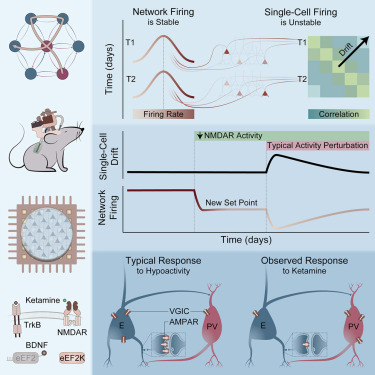
TAU researchers find that the NMDA receptor (NMDAR)—long studied primarily for its role in learning & memory—also plays a crucial role in stabilizing brain activity. This may lead to innovative treatments for depression, #Alzheimer's disease, and epilepsy. https://t.co/B2200M8Nki
1/I’m honored to finally share our new paper in @NeuroCellPress ! Some good news during this challenging time here in Israel. We uncovered a new role for NMDA receptors in regulating spontaneous hippocampal network activity! 🤩https://t.co/crlkUQPKd0
🚨📢 Excited to announce our new paper in Science Advances! We’ve uncovered how Shank3 mutations affect myelination in an autism mouse model and human iPSC-derived OPCs. 🧠💡 Check it out!
https://t.co/0uVHAKHVJS
How do specific projection pathways of the LC-NE system mediate sleep awakenings?
Tomorrow (Wed Oct 9 15:30) at #sfn2024@NMatosevich presents our latest research at the mini-symposium "Emerging Functions of Neuromodulation during Sleep"
https://t.co/XQDQQmKiIo
After three rejections we have finally published our data that 4-week single housing is not stressful for adult male and female mice. Please use and cite to justify single housing in your experiments for the animal welfare commissions.
https://t.co/KLLr3DA1Q0