2025 @umdcs REU-CAAR is out! @DomJWilliamson and I are looking for an REU summer student on bivariate bicycle codes. Yifan Hong and Yu-Xin Wang have a nice project on QLDPC codes. @ShubhamL0 is looking to find record breaking qutrit codes. https://t.co/RQQzfzVoHo
Some more personal details about the spherical codes paper I was so excited about last year. With the recent focus on dual-rail in bosonic coding, I think @Alice__Bob are the only ones actively pursuing cat codes, and I wish them success. https://t.co/0WVQI11D7l
A new concept called quantum spherical codes could make the notoriously fragile information in a photon-based quantum computer less susceptible to errors. Researchers at NIST, @JointQuICS, @JQInews and @UMDscience published their work in @NaturePhysics: https://t.co/owyrh0XHOP
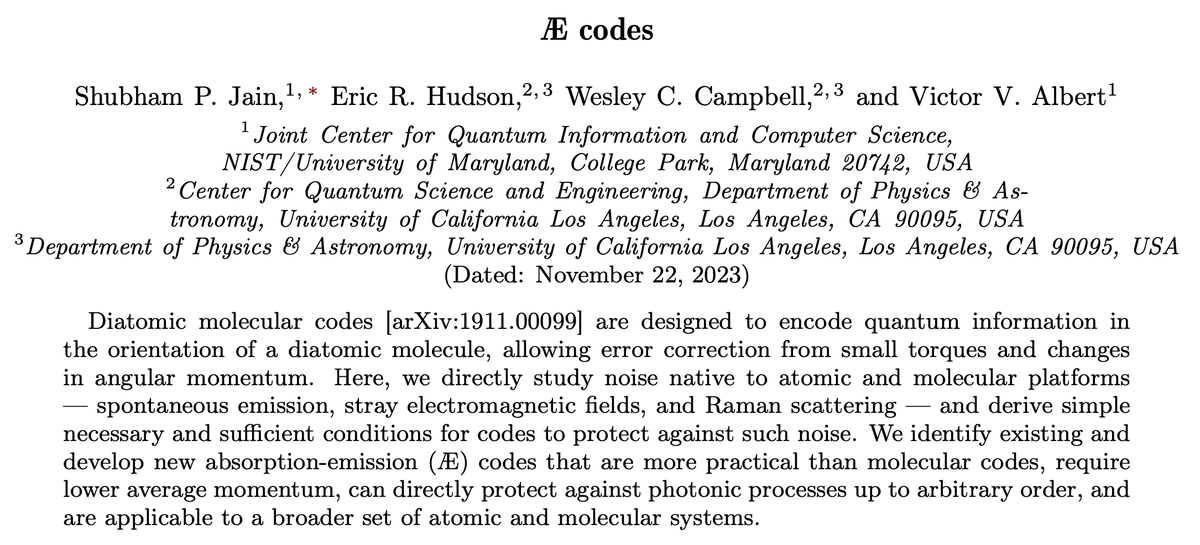
Our preprint on quantum error correction in single molecules is online: https://t.co/R88qSTGnBz We look at ways to implement Æ-codes to protect quantum information against photon absorption and emission. These codes have been found by @victorvalbert and coworkers.
Æ = absorption-emission, since the codes can handle such error processes. These allow for more practical error correction in atoms and molecules than molecular codes. They are to molecular codes as binomial codes are to GKP.
Our recent work titled \AE codes is now on arXiv!(https://t.co/zZveYhy4Vx) w/ @victorvalbert, Wes Campbell, Eric Hudson. We address the long standing question of protecting atoms/molecules against scary noise sources such as spont. emission, Raman scattering (and more!) (1/5)
Our codes also have connections to the binomial codes https://t.co/MTKoSTxOYc and we discuss how these new codes are also new in the fock state world. The codes are compact and could be hosted in atoms/molecules that the community is alrady working with! (5/5)
Multimode cat codes are here! I've been thinking about how to do this for over 8 years, ever since I started working on cat codes in grad school @Yale_QI. https://t.co/b4PGX2Jocj https://t.co/mDtXPjm2XX 1/7