Any interests in extracting invariant functions or physical laws from complex environments? Check our new ICML paper “Discovering Physics Laws of Dynamical Systems via Invariant Function Learning” at https://t.co/NYdsFAiTCU!
#ICML2025
I am glad you asked…
VL pipelines before 2020 relied heavily on region proposals from object detectors (not exactly 3d but at least its some sort of perceptual grouping, reminiscent of good old vision). In implementation this meant you would first run an object detector on your entire training dataset (with non-max suppression and heuristic filtering), cache region features, and then train a VL model on top of these cached features. I suspect most people didn’t even compute their own features and just downloaded features for popular datasets like COCO released by a few popular repos (like BUTD features by @panderson_me et al). And god forbid if your VL task required perception of object categories beyond what your detector was trained on 😱
Compared to this pre-covid monstrosity 👹, today’s VL pipelines are elegant as swans 🦢!
✊Just tokens in and tokens out - heck we don’t even have to worry about whether it’s words or pixels or audio
✊When trained on data that matched your end tasks, any representation learned is directly in service of those tasks (end to end learning at its finest)
✊We no longer have to worry about needing a different classification head for tasks with different answer categories or even different output types. Its just a sequence of tokens so we are good as long as the output can be tokenized without loss of information (be it category names, vqa answers, captions, bounding box coordinates)
So, i think the simplicity is a big feature that has enabled much of the unification and scaling. And its worked better than I could have imagined a few years ago.
But is it enough to carry us through the next decade? Well, today’s VL models still aren’t a 100% accurate especially when it comes to spatial reasoning…so something’s still missing…there is a bug in there somewhere 🤷
I'm not following any algorithm.
I'm working on new architectures (JEPA world models), inference procedures (planning and reasoning by optimization in embedding space), and learning paradigms (self-supervised learning).
When a system with these components starts working, we'll be on a good trajectory.
If you are a student or academic researcher and want to make progress towards human-level AI:
>>>DO NOT WORK ON LLMs<<<
LLMs are an off ramp.
Thousands of engineers are working on LLMs with enormous computing resources.
The only way you could possibly contribute is by analyzing existing LLMs and showing their power and limitations.
But it's more fun and impactful to come up with new ideas and new architectures and show that they might work, even on small problems.
Introducing [#ICML2024] *Minimal Frame Averaging for More Symmetries and Efficiency*, a model-agnostic framework for efficient equivariance across a wide range of groups.
Joint work w/ @JacobHelwig@ShuruiGui@ShuiwangJi
P: https://t.co/nZjwIOT0ZF
C: https://t.co/FgYrA0SYx5
Constructive mindset to deal with 👎paper reviews💡
•Accept that reviewers may have little time/experience.
•They didn't get it? You didn't explain it well
•Missed some details? Highlight them better
•Didn't find the paper exciting? Here's your challenge for the next version!
Submitting to #NeurIPS2024, it asks for a license. Of the choices, I recommend CC BY 4.0. Roughly speaking, this allows people to share and adapt your work, but they have to cite you if they do ("BY").
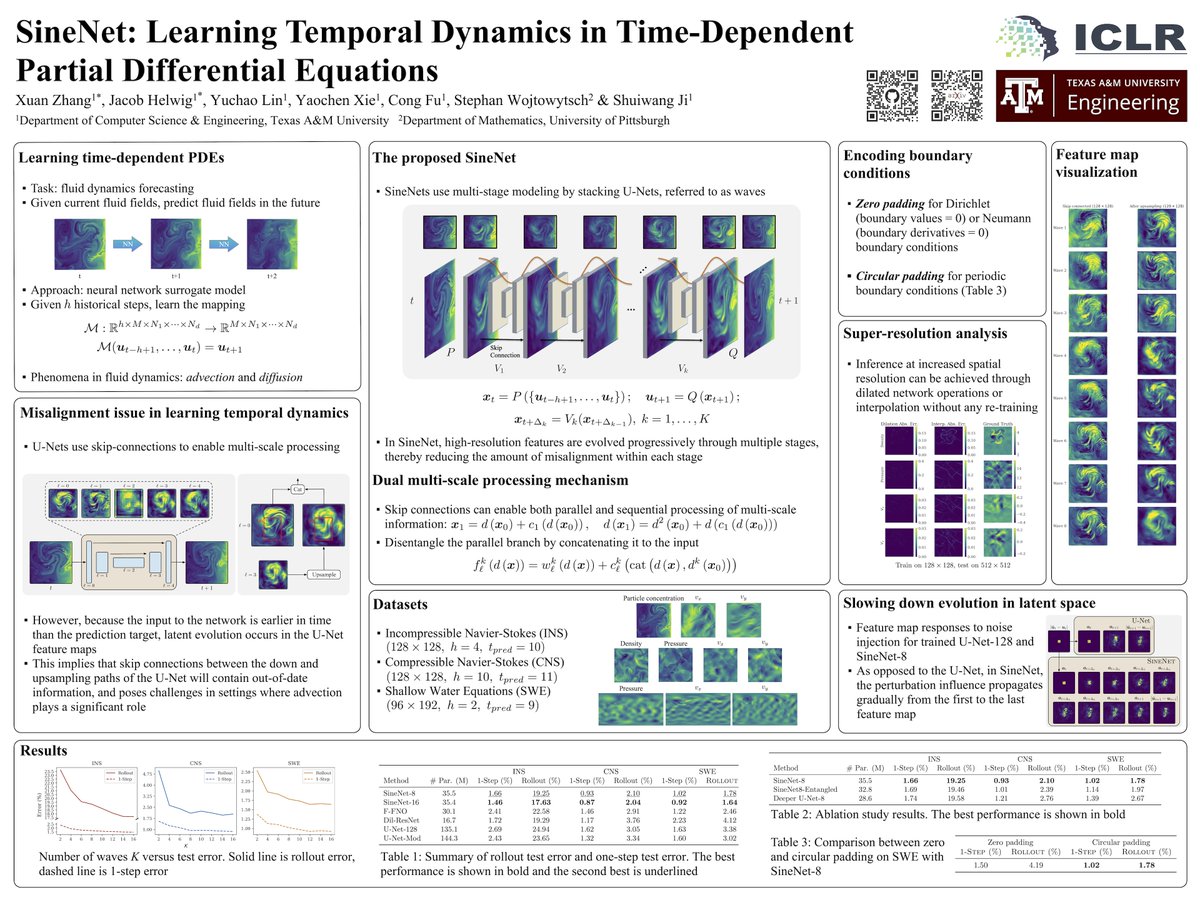
Jacob @JacobHelwig and I will present our paper "SineNet: Learning Temporal Dynamics in Time-Dependent Partial Differential Equations" tomorrow (May 13) from 09:00 to 10:15 EDT in the AI4ScienceTalk series @AI4scienceTalks. Come and join us!.
Details: https://t.co/WBx6SgsDN6
Trilled to have our papers
1. Graph Structure Extrapolation for Out-of-Distribution Generalization (https://t.co/YLi1qDQYv4)
2. Position Paper: TrustLLM: Trustworthiness in Large Language Models (https://t.co/tchKSsF7N7) (https://t.co/uvV0pwk9d0)
accepted at #ICML2024 !
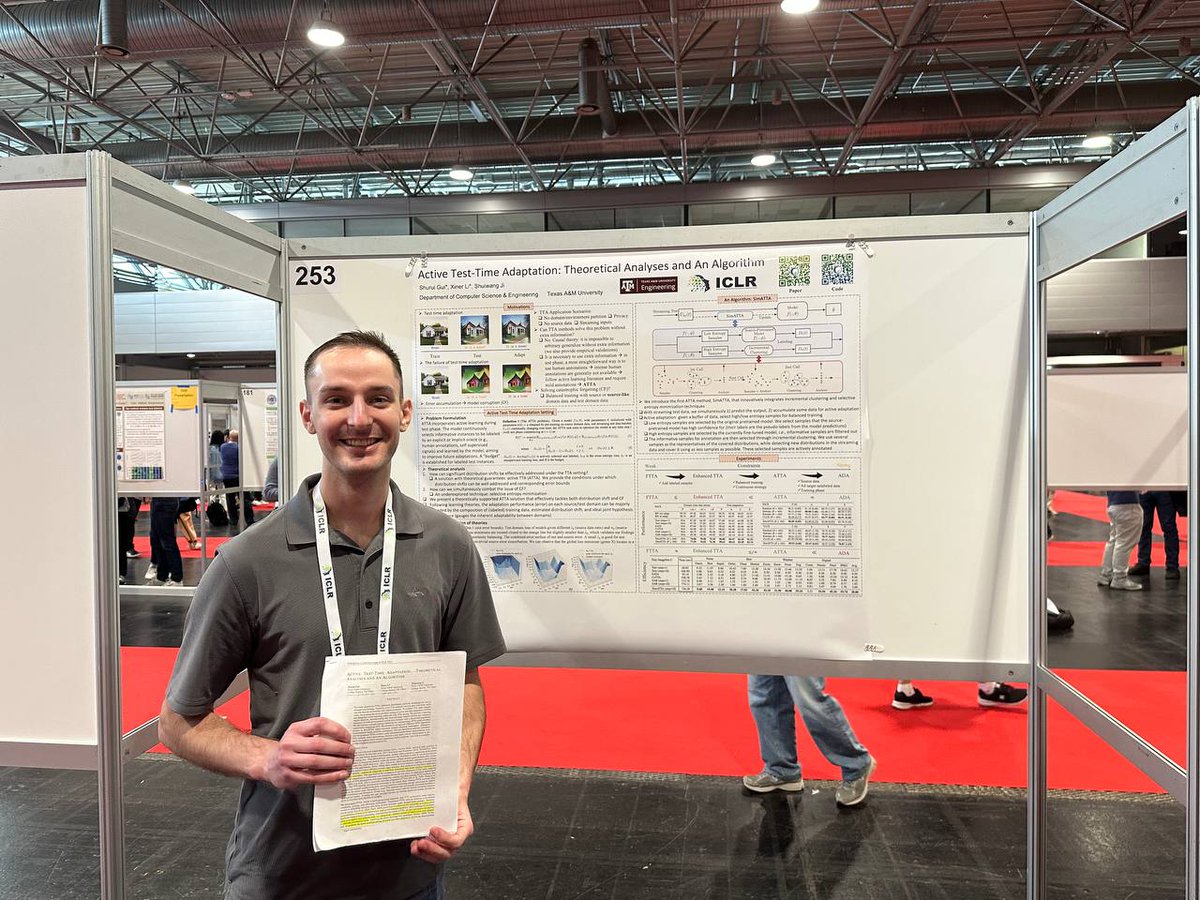
Thrilled to announce that our paper Active Test-Time Adaptation has been accepted by ICLR 2024! 🎉 Many thanks to my great advisor @ShuiwangJi and the remarkable co-author @hyanan16! Interested in this new TTA direction? Follow our project: 😄
https://t.co/bgL8Zvdu4l
#ICLR2024
@AntoineDelefor1 That makes me think it is not simply about "dumb reviewers" or "dumb authors". It is about crowded-in unprofessional researchers who did bad jobs on both.
@AntoineDelefor1 Seems you are unlucky. 3/6 papers got more than two 7+ scores in my batch, and only 1/6 got all rejections. However, I heard in many review batches, about 3/6 papers were withdrawn.


![KruskalLin's tweet photo. Introducing [#ICML2024] *Minimal Frame Averaging for More Symmetries and Efficiency*, a model-agnostic framework for efficient equivariance across a wide range of groups.
Joint work w/ @JacobHelwig @ShuruiGui @ShuiwangJi
P: https://t.co/nZjwIOT0ZF
C: https://t.co/FgYrA0SYx5 https://t.co/rEUcv1Uli1](https://pbs.twimg.com/media/GQDaYMoWsAAL_Vc.jpg)