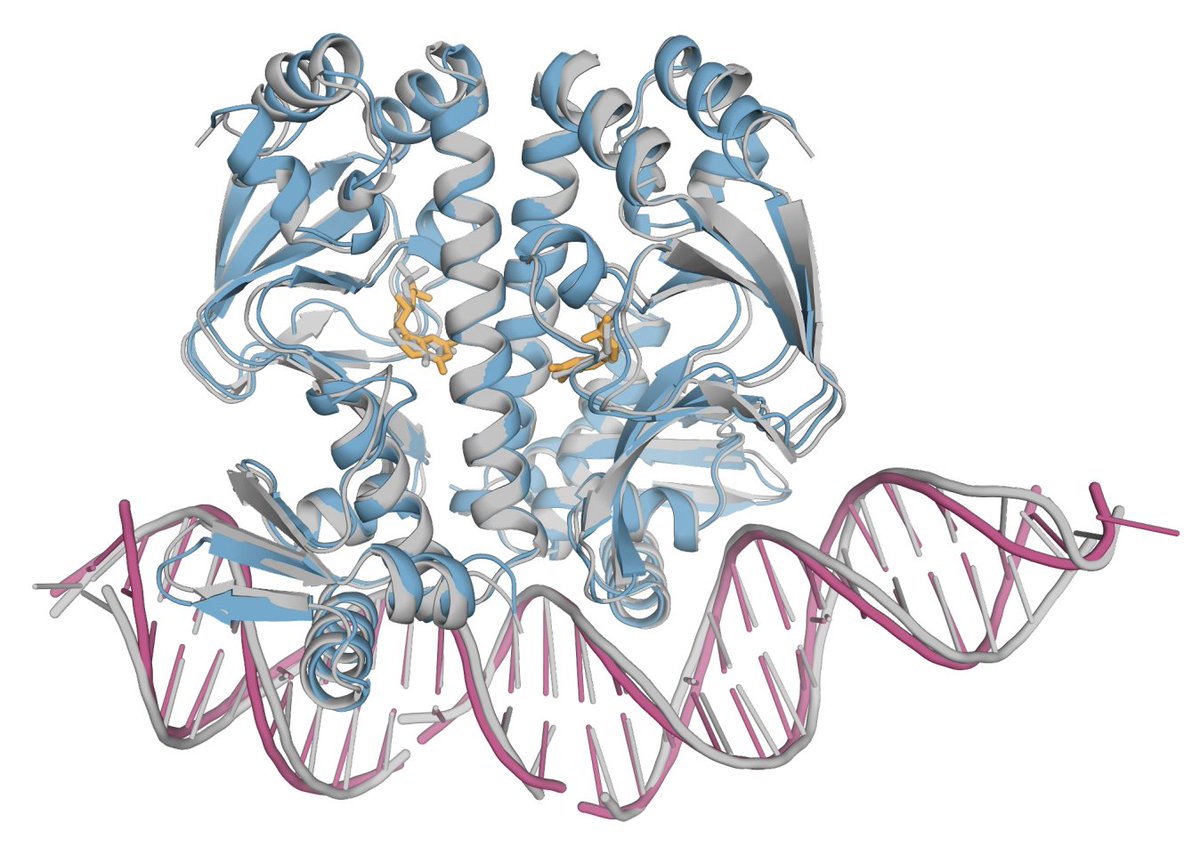
Inspired by @simonduerr at ERC'24 I built and deployed our sequence redesign model called CARBonAra on @thehuggingface.
The model is aware of any biomolecular context and performs on par with ProteinMPNN (paper)
@lucien_krapp@matteodp
Check it out here: https://t.co/Tp94b7G3xL
With David and the Baker Lab in the spotlight today, I wanted to share some insights into the @UWproteindesign and how it operates, a glimpse behind the curtain. I had planned to write this post-graduation, but now seems as good a time as any. (Got twitter blue free trial so this could all fit in less tweets!)
First, the lab is enormous. ~60 grad students, ~60 postdocs, a handful of visitors, undergrads, and a surrounding institution of another 150 or so. Collaboration is strongly encouraged (even mandated) by David, who sets up pro-collaboration incentives. Notably, he's fine with grad students graduating without a sole first-author paper—it's acceptable to "only" have worked as a co-first author. This is a key ingredient in the secret sauce: the tight collaboration between wet lab and dry lab. It ensures that all our work is ultimately grounded in strong wet-lab validation—our "oracle" is the real world, not another computational model.
While we have regular meetings for different subgroups and the entire group, much information travels through the lab via informal one-on-one interactions. In some ways, it reminds me of a classic "tribe of humans in the state of nature"—100-200 people with no clear hierarchy, passing information via "gossip". It’s maybe not the most complete way of ensuring everyone is on the same page, but saves time as we aren’t drowning in endless meetings.
Does David stay in touch with all these grad students and post-docs? Remarkably, yes. Unlike some very large labs known for being run entirely by post-docs, he knows exactly what everyone is working on and the stage of their projects. Each member has monthly one-on-ones with him, and monthly subgroup meetings that David attends. If he suggests you try something at your previous one-on-one, you'd better have it done by the next.
Does he actually contribute research ideas, or is he more of a detached big-picture project manager? Definitely the former. He understands the intricacies of a shocking range of topics. I'll be discussing some arcane deep learning concept with him, and then he'll turn around and talk to someone about the details of a catalytic mechanism. He's actually the most hands-on PI I've ever had—if anything, he verges on over-managing rather than being too detached.
How does he keep track of everything? Partly, he's just a brilliant person with exceptional recall. But he has also built infrastructure above and below him in the lab to handle many of the details, bureaucracy, big picture, and management tasks. This allows him to spend most of his day doing what he's most passionate about and skilled at: walking around talking to people about science. He also lives very much in the moment and in his own words, “never thinks very far ahead". To keep up with tools, methods, and wet lab techniques, he does the occasional project and design campaign himself on the side when time allows.
It's still a tremendous cognitive load to keep all this in his head, but as much as possible, he has offloaded non-scientific cognitive burdens. It helps that he’s in the lab in person most days of the year, rarely traveling for conferences or talks, instead doing them over Zoom or not attending. (1/2).
Congratulations David (and the team at DeepMind) - the price is truly deserved as everything you built over the years is impressive. 🥳
I am still incredibly grateful that I got to be a part of this amazing community in Seattle! 😊 (even though it was just for my Master thesis)
BREAKING NEWS
The Royal Swedish Academy of Sciences has decided to award the 2024 #NobelPrize in Chemistry with one half to David Baker “for computational protein design” and the other half jointly to Demis Hassabis and John M. Jumper “for protein structure prediction.”
BREAKING NEWS
The Royal Swedish Academy of Sciences has decided to award the 2024 #NobelPrize in Chemistry with one half to David Baker “for computational protein design” and the other half jointly to Demis Hassabis and John M. Jumper “for protein structure prediction.”
I'm sharing my story in a difficult time for Palestinians and Lebanon, where we found refuge after being exiled from Haifa. I want to honor those who suffered the most and never got to live out their dreams—my grandparents, Jido Ali and Taita Khadejeh. I hope they’re proud (1/3)
Our method for protein sequence prediction is out.
"Context-aware geometric deep learning for protein sequence design" - check it out at https://t.co/bbKYKzF1U5…
Kudos to Lucien @lucien_krapp and the team @FATPMeireles, @labriataphd, Maria and Sarah.
https://t.co/VkfFat7Ap8
To all Protein Designers!
We @matteodp and the @ISBSIB are working on a database for in silico generated protein structures and need your input that fits our different pipelines. Please fill out our survey and share it: https://t.co/m2NU3Od6rW
#ModelArchive#ProteinDesign
Excited to share that I am starting a lab focused on deep learning-based protein design, biophysics and fundamental biology at @MPI_Biochem and @GeneCenter_LMU in Munich with the Emmy Noether Programme this summer. Join us as a PhD or postdoc. More to follow soon!
@RolandDunbrack@Nature@GoogleDeepMind Often the authors want to release code, and it's an uphill battle to convince the company, lawyers, investors. The second the journal indicated they would accept w/o code, the authors lost all leverage.
The journal ( @nature ) has failed the community, not the authors.
Demis -- I think AlphaFold3 is really exciting. As Reviewer #3, I got great results from the server. I tried hard to get @Nature to urge you to release the code but was unsuccessful. I did not get it for re-review so I don't know if you responded. So why no code? @GoogleDeepMind
New! We’ve just put up a note evaluating the latest, in-development version of AlphaFold (“AlphaFold-latest”). This is a preview - development is still in progress - but performance across a wide range of tasks is striking.
https://t.co/28nuVOir9v
Highlights in the thread.
1/7