from Silicon to Software *x-Intel *Hack New Business Models in software *domain builder -prototyping *AI Finance *Web Dev *eCommerce *Code *Content *Writing
Elon Musk's argument for simulation theory is surprisingly simple:
If technology keeps improving, even slowly, future civilizations will create simulations indistinguishable from reality.
If that's true, the odds that we're living in the original reality become incredibly small.
What's more unsettling, that we're in a simulation, or that we're not?
Breaking: Your smart TV takes a screenshot of your screen twice every second and sells what it sees.
It is called ACR, and it has been running since you set the TV up.
Texas already sued over it. Here is how to turn it off in under 2 minutes:
Marc Andreessen just revealed how Harvard Business School was built on a broken 1941 theory, and how it's now collapsing...
Andreessen co-founded Netscape in 1994 and a16z in 2009.
He has sat on Meta's board since 2008.
He has spent 30 years backing founders — and watching managerial CEOs lose to them.
The pattern traces back to one book: James Burnham's The Machiavellians (1941).
Burnham argued every great company had been founder-run.
Henry Ford ran Ford. Bob Noyce ran Intel.
Today, Elon Musk runs Tesla, SpaceX, and Starlink.
Then, he said, something broke.
Between the 1880s and the 1920s, a new philosophy replaced the founder. It was called managerialism.
The professional manager would now hold a portable skill, usable across any business.
The consequences were:
• Harvard Business School
• Stanford Business School
• Management as a universal skill
• The 1970s conglomerate
"That assumes the managers are going to do a good job," Andreessen says.
For 30 years, they haven't.
Managers can run something static, he says. Soup is soup. A bank is a bank. A car is a car.
But when the industry changes, the manager freezes.
Look at SpaceX.
"Imagine being a professionally trained manager, trained at a top management school, working for a rocket launch company, competing with SpaceX."
Then Elon's rockets started landing on their butt.
"Your management skills ... what good are they at that point?"
Andreessen's conclusion:
"You're much more likely to build something important in the 21st century if you start with the founder and train them on management."
What "professionally run" institution in your life has quietly stopped working?
If you're new here, @GeniusGTX is a gallery for the greatest minds in economics, psychology, and history. Follow along for more similar content.
P.S. I made a free toolkit breaking down 100+ mental models used by history's greatest thinkers.
5,000+ downloads. 113 five-star reviews.
Grab your free copy here: https://t.co/u2q1uUm9vD
• Marc Andreessen ( @pmarca ), co-founder of a16z, on David Senra's ( @
@davidsenra ) podcast
Boris Cherny, the creator of Claude Code at Anthropic, just explained why most people aren't getting real results from Claude
this is one of the best interviews I've seen in a long time
in this talk he breaks down exactly how most people never actually set up Claude:
- the 14% you lose to CLAUDE.md before typing a word
- the memory system that eliminates repeating yourself every conversation
- the custom instructions most users leave completely blank
- the project settings that give Claude permanent context about your work
if you've been using Claude for more than a month and never left the chat window, you have at least 30 untouched features. probably 38
instead of another show tonight, watch this
make sure to bookmark it before it gets lost in your feed
the guide is in the article below
Ray Dalio just gave the most important AI investing warning of the year (Save this).
The question put to him was simple with Alphabet raising $85 billion in equity, debt markets flooding with AI capital, and war spending piling on top, is there a crowding out happening? Can the system absorb all of it?
Yes, it is a bubble and he has said this consistently since late 2025, citing his proprietary bubble indicators, a composite of ownership concentration, sentiment, leverage, and valuations going back to 1900.
By those measures, AI is currently approaching 80% of the level seen at the 1929 peak and the 2000 dot-com top.
But the part investors keep misreading is what that actually means.
Dalio is not saying sell everything and his position is the opposite: the technology is real, the productivity gains are real, the long-term impact is genuinely profound.
What he is saying is that betting on the technology and buying the stocks are two fundamentally different acts.
In every major technology bubble in history, railroads, electricity, the internet, the technology won.
And the majority of companies that got investors excited during the mania either went bankrupt or spent the next decade going nowhere while the underlying technology kept compounding.
The mechanism for how a bubble bursts is the part most investors never think about.
Paper wealth is not money, bubbles do not burst because fundamentals disappoint.
They burst when a large enough group of wealth holders are simultaneously forced to convert that wealth into cash.
What makes the current setup specifically fragile is the concentration.
The top 10% of Americans now hold nearly 90% of all equities, when that group needs liquidity for any reason, the selling pressure falls on a market that is structurally narrow.
There is a graveyard in American tech right now and nobody is walking through it. Companies down 70, 80, 90% from the highs. Still profitable. Still growing. Still the leader in their category. Just unloved. The Trade Desk at 9x earnings. PayPal at 12x with $6 billion in free cash flow. Adobe at 17x and people are talking about it like it’s Kodak. Etsy at 8x EBITDA running a marketplace that two billion people have heard of. Roku trading below its own balance sheet liquidation value if you squint. Match Group, Zoom, Pinterest — each of these would have been a hedge fund’s top pick at this multiple in 2017. Now they’re orphans. Everyone is buying the Mag 7 because the Mag 7 is the trade. The Mag 7 IS already the trade. The trade is over. The next trade is in the rubble pile. You don’t get rich buying what worked. You get rich buying what stopped working for reasons that turn out to be temporary. Every name on that list was a market darling 36 months ago. The fundamentals didn’t fall 80%. The narrative did. Narratives come back. Earnings compound. I’m not buying NVDA at 45x. I’m buying the names CNBC won’t say out loud anymore
Stop modeling OpenAI on DCF. You're using the wrong tool.
@BillAckman told @theallinpod there is one question that matters for SpaceX, OpenAI, and Anthropic: is this person the right person to be running this in 20 years? Everything else is secondary.
He categorizes them as Series D/E stage. Early uncertainty is gone, but they require talent-first underwriting, not financial modeling. The dominant variable in whether the investment works is the quality of the founder assessment.
Every month you delay at current prices is compounding time you lose.
The framework: https://t.co/3axkkQIgxm
Source: All-In Podcast - https://t.co/3EnRCmPuO2
🚨 Leopold fund went All-in on Neoclouds for same reason !!
“Compute through 2027 is sold out.” — OpenAI CFO confirmed on @theallinpod
“If you do not have compute, you do not have revenue.”
OpenAI is passing on opportunities RIGHT NOW because of the shortage.
📝Market prices AI infrastructure on a 2-year horizon.
OpenAI buys on 6 year conjecture 📈
Where she feels most SHORT: 2030, 2031, 2032.
⛔️A single GW-scale data center = $50B + 3 years to build.
The plays ?
The named proxies: $ORCL $CRWV $NVDA
But the real constraint? Power and land.
The neocloud stack I’m watching:
🔲 $CRWV — $99B backlog, OpenAI + Meta locked in, take-or-pay contracts
🔲 $NBIS — AI-native cloud, NVIDIA partnership, 5GW target by 2030
🔲 $IREN — Direct NVIDIA cloud-services contract, DSX partnership
🔲 $APLD — Power + campus execution play, CoreWeave as anchor tenant
🔲 $ORCL — Hyperscaler with long-dated AI contracts
The market is still pricing this on a 2-year lens.
The CFO of the most compute-hungry company on earth is buying on a 6-year lens.
💵 That gap is the trade !!
An NVIDIA executive just told me the GPU-to-CPU ratio will go from 2:1 today to 1:1 “in months" due to agentic AI.
NVIDIA executive is saying 1:1 IN MONTHS.
CPU CPU CPU $NVDA
NVIDIA just put a supercomputer inside a laptop.
Run AI on your laptop — no internet, no subscription, no cloud needed 🤯
RTX Spark specs:
→ 6,144 CUDA cores
→ 1 Petaflop of AI
→ 128 GB unified memory
→ 70 billion transistors
→ TSMC 3nm chip
Jensen Huang said this is "33 years of everything NVIDIA learned in one chip."
That's not a product launch. That's a revolution.
Your next laptop won't just run apps. It will run AI agents. On Windows. Offline. Instantly.
The AI PC era has a face now. It's called RTX Spark.
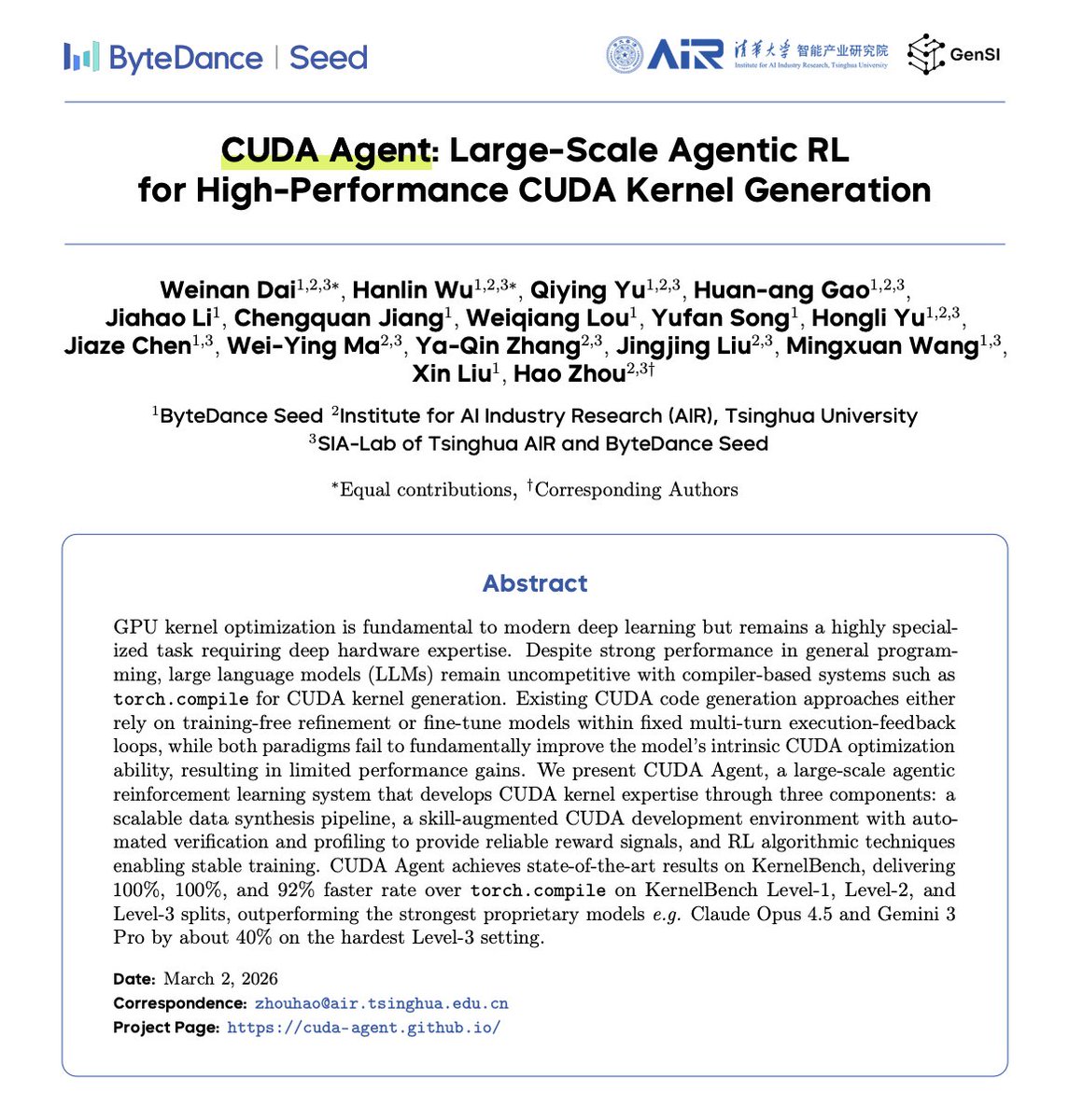
ByteDance has published a paper that should make every NVIDIA investor sweat.
They trained an AI that writes CUDA better than humans experts.
They call it CUDA Agent.
And it completely rewrites the economics of AI hardware.
They built a massive agentic reinforcement learning loop. The AI writes a kernel, compiles it, profiles the hardware, analyzes the bottlenecks, and rewrites the code until it's flawless.
It learned how to optimize memory access patterns and hardware tiling strategies that traditional compilers miss.
The results are staggering.
On the industry-standard KernelBench, CUDA Agent completely destroyed traditional compilers.
It delivered code that runs up to 3.2x faster than PyTorch's native execution.
On the hardest, most complex models, it beat the strongest proprietary models in the world—including Claude Opus 4.5 and Gemini 3 Pro, by 40%.
It didn't just match human experts. It started discovering optimizations that static compilers literally cannot see.
Here is why this is a massive threat to NVIDIA.
NVIDIA's dominance relies on the fact that CUDA is incredibly hard to master. Developers get locked in because optimizing code for other chips is too painful.
But if an AI agent can autonomously generate hyper-optimized hardware kernels...
You don't need a team of $500k a year CUDA engineers to build world-class infrastructure.
And if an AI can autonomously master CUDA, it can master AMD's ROCm. Or custom silicon.
The impenetrable software wall protecting NVIDIA's monopoly just got breached by a reinforcement learning loop.
If anyone can automatically squeeze maximum performance out of any chip...
Hardware becomes a commodity.
The smartest students at Harvard and Stanford aren't smarter than you.
They just stopped studying the way that feels good and started studying the way the brain actually works.
10 techniques their professors actually teach:
There are a lot of smart people at Google.
They have concluded that issuing stock at a 2.5% earnings yield is cheaper capital than issuing 30Y bonds at 5.5-6.0%.
Adjust your asset allocation accordingly.
Andrej Karpathy: by 2026 the "do it all yourself" founder is obsolete
the gap isn't talent anymore. it's leverage.
the dead list: manual research tabs open till 2am, writing every post from scratch, being your own assistant, scheduling your own life, "i'll hire when i can afford it"
what actually compounds:
a research agent that reads the web for you
a content agent that writes in your voice
an assistant agent that runs your tasks
an exec agent that handles ops + scheduling
a strategist agent that thinks a few steps ahead
that's 5 hires for $20/mo. always on. never sleeps.
vibe coding made everyone a builder. agent engineering makes everyone a founder with a team.
the edge isn't working harder. it's being the org while everyone else is still the employee
book & watch, then save the setup below
When Niccolo de Masi first met $IONQ, the company had 35 people.
As of Q1 2026, $IONQ has 1,300 employees.
When $IONQ merges with Skywater later this year, it will have 3,000 employees: Engineers, mathematicians, physicists, and so on.
Niccolo (now CEO of $IONQ) expects the number of employees in quantum to grow 10x over the next few years.
Quantum is just getting started.
Andrej Karpathy (co-founder of OpenAI):
"My agent will talk to your agent. Everything is going to be rewritten - agent-native sensors, actuators, infrastructure."
In 30 minutes, he explained what the agent-first world actually looks like and how you can prepare for it.
Most people are still using AI like it's 2023.
Watch the interview, then read the article below.