I think that's the exact category of artisanal software a lot of people don't realize will be organically manifested, software that you can build from first principles, and judge from first principles, software that never has to be hardened "for production" because it never leaves the sandbox of your business.
@gracegeorgina Even if you do, you will at most get epistemological parity, not epistemic parity, unless your interests and fields of knowledge largely align. You will always still have to strive for some epistemic camaraderie with others.
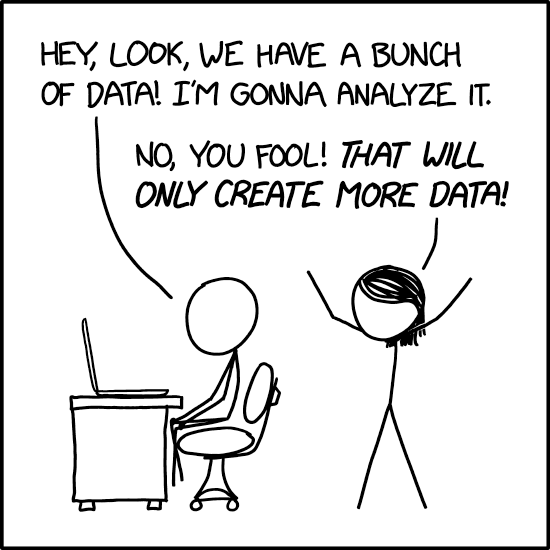
This xkcd comic comes to mind, this type of device (or approach) just leads to datamaxxing, and the ability to process that data into something useful will scale slower than the compute necessary to do something meaningful with it. It's the data version of the tragedy of the commons when everybody and everything does the same thing. More data without methods of "forgetting" rots insight.
Your knowledge of those two specific Afrikaans expressions mean you have far more than a surface level understanding of the SA zeitgeist during the early 1990’s, is it something you discovered in your research or did you spend time in South Africa in the 90’s? I remember discussing these with my father in 1990 when he was deployed at the end of the border war as Mandela was about to be released. I was 6.
@levie If this uses Salesforce’s Flex Credits to work, it’s dead on arrival. It means scaling adoption linearly scales costs, it creates a direct incentive to engineer away from their tooling and stick to using the API.