Delighted to share our latest now published in@NatureComms, where we found a new role for mitochondrial programming of SC-β cell fate through PPARα!
We're excited for the potential to target mitochondria to improve SC-islets to treat #T1D!
https://t.co/6zvVHxwkRt
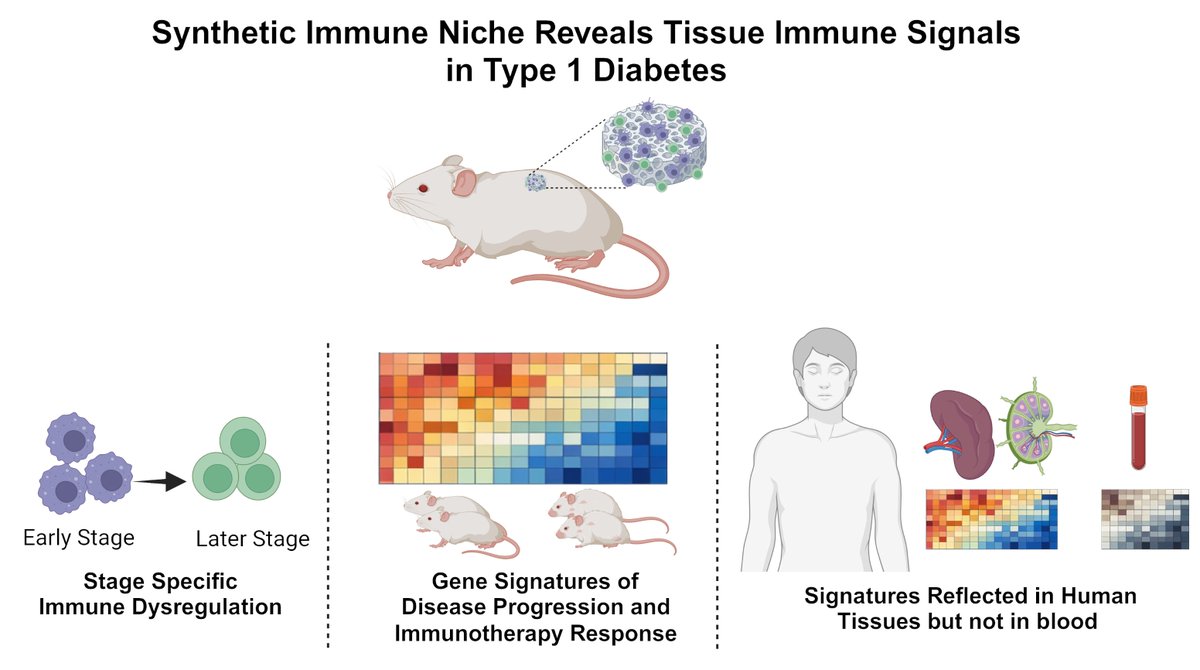
1/7, Could a small implant under the skin reveal early immune signals of type 1 diabetes missed in blood?
We answer this question in our recent Journal of Clinical Investigation @jclinicalinvest paper in collaboration with @LyssiotisLab and Liu lab @UMBME@umichmedicine
Interested in studying the origins of lung cancer and regulation of development, cell fate, metabolism in human lung progenitors? All in a rigorous, science-loving, supportive environment?
I'm looking for postdoctoral fellows, students, technicians! DM me.
Please retweet!
Excited to share our new publication in Nature Metabolism @NatMetabolism led by the fantastic @XingxiuPan, where we uncover an unexpected connection between reductive and oxidative stress. This study contains many exciting findings, and I will be highlighting different aspects of this work in a series of posts.
One of the central conclusions is that the NADPH/NADP+ ratio is a critically underappreciated parameter in mitochondrial dysfunction.
In this study we present SaNADK, a new xenotopic tool based on the S. aureus NAD kinase, which expands the cellular NADP(H) pool nearly six-fold! Most remarkably, together with the Peter Adams lab @AdamsBioAging, we found that increasing NADP(H) levels with SaNADK alone was sufficient to reverse age-associated hepatic transcriptomic signatures linked to metabolic dysfunction and inflammation as well as liver fibrosis highlighting the profound influence of NADP(H) metabolism on cellular aging.
We also uncovered an important aspect of mitochondrial bioenergetics. We found that NADH-driven reductive stress can cause excessive reduction of the coenzyme Q pool, creating a bottleneck for multiple coenzyme Q-dependent reactions. As a consequence, electron flow through CoQ-linked systems is impaired, including DHODH activity and de novo pyrimidine biosynthesis. These findings may help explain numerous observations in the literature that have long appeared counterintuitive, namely that mild mitochondrial complex I inhibition can sometimes be beneficial.
Here is the link to the study:
https://t.co/81x6P2gwHY
Delighted to share the last paper of the lab, published in @ScienceMagazine , uncovering a new role for Golgi-derived vesicles and phosphoinositides in regulating mitochondrial fusion! 👇👇
https://t.co/yF4ASmK10g
Excited to share our new paper! We used CRISPR-edited, T1D patient-derived stem cell islets to uncover how a protective IFIH1/MDA5 variant alters the human islet response to inflammatory and viral stress, reducing stress & death while preserving function https://t.co/2MLpWBo8d6
New paper out in @NatureMetabolism!
We show that loss of m⁶A disrupts pancreatic α-cell identity and promotes their transition toward immature β-cells.
My first as co-corresponding with lots of work from my new lab at @UChicago!
https://t.co/f9QR55lnV8
Our preprint is now published: In collab. w/ Ruma Banerjee we show how the B12 chaperone MMADHC spends its life in two cellular 'zip codes' dictated by the mitochondrial PMF (similar to PINK1). Co-led by @Sneha_Rath_, Zhu Li. https://t.co/5gv3sjinA4
I’m excited to share that we are looking for an ambitious and talented postdoctoral fellow to join my lab working on cardiovascular and metabolism research. We are located at Weill Cornell medical school in New York City. https://t.co/NbafN4XYaT
Strategic Initiative Fund announces first 37 funding recipients https://t.co/ibY309Ba0x
Congratulations to CDI Faculty Members
@SoleimanpourLab, Drs. Patrice Fort, Tom Gardner, Matthias Kretzler and team on securing $40 million in initial funds! 🙌 #caswelldiabetes
@Burke_Lab@JCI_insight@Collier_Lab@PBRCNews Outstanding work, Susan and Jason! I really enjoyed reading it - apologies for the tardy note. Hope you're both having a nice summer.
We have published our protocol for stressing primary human islets with viruses and chemicals and analyzing the outcomes with single-cell RNA sequencing. Check it here - https://t.co/6UsJ5r3tFl
New preprint from the lab, led by the ever-talented grad student Tessa Lochetto
@tloch_! We find that loss of Pptc7 decreases lean mass, induces skeletal muscle dysfunction, and causes metabolic derangements in adult mice: https://t.co/sDqmMBwcWc /1
Scott Soleimanpour at #ENDO2026: mitochondrial QC is impaired in T2DM. Mitochondria are not static kidney bean shaped organelles – they undergo active mitophagy. TFAM + Clec16a are key pathways regulating beta-cell de-differentiation. @TheEndoSociety#Diabetes#Endocrinology