$1 invested in 1801, adjusted for inflation. The results after 220 years:
– Stocks: $2,334,920
– Bonds: $2,163
– Bills: $245
– Gold: $4.06
– US Dollar: 4 cents
Stocks didn't beat bonds. They beat them 1,000 to 1.
And look at the bottom line. Cash felt safe every single day of those 220 years. It never crashed. It never gapped down. It never made a scary headline.
It just quietly lost 96% of its value.
The riskiest asset built 50 million times more wealth than the safest one.
If you invest, you can lose. If you don't invest, you already lost.
But there is one edge available to everyone: time horizon. Increase it and the odds bend toward you until they can't bend further.
Just wait.
this could be the breakthrough to making robots 10x more affordable
MIT just made an artificial muscle that moves exactly like the real ones in your arm.
a soft fiber sits in a charged liquid, a tiny pump runs a charge through it, the charged particles shift, and the fiber squeezes and relaxes.
it's the same motion as you flexing your arm, except there's no motor, no gears, and no noise.
now, the reason this could be huge for robotic economics:
today every joint on a robot moves with its own electric motor and gearbox.
a humanoid can have 30 or 40 of them, and they're expensive, heavy, and loud.
those motors are one of the biggest reasons a robot costs what it does.
and they scale horribly.
if you want a joint to push harder, you have to swap in a bigger, more expensive motor, so the price jumps every time you want more strength.
the artificial muscle works the opposite way:
to make it stronger you just bundle a few more cheap fiber strands together the way real muscle does, so strength goes up while the cost barely moves.
interestingly, a similar economic flip happened with computers.
early computers filled whole rooms because they ran on thousands of vacuum tubes, which were big, hot, expensive, and always burning out.
then the transistor did the same job in something tiny and cheap, and once you could add more of them for almost nothing, computers went from machines only governments could afford to the phone in your pocket.
motors could be the vacuum tube of robotics, and this muscle the transistor.
if it holds up outside the lab, the most expensive part of a robot gets a lot cheaper
which could move robots toward something every small business or household can afford.
still lab-stage, but a situation worth monitoring!
CRISPR's New Cancer Kill Switch
Scientists developed a CRISPR-Cas12a2 system that can recognize cancer specific RNA signals, including mutations in genes like TP53 and EGFR, then shred the cancer cell's DNA/chromatin from the inside.
The exciting part. It could target cancer mutations that have been extremely hard or impossible to drug before.
In mouse tests, mRNA/LNP delivery reduced liver tumors, slowed lung cancer progression, and delayed spread.
A four-year-old in north London learned how to play chess from watching his father lose to his uncle. By age 13 he was ranked the second-best chess player in the world for his age. By 17 he had designed a video game that sold millions of copies. By 34 he had founded the AI lab that 14 years later would win him the Nobel Prize in Chemistry for solving a problem biology could not crack for half a century.
His name is Demis Hassabis.
Here is the story, because the path from chess prodigy to Nobel laureate is one of the strangest careers in modern science.
Demis was born in north London in 1976 to a Greek-Cypriot father and a Singaporean mother. He started playing chess at four. By eight he was using his chess winnings to buy his first computer, a ZX Spectrum. By 13 he had reached master level and was the second-highest-rated player in the world in his age group.
He left school at 16 and got a job at Bullfrog Productions, the legendary British game studio. At 17 he co-designed and lead-programmed Theme Park, the simulation game that sold millions of copies worldwide and helped invent an entire genre. He did this while waiting to start his computer science degree at Cambridge.
After Cambridge he started his own video game company, Elixir Studios, which built strategy games for nearly a decade. Then in his late 20s he made a decision that confused almost everyone around him.
He went back to school to become a neuroscientist.
He earned a PhD in cognitive neuroscience at University College London under Eleanor Maguire. His thesis was on the role of the hippocampus in memory and imagination. His research was named one of the top 10 scientific breakthroughs of 2007 by the journal Science. He was a postdoctoral researcher at MIT and Harvard.
He had a theory. He believed the way to build real artificial intelligence was to first understand how the brain itself learns and represents the world. Most computer scientists thought this was a waste of time. Demis thought it was the whole point.
In 2010 he co-founded DeepMind in London with Shane Legg and Mustafa Suleyman. They had a mission statement that sounded insane at the time. Solve intelligence, then use intelligence to solve everything else.
Google acquired DeepMind in 2014 for around 400 million pounds. The team kept building. In 2016 AlphaGo defeated Lee Sedol at Go, a game most researchers believed was a decade away from being cracked. In 2017 AlphaZero taught itself chess from scratch and beat the strongest engines in the world in four hours.
Then Demis pointed the same approach at biology.
The protein folding problem had stumped biologists for 50 years. Proteins are chains of amino acids that fold into three-dimensional shapes. Their shape determines their function. Predicting the shape from the sequence was considered one of the grand challenges of science.
In 2020 DeepMind entered AlphaFold2 in the CASP14 protein structure prediction competition. The model hit 90 percent accuracy, comparable with experimental methods that take years per protein. The problem was effectively solved.
By 2024 AlphaFold had predicted the structures of all 200 million known proteins across roughly a million species. The database was free. Over two million researchers across 190 countries had used it. Drug discovery, enzyme design, disease research, all of it accelerated overnight.
On October 9, 2024 the Royal Swedish Academy of Sciences awarded the Nobel Prize in Chemistry to Demis Hassabis and John Jumper for protein structure prediction, with the other half going to David Baker for computational protein design.
Demis is a computer scientist who solved a chemistry problem and won a chemistry Nobel for it.
He told reporters that day his goal was always to "solve intelligence, then use it to solve everything else."
He is now working on the next phase at Isomorphic Labs, the drug discovery company he founded inside Alphabet.
A chess prodigy who programmed a video game at 17 just rewrote the rules of biology.
The Library of Alexandria created the first catalog of all human knowledge 2,300 years ago, and a team of fewer than 20 people just finished the modern version and made it free for the entire planet.
It is called OpenAlex. The name is not an accident.
The ancient library had the Pinakes, a catalog mapping every scroll, every author, every subject. When the library fell, the map of what humanity knew fell with it.
For the last two decades, that map existed again, but it was locked up.
Elsevier owns Scopus. Clarivate owns Web of Science. If your university could not afford the subscription, you could not see the structure of science itself. Entire countries were priced out of knowing what research existed.
OpenAlex indexes 474 million scholarly works. Every author disambiguated. Every citation traced. Every institution and funder connected. It updates with roughly 50,000 new works every day.
The whole thing is CC0. Not just free to search. Free to download, copy, sell, and build on. The API allows 100,000 requests a day without an account.
The ancient library burned and the catalog was lost for two millennia.
The new one cannot burn. Anyone can hold a copy.
https://t.co/peUYYpucnc
this is just the most ridiculous AI application i've ever seen lol
a Peter Thiel-backed startup that makes AI collars for cows is now worth $2 billion
and the more I read about it the cooler it gets. here's how it works:
every cow wears a solar-powered collar that talks to a network of radio towers and an app on the farmer's phone
instead of building physical fences, the farmer draws the fence on a map in the app, and the collar keeps each cow inside that invisible line using GPS
when a cow drifts toward the edge, the collar plays a sound to steer her, and a gentle vibration tells her which way to go.
it's like how a car beeps as you back up toward a wall
the cows learn the cues in a few days
so now a rancher can move an entire herd to fresh grass by sliding the fence on a map, without driving out to open a single gate
and that same collar is reading each cow's body the whole time.
it takes five readings per second on every animal, so the AI can catch a cow that's sick, injured, ready to breed, or about to give birth before a person would ever notice walking the field
so it's basically like WHOOP for cows too lol
and they gave the AI behind it the perfect name: the Cowgorithm
it's been trained on more than 7 billion hours of real cow behavior, which is why Halter calls the data its real asset and moat.
they know what a normal cow looks like better than anyone, so they can flag the odd one out instantly
it's already on more than 1M cattle across New Zealand, Australia, and a bunch of US states.
California even used it on public land to graze cattle in patterns that clear dry brush and slow down wildfires
costs about $5 to $8 per cow per month
a job that used to mean barbed wire, gates, and driving the fields all day is now mostly 1 person on their phone
On Tuesday, June 9, we’ll announce the four astronauts who will orbit Earth aboard the @NASAArtemis III mission!
Watch our live event at 11 a.m. EDT (1500 UTC) to find out who will test the docking capabilities necessary for crewed Moon landings: https://t.co/TyU7StKGxH
Scientists just figured out how to turn seawater into drinking water using sunlight.
No chemicals. No toxic waste. No energy grid required.
The leftover salt gets collected and buried inside that salt is lithium.
The same lithium that goes into every EV battery on the planet.
2.2 billion people don't have clean drinking water today.
This could change the math.
Yann LeCun sat across from Lex Fridman and quietly proved that intelligence has nothing to do with thinking.
He did it with two sentences about a trophy.
“The trophy doesn’t fit in the suitcase because it’s too big.”
“The trophy doesn’t fit in the suitcase because it’s too small.”
Same words. One swap at the end.
In the first, “it” is the trophy.
In the second, “it” is the suitcase.
You solved both before you finished reading.
Nobody taught you that. There is no rule for it. No logic chain. No formula.
You knew because you’ve held things. Packed things. Felt the resistance of something too large for the space it was meant to fill.
LeCun calls this grounding.
“A big object doesn’t fit in a small object.”
The machine has read that line a billion times.
It has never once picked anything up.
It knows the word “big.” It has never been small enough to be lifted, or large enough to be the problem.
So when the sentence turns, it has nothing to turn on.
You didn’t solve that riddle by thinking.
You solved it by having lived.
Every object your hands ever closed around. Every door you misjudged. Every suitcase you overpacked and forced shut.
Decades of physics written into your nervous system so deep you can’t even find it.
That is what answered the question. Not your mind. Your life.
LeCun: “You have this knowledge of how the world works, of geometry, and things like that.”
Now point that at yourself.
Most of what you understand, you could never explain.
You cannot describe how you catch a ball. How you judge the weight of a bag before you lift it. How you know a staircase is wrong before your foot confirms it.
Your deepest intelligence has no language in it at all.
We spent centuries convinced that thinking was the highest act of the mind.
LeCun is pointing at something underneath it.
Something older. Something the body learned long before the mouth could speak.
Intelligence was never computation.
It was accumulation.
The slow, silent record of a life spent touching the world.
The machine holds every word ever written about it.
It has never once been in it.
We keep asking whether it thinks.
It cannot even tell us which “it” we mean.
Congratulations to Carolina Figueiredo of Princeton, who found an unexpected geometric structure connecting three different particle theories, hinting at an even deeper theory of our universe.
She is the inaugural winner of the Vera Rubin New Frontiers Prize, presented by our CEO Jensen Huang and @yurimilner at the 12th @brkthroughprize ceremony.
A new honor. A legendary name. A future built by scientists who dare to see what others can’t. #BreakthroughPrize
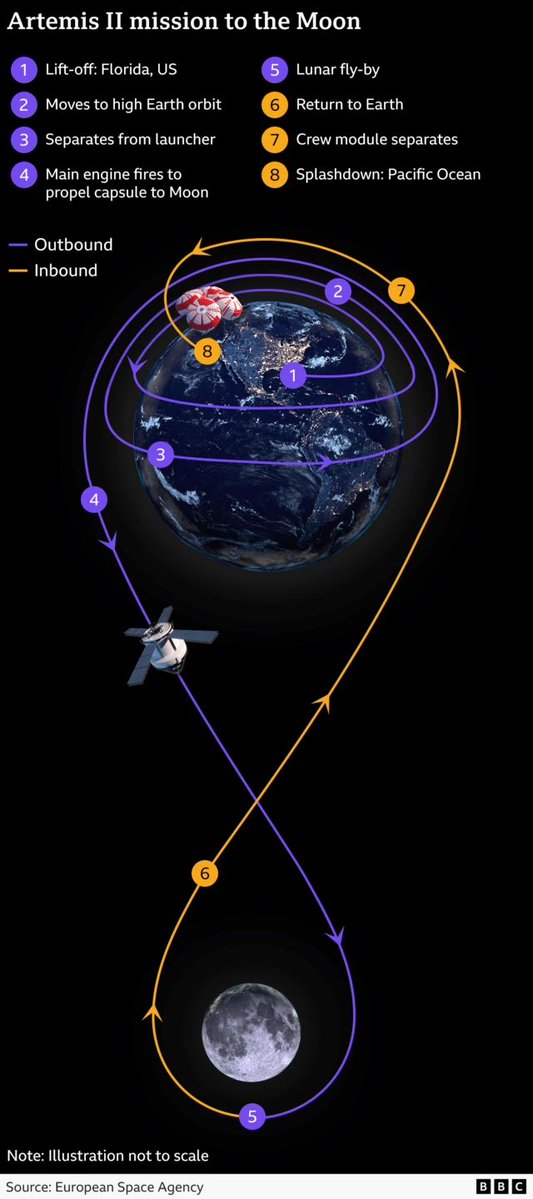
🚨SHOCKING: Artemis II mission isn’t “going to the Moon.”
It’s aiming for a precise point in space where the Moon will be.
252,706 miles away .
The human brain cannot process what this actually means.
Every space mission you’ve ever seen depicted gets this fundamentally wrong. Movies show rockets flying toward a destination like an airplane flying toward an airport. Point at target, fire engines, arrive.
Reality operates under completely different physics.
When NASA launched Artemis II on April 1, 2026 , the Moon was somewhere entirely different than where the spacecraft will intercept it on April 6 . The rocket launched toward empty space, betting everything on a mathematical prediction of where a target traveling 67,000 miles per hour would position itself five days  in the future.
Space travel is not transportation. It’s temporal ballistics.
The Moon orbits Earth every 27.3 days, covering roughly 1.5 million miles of distance. During the ten day journey of Artemis II  , the Moon moves approximately 370,000 miles along its orbital path. The spacecraft launched in a direction that looks completely wrong to every human instinct, following a free-return trajectory that intercepts the Moon’s future position  , not its current one.
This requires predicting exactly where an object the size of a continent will be located, down to mile precision, five days before the meeting happens. Any error in orbital calculation, any miscalculation in the Moon’s gravitational influences from Earth and Sun, any slight deviation in spacecraft velocity, and the crew of Reid Wiseman, Victor Glover, Christina Koch, and Jeremy Hansen  sails past their target into the infinite void of space.
NASA engineers call this a “free return trajectory,”   but the name obscures the cognitive breakthrough required to make it work. You cannot think about space travel the way you think about any form of transportation that exists on Earth.
Destinations don’t exist in space. Only intercepts exist. You’re never going somewhere. You’re always going somewhen.
The mathematics behind orbital rendezvous calculations treats time and space as completely integrated variables. The spacecraft’s translunar injection burn on April 2  lasted exactly six minutes. Miss that window by even minutes, and the geometric relationship between Earth’s rotation, the Moon’s orbital position, and the spacecraft’s trajectory becomes unsolvable. The destination literally disappears from the realm of possibility until celestial mechanics realign.
The Artemis II crew spent five days flying through vacuum toward coordinates   that would contain nothing but empty space if they had launched 24 hours earlier or later.
They bet their lives on humanity’s ability to predict the future position of celestial objects with mathematical precision that exceeds anything we do on Earth.
Today, April 6, they’ll pass within 4,070 miles of the lunar surface , reaching their maximum distance from Earth. But they launched toward empty space and intercepted a moving target with pinpoint accuracy across a quarter million mile void.
Space doesn’t contain destinations. It contains equations.
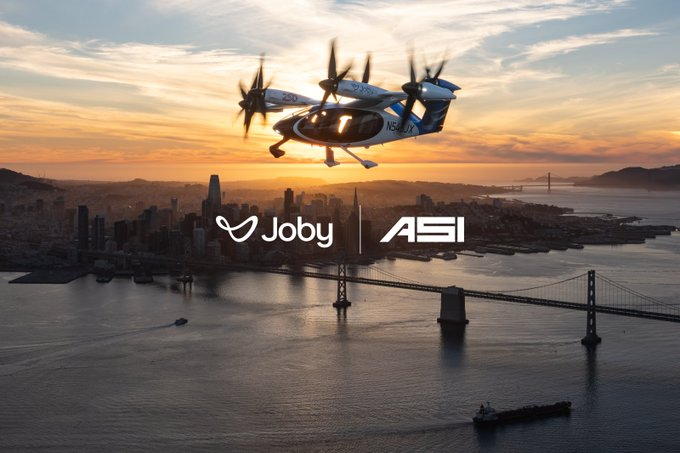
$JOBY just partnered with Air Space Intelligence to help manage high-density eVTOL traffic.
By combining Joby’s flight operations with ASI’s Flyways AI platform, they’re building the predictive airspace layer needed for the next generation of air traffic control.
In 2013, Yale professor Ben Polak gave a legendary 1-hour lecture on Game Theory.
It will change how you make decisions in negotiations, business, and life.
His frameworks:
• Dominance arguments
• Backward induction
• The proactive bias
12 lessons to make better decisions:
NASA is building SR-1 Freedom, a nuclear electric propulsion spacecraft, launching to Mars in 2028.
We are proud to announce this during the 250th year of the United States, the mission’s name reflects the spirit of American innovation and exploration.
This mission will bring America’s nuclear power capabilities to space and deliver the Skyfall payload of Ingenuity class helicopters to explore the Red Planet.
Nuclear power and propulsion will be the key to undertaking crewed missions to Mars and exploring the outer solar system.
Space Reactor-1 (SR-1) Freedom will make the next giant leap and accomplish a key component of President Trump’s National Space Policy, bringing nuclear to space alongside @Energy.
Elon Musk just explained how Starlink moves the GDP of entire nations.
The formula is so simple it should embarrass every development agency on the planet.
Musk: “GDP is a function of average productivity per person.”
Productivity per person goes up. GDP goes up. That is the whole equation.
Everything else is decoration.
And connectivity is the single largest lever on Earth for pushing that number.
Musk: “If you don’t have access to the internet, or it’s too expensive or low bandwidth, you cannot access the MIT lessons and you can’t sell the goods and services that you produce.”
No internet means no global knowledge. No global markets. No ability to sell to anyone beyond your village or learn from anyone outside of it.
The penalty is total. And it has nothing to do with the person serving it.
There is a child alive right now who is as intelligent as anyone who has ever walked the halls of MIT.
She does not know it. Nobody around her knows it. Because the coordinates of her birth have no connectivity. No library. No signal. No link to the world that would show her what she is.
She will grow old inside a ceiling that geography built for her. Not because of talent. Not because of effort. Because of a satellite that had not been launched yet.
Musk: “Internet connectivity is certainly a candidate for one of the things that would do more to lift people out of poverty than anything else.”
Traditional infrastructure takes decades. Fiber has to be laid. Towers have to be built. Permits have to be approved. Capital has to be attracted to regions that cannot attract it.
Starlink bypasses all of it from orbit. No cables. No permits. No waiting for a government to prioritize your village. A dish goes up. Isolation ends.
Someone who could not access a textbook yesterday downloads MIT’s entire curriculum today. Someone who could only sell to neighbors starts selling to the planet tomorrow.
That is not an upgrade. That is a different life.
Musk: “Starlink will actually move the GDP of countries. Like it’s gonna be that kind of thing.”
He said it like a feature update. But read it again.
Move the GDP of countries. Not a company’s revenue. Not an industry’s output. The gross domestic product of nations. Shifted by one constellation.
The telecom industry spent decades deciding which regions were profitable enough to connect. The rest were written off. Starlink does not make that calculation. It covers the planet. Every farmer. Every welder. Every kid with a clear view of the sky.
The minds that will cure diseases, solve energy, and build things we cannot yet name are already alive. They are already thinking.
They have no signal.
Starlink is the first technology in human history that can reach them at the speed of deployment instead of the speed of bureaucracy.
And when those minds come online, they will not change their own lives. They will change the trajectory of the species.
That is what Musk actually built. Not a telecom company. The largest unlock of human potential ever launched from a single network.
Not posting about biotech today.
I have family in Iran I’ve never met, 40 plus years of separation because of a regime that stole freedom from millions.
My parents left everything behind in 1979 so I could live free.
One day soon, I’ll meet my cousins. I’ll walk streets my parents remember. I’ll see a free Iran.
Holding onto that hope today. 💚
"a first step towards becoming a Kardashev II-level civilization." - Elon Musk
In the last three weeks:
SpaceX acquired xAI, merging the world's largest rocket company with one of the fastest-moving AI labs on the planet. SpaceX valued at $1 trillion.
The stated goal of the merger: build orbital data centers. A constellation of a million satellites that generate AI compute in space, powered by near-constant solar energy with near-zero operating costs. Elon Musk's words: "Within 2 to 3 years, the lowest cost way to generate AI compute will be in space."
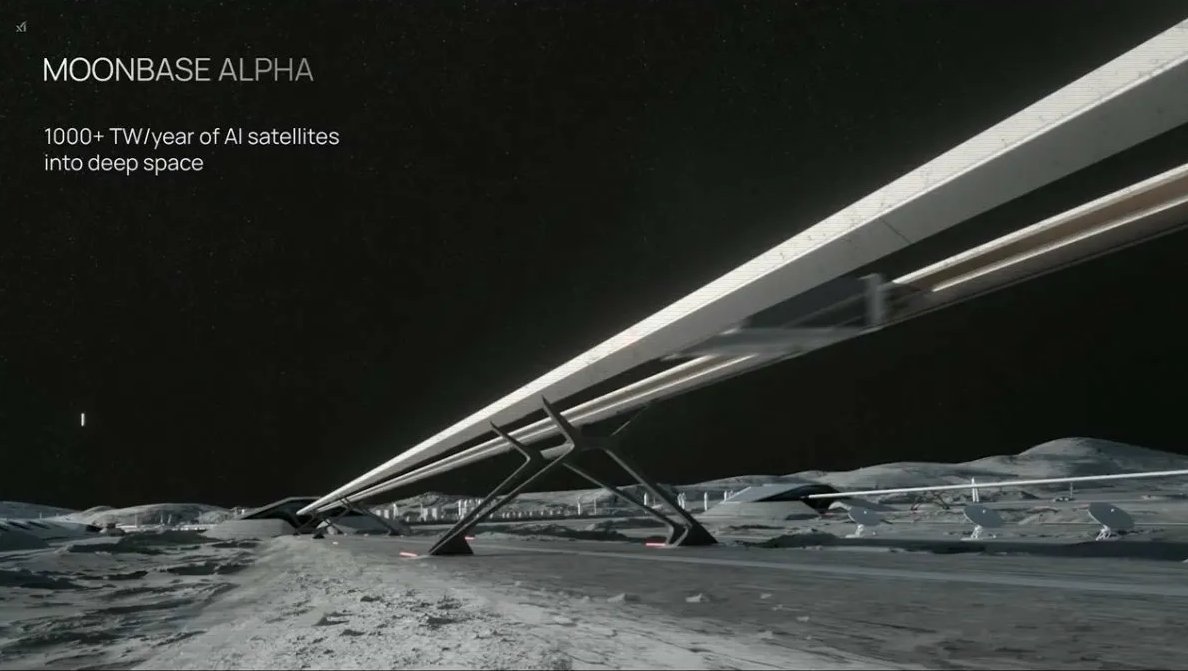
The math he laid out: launching a million tons per year of satellites generating 100 kW of compute per ton adds 100 gigawatts of AI compute capacity annually. The long-term path is 1 terawatt per year from Earth launches alone. And with lunar factories using electromagnetic mass drivers, 500 to 1,000 terawatts per year into deep space.
Elon Musk also announced SpaceX is building a self-growing city on the Moon. Target: under 10 years. First uncrewed landing: March 2027. Lunar manufacturing will feed the orbital compute network. Factories on the Moon building satellites and launching them deeper into the solar system.
And the rocket that makes all of it possible, Starship V3, with 100+ tons to orbit, orbital refueling, and Raptor 3 engines, is targeting its first flight in mid-March. The plan: launches every hour, 200 tons per flight, millions of tons to orbit per year.
The most powerful rocket in history. Aimed at the Moon. Designed to launch the largest AI infrastructure ever built. Weeks from flying.
It's happening.
a16z Speedrun Alpha, for pre-idea/pre-team/pre-everything founders
it's time to bet on yourself, and figure out your startup idea. 2026 is well underway, crazy stuff happening in AI, and you're building agents/apps/whatever every night+weekend. You want to start a startup but you're working or still going to school.
what if you're pre-idea, pre-product, pre-launch, and even a solo founder? You need time to cook
The Alpha Fellowship is for you.
https://t.co/9zJI7CzTee
details:
- $20K equity-free upfront to start building
- up to $250K investment when you finalize
- automatic final interview for a16z speedrun, with up to $1M investment
- 8-week, in-person experience with a kickoff retreat, founder AMAs, and small-group dinners alongside the a16z speedrun community
- targeted to early-career highly technical founders
- deadline to apply is March 6
We ALSO have a "startup track" for the Alpha Fellowship where you can get more founder experience by working for a portfolio company if you're not quite ready to found something.
The Alpha Fellowship places top early-career engineers into full-time roles at fast-growing a16z speedrun and Andreessen Horowitz portfolio companies. For future founders, we provide capital before a team or idea even exists.
We're looking for highly technical students and recent grads who don't want to wait to start building. Fellows take full-time roles at fast-growing portfolio companies - or, if you're ready to build now, receive capital to start your own company - kicking off with a two-month in-person fellowship. Fellows also have access to the a16z speedrun and EO Ventures communities and events.
...
If this is you, want to meet you. If you have people to introduce us to, that would be amazing too.
will have more to say, and lots of ideas coming up here. But excited to get this out! Excited to host y'all soon.