NEW report & interactive storymap
Designed to Kill: Who Profits from Paraquat? traces the supply chain of a toxic weedkiller from fossil fuels to U.S. farms.
The U.S. imports virtually all its paraquat from China & the UK, where it is banned.
https://t.co/J1qWxYFW61
Burning coal is up to four times more expensive than getting electricity from renewable sources. And as President Trump clings to the past, his massive giveaway to coal companies will mean higher bills and dirtier air for the rest of us. https://t.co/DnprtyuF2w
The federal agency that investigates chemical disasters in the U.S. has fewer than 50 employees and a roughly $14 million budget. Now, President Trump wants to eliminate it entirely.
https://t.co/rMxMlgT70I
Farmworkers are at special risk for Parkinson’s, because the fields where they work are frequently doused with pesticides. But people who simply live near farms are also in danger.
https://t.co/7IKv3drMEW
Instead of protecting workers and families from death, injury, and illness, Trump’s EPA is putting communities at greater risk of harm.
https://t.co/q8togeBXz5
On health and its costs, Americans aren’t as divided as you think.
82% of Trump supporters want him tougher on polluters. 81% of all Americans say pollution’s costs are showing up on medical bills.
EPA leaders think we want fewer protections. The country just said otherwise.
The @EPA is giving chemical manufacturers and petroleum refiners more time to provide data on a group of chemicals that have been linked to human health harms as officials consider tighter regulations.
https://t.co/GqA7hniZUz
As data centers boom in Virginia, a new @washingtonpost analysis shows that residents there are breathing in the exhaust from more than 10,000 diesel generators By @evanhalper and @kcrowebasspro https://t.co/w0FtNTmWD6
A near-miss incident and a deadly chemical accident in a single week have affected thousands and drawn scrutiny to federal rules around risk management at chemical plants
https://t.co/HmDjC4O8NC
A near-miss incident and a deadly chemical accident in a single week have affected thousands and drawn scrutiny to federal rules around risk management at chemical plants
https://t.co/HmDjC4O8NC
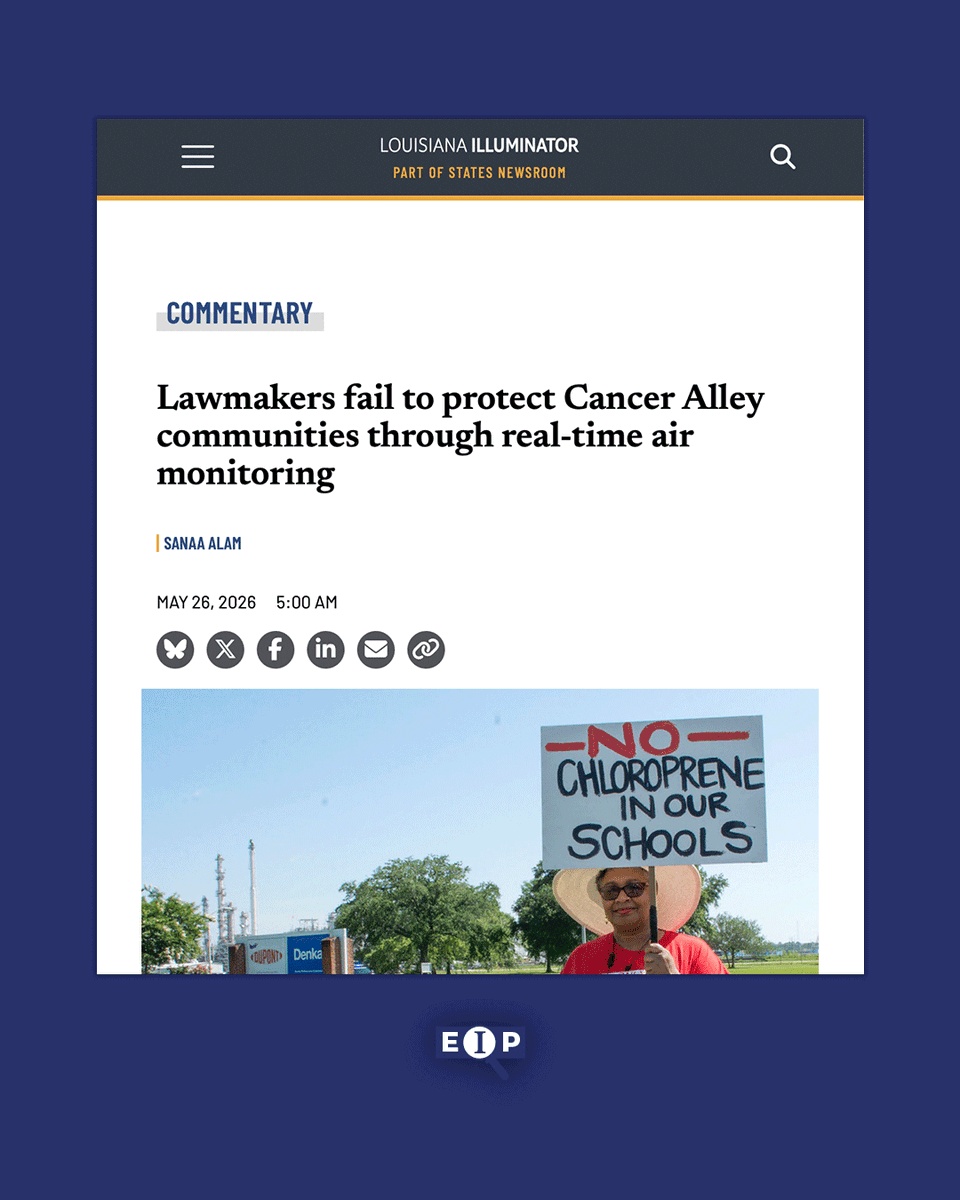
Louisiana lawmakers failed to pass a bill that would have allowed communities near oil and petrochemical facilities to access fenceline air monitoring data at more than 100 high-risk facilities. The state currently monitors air quality at less than two dozen sites. https://t.co/QM79NzTSxw
Atrazine, the most widespread pesticide water contaminant in the USA, still has no safety threshold identified under the Clean Water Act
This hamstrings one of our most effective laws to get poisons out of our rivers, lakes and streams
Time to sue
https://t.co/yzRLOIv5rd
Weakening limits on toxic “forever chemicals" will only expose more families to cancer-linked chemicals in their drinking water and leave communities to shoulder the health and cleanup costs.
https://t.co/sSMXrml6zY
A chemical tank explosion in WA kills 1. 9 are missing. As families seek answers, the Trump admin aims to weaken safeguards that could prevent similar disasters, putting ~180M people living near facilities that could cause chemical catastrophes at risk. https://t.co/KJbPgILYJl
The threat of a chemical tank blast in CA has eased, but ~180 million Americans live near a facility capable of causing a catastrophic chemical disaster. Instead of strengthening safeguards, the Trump admin has proposed to weaken them:https://t.co/UIhYOLu1So
Today, @GovPhilScott signed H. 739 into law, making Vermont the first in the United States to ban paraquat, a pesticide linked to increased Parkinson’s disease risk.
Upon signing the bill, Governor Scott said: “Today, I signed H.739, which phases out the use of the harmful herbicide paraquat over the coming years. I appreciate Michael J. Fox and his Foundation for their work on this issue and hope this can serve as a model for other states to follow.”
Next, Vermont will end the sale and use of paraquat later this year, with a phased transition for certain crops until a full statewide ban takes effect in December 2030.
70+ countries and one U.S. state have now banned paraquat. This is a clear and critical message to other states and our federal government: The time to ban paraquat is now.
NEW: Vermont has become the first US state to ban paraquat, a weed-killing pesticide, after lawmakers cited research linking the chemical to Parkinson’s disease.
@MichaelJFoxOrg@GovPhilScott@RayDorseyMD
https://t.co/ogZuanjAKX
There are over 12,000 high-risk chemical facilities in the U.S. - roughly 40% of US residents, disproportionately BIPOC communities, live within a 3 mile radius with the threat of leaks, spills & explosions.
You’d think incidents like this would lead to stronger chemical safety protections and emergency planning.
Instead, the Trump admin is rolling back chemical disaster prevention rules and proposing to eliminate the Chemical Safety Board.
Put our health & safety first.