WE COUNT THE ENEMIES WE KILL. WE RARELY COUNT THE ONES WE CREATE.
Nidal Hasan was a patient on my floor in the surgical trauma ICU at Brooke Army Medical Center.
I wasn't there when he arrived. I had just left for my deployment to Mosul, Iraq. But the nurses and doctors who cared for him were my peers and my friends, and I know exactly what that required of them, because every one of us had done some version of it before. Before anyone tells me what strength looks like, understand what that work demands.
I have cared for a drunk driver who wiped out an entire family and landed in our ICU himself. I have cared for gang members who shot up a block while children were stepping off a school bus, then ended up on our unit with bullets of their own. I have kept alive people who murdered their own families and failed at taking their own lives. And in Iraq, I saved the lives of the very enemy fighters who had just tried to kill us and miraculously survived our response.
Every one of those patients got our best. Not because we felt anything for them, but because of who we were. You set aside anger, grief, prejudice and every personal feeling you have, because a life in front of you is a life in front of you. That's the oath. That's the duty.
So when Hasan came through those doors, my colleagues did what we had always done. They preserved the life of a man who murdered thirteen people and would have killed them too, given the chance. He killed those men and women in one of the very same buildings many Soldier's like myself have been in when I was stationed at Fort Hood.
He is alive today because they did their jobs. That was not sentiment. It was a hard, tangible expression of the values this country claims to stand for. Our principles had to mean something even when the person benefiting from them had violated everything we believed in.
Now the Pentagon plans to livestream his execution by firing squad on Dec. 3, and our leaders apparently believe turning his death into a public spectacle will demonstrate American strength. I think it demonstrates how little they understand the enemy they claim to be fighting. We kept Nidal Hasan alive, now our leaders want to make him a martyr.
Hasan walked into Fort Hood expecting to die. He believed his death would be rewarded. At his trial, he called no witnesses and offered no defense, and his own court-appointed lawyers worried he was seeking execution. He failed at martyrdom once. Now we're about to hand it to him, in high definition, for every extremist with an internet connection to replay, manipulate and celebrate.
We supply the footage. They supply the meaning.
Long after the politicians finish congratulating themselves, that video will still exist. Their moment of bravado becomes somebody else's recruiting material for decades. And this failure to think past the immediate display of power reaches far beyond one execution. We count the enemies we kill. We rarely count the enemies we create.
Look at the school in Minab, Iran, where multiple investigations attributed the strike that killed more than 100 children and their teachers to us. You cannot bury people's children beneath the rubble of their classrooms and expect a speech about American intentions to decide how they remember you. No denial brings those children home. No claim of good intentions makes their parents forget whose weapons killed them.
If those were our children, we would remember for the rest of our lives. We would demand accountability. Many of us would want vengeance. We would tell their stories to the next generation. We know this because we did exactly that after September 11.
Why do we imagine other people love their children less, grieve less deeply, or remember less clearly?
We have developed a horrifying talent for creating more terrorists than we will ever stop. We inflict suffering, evade responsibility, and then act as though the anger that follows came out of nowhere.
Think back to the first time you saw one of those al Qaeda videos of an American being beheaded. Remember the sickness in your stomach. Remember the rage. Remember thinking that only savages would film a killing and send it out for the world to watch. Now ask yourself what the rest of the world will see when the camera is ours.
Terrorist organizations stage executions for the cameras. Authoritarian regimes make death a public spectacle to feed fear and rage. Watching our own leaders reach for those same tools should force us to confront how much of ourselves we are surrendering in the name of defeating them.
The line separating us from the people we condemn has to live in our conduct. A flag cannot hold it for us. Neither can a uniform, a title, or a declaration that we are the good guys.
On that ICU floor, on a bloody street in Mosul, and in trauma bays across this country, people like my colleagues hold that line every day under circumstances most will never face. They keep monsters alive because their duty and their humanity are bigger than their hatred of what those monsters have done.
Execute him if that's the sentence. But do it the way a confident nation does; quietly, lawfully, and without giving him the stage he always wanted. Let him be forgotten.
I expect our leaders to show at least as much discipline as the nurses who had to care for him.
They keep telling us they are defending what makes America different. Every day, they make that difference harder to see.
Robert W. Burns III is the editor and publisher of The Space Coast Rocket, an Army veteran and a retired trauma nurse. The views expressed in this column are his own.
@ryu_tay And then you turn up to a branch, they tell you that you can't see anybody to get help without an appointment. Well genius, I didn't know 4 days ago I'll be needing help today and that your stupid chat bot will be absolutely useless, to make a prior appointment. Freaking annoying
Firmus may pull IPO amid light investor interest
- pathfinder prospectus sent to investors this week was light on detail
- Very little to nothing on balance sheet
- Very little to nothing on how it would fund the forecast $US37.7b capex in next few years
- Not much on how it could construct data centres far cheaper than established peers
- ~85pc of the $US5.8b EBIT is forecast to come from Malaysia and Indonesia data centres, brings some sovereign risk
Paddy came home drunk at four in the morning, and his wife was all over him, yelling and crying because she thought he’d been with another woman.
“No, honey, I swear! I was at this bar, and it was so fancy that even the urinals were made of gold.”
She didn’t believe him, so she called the bar.
“Hello,” she said. “I just want to ask you something. My husband claims to have spent the night at your bar, and I have one question: Are your urinals covered in gold?”
She then heard the bartender yell across the room:
“Hey, Clarence! I think we found the guy who pissed in your saxophone!”
En Chine, des internautes ont transformé le patron de Nvidia en rock star ... et rien de tout ça n'est réel.
Jensen Huang en concert devant un stade plein, des têtes bien connues de la tech qui hurlent dans la foule, Elon Musk qui se marre dans le public : tout est généré par IA.
Les paroles valent le détour (traduites du chinois) :
"Ils disaient tous : Jensen, ton CUDA est nul"
"Dix ans sur le banc de touche, regardez-moi abattre mes cartes"
"La valeur explose à 5 000 milliards, Wall Street reste bouche bée"
Et le refrain : "Just AI, AI, AI" (bon courage pour vous l'enlever de la tête).
Tell me you started watching cricket recently without telling me.
You’ve seen Sachin at 38. You’ve seen Virat at 38. Cool. But apparently you forgot to watch what Sachin was actually doing at 37–38. 😭
2010: 1,562 Test runs at 78.10, with 7 centuries. (hmmmm)
2010: First ever ODI double century – 200* vs South Africa.
2011: 482 runs in the World Cup at 38, helping India win the damn trophy.
2010: Won the Sir Garfield Sobers Trophy as ICC Cricketer of the Year.
And after all that, you’re telling people Sachin “was never this good at 38” because Virat smashed 100 off 74* in one innings?
That isn’t cricket analysis. That’s selective memory with a blue tick.
Respect Virat’s run, but rewriting Sachin’s age-38 cricket to make your favourite look better is just embarrassing. 🤡
📚 Au Japon, des gens vont désormais en boîte de nuit… pour s’asseoir silencieusement et lire un livre pendant qu’un DJ joue de la musique d'ambience.
Le concept s’appelle JUCY BOOK RAVE et se déroule notamment dans un club souterrain de Shimokitazawa, à Tokyo. Ici, pas besoin de danser ni de hurler pour parler à la personne située à 30 centimètres de vous. Les participants viennent avec un livre, s’installent dans la pénombre et lisent pendant que la musique accompagne leur soirée.
Once upon a time, I set out to solve one of marriage’s great mysteries.
Armed with a notebook, a recorder, and the confidence of a man who had absolutely no idea what he was getting into, I began my investigation into why men always forget the weekend plans.
Here’s what I found.
Now, I’m making up this exact conversation, but it generally tracks.
Me, making plans:
“Hey, hon, I’m going fishing Saturday at 7 a.m.”
“With who?”
“Frank and Jim.”
“When will you be back?”
“I don’t know. Probably between 10 and noon.”
“Where are you going?”
“On Jim’s boat.”
“Which lake?”
“I don’t know.”
“I thought Jerry’s wife was sick this week. Is he sick too?”
“I have no idea. All I know is that I’m leaving the house at 7 a.m. Saturday.”
“Are you having breakfast first?”
“Yes. Before I leave. At 7. On Saturday.”
“Okay, but you have to be back by noon because—”
“I will leave at 7 a.m. Saturday and be back before noon.”
Notice what happened here.
I communicated two critical pieces of operational intelligence:
Departure: Saturday, 0700.
Return: no later than 1200.
And then, like a military radio operator confirming coordinates, I repeated them six times.
Now let’s flip the script.
Her, making plans:
“This weekend there’s a flower festival I want to go to, but Sue also invited me to that yoga class I’ve been wanting to try, which I think starts at 10, but it might be canceled because the instructor is a single mom and her son Franklin, who is seriously the cutest boy ever especially when he’s wearing glasses, has band rehearsal, so the class is Saturday but could get moved to Sunday afternoon, which I can’t do because—”
“So you’re doing yoga Saturday at 9?”
“No. You never listen. It’s Saturday at 10. I think. Let me check the calendar. Oh, that reminds me, we need to reschedule the teacher meeting Tuesday, but don’t worry, she’ll probably be at yoga, and I hate bringing up work on the weekend, but maybe I can ask her there.”
“So…10. Got it.”
“No, that’s not confirmed yet! But if I do go, you need to pick up bagels at the grocery store, and make sure you get the ones without onions this time. We don’t need cream cheese. We still have some from last week.”
And that was the breakthrough.
Men tend to communicate plans like a flight plan:
Time. Place. Mission. Return time.
Then we repeat the coordinates until everyone acknowledges receipt.
Women communicate plans like an intelligence briefing assembled from six agencies:
There is a primary plan, an alternate plan, a weather contingency, three supporting characters, a child named Franklin, a teacher conference, grocery requirements, and several unresolved diplomatic issues.
Somewhere inside that 11-minute briefing is the actual time she plans to leave the house.
Your job is to find it.
This is why a man can listen attentively to every single word his wife says and still, 20 minutes later, ask:
“So…what time are you leaving?”
I've been thinking about this 👇🏻 conundrum quite a bit recently with respect to $GOOG and it's lucrative ad and search business versus the impact of personal AI agents like Muse🤔
How do companies act when they are being existentially threatened by new technology?
There’s a big difference between a stock worth buying and a stock worth owning, and we’re undoubtedly going to see a lot of the former in AI disrupted companies…but it’s more difficult to determine which names fall in the latter.
When we look at the recent past for example, we see something of a gradual cycle in which it “becomes obvious” a company has been disrupted, everyone sells. Then that overextends the stock to the downside relative to current fundamentals (or relative to headlines announcing the companies are taking measures to adapt), at which point dip buyers come in.
In the examples of real disruption, it corrects back to a trend, but the cycle restates itself and the trend proves to be a downward one on a long enough timeframe (downward can also simply be massively underperforming the index by going sideways for a decade).
The insidious nature of these names is that technological disruption manifests first as multiple compression, current earnings tend to look reassuring and near-term analyst expectations tend to overestimate the impact (and under-estimate in the long term). This results in better than expected results that can mask the competitive damage.
These rebounds don’t actually prove the preceding selloff overshot fair value, and the rally tends to be overly optimistic on what future life should be assigned to today’s profits.
Two classic and relatively recent examples.
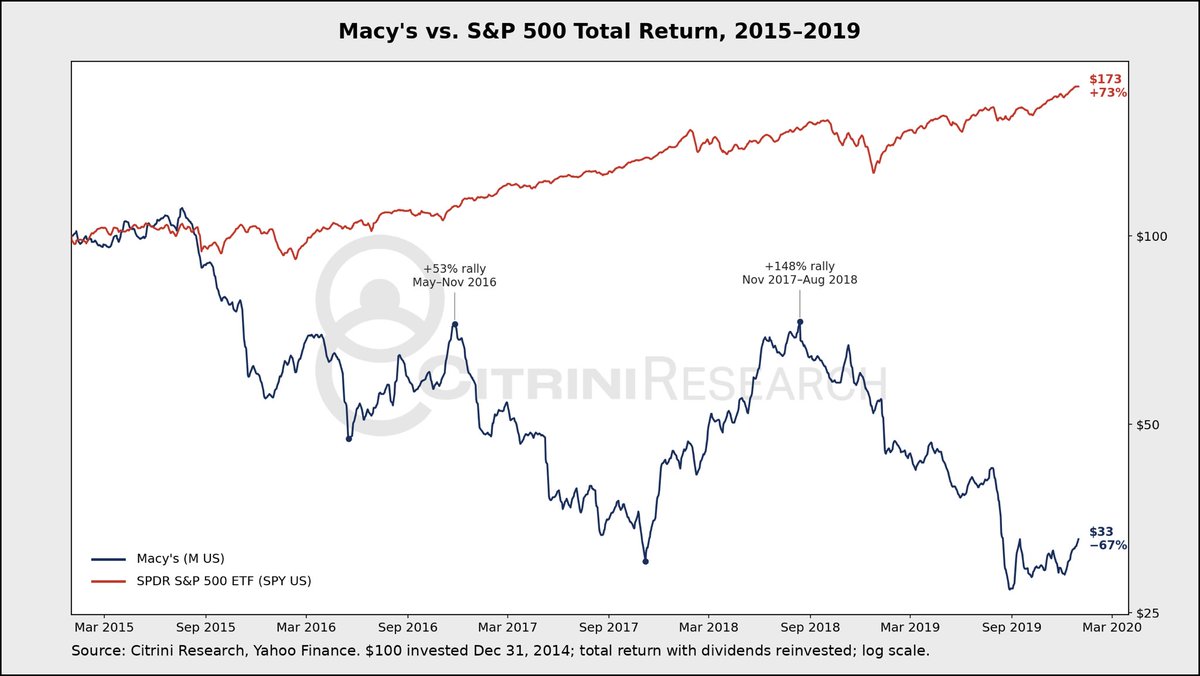
Macy’s had two of these moves. +58% in 2016 and +148% in 2018. But across 2015-2019 the shares still declined -67% compared to SPY’s +73% gain. In 2016, there were skeptics regarding the extent to which e-commerce’s growth sounded a death knell for brick and mortar - after all, malls had been a mainstay of the American town for decades. By 2019, it would be a difficult task to find an investor who owned Macy’s on the thesis that Amazon’s disruption to the company was overstated.
And it’s not like these rallies were on pure sentiment shifts. In 2018 same store sales rose 2% YoY.
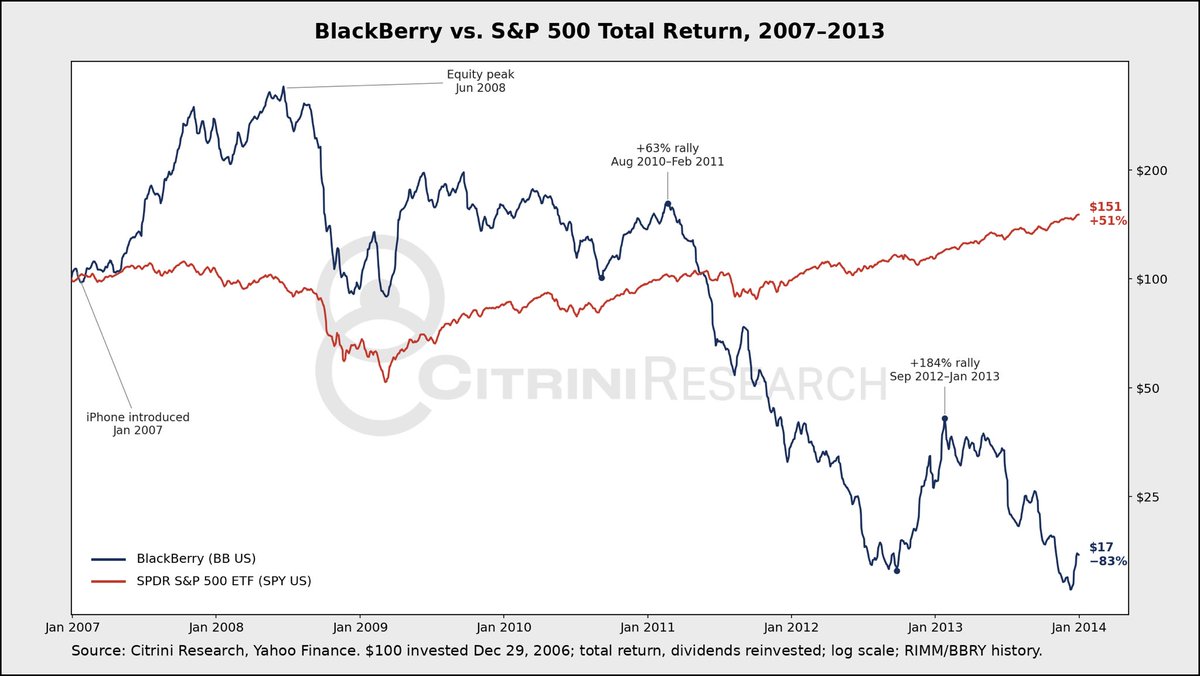
Apple unveiled the iPhone in Jan 2007, BlackBerry’s stock price peaked in 2008 but its revenue didn’t peak until 2011. And even if you shorted the revenue peak you still had to sit through a rally where it tripled on its way to declining 95% by 2013.
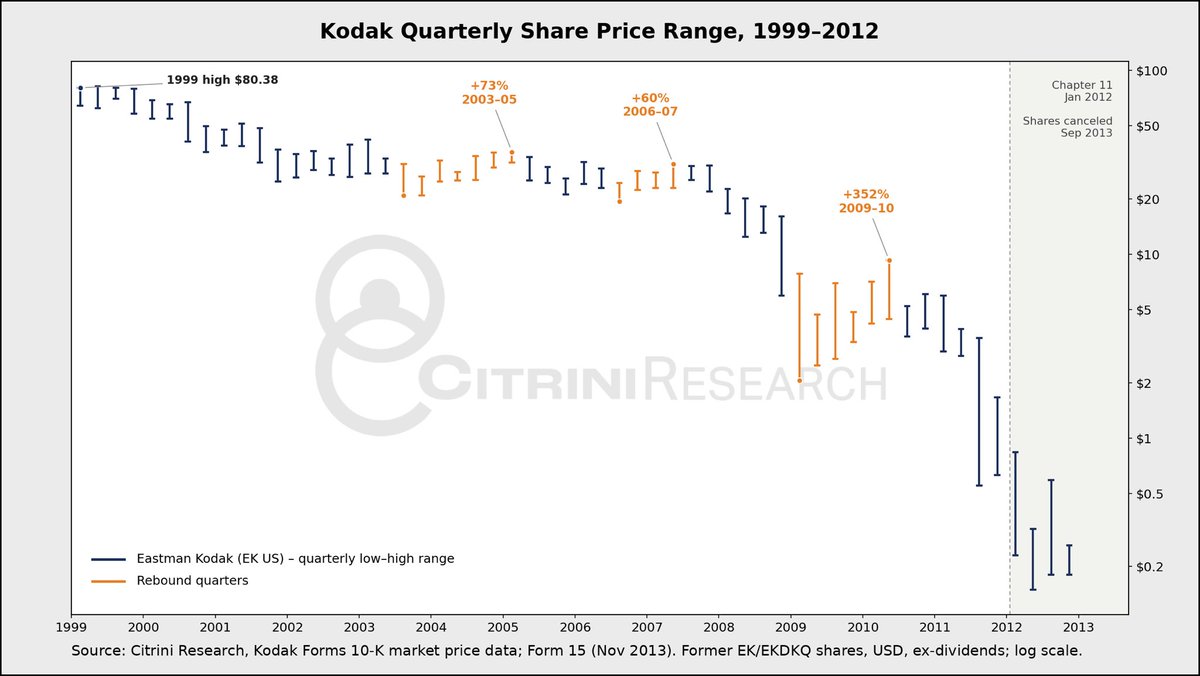
The most tricky aspect seems to be when companies present as having adapted but, for any number of reasons, can’t actually manage. Kodak, for example, had shifted mix to a majority digital (54%) by 2005. But that simply was no match for the hit to the amazing recurring revenue of the film/processing model.
Adding new technology doesn’t make up for losing the disrupted profit pool, especially when it transitions your business model to a less favorable or competitive one.
In 2010, Kodak jumped 30% on quarterly numbers signaling a turnaround on lower costs, printer sales and licensing income. They filed for Chapter 11 in 2012.
Ive been thinking about what we can we do to avoid falling into the same traps while also not being blind to the potential for real opportunities in poorly understood disruption. Hard to answer without sounding cliche or generic but…
At least for now, “having/using AI” is not a solution. That will be the default for every company on earth soon enough.
The questions that matter are more nuanced: Do customers still renew? Does pricing hold? Who owns the customer relationship? After the new costs and old cannibalization, does the new strategy/product even replace the old profits?
It’s going to be pretty difficult to differentiate the incumbents that deserve to rebound from the ones that don’t but at the very least I’m taking notes as things play out.
Genuine question - Does anyone care about these speeches being made by world leaders at the current UN General Assembly?
Or is it all just hubris and theatrics ?
Most of the real wheeling and dealing would happen behind closed doors, so why bother with these laborious speeches?
I continue to be amazed how the tech industry doesn't realize that the majority of people won't hand over a digital wallet for AI agents to go and spend on stuff, because buying socks + groceries is not a chore to outsource w/o oversight, but an expense to manage...