Read. Count. Measure. Price. Done. ✅
Drop in your drawings and SupplyLoop counts the doors and windows, measures every room to scale, traces the walls and turns it into a priced BOQ in minutes.
DM us “drawings” and we’ll show you a demo.
🔗 https://t.co/Mu2TW29OlD
The estimator priced your cement on Tuesday. From the price list you sent in August.
A PDF is right the day it's sent. The bill gets priced later.
On SupplyLoop, your live rate is there as they price it.
Verified suppliers only. Free to list.
https://t.co/qYeYx6cR7n
Today we're launching @SupplyloopAI
The AI operating system for construction. From the first drawing to the last snag.
Drop in your drawings, run Auto Takeoff, get a priced BOQ on real supplier rates. Then buy materials and track progress, all in one place.
Demo 👇
@davidgcant Agreed. The best toolbox talks I've seen were mostly questions, not a lecture.
Who gets the most out of it on your sites, the foreman or the newest starter?
@kayzed_model Photos of the conduit and pipe runs before the pour are cheap insurance.
Do you do a final walk with the plumber and electrician together?
Showroom first, local production of doors and windows later.
That's how a materials brand tests a new market before it commits to a factory.
For contractors the real win comes in phase two: shorter lead times and fewer import delays.
International building-materials company ABC Group has entered the Kenyan market with the opening of its first showroom, ABC Hauz, along Mombasa Road in Nairobi.
The company plans to explore local production of furniture, doors and windows within the next two years.
@CollinsOmo30163 The 135 degree hook is the detail that gets skipped because it's slower to tie, and it's the first thing to open up when it matters. Does anyone actually check hook angles before the pour on your sites?
@SanketSanki Payment plans tied to construction only build trust if the progress updates behind them are real site photos, not renders. How often do you send buyers a proper site update?
@RahmanMayowa No MEP drawing means the routes get decided by whoever reaches site first. Then the plumber is cutting where the electrician already chased. Coordination on paper is always cheaper than coordination on the wall.
@imran_services Same rooms, very different cost drivers. The duplex adds decking, stairs and formwork, but it needs less roof and foundation area. On a tight plot the gap can be smaller than clients expect. What difference do you usually see between the two?
@Edmond2321 And log every rejected truck with its ticket number. When the full pour shows up on the supplier's invoice a month later, that record is what settles it.
@JoeyNelson2022 Writing the viewing distance and the lighting into the standard is the part most teams skip. Without it every walk turns into a Level 5 argument. Do you put it in the subcontract too, or just the punch standard?
4. Price the risk, then show it.
A named contingency line is easier to defend than a padded rate.
5. Re-quote before you resubmit. Never reuse a 60 day old price.
What would you add?
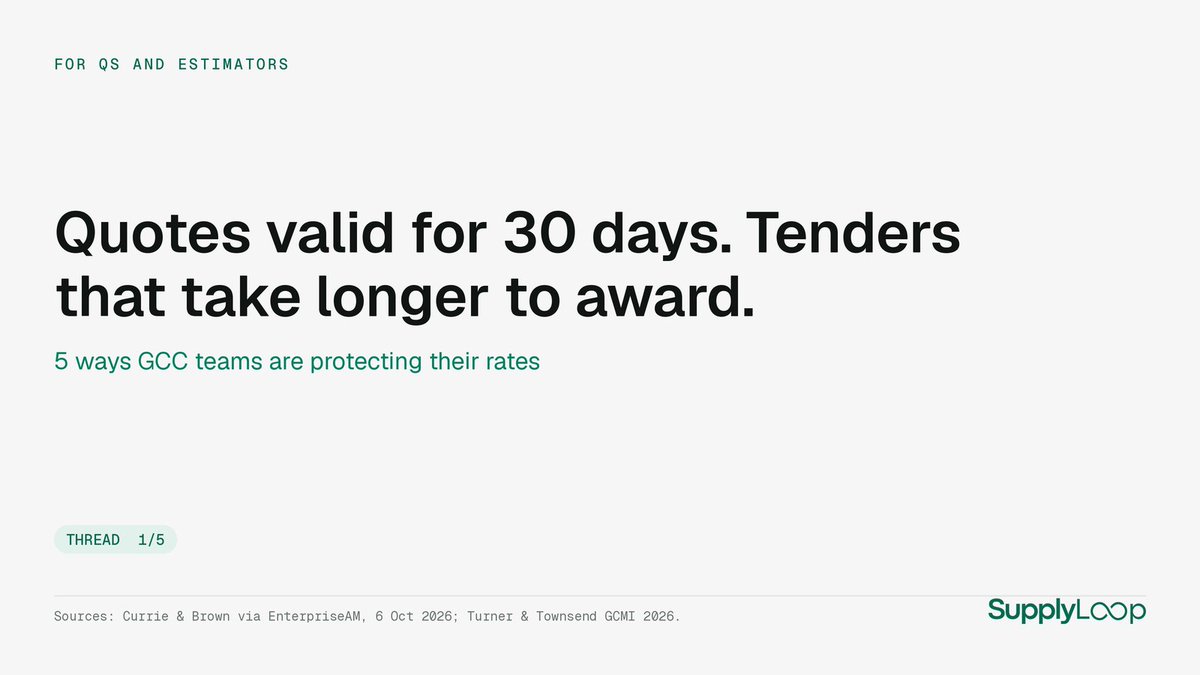
Quotes valid for 30 days.
Tenders that take longer than that to award.
That gap is where margins go to die.
5 ways GCC QS and estimating teams are protecting their rates right now 🧵
3. Flag long lead items on day one.
Transformers, lifts, escalators and generators often run past 12 weeks (Turner & Townsend). Get dated quotes early and put the lead time in your qualifications.