AI biology needs more than bigger models.
It needs more people who can understand, rebuild, and push those models forward.
OpenAI engineer Chris Hayduk just launched BioTorch — a hands-on learning platform designed to help researchers enter biological AI.
116 PyTorch exercises.
17 model guides.
From core tensor operations to ideas behind AlphaFold2, ESM2, and RFdiffusion.
The goal: turn influential bio AI papers from something you read into something you can build on.
A missing layer of AI biology infrastructure is starting to emerge.
Free during beta.
🔗 https://t.co/TtwqOrBifG
Fun interactive science app ideas | Part 12
Built an app to explore protein folding
Structures from the Protein Data Bank. The folding path is modelled
Code : Opus 5
Progress in AI modeling of proteins leaves major gaps affecting most proteins and especially functional analysis. The opportunities to transcend them beacon:
AI models can now predict static protein structures with high accuracy. This achievement is rightly celebrated. It is equally important to recognize what remains unresolved and why those gaps matter hugely for biology.
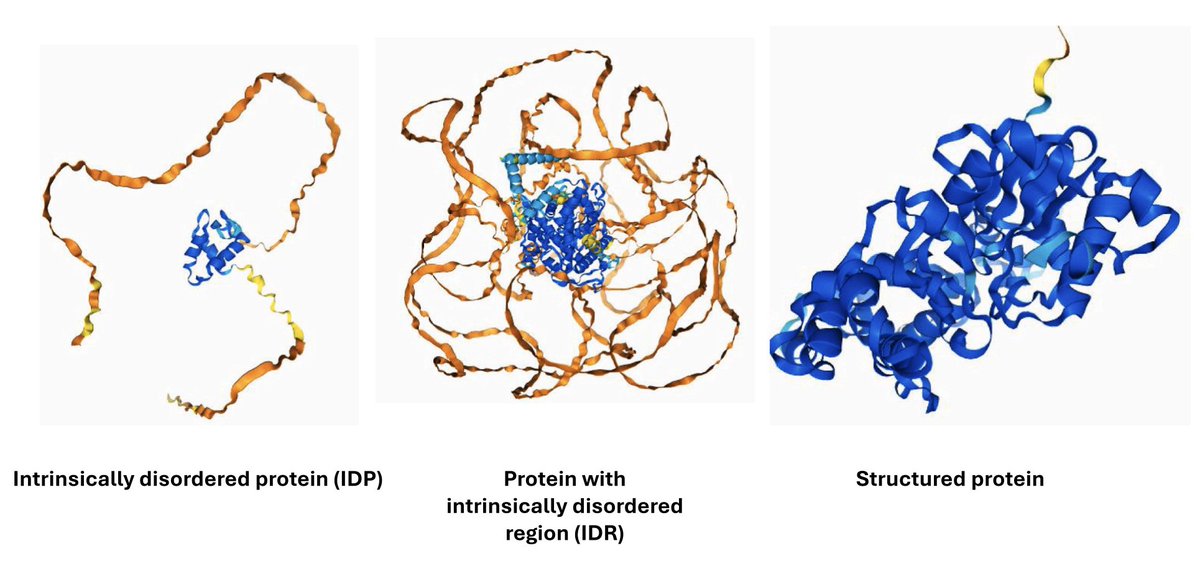
1. Modeling intrinsically disordered regions (IDRs) is a central limitation.
Roughly 30–40% of amino acid residues in the human proteome fall into this category, and ~70% of proteins contain substantial disordered segments. These regions do not adopt a single stable structure; instead, they exist as dynamic ensembles that often become structured only upon binding or under specific cellular conditions. Current AI models -- trained on static structures -- do not predict these ensembles. Instead, they either assign low confidence or produce arbitrary conformations. This is not a minor edge case; it is a large and functionally critical fraction of proteome space, deeply involved in signaling, regulation, and disease.
2. A second key limitation concerns protein function.
Biology ultimately depends on changes in conformation, interactions, and state. Many key biological processes arise from shifts between multiple conformations or from subtle perturbations induced by amino acid substitutions, post-translational modifications, or binding partners. Current models are optimized to predict a single, most likely structure. They are not designed to capture how that structure changes under perturbation, nor how populations of states shift. As a result, predicting function -- arguably the central goal -- remains a weakness in many cases.
Outlook
These two challenges point to a deeper issue: proteins are not static objects but dynamic systems governed by energy landscapes. What is needed next is not just better structure prediction, but models that can capturing ensembles, relative state populations, and the effects of perturbations on those distributions. This will likely require accurate and scalable measurements of proteins, integrating generative models, explicit or learned energetics, and dynamic sampling into a unified framework.
In this sense, the field is entering a new phase. Predicting “the structure” was a milestone. Understanding how proteins move, adapt, and function -- especially in the large, disordered fraction of the proteome -- remains the frontier.
We made a huge poster that illustrates all of the major genome editing tools in one place.
You can download a copy for free from the @AsimovPress website.
https://t.co/fI2mWvUA7f
For generations, women have led the way—restoring ecosystems, protecting biodiversity, and driving peace. 🌱✨
📢 It’s time to back their leadership to push forward for peace and climate justice #ForAllWomenAndGirls.
Learn more: https://t.co/vOtndT3qWA
Quantum physics explained in 22 minutes @ProfBrianCox
0:00 The subatomic world
1:23 A shift in teaching quantum mechanics
2:48 Quantum mechanics vs. classic theory
6:07 The double slit experiment
11:31 Complex numbers
13:53 Sub-atomic vs. perceivable world
16:40 Quantum entanglement
@monisharaj@YouTube Rather than escape I will say it shows us a path to overcome our obstacles and empowers us, changes our perception to various hurdles🙏
1/Here’s an excellent article - published in the recent @WIRED issue, by Nobel prize winner Jennifer Doudna about how AI & machine learning are amplifying the impact of CRISPR & Gene editing in all walks of life - medicine, agriculture, climate change & research landscape.🧵👇
Check out this new video by @ArtemKRSV on our work on how the brain selects experiences to remember 📸🧠, published in @ScienceMagazine.
https://t.co/bGwoeElr5W
For us, these observations have also influenced our thinking in AI as @winnieyangwn has started doing AI Safety, and I have started doing open-ended learning since joining Google DeepMind.
On a personal note, for a long time, I have held the conviction that AIs in general (and in the present day, LLMs in particular) need and do *not* currently possess a proper mechanism for encoding, storing, and consolidating long term memories akin to the hippocampus in the brain.
As a result, frontier models still do not possess the kinds of continual learning capabilities long held by the biological brain and arguably one of the fundamental reasons for our own intelligence and our unsurpassed capacity for knowledge accumulation.
1/4
1/ A new series of #CryoSPARC tutorial videos from this year’s S2C2 #cryoEM image processing workshop are now online! These videos will be interesting to all users and especially those newer to #cryoEM.
https://t.co/TCNZ63fbJg
🚨 Excited to announce the release of the DL4Proteins notebook series! 🌟
Learn AI for protein design with hands-on Colab tutorials inspired by the groundbreaking work of 2024 Chemistry Nobel Laureates David Baker, Demis Hassabis, & John Jumper.
https://t.co/pi1tEwr0ij
Now that #lecanemab (#Leqembi) has been approved in Europe, we have updated our #Alzheimer game! Play and find out when is the best time to start immunotherapy. Play at --> https://t.co/K17Ci83EzU