@ccutrone1970 returns to Common Ruin for the first episode of season 4 to discuss the administration’s latest geopolitical maneuvers, as well as the memeification of politics.
https://t.co/jf0fL7XWGm
Well said.
Nixon was a thoughtful person (lapses into bigotry, geopolitical delusions, etc., notwithstanding). His descriptions of his mother and father, for example, are quite moving as well.
Richard Nixon's brutal truth on happiness that hits harder in 2026:
"The unhappiest people in the world are those in the watering places—south coast of France, Newport, Palm Springs, Palm Beach—parties every night, golf every afternoon, bridge, too much drinking, too much talking, too little thinking. Retired, no purpose."
He saw it decades ago: Endless leisure without struggle isn't paradise—it's a slow death of meaning.
"What makes life mean something is purpose, a goal, the battle, the struggle—even if you don't win it."
In an age of quiet quitting, early retirement dreams, and infinite scrolling... Nixon reminds us: The fight is what keeps the soul alive.
What keeps you in the "battle" right now—even when it's exhausting?
Except they didn't. The actual claim is it happened in the tiny town Sviyazhsk, not Moscow, and it comes entirely from one guy, Henning Kehler, a Danish writer whose book is half-invented. There's literally no other substantiation. Even the museum in Sviyazhsk looked and found nothing.
An Austrian Tongue Choir from the Alps region of Tyrol sings ‘Moscow Nights’ with their tongue in a 1982 performance.
If not for the Internet, we’d never know music videos like this existed.
@Cernovich Lol One day you (philosophically liberal) conservatives will understand the bourgeoisie has no interest whatsoever in your little class collaborationist projects.
"If, for Hegel, logic is ontological, it is also theological. Ontology and theology are inseparable; an avowel that brings Hegel closer to the scholastic than the Lutheran tradition."
- Cyril O'Reagan, Heterodox Hegel, 1994, p.88
@ionicbondzzz@TuttReal What does his “anti-capitalism” actually amount to, really? A vague pessimism about neoliberalism is all he’s ever been able to muster. (And he’s equally pessimistic about the prospect of any conceivable communistic mode of production alternative, if not more so.)
"There is a rough scholarly consensus that there is something Platonic about Aristotle's doctrine of God: not that Plato himself believed that some divine being is the first unmoved source of motion, but that Aristotle, in constructing this doctrine and the arguments for it, was deliberately taking Plato's position and modifying it, to present a reformed Platonism as an alternative to Plato's position."
- Stephen Menn, Aristotle and Plato on God as Nous and as the Good, The Review of Metaphysics, Vol. 45, No. 3 (Mar., 1992), pp. 543-573
https://t.co/r5r7XiGNsb
"The Socratic fate becomes to Plato a philosophical problem. He is in a position similar to Orestes or to Hamlet. The father of his soul, Socrates has been murdered and his mother, the city [of Athens], is guilty; and in the city both parties have equally sinned against Socrates: the conservatives by requesting him to comply with their arbitrary, illegal dictatorship; the democratic party by actually killing him. The master's message admonished Plato that the only revenge is to show the better reason, to 'follow the logos.' But was not this way blocked? Had not the world declared that it did not want to hear the gentle voice of reason? What, then was the status of the ideal in the world? What kind of reality was that which could not bear a good and happy man in its midst? The negation, the non-being of truth must be comprehended in truth. Just as the non-being, the mortality of all finite things must be comprehended in the eternal whole. The death of Socrates is the birth of Plato's dialectic."
- Gustav Emil Mueller, Philosophy as Dialectic, pp.42-43
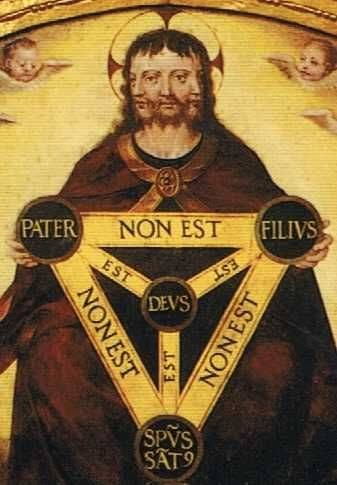
Hegel describes how the persons of the Trinity cannot be counted
“Reason employ all the relationships of the understanding, but only insofar as it destroys the forms of the understanding. And so it is with the Trinity. Hence the very word “triune” is an extreme misuse as far as the understanding is concerned – for it believes the mere fact of the formula being used establishes its rights; but to use it as one does here to say “three equals one” is to misuse it. Consequently it is an easy matter to point out contradictions in such ideas, distinctions that go to the point of being opposites. Everything concrete, everything living contains contradictions within itself; only dead understanding is identical with itself. But the contradiction is also resolved in the idea, and the resolution is spiritual unity.... In the Christian religion it is no merely asserted that God is triune but also that he subsists in three persons. This is being-for-self taken to the extreme, the extreme being not only one but person, personality. Being a person is the highest intensity of being-for-self. Here the contradiction seems to be pushed so far that no resolution, no mingling of one person with another, is possible. But just this resolution is expressed in the assertion that God is only one; the three persons are thus posited merely as a transient moment or aspect. ‘Personality’ expresses the fact that the antithesis is to be taken as absolute, that it is not a mild one, and it is only when it is pushed to this extreme that it sublates itself.”
- Georg Wilhelm Friedrich Hegel, Lectures on the Philosophy of Religion, Volume III: The Consummate Religion, ed. Peter Hodgson, trans. Brown, Hodgson, and Stewart, Berkeley: University of California Press, 1985: 192-194






![RyanHaecker's tweet photo. "The Socratic fate becomes to Plato a philosophical problem. He is in a position similar to Orestes or to Hamlet. The father of his soul, Socrates has been murdered and his mother, the city [of Athens], is guilty; and in the city both parties have equally sinned against Socrates: the conservatives by requesting him to comply with their arbitrary, illegal dictatorship; the democratic party by actually killing him. The master's message admonished Plato that the only revenge is to show the better reason, to 'follow the logos.' But was not this way blocked? Had not the world declared that it did not want to hear the gentle voice of reason? What, then was the status of the ideal in the world? What kind of reality was that which could not bear a good and happy man in its midst? The negation, the non-being of truth must be comprehended in truth. Just as the non-being, the mortality of all finite things must be comprehended in the eternal whole. The death of Socrates is the birth of Plato's dialectic."
- Gustav Emil Mueller, Philosophy as Dialectic, pp.42-43](https://pbs.twimg.com/media/HOUsHk-WEAExsQi.png)