Everyone is sleeping on this new OCR model!
dots-ocr is a new 1.7B vision-language model that achieves SOTA performance on multilingual document parsing.
- Supports 100+ languages
- Works with both images and PDFs
- Handles text, tables, formulas seamlessly
100% open-source.
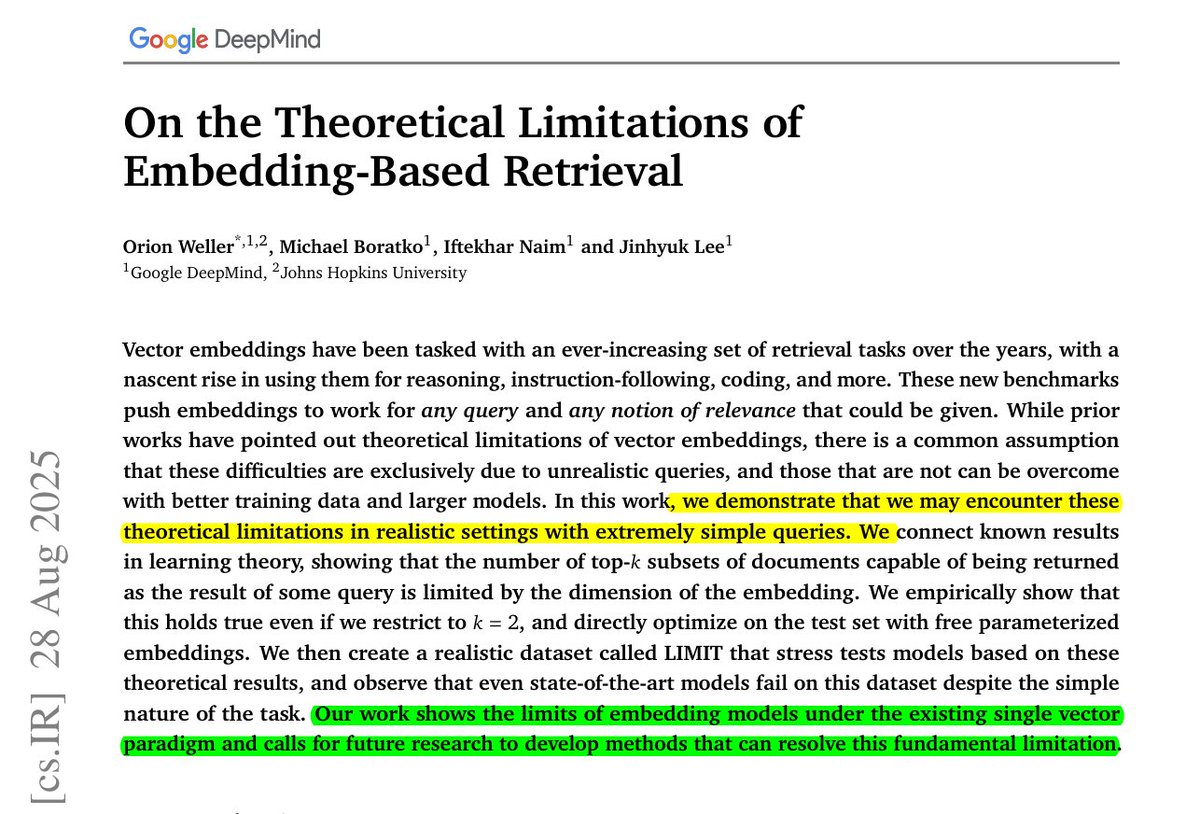
BRILLIANT @GoogleDeepMind research.
Even the best embeddings cannot represent all possible query-document combinations, which means some answers are mathematically impossible to recover.
Reveals a sharp truth, embedding models can only capture so many pairings, and beyond that, recall collapses no matter the data or tuning.
🧠 Key takeaway
Embeddings have a hard ceiling, set by dimension, on how many top‑k document combinations they can represent exactly.
They prove this with sign‑rank bounds, then show it empirically and with a simple natural‑language dataset where even strong models stay under 20% recall@100.
When queries force many combinations, single‑vector retrievers hit that ceiling, so other architectures are needed.
4096‑dim embeddings already break near 250M docs for top‑2 combinations, even in the best case.
🛠️ Practical Implications
For applications like search, recommendation, or retrieval-augmented generation, this means scaling up models or datasets alone will not fix recall gaps.
At large index sizes, even very high-dimensional embeddings fail to capture all combinations of relevant results.
So embeddings cannot work as the sole retrieval backbone. We will need hybrid setups, combining dense vectors with sparse methods, multi-vector models, or rerankers to patch the blind spots.
This shifts how we should design retrieval pipelines, treating embeddings as one useful tool but not a universal solution.
🧵 Read on 👇
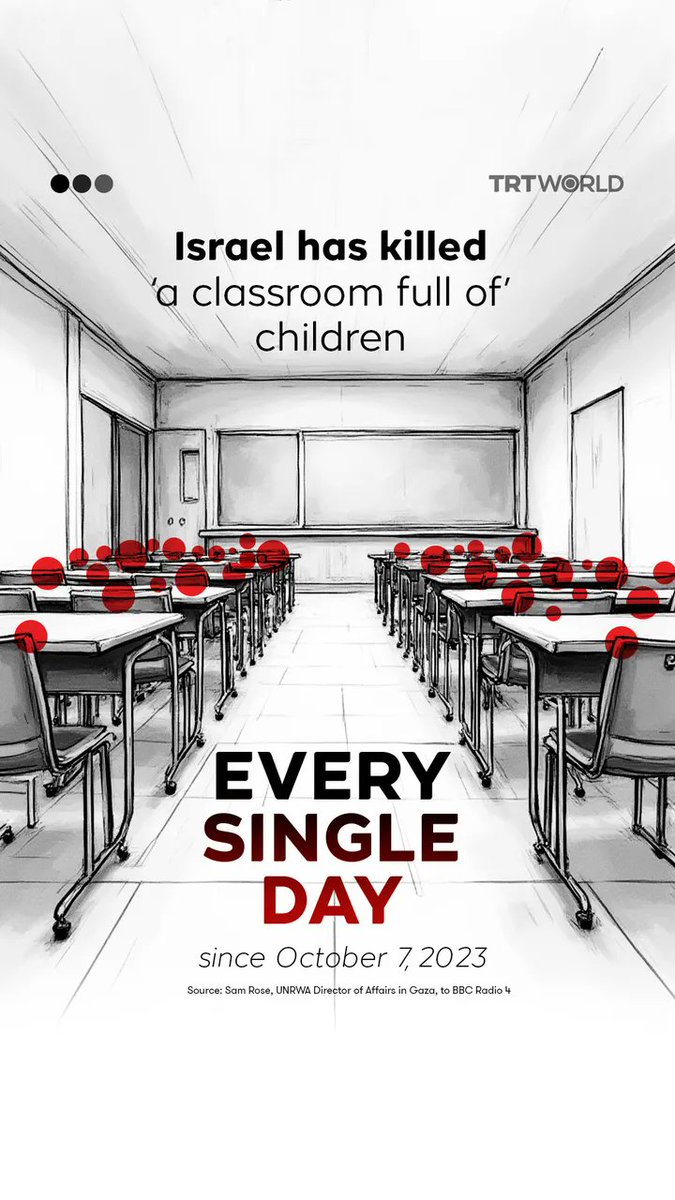
If you made a horror movie in which the bad guys sent flying robots to drop grenades on women and children taking refuge in tents, it would seem too comically evil to be believable.
But that's what Israel is doing in real life, right now, every day.
“Israel has killed a classroom full of children every single day.”
UNRWA Sam Rose tells BBC Radio 4.
Children in #Gaza have been killed while sleeping, sheltering in schools, or queuing for water.
Graphic by @TRTWorld
🎉Finally out!
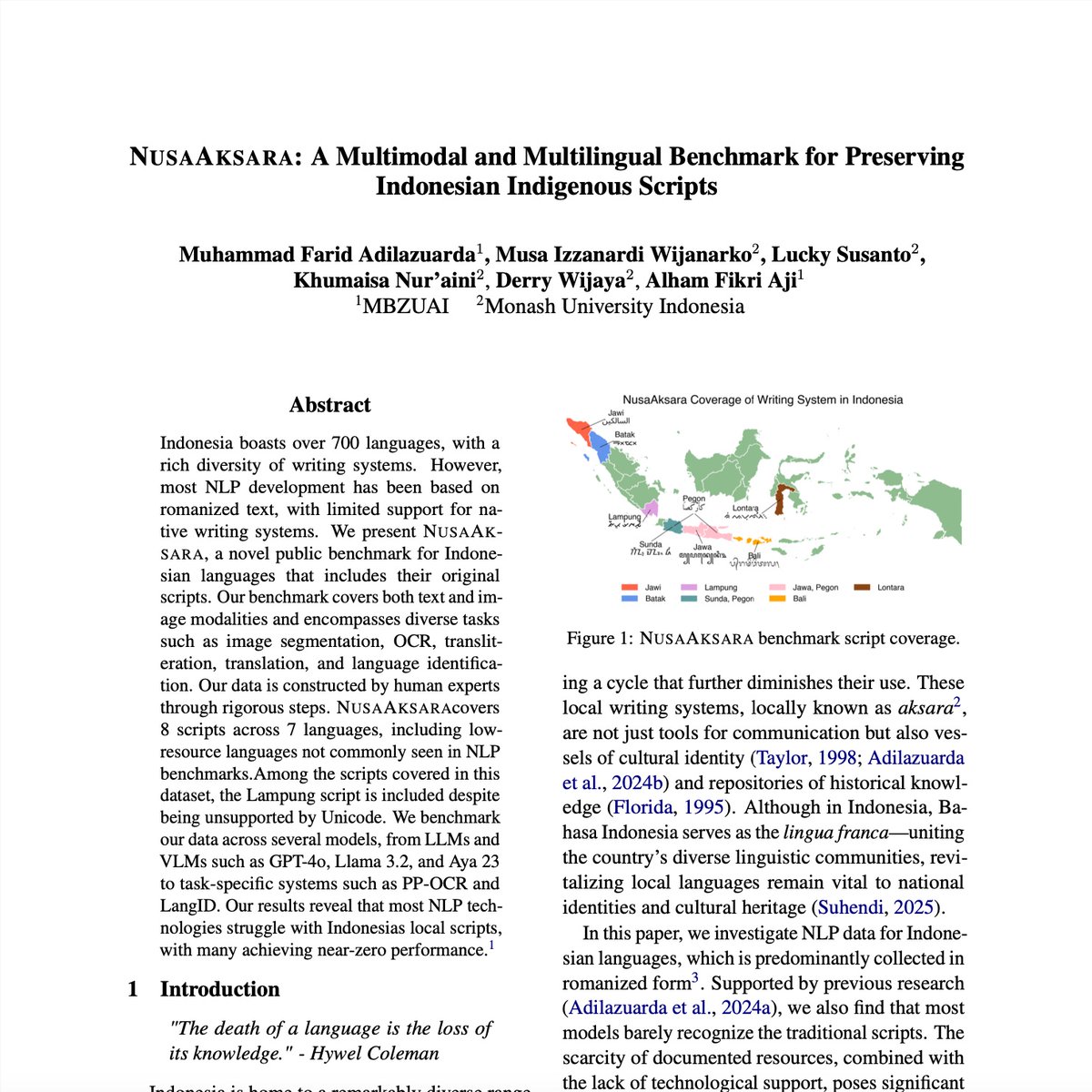
Despite the script diversity, 🇮🇩NLP mainly focuses on Latin script
We’re releasing a multi-modal benchmark for local scripts covering OCR, transliteration, MT, LID
One script, Lampung, lacks Unicode support
📜https://t.co/4qH7iIMLYK
📁https://t.co/UI6G7NiSMB
Which optimizer is opt? Our new work compares SGD, Adam, Adafactor (+ momentum), Lion, and, simply, SignSGD on LLM training wrt performance _and_ hyperparameter stability. tldr: Use anything but SGD, the rest are nearly identical:
Awesome and highly useful: FineWeb-Edu 📚👏
High quality LLM dataset filtering the original 15 trillion FineWeb tokens to 1.3 trillion of the highest (educational) quality, as judged by a Llama 3 70B. +A highly detailed paper.
Turns out that LLMs learn a lot better and faster from educational content as well. This is partly because the average Common Crawl article (internet pages) is not of very high value and distracts the training, packing in too much irrelevant information. The average webpage on the internet is so random and terrible it's not even clear how prior LLMs learn anything at all. You'd think it's random articles but it's not, it's weird data dumps, ad spam and SEO, terabytes of stock ticker updates, etc. And then there are diamonds mixed in there, the challenge is pick them out.
Pretraining datasets may also turn out to be quite useful for finetuning, because when you finetune a model into a specific domain (as is very common), you slowly lose general capability. The model starts to slowly forget things outside of the target domain. But this is not only restricted to knowledge; You also lose more general "thinking" skills that the original data demanded, but your new domain might not exercise. i.e. in addition to the broad knowledge fading, those computational circuits also slowly degrade. So there are likely creative ways to blend the pretraining and finetuning stages.
Kemarin ada yang ngeluh kenapa di Indonesia susah banget nyari buku anak yang bagus…
Eh hari ini nemu beberapa sumber yang bisa dilihat/diunduh dan gratis buat buku anak.
1. Kemdikbud
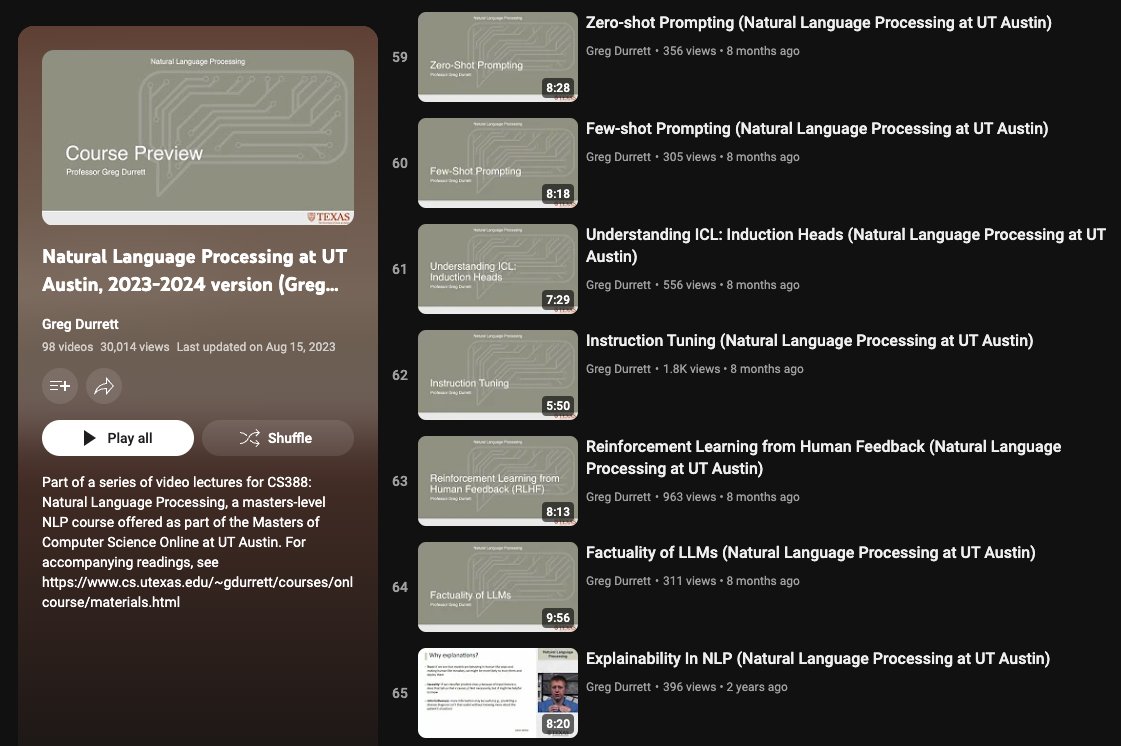
CS388: Natural Language Processing
Great list of byte-sized lectures on NLP and LLMs.
It provides nice summaries of modern NLP topics and recent ones like RLHF, instruction-tuning, few-shot prompting, chain-of-thought, and more.
A great resource to catch up on the space.
Lectures: https://t.co/dpSsFPS0zq
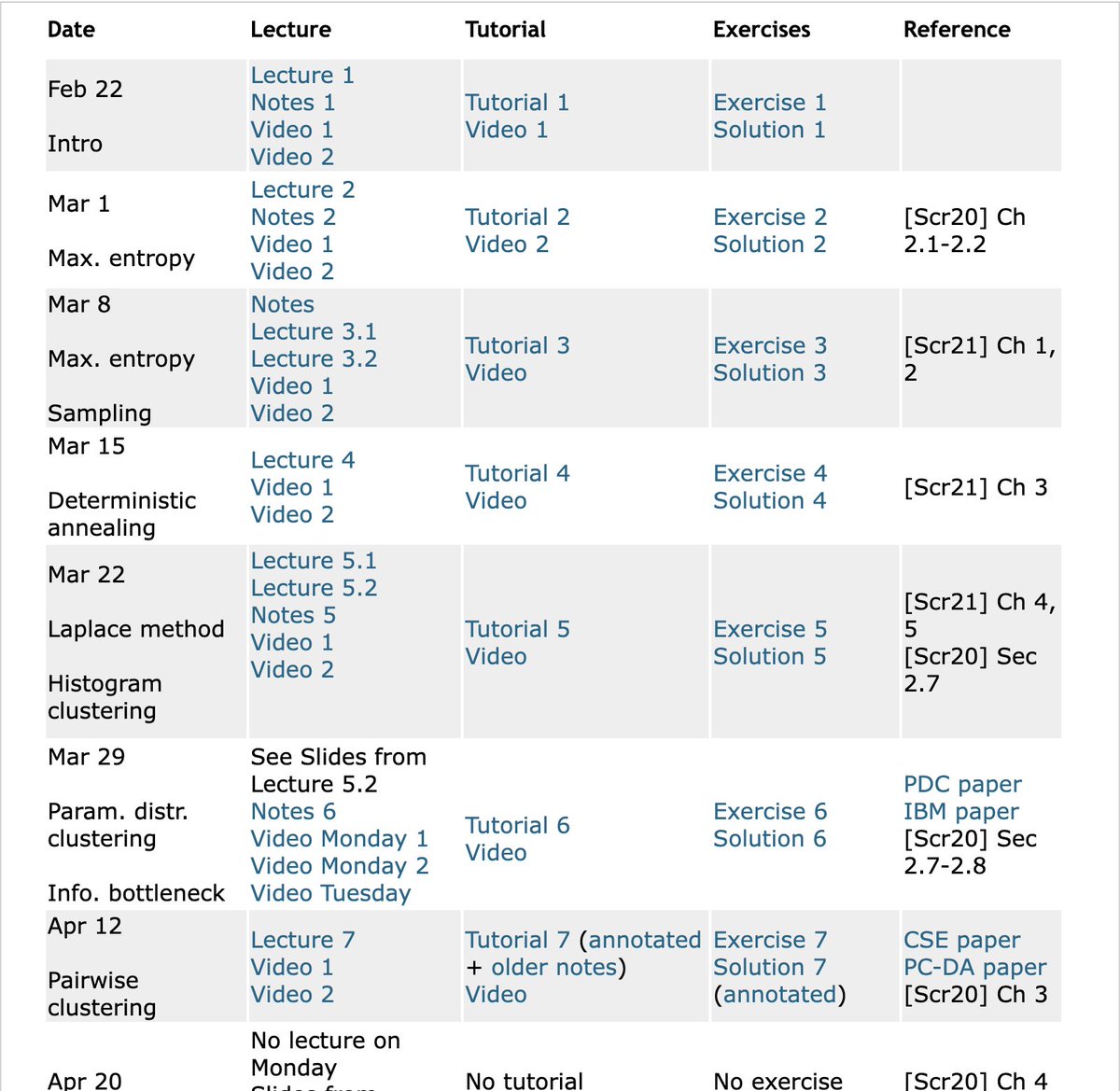
Dive into the world of Statistical Learning Theory with ETH Zurich's Spring 2021 lectures!
Here are the open lecture videos: https://t.co/tm5ldOsjjS
There are also lecture notes, exercises, and solutions on the website: https://t.co/65WXrcRsn0
Excited to share Penzai, a JAX research toolkit from @GoogleDeepMind for building, editing, and visualizing neural networks! Penzai makes it easy to see model internals and lets you inject custom logic anywhere.
Check it out on GitHub: https://t.co/mas2uiMqj9
Slides are done! See you tomorrow at 4:30pm PST for the whole story. From alpaca, openassistant, qlora, zephyr, tulu, to today.
Slides: https://t.co/vzXx08IZOr
Course link (with zoom): https://t.co/ND6wUSebnG