IFT-5 Infographic!
Curious about the changes? Here are some:
S30:
- Upgraded TPS Heat Shield that adds an ablative layer beneath the tiles in most of the places.
- The Hexagonal Antennas on the nosecone were redesigned into a single big hexagonal antenna beneath the payload door. The Antenna beneath the hexagonal TPS is the same as on Super Heavy booster.
- Right Flap camera removed, and instead 4 camera boxes were added next to each of the flaps.
- Two new vents, one for Oxygen, one for Methane.
B12:
- Additional FTS added near the upper part of the chines.
- Possibly additional propellant tanks that add extra Oxygen into the booster header tank for landing. There's 9 total, in 3 groups. This was first spotted on B15, and most likely retrofitted onto older boosters.
- Strengthened stringers on the sides of the booster for the stabilization pins. (Not visible in the infographic)
The link to full resolution infographic can be found in the comments down below!
You have my permission to use this infographic in your works, with proper credit.
The 6th Shaw-IAU Workshop on Astronomy for Education will be fully virtual and take place from 12 to 15 November 2024.
The deadline to register is 12 November 2024 (7 am UTC).
https://t.co/lOK1k1mgRr
Impressive!
146 co-authors from 15 countries on 4 continents have released the most detailed infrared map ever of the Milky Way, containing more than 1.5 billion objects.
Messier 17, featured in this image, is one of those objects.
The gigantic infrared map reveals, thanks to VISTA's (Visible and Infrared Survey Telescope for Astronomy) infrared camera VIRCAM, previously hidden (by the dust and gas permeating our galaxy) stars, brown dwarfs, and globular clusters, in addition to the discovery of hypervelocity stars ejected from the galactic center, which sheds light on gravitational phenomena around the central black hole.
It also demonstrates the importance of international cooperation in scientific research.
In the future, the scientific community might utilize this incredible map for studies of Galactic structure, stellar populations, variable stars, star clusters of all ages, and furthermore in other exciting research areas, from stellar and (exo)planetary astrophysics to extragalactic studies.
In short, this project not only expands our current knowledge but opens the door to new questions and research. The ability to observe and catalog such quantities of objects will allow astronomers to make more robust statistical inferences about star formation, galactic dynamics, and other physical properties.
Image: As part of the infrared map of the Milky Way, admire this stunning and detailed infrared view of Messier 17, also known as the Omega Nebula or Swan Nebula. It is about a stellar nursery located some 5500 ly away in Sagittarius.
Credit: ESO/VVVX survey
Paper: “The VISTA Variables in the Vía Láctea eXtended (VVVX) ESO public survey: Completion of the observations and legacy”➡️https://t.co/tAFlaUNo3i
Press release➡️https://t.co/RVLMZ9zj6k
#JWST
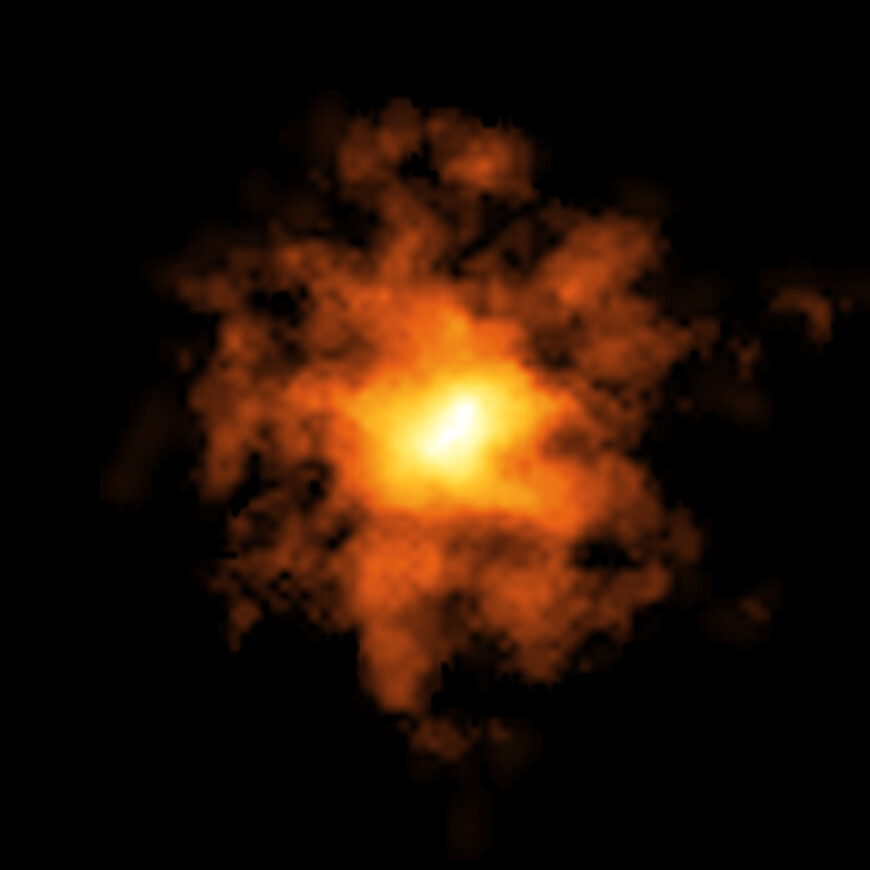
#BreakingNews Space oddity: Most distant Milky-Way-like galaxy yet observed.
🌀Dubbed REBELS-25, this disc galaxy seems as orderly as present-day galaxies, but we see it as it was when the Universe was only 700 million years old
🔗https://t.co/xid0FPXNoj
just to let everyone know, europa clipper is the BIGGEST planetary exploration spacecraft from nasa, coming in at 100 feet across when fully extended!!!
if that doesn’t make you excited for this mission, i don’t know what will.
Comet as you are. 🌠
This amazing photo of Comet C/2023 A3 was recently snapped shooting past Murriyang, our Parkes radio telescope, by photographer Alex Cherney. Alex was in Parkes to help judge the David Malin Awards for astrophotography.
europa clipper may be delayed, but it’s better to have a SAFE launch than a risky one.
spaceflight is an industry that requires a lot of precaution. there’s a lot at stake here. don’t worry, clipper WILL fly!!
I am going back to Antarctica! 👩🏾🚀🇦🇶
I’m thrilled to join @QuarkExpedition Ultramarine for their Epic Antarctica expedition!
From December 16, 2024, to January 7, 2025, we’ll set sail on a 23-day voyage to explore the Antarctic Peninsula, Falkland Islands and South Georgia. Are you ready to join me on this voyage?
Here’s what we’ll experience together:
🌊 Conquer the legendary Drake Passage
🏔️ Step foot on the 7th Continent—Antarctica!
🧭 Cross the Antarctic Circle at 66’30°S
🐧 Explore wildlife-rich South Georgia
🦅 Visit the remote and stunning Falkland Islands
🎉 Ring in the New Year surrounded by Antarctic beauty!
As a geoscientist, educator, space artist, the first Black woman to pilot a spacecraft, and Ultramarine’s Godmother, I can’t wait to share this adventure with you.
You’ll have the chance to join me for some exclusive experiences like a keynote and Q&A session, art session, women in STEM panel, an autograph and photo session, and a charity auction featuring my space-themed artwork.
And here’s an added bonus—use code PROCTOR5 for 5% off this once-in-a-lifetime voyage! (Terms and Conditions apply.)
Don’t miss your chance to explore the wonders of Antarctica with me. Click the link for more details!
https://t.co/H79oezcQhQ
#Antarctica #ExpeditionTravel #QuarkExpeditions #Penguins
This is the new wonder from @NASAWebb featuring the open star cluster Westerlund 1, the most massive young one in the Milky Way.
Located about 12,000 ly away in the constellation Ara, Westerlund 1 is among the fascinating stellar objects studied by the Extended Westerlund 1 and 2 Open Clusters Survey (EWOCS) project. This image was captured by JWST's NIRCam instrument as part of that project.
The cluster is very compact and dense; astronomers estimate it may contain between 50,000 and 100,000 times the mass of the Sun, confined to a region less than six light-years across.
It is known to host hundreds of very massive stars, some of which (24 Wolf-Rayet stars) are among the most massive known.
W26 is a red supergiant located in the outskirts of Westerlund 1. It is one of the largest and brightest stars known, with a radius more than 1000 times the radius of the Sun and a luminosity over 200,000 times that of the Sun. If it were at the center of the Solar System, its photosphere would engulf the orbit of Jupiter.
Because of the enormous population of massive stars, Westerlund 1 is a site where supernova explosions are expected, over 1,500 in a time span of less than 40 million years. Some of the supernovae observed in our galaxy may have originated from this cluster.
The study of Westerlund 1 is crucial to understanding the formation of massive stars, the evolution of star clusters, and the processes that lead to supernovae and the formation of black holes.
Because of the large amount of interstellar dust between us and the cluster, JWST offers a unique, powerful infrared eye.
Westerlund 1 is interesting not only for its massive star content, but also for what we can learn about how the largest and brightest stars in our galaxy are born, live, and die.
Credit: ESA/Webb, NASA & CSA, M. Zamani (ESA/Webb), M. G. Guarcello (INAF-OAPA) and the EWOCS team
Source➡️https://t.co/IlKz0nvzkB
#JWST #Webb