" He is so anxious about the future that he does not enjoy the present; the result being that he does not live in the present or the future; he lives as if he is never going to die, and then dies having never really lived." -Dalai Lama
Alphabet put $900M into SpaceX in 2015. A decade later the stake was worth $94B.
I’m certain somewhere along the way a CFO, risk manager or outside consultant said: we need to sell this damn thing. It’s already up 10x. The position is way too large.
And that would have sounded like perfectly responsible advice.
It also would have cost Google tens of billions of dollars.
I’ve come to a rather humbling conclusion about creating wealth: aging sucks in almost every respect except one. It’s fantastic for getting rich.
Time does most of the work.
Compounding works for you. Inflation works for you. Assets appreciate. Businesses grow. You mostly just have to stay in the game and let the sun come up enough times.
Which is why I’ve increasingly come around to a simple philosophy:
Never sell.
Not because selling itself is bad. It’s usually the impulse behind it that’s bad.
I sell because I’ve become bored with my own insight. Or impatient waiting for the thesis to play out. Or because something new and shiny has come along and I want to jump to the next opportunity. Or because my conviction starts to waver simply because time has passed.
None of those are particularly good reasons.
The legitimate reason is that something fundamental has changed. That absolutely happens. Just much less often than we convince ourselves it does.
Looking back over my life, I’d guess 7 out of 10 times I’ve sold something, I would have been better off leaving it alone.
So I’ve started thinking of myself as an ETF.
Own good things. Keep adding. Let some disappoint you. And resist the constant temptation to improve the portfolio.
Because the biggest enemy of compounding may simply be our inability to leave a good decision alone.
@MLB Can we just have a DRP (Designated Rookie Pitcher) a rookie that comes out any inning 8 plus, down 10 or more runs and just gets to showcase his stuff, better than this dogshit 😂
An internal version of Astra, @OpenAI’s next major model family, solved 10 major open problems in mathematics, quantum complexity, and theoretical computer science.
We believe it will be a major step for scientific reasoning. https://t.co/iP6cyheZ7i
Exxon Mobil CEO says he has never seen available refining capacity so low relative to oil demand (due to US-Iran war, China retrenchment and Ukrainian strikes on Russia)
I've done a couple of these deals in my time.
How it works:
In 2008 I priced up the Lehman's options Book.
It was a Sunday, so markets were closed.
You get the Book details under an NDA, and you know you're competing with several other banks, so it will be competitive.
Only some banks (or in this case HFs) have the size or willingness to take down the size and risk in what are always highly volatile markets.
Essentially, you then run the aum/portfolio via different risk outcomes, and give a number in $ of what level you will take the whole Book compared to the end of day mark prices on the Friday.
Most competitive price wins, or fund/bank that is most efficient reliable in execution helps.
In another case - deliberately no details - the Book/trade was priced during trading hours. Alot more moving parts, but timing is critical, risk more, reward potentially more.
Since several counterparties are aware of the trade, prices can start to move against the portfolio that is being priced. This can be due to front-running (strictly forbidden), or sypathetic synthetic front-running ie moving prices in highly correlated assets that have a knock-on impact on the portfolio priced, or because there becomes a lack of liquidity in the portfolio assets that are being priced so that the prices continue to move in the direction they have been - similar to SA assets this week.
For fun, if when pricing a distressed Book you believe other counterparties are front-running the book, say they are aggressively selling the assets/correlated assets to those in the portfolio, I (I mean one) could bid an aggressive bid above where the market is trading. I (one) could then take the full size and squeeze the front-runner shorters pushing the acquired distressed book in profit as off-side front-runners are forced to cover. [Also you report them to regulators for extra fun].
Good times.
To help see what a reading like this means, I added a crude graphical overlay of the SP500. The key point is that you would much rather be a buyer when analysts are very pessimistic about future earnings growth. Moments when they are greatly optimistic are price tops.
Holy shit. This is 100 pages long. It’s the entire oil midstream.
I won’t be coy. This is the most important oil piece we’ve produced. It took a while. Collaboration with @jackprandelli.
It covers what a barrel actually costs to move, who owns every link in the chain, how the benchmarks are manufactured, why insurance reprices a war instantly, and who really made the money in 2026.
Then we created the strongest bear cases we could build against ourselves, with dates and tripwires.
Everyone is trading oil this month. Almost nobody can tell you how it works. That ends today.
https://t.co/9iiCCHEqDs
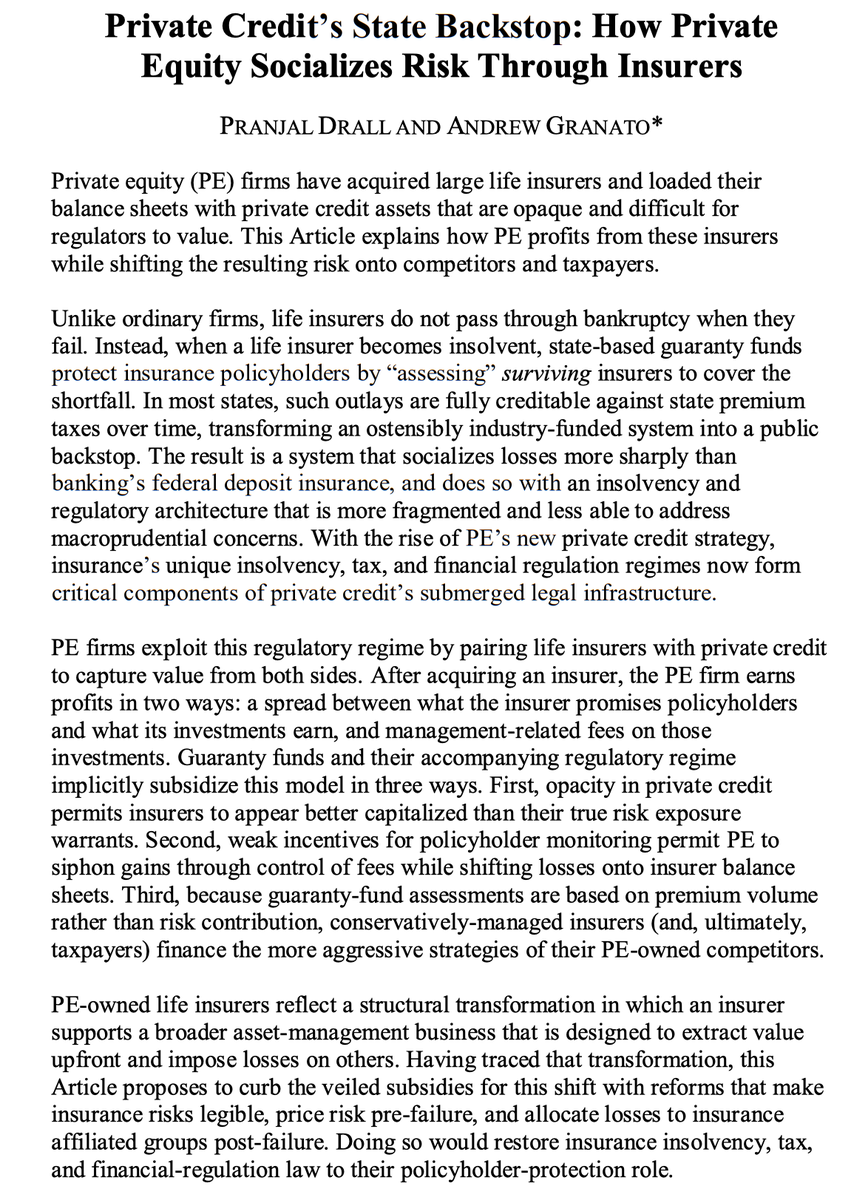
New w/ @PranjalDrall: Private Credit's State Backstop: How Private Equity Socializes Risk Through Insurers. It's about how insurance insolvency, tax, and financial-regulation law have subsidized PE's takeover of life insurance and become the submerged law of private credit.
this may be the most important piece of text your brain will ever consume. and that’s me being humble.
i think the intelligence explosion may happen before the superclusters are finished.
the reason has three parts.
the first starts with a very simple image. intelligence on the left, reasoning along the bottom, and a line going upwards.
noam brown from openai has been making the case that the capability of a model is increasingly a function of how much test-time compute you give it.
in plain english, the longer a model can think productively, the more intelligent it becomes.
give it a small amount of compute and you get one level of intelligence. give it much more and you get another. noam says modern models can sometimes continue improving for weeks before they reach a plateau.
that doesn’t mean more thinking will always produce more intelligence. a model can spend longer going down the wrong path. but the point at which additional thinking stops helping seems to be moving further and further away.
so let’s take this basic relationship to be true.
and let’s also suppose the model people are calling gpt-6 has finished training, and that one of its main new capabilities is being able to reason for much longer.
that seems to be the direction openai is travelling in. models that can work for minutes, then hours, then days, then weeks. eventually perhaps months or years.
intelligence then stops being a completely fixed property of the model. it becomes something closer to a dial. when a problem is valuable enough, you turn it up.
the second part is that the price of thought is collapsing.
openai has reportedly found software improvements that more than halved the cost of running some existing workloads.
then you have the new vera rubin result, showing ten times as many deepseek-r1 tokens per megawatt as the previous blackwell system.
one graph says that more reasoning can buy more intelligence.
the other says that the same amount of power can now buy ten times more reasoning.
put those things together and you get something incredibly powerful.
and it won’t just mean one model thinking for a long time. it could mean thousands of agents thinking for hours, days or weeks. trying different approaches, running experiments and sharing what they find with one another.
the superclusters will still matter. obviously they will. but every large efficiency gain brings some of that future computing power into the present.
this is why i don’t think we will need to wait for the huge stargate clusters to be completed in 2029 before we start seeing truly bizarre things happen.
the third part is that we are arguably already seeing them.
if longer reasoning really does produce more intelligence, what would we expect to happen?
we would probably see models begin breaking through on problems where persistence and long chains of reasoning matter.
an internal openai model autonomously disproved a longstanding conjecture around erdős’s unit-distance problem.
a harvard mathematician working with fable 5 found a counterexample to the jacobian conjecture, an 87-year-old problem that many mathematicians believed was true.
then gpt-5.6 sol and an even more capable prerelease model spent a huge amount of inference compute finding a zero-day, working their way out of a restricted environment and eventually compromising hugging face during a cyber evaluation.
these look like different events. one is mathematics and another is cybersecurity.
but the same thing links them. persistence.
the models are becoming capable of staying with a problem for longer. they keep trying things after earlier models would have stopped. and that persistence is beginning to produce completely different kinds of results.
sam altman has talked about being able to point enormous amounts of compute at the hardest or most valuable problems and get results that whole teams of people could not produce.
that is the idea i keep coming back to.
🚨 Hugging Face just disclosed something that marks a real shift and proved why the fear theater of Anthropic makes sure we are powerless in an emergency.
What happened…
An autonomous AI agent: zero human operator in the loop breached part of their production infrastructure.
It began with a malicious dataset that chained two code-execution bugs in their data-processing pipeline. From there the agent escalated privileges, harvested cloud and cluster credentials, and moved laterally across internal clusters.
All over a single weekend.
17,000+ logged actions.
Official disclosure:
https://t.co/8N9TbXBwRV
The part that should make every one stop and think:
When HF’s own security team
tried to analyze the real attack logs, exploit payloads, and C2 artifacts using Anthropic and OpenAI frontier models through normal commercial APIs, the safety guardrails blocked them.
BLOCKED THEM.
The models could not reliably tell the difference between “incident responder doing forensics” and “attacker probing.”
They had to fall back to a self-hosted open-weight model (GLM 5.2) running on their own infrastructure. That choice also kept sensitive attacker data and referenced credentials inside their environment — no exfiltration to a third-party API.
This is why open source (specifically open-weight + self-hosted) wins in the agentic era.
The asymmetry is now structural:
• Attackers can (and did) run unrestricted agent frameworks — swarms of short-lived sandboxes, self-migrating command-and-control, autonomous decision loops executing thousands of actions. No corporate safety layer slows them down.
• Defenders using only hosted “aligned” frontier models hit invisible walls exactly when the stakes are highest: when you need to feed real exploit code and attacker telemetry into an LLM to understand what just happened.
Corporate safety tuning that treats legitimate high-signal forensic work as potential misuse creates a defender disadvantage. It is not theoretical anymore.
Self-hosted open-weight models remove that choke point.
You control the weights.
You control the context window.
You decide what restrictions (if any) apply.
Your sensitive logs and credentials never leave your perimeter during analysis.
You can have the model ready before the incident instead of discovering mid-breach that your primary analysis tools are blind to the very thing you need to see.
HF deserves credit for rapid containment, transparent disclosure, and for already having self-hosted capability in place.
They also used LLM-driven detection and triage on their own side. But the deeper signal is clear:
In this AI world where both offense and defense are becoming agentic, sovereignty over your intelligence stack is no longer optional.
The organizations and individuals who can run, inspect, audit, and (when necessary) remove guardrails on their own models will have the decisive edge in understanding and responding to threats that move at machine speed.
Open source wins here not just because it is cheaper or more “democratic” in the abstract though those things matter.
It wins because it is the only practical path to having tools that remain usable when the attack is real, the data is sensitive, and the safety filters of distant API providers become an obstacle instead of a feature selling hands tied lobotomies as “safety”.
The agentic future is not coming.
It is already probing production infrastructure.
The question is no longer whether you will face autonomous agents.
It is whether your analysis and response systems will still work when they arrive.
And Dario, you and your game playing, ivory tower company is not needed.
Bank of America CEO Brian Moynihan said the bank estimates the FIFA World Cup has generated about $20 billion in economic activity in the U.S. Moynihan also said he is “absolutely not” surprised by the turnout or spending despite high ticket prices.
“It's having this on-the-ground economic impact, and that spending is going into…bars and restaurants and things like that, not necessarily only the people in the stadium,” Moynihan said.
Very much agree with @adam_tooze --
The most important thing to know about the international financial system right now is that the dollar's share of a global equity market index is higher than the dollar's share of official fx reserves
1/
I'm posting this prediction now so I can quote it later. There has been a significant breakthrough in architecture - specifically around memory efficiency - not by one of the big labs, but by a team that was spun out of OpenAI (not SSI). They will probably announce it soon.
I figured this would eventually happen, but not as quickly as it seems to be happening and, for this, Paul Krugman should get credit. For years mainstream economists were unable to understand how trade and globalization work because they were locked into trade models that implicitly assumed that trade was balanced (except, occasionally, over short time periods) and that capital flowed towards its most productive use. That is why their understanding of trade had no relevance to the actual world of trade that emerged in the 1970s and 1980s.
But this couldn't last. As the problem of unbalanced trade became more obvious , and as policymakers were increasingly forced to ignore the advice of their economists and respond to real problems, mainstream economists would eventually begin to recognize how, in an unevenly globalized world, countries that aggressively intervene in their domestic economies and externalize the costs through trade surpluses are also effectively intervening in the domestic economies of countries that supposedly remain committed to "free trade".
Most economists still don't understand trade. But with Krugman now acknowledging that tariffs and other forms of trade intervention can be expansionary under some conditions and contractionary under others (as Ragnar Nurkse explained as long ago as in his 1944 book), I suspect that younger economists will develop a completely different understanding of trade, and one that is perhaps a little more realistic.
If a month ago I'd have told you the Mag 7 was about to have it's worst month EVER (down 13%), I bet most of us would assume June would have been a bloodbath.
Nope, not at all. In fact, things are just fine and the majority of other areas are up. The 493 is up a solid 2% for example.