The U.S. Army spent a week in Oklahoma firing a pickup truck with a 30mm cannon, the same type of gun used on Apache helicopters, at drones ranging from small quadcopters to aircraft weighing hundreds of pounds.
https://t.co/8vXnRMQvCz
@AndyKaplan3 The interview was recorded in april so things might have changed since then, who knows.
I would imagine that EOS is in quite advanced negotiations with Saudi Arabia for HELW.
$EOS.AX
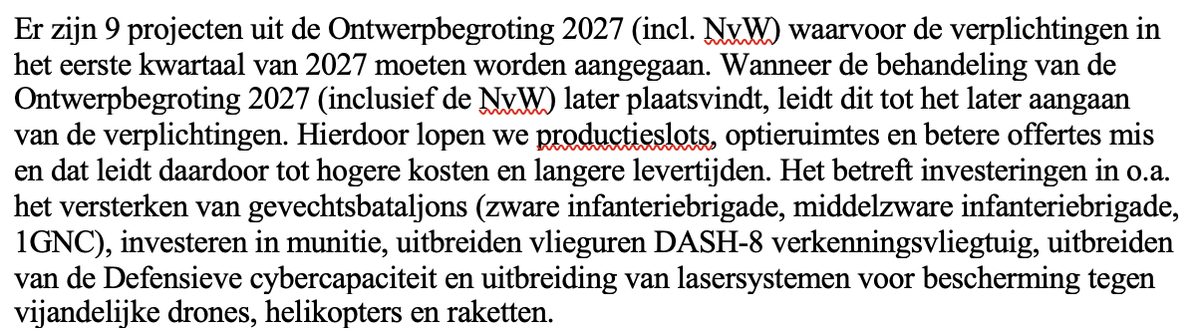
On 9 November the Dutch MoD filed an amendment to the 2027 materiel budget. (37020-K nr. 5)
It lists nine projects whose contracts must be signed in Q1 2027, including the “expansion of laser systems for protection against enemy drones, helicopters and missiles”.
While the document names no supplier or amount, we know that EOS is the Netherlands’ official laser partner after signing the LOI in September.
EOS also lists a follow-on low-rate laser production opportunity worth more than A$300m with its existing European customer in its H1 presentation.
Long $PDYN. I haven't listened to the call so I don't know the actual tone, but reading the earnings transcript ( and maybe it was just my bias from having experienced firsthand how frustrated Ben was when the stock was in the $5s - he probably burst a few arteries in the $2s and $3s), but the call READ frustrated. 🤣
Here's my take. Three things I want to focus on:
1. Timing and the risks to the business and stock
2. Capital needs and operating leverage
3. What happens if some of these opportunities start turning into meaningful revenue
1. Timing
They're doing great with the things they can control. Expanded military exercises, building relationships with business partners, the DoW, politicians, etc. Revenue is growing, margins are improving and the technology continues to get validated. SwarmOS getting the highest rating across all nine Army evaluation criteria is a big deal.
I know Ben won't let this fail without doing everything in his power to make it successful. He's also significantly incentivized at much, much higher stock prices, so I don't see him being particularly interested in selling the company at anything close to today's valuation.
The issue is timing, both for the stock and the business. Hopefully the stock's recovery holds, but the sector is still in a bear market and dead cat bounces happen. On the business side, budget uncertainty is real and could push contracts and revenue out.
2. Capital needs and operating leverage
With $47M in cash/investments and ~$13M available on the ATM, I believe the risk they NEED to raise additional capital has been materially reduced. Not saying they won't raise, but there's a difference between needing capital and choosing to raise it.
My thinking:
If the existing business, ex-software revenue (so components, avionics, engineering and DoW development/integration contracts), grows only 20% next year to roughly $30M-$33M, I think cash burn could decline from ~$36M-$37M this year to $24M-$28M.
The biggest risk is budget timing, which is also why I think these numbers for today's business could be VERY conservative if contracts and funding move forward without significant delays. Backlog wasn't ideal, but the companies that mainly benefited from the budget flush were existing programs and replenishing the arsenal depleted in Iran. Hopefully we'll see new contracts pick up over the next quarter or two.
Assume they finish 2026 with $40M cash + use the $13M ATM in 2027. That's ~$53M in potential liquidity, or two+ years of runway at my projected burn rate, assuming burn continues declining as revenue grows in 2028. And that's BEFORE meaningful high-margin software revenue from IQ, SwarmOS or Pilot, which would further reduce burn. Using the ATM would also remove the remaining stock overhang, albeit with dilution.
Could they still raise capital? Sure. Working capital, standing up manufacturing for IAI, M&A, etc. All potentially good reasons if the returns justify it.
Operating leverage: Nobody seems to be talking about this. My guess is manufacturing is running at 30%-40% capacity utilization on one shift, leaving considerable room to grow without adding much fixed overhead. They also shouldn't need to add much G&A after the hiring in the first half of the year.
Look at Q3. Revenue increased 48% sequentially, gross margins went from 29% to 44% and adjusted EBITDA (my approximation) improved from roughly ($10.4M) in Q2 to ($7.8M) in Q3. That's a $2.6M improvement in one quarter. And remember, they hadn't acquired the engineering and manufacturing businesses in Q3 2025, so the YoY comparison isn't apples to apples.
3. What happens if things go right?
IQ: Let's assume $35K per robot in license value, with potential additional recurring maintenance revenue of 10%-30% annually. These are my assumptions, not company guidance.
For every 100 robots, that's $3.5M in potential license value.
FANUC does something like 40K new robots annually in the U.S., plus hundreds of thousands in the installed base. Just 1% penetration of annual new sales would be 400 robots or $14M in potential license value. At potentially 80%+ gross margins, the incremental contribution to profitability could be substantial.
And that's just FANUC. IQ works on other manufacturers' robots, so hopefully they can sign similar deals with others and expand internationally over time.
My guess is we'll see small and midsize manufacturers start generating revenue in 2027, while larger Fortune 100 companies begin with smaller testing programs. The bigger catalyst would be signing contracts for broader implementation.
SwarmOS: Ben laid out the business case on the call, including software pricing tied to the cost of the drone. Similar high-margin opportunity to IQ.
The Army validation, expanding exercises, Anduril integration and growing partner relationships are encouraging. Now they need to turn that activity into contracts.
Gremlin-X: Getting considerable exposure through Army exercises, apparently including allied forces, and progressing with additional use cases like the Federal/Mossberg counter-UAS opportunity. I think the exposure to allied forces provides long-term optionality that hasn't received much attention given their focus on the DoW.
And don't overlook the components/avionics business. PDYN doesn't have to provide the autonomy software to participate in programs. That's another way to win.
IAI: I don't expect much meaningful production revenue in 2027, but there could be catalysts.
The DoW could purchase test units, potentially generating some revenue for PDYN even if they're initially manufactured in Israel. More importantly, that would signal progress toward much larger contracts.
Any indication they're preparing to stand up U.S. manufacturing would also be significant.
We're talking about programs that could potentially be worth nine or ten figures, so procurement takes time. I wouldn't expect the big revenue opportunity overnight.
Bottom line: I think PDYN is making considerably more progress operationally than the stock reflects. The existing business has room to grow, operating leverage could be substantial and there are several potentially large opportunities contributing little, if anything, to revenue today.
The question is timing. How quickly do these opportunities turn into contracts and revenue, and how much cash do they burn getting there?
I believe the risk associated with needing capital has come down materially, while the upside from software adoption and larger defense programs remains significant.
I'm bullish, but not ignoring the risks. I think the risk/reward is pretty interesting at these levels for medium- to long-term investors. That said, I believe the market/sector trend is lower over the next several quarters and that will likely take Palladyne with it.
Take it for what it's worth, but my $0.02 is that the market/sector/stock need an end to the Iran war, the 2027 budget approved (even if it's not at $1.5T) and the Fed to start taking a more accommodative stance before we put in a bottom.
I'm heavy in cash (not as heavy as I'd like, unfortunately) and will be patient deploying it. For now, I'm holding my PDYN and will back the truck up at some point if the stock retests prices from the last few weeks.
Disclosure: I previously provided IR services to PDYN. These are my personal opinions as an investor based on publicly available information.
LMK what you think 👇
#physicalai #robotics #embodiedai #automoussystems @HenryInvests@sunao_viewer@GrumpierBTDay@LilyFunds@nick88886666@GeoInvesting@MSmicrocaps@NasdaqExchange@stockseer@CUAS_NEWS $ONDS $UMAC @Rewkang@MicroCapClub@PlanetMicroCap@Zero_Hour_Group@BlackScholesMan@GreatMattsby@HumanoidInvest@HGResearchLLC@JeffGabel
Management themselves said they would close an initial contract with Jordan in the near future.
The press release also describes the customer as a Middle Eastern customer rather than a GCC member. The only non-GCC country in the Middle East that would be a logical customer for MARSS is Jordan.
If you know where to look, the press release also accidentally reveals that the customer is Jordan, but I think the company is going to fix that today.
$EOS.AX announced a new MARSS NiDAR contract with a new Middle Eastern customer today.
It's an initial qualification order that could scale significantly in the future.
MARSS now has contracts with:
•Saudi Arabia
•Jordan (this contract)
•Bahrain
•Qatar
•Kuwait
It's also expanding into the UAE.
This year alone, MARSS has secured almost A$1bn in order intake from the Middle East.
$EOS.AX
Do the math on the quarterly report and you'll find that EOS has already reached the bottom end of its FY2026 guidance.
Unless something goes horribly wrong in Q4, we should see a very large beat.
BREAKING: The U.S. Space Force has selected SIX commercial companies to provide satellite tracking and surveillance capabilities that can be rapidly expanded during a military crisis.
The companies selected for its Commercial Augmentation Space Reserve (CASR) are:
1. Anduril
2. LeoLabs
3. Slingshot Aerospace
4. Intrack
5. EOS (Australia)
6. NorthStar Earth & Space (Canada)
The program gives the Pentagon access to commercial systems capable of detecting and tracking satellites, monitoring suspicious orbital maneuvers and identifying debris or spacecraft breakups.
Modeled on the Air Force's Civil Reserve Air Fleet, CASR is designed to let the military increase its use of commercial space capabilities during wartime without having to build and maintain all the infrastructure itself.
The six companies have received initial operational contracts, with additional providers and capabilities expected to be added over time.
The Space Force is also considering satellite communications, launch services and spacecraft tracking and command as future additions.
Contract values were not disclosed.
$EOS.AX
According to Handelsblatt, Diehl is preparing to deliver 48 GARMR counter-drone systems to the Bundeswehr as an interim solution, as Rheinmetall's Skyranger is running two to three years behind schedule.
24 systems will be equipped with a gun and 24 with Cicada interceptor drones. The weapon station on GARMR is an EOS R400.
The systems are mainly needed for Panzerbrigade 45 in Lithuania, which has to be fully operational by the end of 2027 and would otherwise be left largely without drone protection.
According to company sources, Jordan has already ordered the same GARMR model, and Diehl expects further orders from the Bundeswehr and other European countries.