No Original Ideas :). There are enough of those on Twitter! I Only re-tweet what I find interesting, and need to refer to. Nothing more...nothing less.
Apple was the 15th smartphone maker
Spotify was the 10th music platform
Google was the 21st search engine to enter the market
Facebook was the 10th social network
Netflix was the 7th streaming provider
Uber was the 4th ride sharing service
TikTok was the 8th short-video app
Zoom was the 11th video-calling app
Being first doesn't mean winning
I own 11 apartments across Manila, Bali and Dubai. All bought in cash since 2019.
7 years in, my verdict: real estate is a terrible investment, and I'd be richer and calmer if I had clicked "buy" on an index fund once in 2019.
Here are the actual numbers, unit by unit.
Major cheat code for life: Be fully where your feet are. When you're at work, work. When you're with family, be with family. When you're resting, rest. Most people are physically present and mentally everywhere else.
Central banks are sitting on massive stockpiles of gold after years of record purchases:
Global central banks now hold ~38,666 tons of gold, reflecting ~17% of all gold ever mined.
Still, the largest portion of gold remains in private hands, with ~97,645 tons held as jewelry, or ~43% of the total.
Investment-related holdings, including bars, coins, and ETFs are ~50,978 tons, making up 23% of the total.
The remaining ~32,602 tons, or 14%, fall into other categories, such as industrial use and private reserves.
Central banks are now major players in the global gold market.
Jensen Huang said AI has 5 layers of value. India doesn't have a presence in any of them.
⚡ Layer 1 — Energy. A hyperscale AI campus now draws 1–2 gigawatts — a mid-sized nuclear reactor, for one building. China added nearly India's entire installed grid in new capacity last year.
💾 Layer 2 — Chips. The silicon brain and everything that makes it.
→ GPUs: Nvidia (US), AMD (US), Broadcom (US) design. TSMC (Taiwan) fabs at the cutting edge.
→ HBM, the high-speed memory beside every GPU: ~90% Korea.
→ ASML (Netherlands) has a monopoly on the one machine that prints the most advanced chips.
→ Silicon wafers ~60% Japan. Photoresist ~90% Japan.
🏭 Layer 3 — AI infrastructure. The data centre and everything around the chips.
→ Hyperscale cloud: AWS (US), Azure (US), GCP (US); Alibaba (China), Tencent (China).
→ Servers and AI-rack cooling: Supermicro (US), Vertiv (US), Schneider (France), Eaton (US).
→ Commodities: copper (Chile, Peru), niobium (~90% Brazil), rare earths (~85% processed in China).
🧠 Layer 4 — Models. Closed: OpenAI (US), Anthropic (US), Google (US), Meta (US). Open: DeepSeek (China), Qwen (China), Kimi (China).
💻 Layer 5 — Applications. ChatGPT (US), Copilot (US), Cursor (US), Claude Code (US), Agentforce (US). Mostly US. Increasingly Chinese.
China has a presence in all 5. Korea owns HBM. Taiwan owns the cutting-edge factory. Netherlands owns the machine that makes it possible.
India:
Layer 1 — grid stretched, industrial power expensive and patchy. 24/7 clean power is hard to deliver today.
Layer 2 — no frontier chip factory. Tata-PSMC (India-Taiwan) at ~28nm is a decade behind AI chips. India's chip design talent works for Nvidia (US), AMD (US), Qualcomm (US), Intel (US). Value flows to US balance sheets.
Layer 3 — India builds the data center buildings (Yotta, Adani, Reliance) and generic industrial power and cooling gear (BHEL, Crompton, Blue Star). But no hyperscale cloud, and no specialized AI-rack cooling or power shelves. Every Indian AI startup runs on AWS (US) or Azure (US).
Layer 4 — Sarvam, Krutrim (India). Real teams, orders of magnitude below the frontier.
Layer 5 — Zoho, Freshworks (India) are real SaaS businesses, but their AI features — like most Indian AI-app startups — are thin wrappers on OpenAI (US), Anthropic (US), Google (US). And not agentic. Agents are where the flywheel lives. India has no agentic platform at that scale.
This is a 30-year-old choice. India bet on services and not manufacturing. TCS, Infosys, Wipro, HCL (India) built a ~$250B export industry. It paid off. But services sit above the stack — they don't own any layer of it.
India's AI Mission is ~$1B. China's is in the hundreds of billions. That's not a gap to close — it defines the game.
god i didn’t think ai would kill entire industries this fast
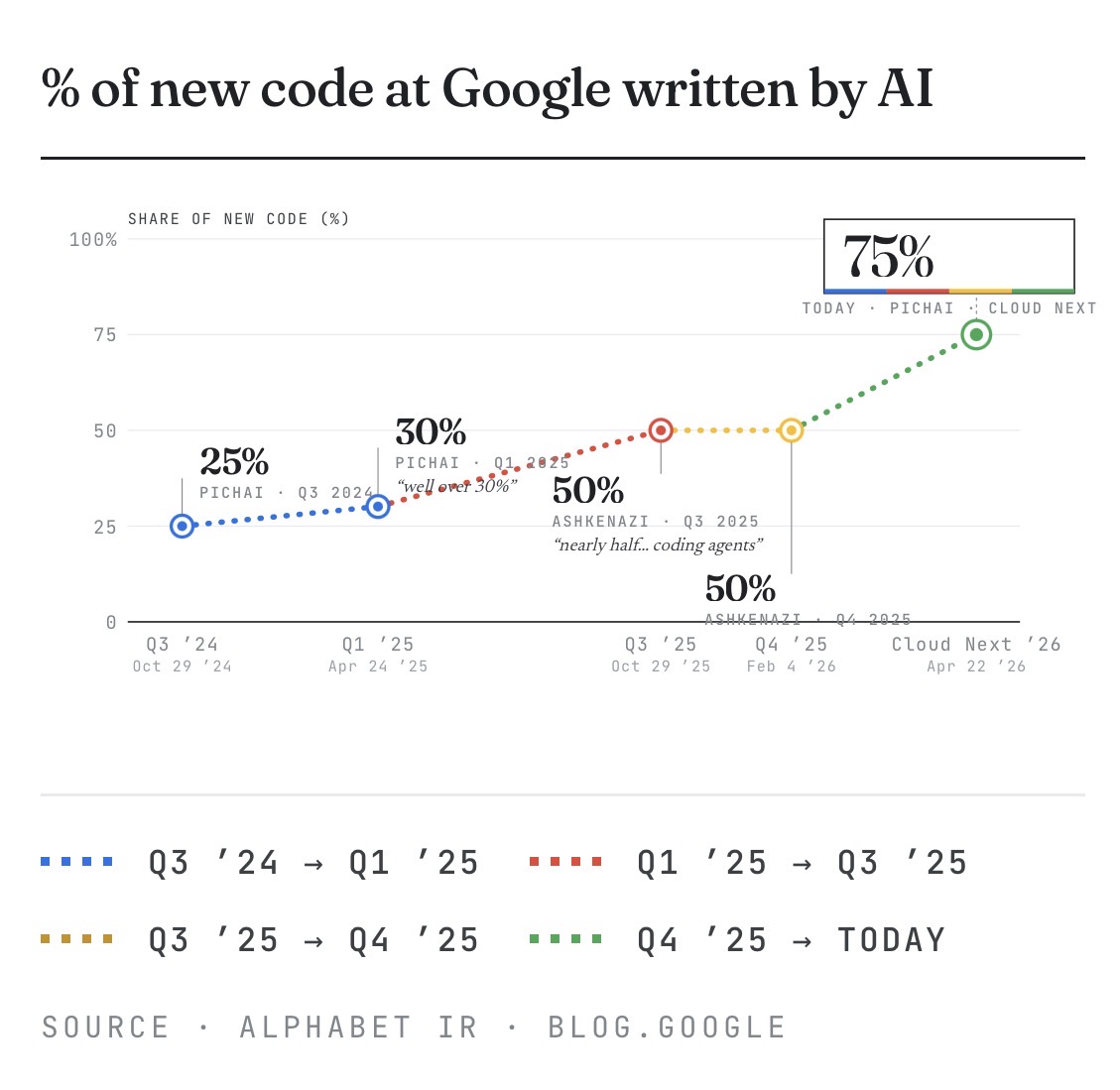
- claude code is killing SaaS companies, stocks are down -15-30% over last 2 months.
- google genie is killing gaming companies, stocks tanked -15% since public release last week
- video models like kling, veo3 and higgsfield are replacing human content creators - it’s so bad the SAG is creating a new tax for ai influencers to donate to a human actor union fund.
- fortune 500 companies are pulling multi-million dollar software contracts and replacing them with agent platforms
- Oai, anthropic are aggressively partnering with science institutes and launching health features to automate the entire health industry (medical care, pharma, research are worth trillions)
- GPT 5.2 & gemini are solving unsolved problems in mathematics - what’s a math degree worth if an AI can solve complex shit 24/7?
but that’s not even the craziest part
“codex is now building itself, we just supervise” - Tibo (openai codex lead)
anthropic team has said the same about claude - it self-improves.
we’ve reached a point where ai models aren’t just automating away major industries - they’re doing it to THEMSELVES too
the acceleration of human and artificial cognition will come down to an equation of compute, energy and silicon chips
what a total mind fuck
Investment banking analysts not marked safe from AI
I asked Claude in Excel to do a DCF. In ~3 minutes, it pulled web data and built the model (w/ notes, formatting, citations)
It then recognized the result was lower than the market price, so added a sensitivity analysis 🤯
the AI bubble will accidentally trigger a human renaissance
here's what will happen between now and 2030:
phase 1 (2026-2027):
> everyone automates everything
> productivity goes through the roof
> we celebrate never having to think again
phase 2 (2028-2029):
> mass digital burnout
> people realize they've outsourced their cognitive abilities
> depression rates spike because nothing feels earned anymore
phase 3 (2030+):
> the pendulum swings hard in the opposite direction
> outdoor experiences become the new luxury
> manual skills and human connection become premium
> we start valuing struggle and effort again
the faster we rush toward full automation, the faster we'll crave what makes us fundamentally human
that's what i'm hoping for anyway