Establishing early clinical evidence that a therapy works is essential to advancing promising gene therapy programs from the lab to real-world patients.
Last week at #GATC26, we announced an expansion of the Dyno Frontiers Network to include three Frontiers Translational Partners, Aurelix Bio, CoJourney, and PrimeRA Pharma Partners. These partners provide gene therapy developers regional expertise to choose and pursue the path to the clinic that fits their program goals, whether through an Investigational New Drug (IND) application, a Clinical Trial Application (CTA), an Investigator-Initiated Trial (IIT), or a coordinated multi-region approach.
Welcome to lesson #7 of 𝗦𝗰𝗿𝗶𝗯𝗲 𝗦𝘆𝗹𝗹𝗮𝗯𝘂𝘀! This week, we explore how scientists use molecular engineering to transform naturally occurring CRISPR systems into more potent and precise tools for genetic medicine.
CRISPR systems evolved to help bacteria defend against viruses, not to treat disease in humans. Turning them into therapeutics means modifying and optimizing their molecular components so they work in human cells – building on nature’s original design.
𝗙𝗿𝗼𝗺 𝗻𝗮𝘁𝘂𝗿𝗲 𝘁𝗼 𝗺𝗲𝗱𝗶𝗰𝗶𝗻𝗲: 𝗛𝗼𝘄 𝘀𝗰𝗶𝗲𝗻𝘁𝗶𝘀𝘁𝘀 𝗲𝗻𝗴𝗶𝗻𝗲𝗲𝗿 𝗖𝗥𝗜𝗦𝗣𝗥
🧬 Engineering CRISPR enzymes: how changing amino acids changes performance
🧬 Engineering guide RNAs: how optimizing the targeting sequence and structural scaffold can improve CRISPR function
🧬 The iterative engineering process: design, build, test, learn, refine
🧬 Why molecular engineering matters
Dive in on our Substack: https://t.co/TOLa3EPfMZ
Want to learn more about molecular engineering? Leave a question in the comments!
“There’s already more good drugs discovered than we can afford to develop.” And with AI, drug discovery is only getting more productive.
Our CEO @BenjamineYLiu joined @tbpn to explain why we established a fund to help the industry take more shots at developing new treatments, so ultimately more medicines can reach patients:
IL-12 is one of the most potent immune-stimulating cytokines known to cancer researchers – and one of the hardest to control.
In her new article for the Biotech Strategy Blog, @MaverickNY covered how Strand aims to safely harness the power of IL-12 through our programmable mRNA approach, designed to produce IL-12 inside tumors while sparing healthy tissue.
In the piece, our Chief Medical Officer @jasonlukemd discusses how we’re investigating repeat dosing has looked like for our self-replicating mRNA therapy, STX-001. Church also covers ASCENT-1, our newly initiated trial for systemic administration of STX-003.
Read more: https://t.co/lkdc4kxv6v
AI is designing more molecules than ever. But when will that pay off for patients?
In this week’s The Prototype newsletter from @Forbes, @TheAlexKnapp looks at why AI drug development hasn’t yet lived up to its potential. He spoke with our co-founder and CEO @Ronalfa about what he sees as the real barrier.
Ron explains: “Pharma has dozens and dozens of programs in their pipelines. The problem is not ‘How do we make more molecules?’ – the problem is, ‘How do we get things to work in patients more efficiently so we’re not spending billions of dollars on failed drugs?’”
That’s exactly what Noetik’s biological foundation models are built to do. By connecting standard tumor imaging to the genetics underneath, they help predict how a drug will affect each patient. Our new partnership with Memorial Sloan Kettering Cancer Center (MSK) adds clinical care and patient outcomes data to that mix.
Read more: https://t.co/KLZbxJQWj3
“Speed without sacrificing safety is possible.”
At last week’s @MilkenInstitute Future of Health Summit, Strand CEO and co-founder @DrSynbio talked about why US clinical trials are so slow to launch. Many hospitals aren’t resourced to prioritize clinical research, so even after a trial is cleared, it can take months to enroll the first patient.
For those participating in early oncology trials, those months can come at a real cost. As Jake put it, “We have confused moving slowly with moving safely.”
He made the case for treating clinical trials as a national resource and investing in the hospitals and community health centers that make them possible, so new medicines can reach patients sooner.
Thank you to the Milken Institute, TIME’s @AliceParkNY, and the other panelists @SecAzar, Dave Fredrickson, John Halamka, and Grace Graham for discussing the future of US biotech.
You can watch the #MIHealthSummit panel replay here: https://t.co/Gjoz3N4daK
What a great day. It's a historic moment for genetic agency, and our work continues, together.
Thank you to everyone who joined us for GATC! We can't wait to see you next year, and see how much progress we've all made. #geneticagency
At #AHA26, we presented preclinical data highlighting new advances across our engineered #CRISPR technologies for epigenetic silencing and gene editing, targeting key lipid drivers of atherosclerotic cardiovascular disease.
Highlights from the two presentations:
🧬 A single dose of a STX-1150 prototype lowered LDL-C by up to 68% in non-human primates, with >50% lowering sustained for at least two years at a therapeutically relevant dose – without permanently altering DNA
🔁 In a separate NHP study, repeat administration of STX-1150 enabled further LDL-C lowering while maintaining tolerability
⚒️ A single administration of a STX-1200 surrogate achieved >95% Lp(a) reduction in NHPs, without detectable off-target editing in primary human hepatocytes
♥️ Together, the data reinforce our approach of developing ultra-long-acting medicines designed to sustainably lower the lipids driving heart disease, with the potential to substantially reduce lifelong treatment burden and empower patients to prevent disease before it develops
Recap of our two presentations at the @American_Heart
(AHA) Scientific Sessions 2026 in our press release: https://t.co/s2mn2UBGJw
#ScientificSessions26 #EpigeneticEditing #GeneEditing
1/ Today we’re announcing @NOETIK_ai collaboration with @MSKCancerCenter to advance cancer biology world models.
This collaboration brings together MSK’s world class oncology expertise and research resources with NOETIK’s frontier AI and data foundry capabilities.
Noetik is expanding the scale and diversity of data behind our cancer biology world models.
We’re excited to announce a collaboration with @MSKCancerCenter, providing access to proprietary data from tens of thousands of patients, collected during routine clinical care.
By enabling a more diverse and comprehensive view of cancer development, the new data will help us train and advance our models’ ability to predict therapeutic response for patient impact.
Read more here: https://t.co/MYu2tppfg3
ICYMI: Scribe’s latest preprint is live on bioRxiv!
Our latest manuscript lays out how our comprehensive molecular engineering approach transformed a naturally occurring CRISPR system into X-Editor (XE), our highly engineered gene-editing technology designed to combine industry-leading potency with high specificity.
What the data show:
✏️ More than 100-fold higher editing activity in human cells compared to naturally occurring CasX, achieved through extensive engineering of both the CasX protein and guide RNA
🔬 Cryo-electron microscopy structures revealing the new molecular interactions underlying XE’s enhanced activity
🧪 Potent editing at low doses across two distinct genomic targets in nonhuman primate liver, exceeding editing levels reported in comparable preclinical studies of Cas9-based therapies now in the clinic
🎯 No off-target editing detected in primary human hepatocytes at 10 times the on-target effective dose
Together, these findings reinforce Scribe’s approach to engineering potent, precise CRISPR technologies that underpin our gene-editing programs, STX-1200 and STX-1400, and support our clinical-stage epigenetic silencing program, STX-1150.
Read the full manuscript: https://t.co/8miW1Ya4YK
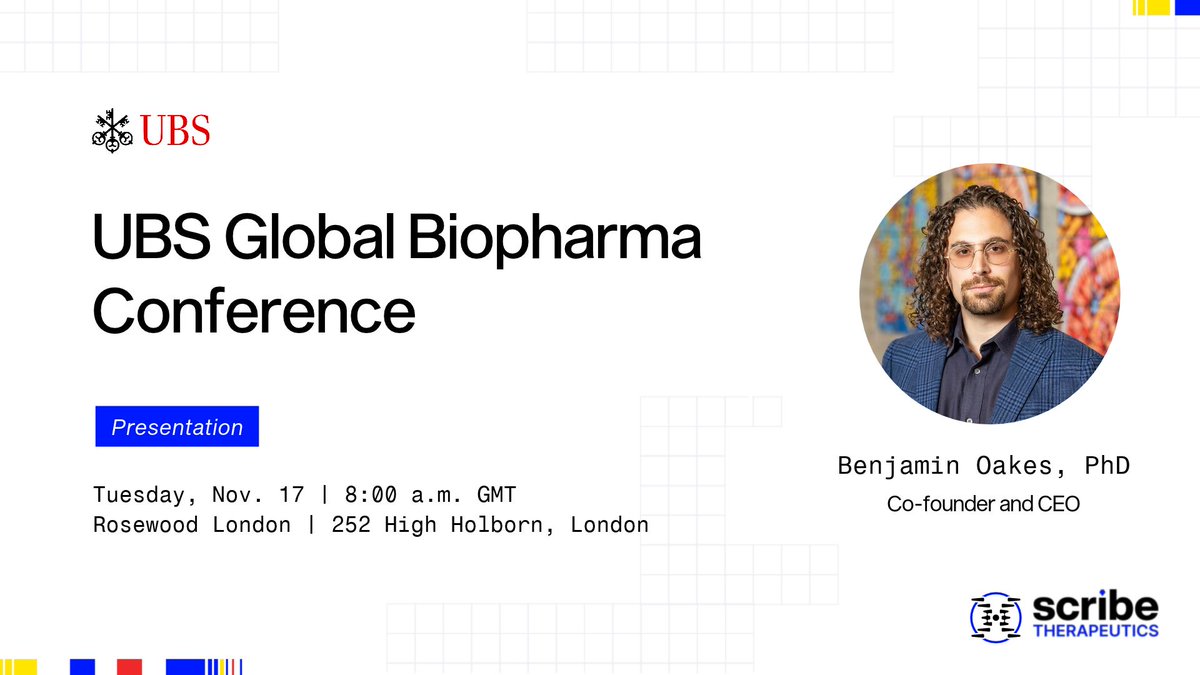
At the UBS Global Biopharma Conference in London this week? Don’t miss Scribe CEO @BenjaminLOakes' presentation in conversation with Timothy Chung.
Ben will share how Scribe is pioneering highly engineered #CRISPR technologies to advance a new generation of genetic medicines, including progress across our pipeline targeting key drivers of cardiovascular disease, with the goal of shifting the paradigm from treating disease to preventing it.
🗓️ Tuesday, Nov. 17 | 8:00 a.m. GMT
📍 Rosewood London, 252 High Holborn, London
We hope to see you there!
Heading to London Life Sciences Week Nov 16-19? Let’s connect!
Building on our established collaborations with leading pharma companies like Lilly and Sanofi, we are excited to explore new opportunities to broaden the impact of our engineered #CRISPR technologies.
Interested in learning more and exploring partnership opportunities with Scribe? Schedule a meeting with our team through the BIO Partnering system below 👇
https://t.co/hKkJr2rL3i
See you in London!
#LondonLifeSciencesWeek
Sid Narayanan, on Edison's research team, has written up a nice inside look at what self-improvement and auto-research actually looks like in practice in our research org, with our recent work on compaction as a case study.
Edison’s research team is small, only 6 or 7 people, but is responsible for improving Kosmos’ performance across the biotech R&D pipeline. They have massively improved their productivity over the past 6 months, by getting Kosmos to do most of the research itself at this point. It has been cool to see. Read below.
Today we reported our third quarter 2026 financial results and recent corporate highlights, including:
→ Listed on the Nasdaq Global Market under the ticker symbol “SCTX,” and raised capital to fund the initial clinical development of STX-1150, STX-1200, and STX-1400
→ Continued enrollment in our first-in-human Phase 1 trial of STX-1150, our in vivo epigenetic silencing therapy for LDL-C lowering, with initial clinical data expected in the first half of 2027
→ Expanded collaboration with @sanofi, providing them access to ELXR, our epigenetic silencing technology
→ Advanced our cardiovascular pipeline and ELXR and XE technologies, including new data presented at the @American_Heart (AHA) Scientific Sessions and the @ESGCT Congress
“This is a period of continued execution for Scribe, marked by the successful completion of our IPO and expansion of our collaboration with Sanofi to include the epigenetic silencing technology. Together, these milestones strengthen our foundation as we work to translate the potential of our technologies into meaningful medicines for patients,” said our CEO @BenjaminLOakes.
Learn more in our press release: https://t.co/Bb0r042fQo
What will it take for US biotech to stay competitive?
@DrSynbio believes early-stage research is what “spins the flywheel” for American biotech, drawing in the investment that turns new science into new medicines. In a recent article from @biospace, Annalee Armstrong recaps last month’s webinar, where our CEO and co-founder warned that US biotech could fall behind without policy action.
This afternoon, Jake takes that discussion to the @MilkenInstitute Future of Health Summit on a panel about what the country needs to do to lead the next era of biomedical innovation.
Read the article from BioSpace: https://t.co/8Ddo3N7izE
Tune in to the #MIHealthSummit livestream today at 1:30 p.m. ET: https://t.co/ylS9DqOJ4C
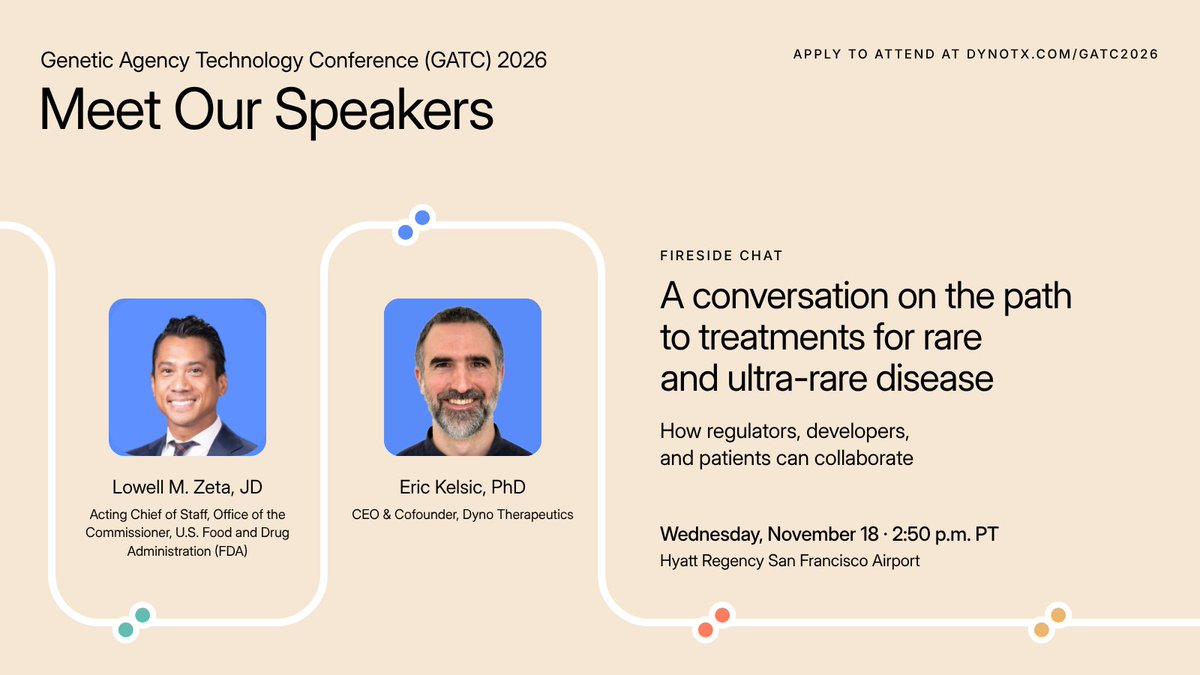
For many families facing a rare or ultra-rare diagnosis, the search for treatment options means taking an active role in drug development themselves. Their experiences are challenging conventions about how new medicines are developed and reach patients.
At the second annual Genetic Agency Technology Conference (GATC) on Nov. 18, Lowell M. Zeta, Acting Chief of Staff in the Office of the Commissioner at @FDA, will join our CEO @ekelsic for a fireside chat on how industry, patient communities, and regulators can work together to support this emerging model.
Language models are great but we got really tired of the slop.
So, we came up with a deslopper. Now, Kosmos can teach itself to write like a human expert in any domain.
See examples below. Experts can’t distinguish our model outputs from real human-written text. Can you?
At Edison, our machine learning research is guided by the challenges we encounter in developing Kosmos, our AI scientist. One such challenge is improving its scientific writing style.
Our latest blog introduces a method for post-training reasoning LLMs using only examples of effective scientific writing, such as published papers, patents, and more. We show that the method improves a model’s scientific writing style, as evaluated by human experts.
Can you tell which abstract was written by our model?