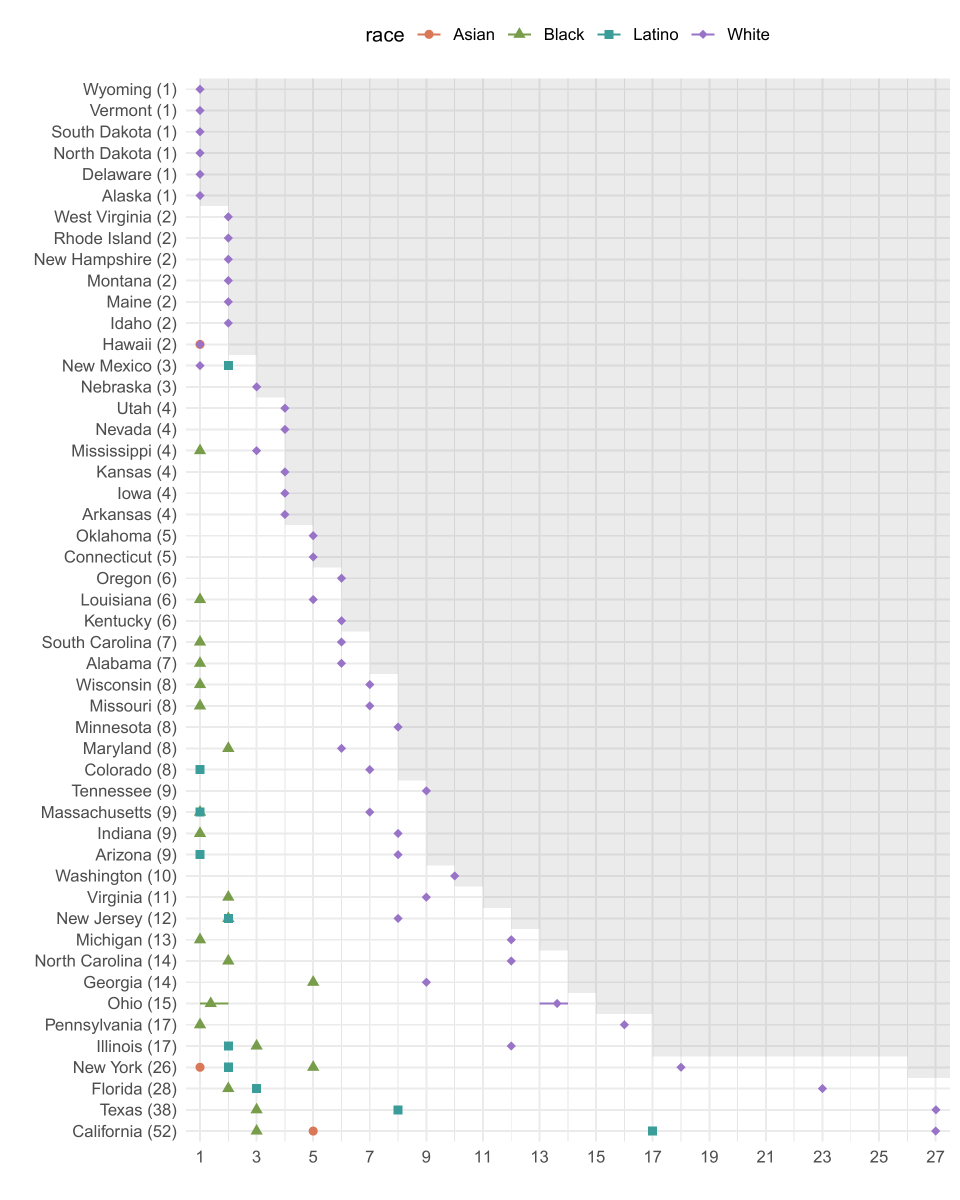
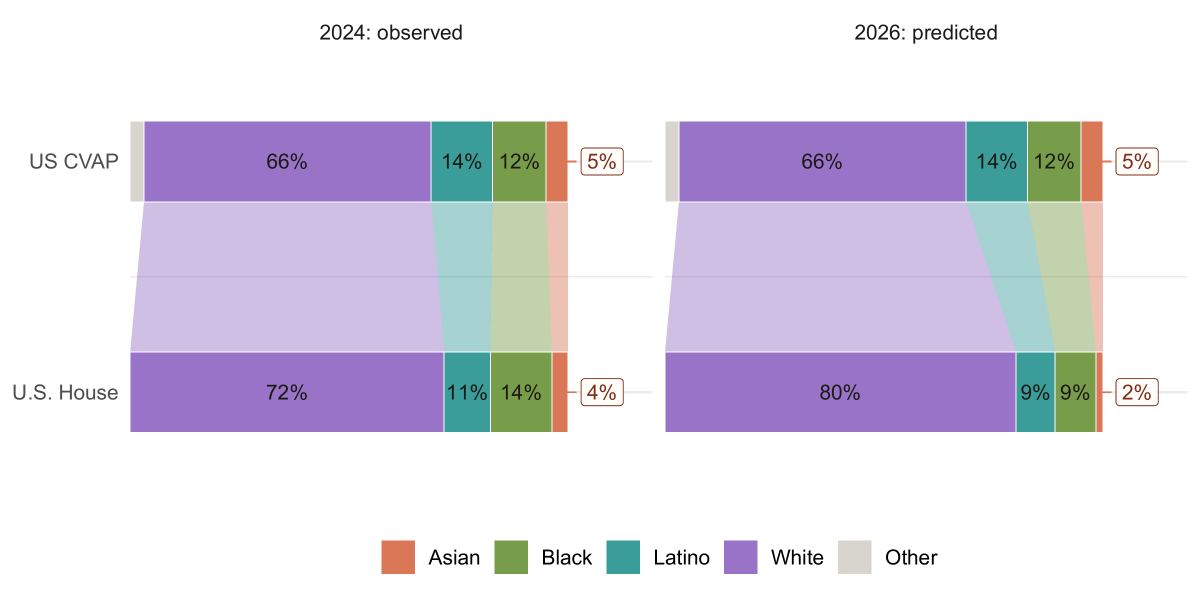
Kolbe Dumas (@UHPoliticalSci) and I made predictions about *racial descriptive representation* in the 2026 midterm elections. Our predictions are theory-based and probabilistic. With obvious limitations, we explore how far we can get with theory alone.
🔗 https://t.co/n1dAiVt3NU
Are voters myopic? In our newest publication, Markus Prior and I find that what looks like short-sightedness in retrospection may actually be a genuine preference for improvement over time. Read more in the @apsrjournal: https://t.co/jM4v7s8bbx
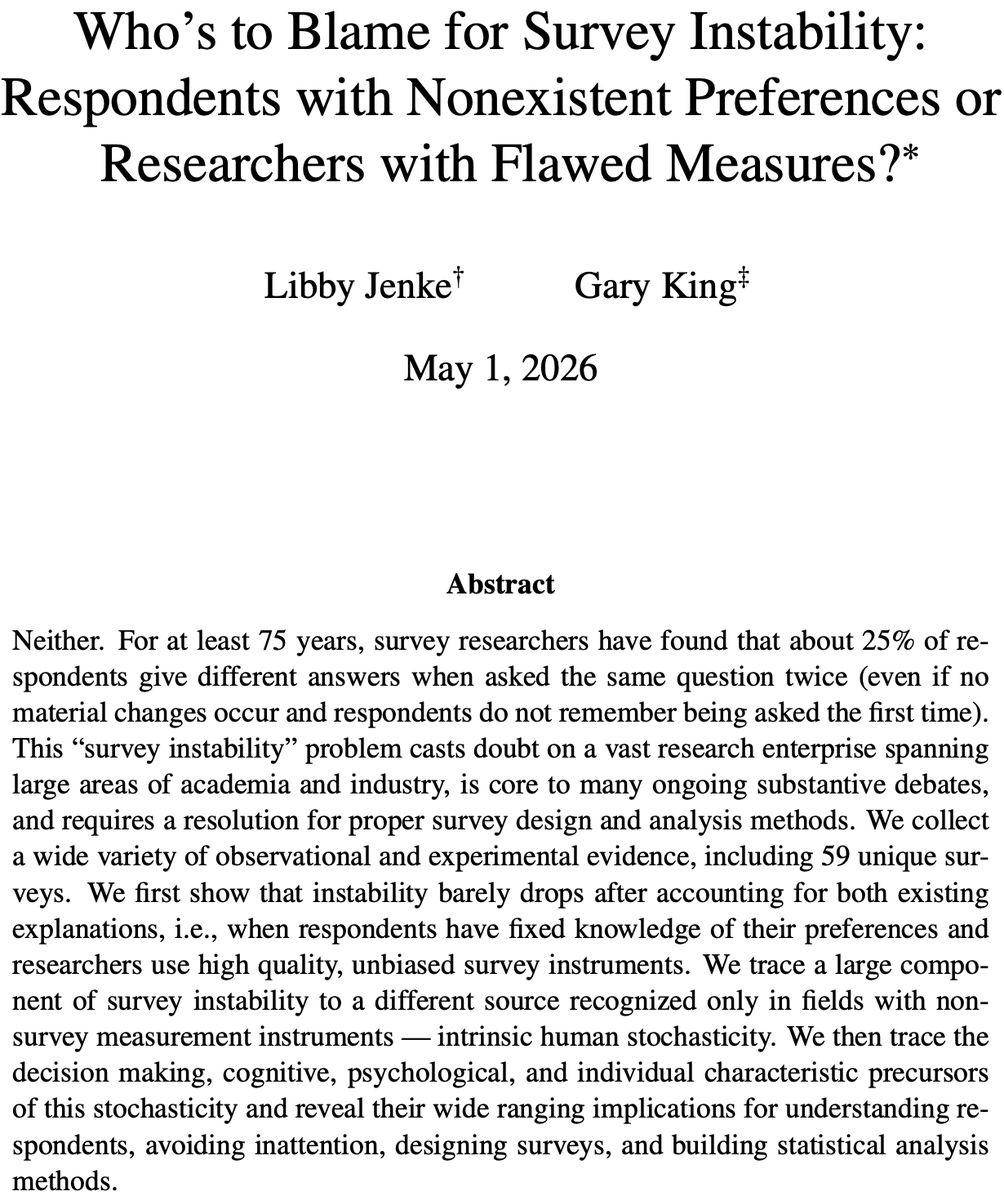
New paper: "Who's to Blame for Survey Instability: Respondents with Nonexistent Preferences or Researchers with Flawed Measures?" with @LibbyJenke. Comments welcome! https://t.co/5LhPD68qux
Guidelines for survey research often suggest including transition statements to signal topic changes for your respondents. Trent Ollerenshaw and I explore whether they matter in our blog post for @YouGov's Methodology Matters series: https://t.co/OzzuFnh55H
🚨 To what extent is the American public willing to hold incumbents accountable amid incremental erosion of democracy? What strategic sequence of democratic backsliding may harm voter accountability? I answer these questions in this new paper at @BJPolS.
https://t.co/vlzRIwTp7d
Currently in FirstView: In “Odd Profiles in Conjoint Experimental Designs: Effects on Survey-Taking Attention and Behavior,” @KCBansak and Libby Jenke consider how survey-takers respond to odd combinations of conjoint attributes.
Thrilled to see our work out in Journal of Politics! We theorize how autocrats use redistributive messaging to claim democratic legitimacy—and show it can shape public opinion. Grateful for the journey with @eddySFYeung and the support we received throughout.
Yumin (@hsuyumin) and I are excited to share our new paper at @The_JOP! In this paper, we theorize and test the logic of “redistributionist propaganda”—state messaging boasting about redistributive efforts of the regime. 1/
📰 https://t.co/NU817N1KuF
From our new issue: "Confronting Core Issues: A Critical Assessment of Attitude
Polarization Using Tailored Experiments " by YAMIL RICARDO VELEZ (@YamilRVelez) and PATRICK LIU (@patrickpliu) #APSRNewIssue https://t.co/19g31dajnW
Speaking their language?: Multilingualism in party communication across democracies by Taishi Muraoka, Dahjin Kim, Christopher Lucas, Jacob Montgomery, and Margit Tavits is now available in Early View. @Jacob_Montg @WUSTLPoliSci @AcadSinica https://t.co/bE6Z6fG0E9
New working paper linked below w/@dianamejordan and Andrew Trexler! We run large-scale tests of bias and precision in repeated measure experiments — and the topline looks good for repeated measures!
📈 Big precision & power gains
⚖️ Only modest attenuation of treatment effects
Just published on APSR First View: "Partisan Leaning" by Zuheir Desai, Anderson Frey (@ander_frey), and Scott Tyson (@scottatyson). https://t.co/Z14TVQMAre
🚨@HobbySchoolUH hosts the Francisco Cantú Memorial: Empirical Implications of Theoretical Models conference, March 28-29. It exhibits innovative research w/ EITM & legacy of F. Cantú.
Please share & join us!
Register: https://t.co/3HPgs3ArJD
Program: https://t.co/S6awitQYz0
✅Now published!
"The Limits (and Strengths) of Single-Topic Experiments"
w/ Scott Clifford
Open-Access: https://t.co/1w5kuHxyhj
We've got three goals with this one... 👇
From our new issue: "Varieties of Values: Moral Values Are Uniquely Divisive" by Jae-Hee Jung and Scott Clifford. #APSRNewIssue https://t.co/LnIlPkHpw6
New Paper 🚨 at ERSS
How does partisanship affect energy preferences? My conjoint experiment shows that Republicans’ choice of energy mix is determined mostly by price, whereas Democrats’ choice is determined equally by price and by % of renewables.
https://t.co/g8rcvjJ5ed
Grateful for the valuable feedback from @LSQjournal
reviewers @ste_mueller & for the editor's efficient & smooth process. Special thanks 2 grant supports from Taiwan’s NSTC @NexSys@ucdpolitics supports. Having you all together this academic journey is cherished. @govsoc_bham